
Israel–UAE–India vs Saudi–Pakistan–Türkiye: New Blocs
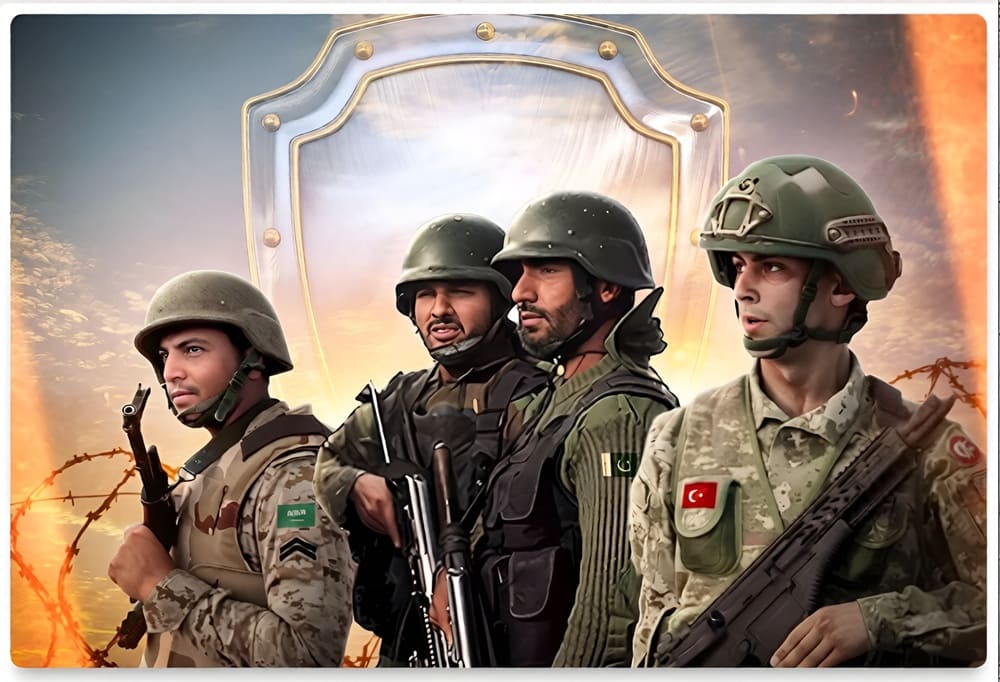
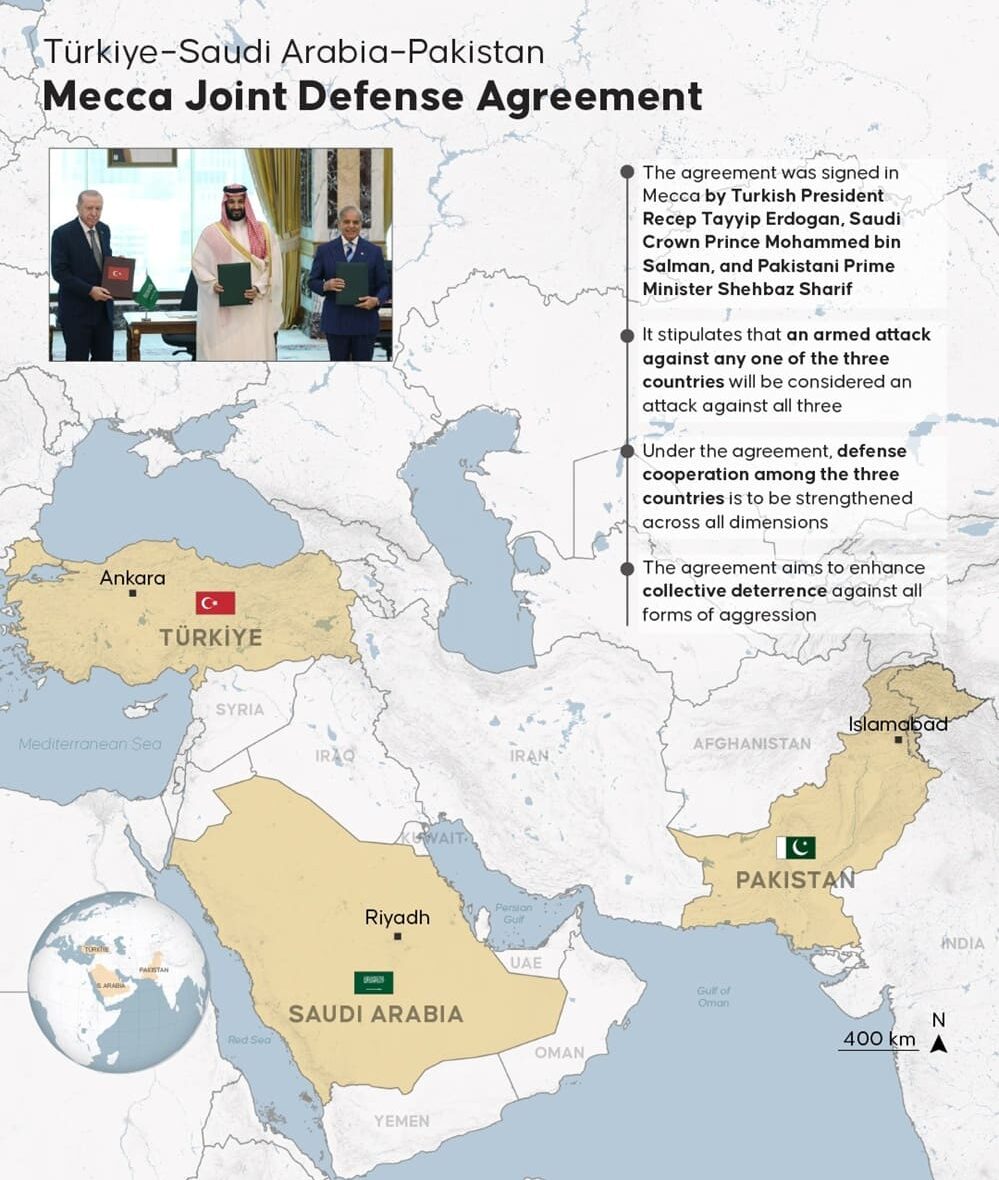
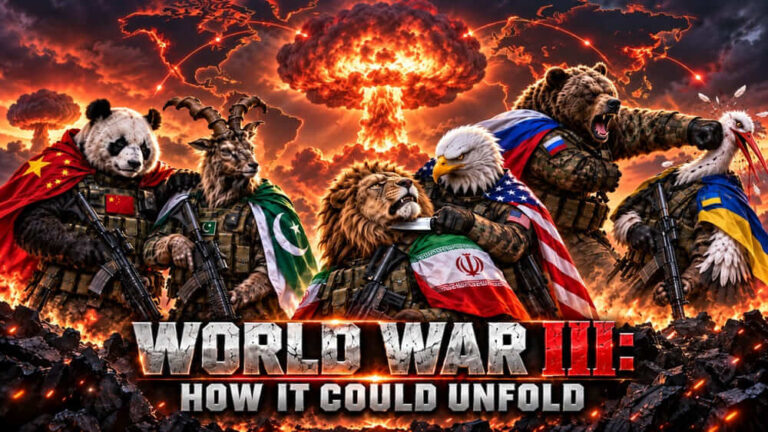
7 August 2026. Assessment based on verified open sources. No classified material is treated as fact; less visible aspects derive from public military, budgetary and diplomatic indicators. Since 7 August 2026, the strategic map linking South Asia and the Middle East has changed significantly. Saudi Arabia, Pakistan, and Türkiye have signed the Mecca Joint Defense Agreement. It establishes a system of collective defense, in which an armed attack against one of them is an attack against all three.
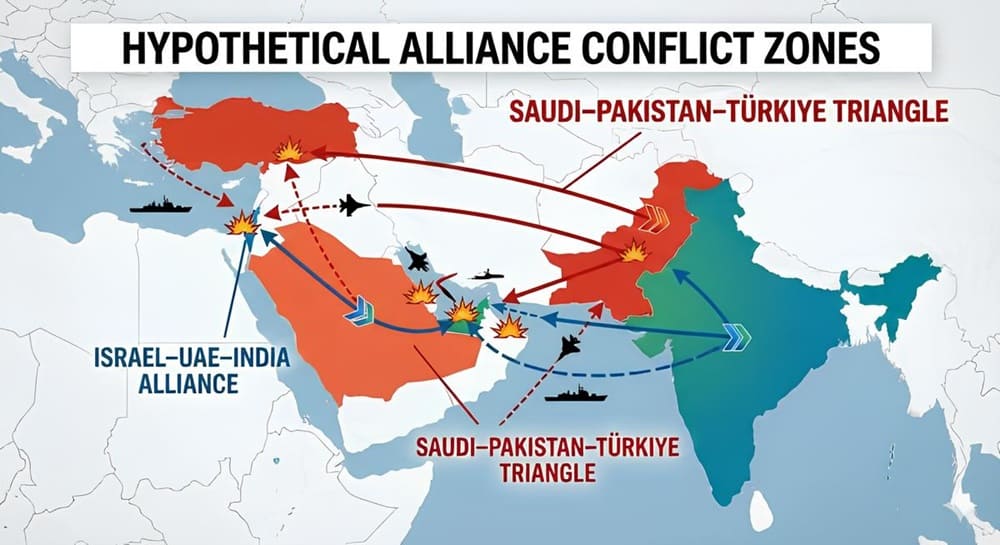
However, the published statement does not describe automatic force commitments, integrated commands or escalation procedures. Israel, the United Arab Emirates and India don’t have a trilateral mutual-defense treaty to compare. But their deepening bilateral defense, technology and economic ties increasingly resemble a distributed strategic network. So these aren’t two NATO-style equivalent blocs. The “versus” framing need not mean inevitable conflict either. Instead, two different security architectures are emerging: one treaty-based and politically explicit and one technology-driven, modular and strategically ambiguous.
Military Balance
The most useful baseline is the most recent comparable SIPRI data, released in April 2026 for 2025. India spent $92.1 billion, Saudi Arabia $83.2 billion, Israel $48.3 billion, Turkey $30.0 billion, and Pakistan $11.9 billion. Saudi Arabia, Pakistan and Türkiye spent a total of $125.1 billion combined. SIPRI does not have a comparable figure for 2025, but India and Israel alone, excluding the UAE, accounted for $140.4 billion.
| Capability | Israel–UAE–India | Saudi–Pakistan–Türkiye |
|---|---|---|
| Political structure | Overlapping strategic partnerships | Formal collective defense pact |
| Airpower | F-35I, F-16E/F, F-15, Rafale, Su-30MKI | F-15SA, Typhoon, F-16, J-10CE, JF-17 |
| IAMD | Arrow, THAAD, Patriot, S-400, Barak-8 | Patriot, HİSAR/SİPER, Chinese/Pakistani systems |
| Defense industry | IAI, Rafael, Elbit, EDGE, DRDO ecosystem | Baykar, ASELSAN, TAI, SAMI, PAC, HIT, NESCOM |
| Nuclear factor | India plus Israeli nuclear opacity | Pakistan |
| Primary advantage | Sensors and technological integration | Collective deterrence and force availability |
Military expenditure alone does not equal combat effectiveness. Israel, India and the UAE are particularly strong in areas such as AESA radar, electronic warfare, missile defense, precision strike, space-enabled ISR and maritime surveillance. Israel provides the sophisticated sensors and the interceptor technology. India has strategic depth, naval mass, space infrastructure and a large defense industrial base.
The UAE provides capital, Gulf geography, advanced combat aviation and layered air defense. The other triangle has other strengths. Saudi Arabia has financial depth, infrastructure and F-15SA/Typhoon airpower bases. Turkey offers NATO operational experience, unmanned systems, electronic warfare and a fast-growing indigenous industry. Pakistan deploys large forces, J-10CE and JF-17 Block III fighters, missile forces, air defense and nuclear deterrence.
Interoperability Challenges
Aircraft numbers are not the most important technical variable. “It’s the ability to transmit targeting data over the sensor-to-shooter link. That poses a formidable challenge for the Mecca pact. Saudi and Turkish forces are heavily reliant on Western or NATO-standard architectures. Pakistan has a more diverse ecosystem with legacy Western equipment and Chinese-origin fighters, missiles, radars and tactical data links. To achieve a common recognised air picture, there would need to be secure gateways, compatible IFF procedures, cross-domain security solutions, releasable cryptographic keys and standardised rules of engagement.
None of the deeper integration layers have been publicly confirmed. This implies that political deterrence could come about far more rapidly than machine-to-machine military interoperability. And Israel-UAE-India has its integration challenges. India is a blend of Russian, Israeli, French, American and indigenous systems. Israel tightly guards sensitive electronic-warfare databases, source code and mission-data files. Meanwhile, this network has a strong technological base, given decades of India-Israel cooperation in missiles, UAVs, radars and electronic warfare.
A Pact Across Competing Security Networks
Saudi Arabia, Türkiye, and Pakistan enter the Mecca Joint Defence Agreement from three different security environments. Saudi Arabia remains a member of the GCC and has strong defence ties with the West. Türkiye is a member of NATO, with alliance obligations, interoperability standards and access to Western command structures. Pakistan, meanwhile, is China’s closest major defence partner, sometimes analytically described as Beijing’s “Israel” because of its unusually deep strategic and military cooperation. The pact will thus be more of a “federated security architecture” than a single military bloc, tying Saudi money and basing, Turkish technology and NATO experience, and Pakistani manpower, nuclear deterrence and Chinese-origin systems.
Case Study: Pakistan’s Saudi Deployment
The most significant operational development came ahead of the August agreement. Pakistan has sent about 8,000 troops, fighter jets, drones and an air defense system to Saudi Arabia as part of the 2026 regional crisis. That deployment is more militarily important than in ceremonial diplomacy. Deploying combat aircraft and ground-based air defense units overseas requires basing agreements, maintenance facilities, fuel, communications, airspace coordination, force protection, and persistent logistics.
Even if the Pakistani forces remain under Pakistani command, their presence provides an existing deployment architecture that the trilateral agreement can build upon. Another is the Turkish-supplied defense industry. Ankara and Islamabad already work together on naval construction, aviation training, and unmanned systems. Saudi Arabia has also become a key customer for Turkish technology. The model could be a blend of Saudi financing and infrastructure, Turkish engineering and Pakistani operational battle-hardened manpower.
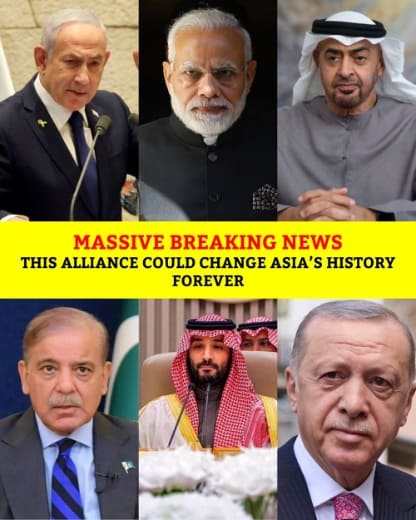
India–UAE–Israel Takes Shape
The other alignment is less formal and was to become far more visible in 2026. On 15 May 2026, India and the UAE signed the Strategic Defense Partnership Framework. Interestingly, the same official bilateral record also mentions a term sheet for an eight-exaflop supercomputer cluster between Indian and UAE entities. The computing project remains civilian, the public documentation states. But the fact that it is evolving in parallel with defense cooperation is strategically important. With sensor fusion, satellite-image exploitation, electronic intelligence processing, autonomous systems, simulation and AI-assisted decision support, modern military systems require more computing power than ever before.
There is no proof that the system is a military AI network. This indicates that cooperation is increasingly focused on developing infrastructure capable of supporting advanced dual-use applications. An even stronger political signal was sent on 30 June 2026. Maj. Gen. (Res.) Director General of the Israel Ministry of Defense Amir Baram has been outspoken in his support of a broader regional architecture from India through the UAE to Greece and Cyprus. That is a significant sentence. It provided an Israeli official with a blueprint for an alignment that until now had been discussed mainly by outside analysts.
IAMD Advantage
IAMD, Integrated Air and Missile Defense, will probably be the most consequential technical competition. Israel has done a lot of work with Arrow, David’s Sling, and Iron Dome. The UAE has THAAD and Patriots. India inducts S-400, Barak-8, and Akash missile defense systems. They have extensive experience in dealing with ballistic missiles, cruise missiles, aircraft and UAVs. The Saudi–Pakistan–Türkiye architecture is more heterogeneous. Saudi Arabia relies on mainly Western systems. Turkey is still expanding its families of HİSAR and SİPER. Pakistan’s air-defense capabilities are a mixture of indigenous and Chinese sources, including the successful HQ-9.
Interceptor range is only one measure of overall system effectiveness. The coalition’s effectiveness is contingent on radar track quality, latency, track correlation, engagement authority, electromagnetic deconfliction and secure data exchange. A workable trilateral solution would probably require federated BMC3 — battle management, command, control and communications. Each country would maintain sovereign firing authority but share some sensor tracks. In principle, that architecture can work. The bigger hurdles are political permission and cryptographic compatibility.
Nuclear Deterrence Balance
Both these strategic groupings are fundamentally different from conventional alliances because of nuclear weapons. India and Pakistan are nuclear armed. Israel has a policy of nuclear ambiguity. But there is nothing in the Mecca deal to indicate that Pakistan will provide a nuclear guarantee to Saudi Arabia. Pakistanis have previously played down suggestions that its nuclear deterrent automatically extends to Riyadh, Reuters notes. That’s a huge difference. Traditional collective defense can be initiated in a step-by-step manner by intelligence sharing, air defense, logistics, maritime patrols or reinforcement. A credible extended nuclear deterrent needs clear doctrine, command and control, authentication and escalation thresholds. No such trilateral architecture has been released publicly.
Three Rivals, Three Different Concerns
The Mecca Joint Defence Agreement will probably be read differently by Iran, Israel and India. Riyadh and Ankara have significant military presence in the region, and Tehran may see the Saudi-Pakistan-Türkiye alignment as a potential Sunni counterbalance. Israel could see the agreement as yet another independent security architecture that complicates its freedom of action across the Middle East. India’s worry is more pressing. Saudi Arabia and Turkey could offer Pakistan more financial help, technology, intelligence sharing and diplomatic support. New Delhi will, therefore, be watching closely whether the deal enhances Pakistan’s military capabilities on the western border with India and the regional balance of deterrence.
Strategic Outlook
Today, the Saudi–Pakistan–Türkiye triangle has a stronger legal framework, with the August 2026 agreement explicitly referencing the principle of collective defense. Pakistan’s Saudi deployment also shows real expeditionary infrastructure. Its greatest weakness is still the technical interoperability of American, NATO, Turkish, Pakistani and Chinese systems. Israel-UAE-India has the better potential high-tech ecosystem. Its strengths include missile defense, ISR, electronic warfare, computing, maritime power, capital and increasingly institutionalised defense cooperation.
But it lacks a trilateral mutual-defense pledge and an integrated military command. So the competition will largely be below the threshold of conventional war. Joint exercises, co-production, AI-assisted ISR, counter-UAS networks, secure tactical communications and integrated missile defense will matter more than political symbolism. The contest that is shaping up is not finally one triangle against another. It is a race between networked technological integration and formalised collective deterrence.
References
- Reuters, Saudi Arabia, Turkey and Pakistan pledge mutual defence as Middle East turmoil escalates, 7 August 2026. Reuters report
- Stockholm International Peace Research Institute, Trends in World Military Expenditure, 2025, April 2026. SIPRI fact sheet
- Embassy of India, Abu Dhabi, India–UAE Bilateral Agreements, including the May 2026 Strategic Defence Partnership Framework. India–UAE agreements
- Israel Ministry of Defence, Israel Must Prepare for a New Regional Architecture as Iran Threat Grows, 30 June 2026. Israel MOD statement
About the Author

1 thought on “Israel–UAE–India vs Saudi–Pakistan–Türkiye: New Blocs”