
China’s Space Surge — Why It Worries Washington
“China’s space boom has moved from scientific prestige to basic military infrastructure. Beijing is melding surveillance, communications, navigation, missile warning, targeting, and counterspace forces together. Washington is not only worried about the number of Chinese satellites. The central question is whether China can use orbital data to accelerate combat decision-making.
However, the strategic danger is not a single revolutionary spaceship. It’s a distributed system connecting sensors, command centres, launch sites and long-range weapons. The architecture could shorten the sensor-to-shooter loop of the People’s Liberation Army in a Taiwan conflict.
Expansion at Industrial Scale
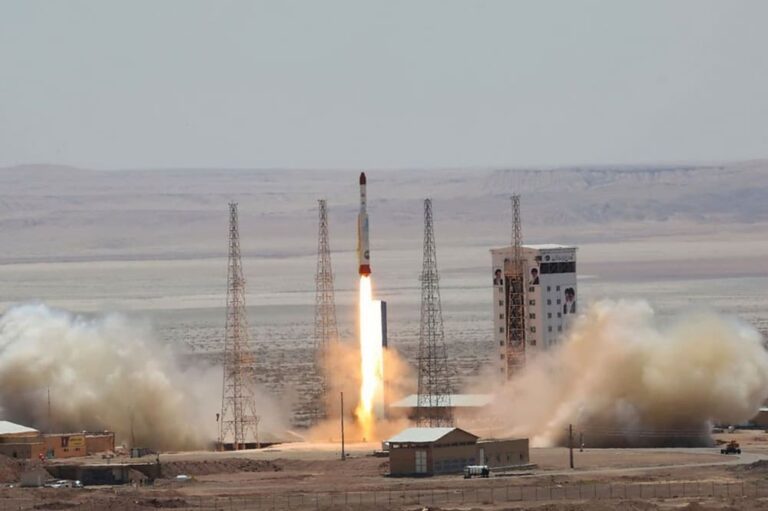
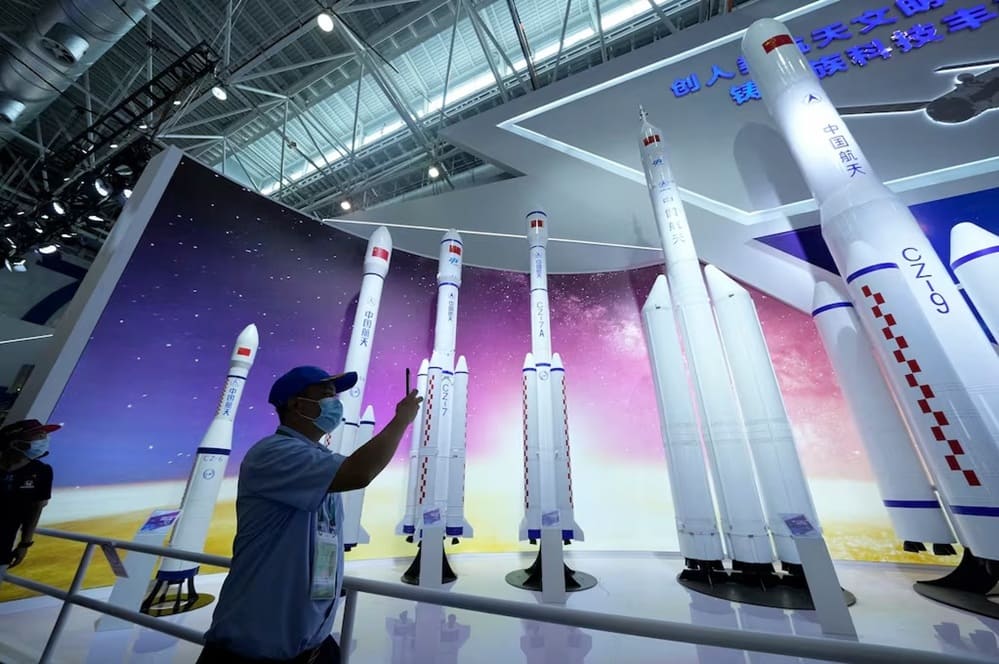
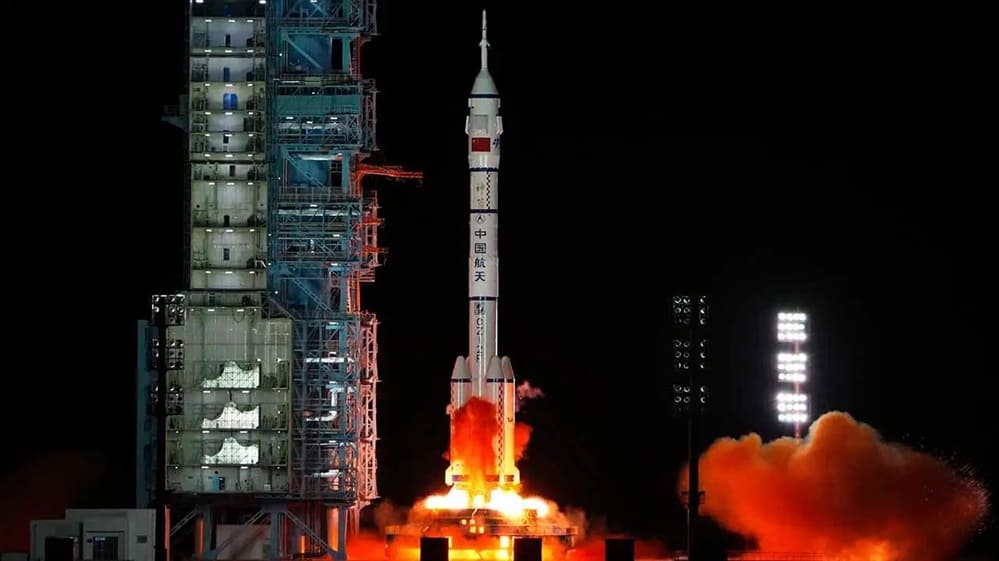
It’s impossible to overlook the scale of China’s expansion. The U.S. Space Force has monitored 1,506 Chinese payloads with 37 launches by June 2026. China also has 140 launches planned for 2026, up 52% from last year.
Reports said the PLA has access to more than 510 satellites for intelligence, surveillance and reconnaissance. These systems are equipped with optical, multispectral, synthetic aperture radar and radio frequency sensors. China also had 200 G60 and 168 SatNet communications satellites in low Earth orbit by 1 June.
The point of military success is not just numbers. However, the constellation density alters the operational geometry. More satellites mean higher revisit rates, more coverage and greater data-path diversity and resilience. Frequent launches also have a hidden ability to replace damaged spacecraft during an extended crisis.
Orbital Sensor-to-Shooter Network
China’s remote sensing fleet is a collection of many complementary phenomenologies. Electro-optical satellites can provide very detailed images, as long as the weather and lighting conditions are favourable. Multispectral payloads distinguish materials by spectral signatures. Synthetic-aperture radar can see through clouds and operates in the dark. Radio-frequency satellites can detect and locate radar, communications and other electromagnetic signals.
Cross-cueing makes the architecture more dangerous than any one sensor. Radio frequency detection also shrinks the size of the search box of other satellites. Movements can be built up over time, and the custody track can be maintained. The data is then transmitted to processing centres and deployed units via communications satellites.
The network could become the backbone of the PLA’s long-range strike complex. Potential shooters include aircraft, submarines, surface combatants, and ballistic or cruise missiles. But there is no public evidence of the wartime latency and reliability of every link. Meanwhile, the U.S. Defence Department’s 2025 assessment still saw Chinese satellites as increasingly conducive to long-range kill chains.
The central problem for carrier forces is that of continuous targeting. Without timely location updates, the advertised range of a missile is meaningless. The space boom in China solves that problem through sensor diversity and orbital proliferation. So the American forces need deception, emission control, mobility and distributed operations.
Shijian-21’s Dual-Use Manoeuvres
In 2022, China demonstrated a strategically important capability. Its Shijian-21 spacecraft docked with a dead BeiDou navigation satellite and moved it to a graveyard orbit above geostationary orbit. Beijing described the activity as “debris mitigation and satellite servicing.”
The mission demonstrated accurate rendezvous, proximity operations, relative navigation, controlled capture, robotic manipulation and major orbital manoeuvres. Those same technologies could be used to inspect, reposition, interfere with or potentially disable another spacecraft.
In 2024, three Shiyan-24C satellites performed complex proximity operations. At times they came within a kilometre of each other. These tests improve formation flying and offer experience useful to co-orbital counterspace operations.
This ambiguity causes a warning problem. A servicing satellite might appear peaceful as it makes its way toward a sensitive target. Its purpose may not be obvious until very late, and decision time in a crisis may be compressed.
China’s Layered Counterspace Forces
China’s counterspace programme includes both kinetic and non-kinetic means of attack. In 2007, the Chinese destroyed a weather satellite in low Earth orbit with a ground-launched anti-satellite missile. It produced thousands of trackable debris objects and drew international condemnation.
Since then, Beijing has not publicly acknowledged another destructive intercept. But the Space Force says the earlier capability became operational against satellites in low-Earth orbit. A Chinese ballistic object in 2013 reached some 30,000 kilometres, indicating development against higher orbital regimes.
Non-kinetic systems can have temporary, localised and deniable effects, with no debris. The U.S. assessments mention jammers targeting communications, radar satellites and navigation services. They can also detect laser attacks from the ground that may interfere with satellite sensors.
Cyber operations are another avenue of attack. Compromised mission software, ground stations, data links or processing networks can neutralise a spacecraft. Counterspace warfare can be conducted on the orbital, link and terrestrial segments at the same time. In the United States, therefore, orbital, electromagnetic and cyberspace warfare are components of the space control doctrine.
Space-Based Nuclear Warning
China is also building a space-based missile warning architecture. The Defence Department believes that the TJS, or Huoyan-1, satellites probably carry infrared payloads in geosynchronous orbit. The sensors can detect an intercontinental ballistic missile in 90 seconds. In three or four minutes they could send out a warning.
Such sensors, coupled with large phased-array radars, could support an early-warning counterstrike posture. This is a development that has implications for strategic stability, not just for conventional war. A better warning can increase chances of survival but also increase pressure to make a quick decision in uncertain circumstances.
Cislunar Military Potential
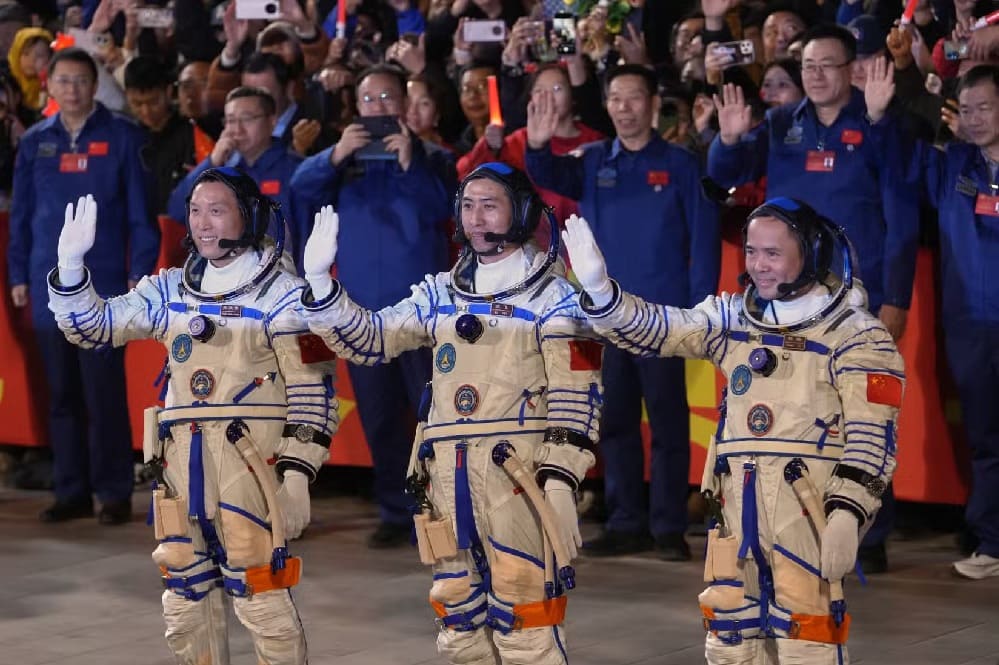
Chang’e-6 offered another important demonstration in June 2024. The mission returned 1,935.3 grams of material from the far side of the Moon. This marked the first time in history that any sample from the far side of the Moon returned to Earth.
The mission included autonomous landing and ascent, orbital rendezvous, Earth return, and communications beyond terrestrial line-of-sight. Controllers are linked to the far side landing site through the Queqiao-2 relay satellite.
By their nature, these technologies are not weapons. But they get experience with deep space navigation, tracking, relays and cislunar awareness. The Chang’e-7 and Chang’e-8 will act as a prototype for an International Lunar Research Station. China also plans to send astronauts to the moon before 2030.
What Remains Secretive
The most important performance factors remain obscure. These include imaging resolution, latency of tasking, accuracy of geolocation, inter-satellite bandwidth and data-fusion performance. China conceals its secret jammer power, laser properties, counterspace inventories and command authorities.
Open-source evidence shows capability families, not guaranteed combat effects. We still consider it analytically useful to have words like “likely”, “probably” and “reportedly”. If you read a particular claim of classified performance and there is no declassified source, you should be sceptical.
Secrecy is a military asset. “An ambiguous spacecraft can cause defensive manoeuvres and use tracking resources without attacking. China can inflict costs with plausible civilian explanations during peacetime.
Washington’s Strategic Concerns
Space is essential to U.S. joint operations. Satellites provide warning, communications, navigation, weather, intelligence and precision timing. Disruption could impede decision-making and degrade the effectiveness of weapons across all domains.
The growth of China’s constellations also undermines the credibility of basic counterspace options. Distributed networks can absorb losses that would destroy a smaller architecture. Commercial systems complicate the targeting problem, because civilian and military functions can overlap.
Washington should focus on resilient constellations, protected communications, alternative navigation, rapid launch and distributed ground infrastructure. Allied sensor sharing and common data standards are just as important: Forces must also train with degraded positioning, communications and orbital intelligence.
China’s space surge rebalances Indo-Pacific below the threshold of war. Beijing is building an architecture to locate distant forces, coordinate strikes, protect networks and threaten hostile satellites. The competition will focus on resilience, speed, integration and sustained operations when orbital systems come under attack.
References
- U.S. Space Force, “Space Threat Fact Sheet”
- U.S. Department of Defence, Military and Security Developments Involving the People’s Republic of China 2025
- U.S. Space Force, Space Force Doctrine Document 1
- China National Space Administration, “Chang’e-6 Collects 1,935.3 Grams of Samples”
About the Author