

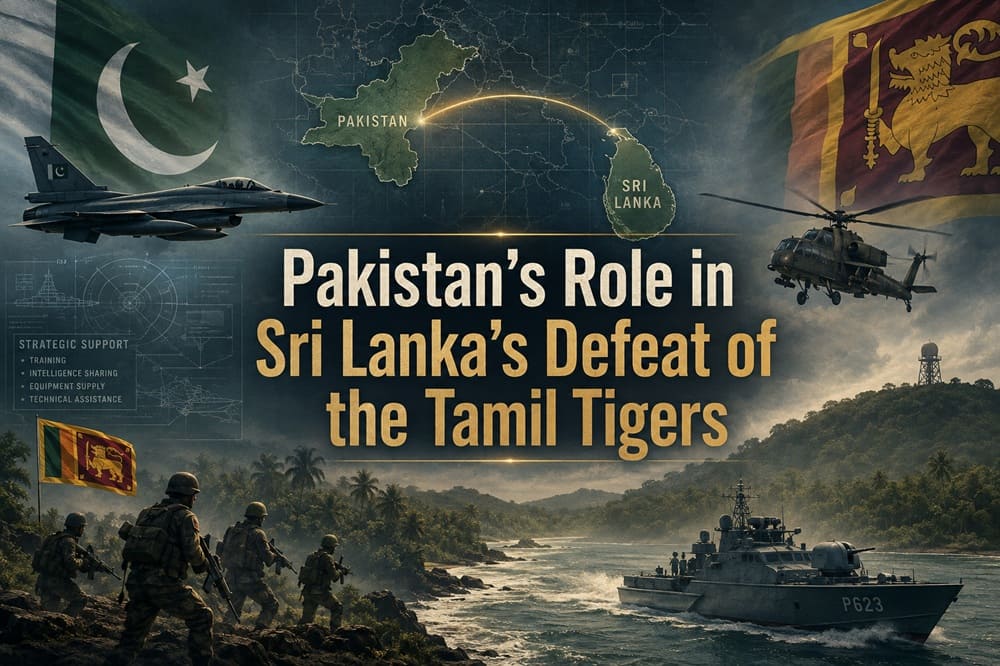
Pakistan’s Role in Sri Lanka’s Defeat of the Tamil Tigers
Pakistan’s role in the Sri Lankan military defeat of the Liberation Tigers of Tamil Eelam (LTTE) was significant but often exaggerated. Eelam War IV was not planned or directed from Islamabad. Pakistani assistance was not the only reason for the Tigers’ defeat. However, Pakistan supplied ammunition, maintained defense ties, provided training and helped Colombo overcome procurement limitations during crucial stages of the conflict, which played a crucial role.
Sri Lanka achieved its victory mainly through force expansion, operational adaptation, maritime interdiction, intelligence, sustained political direction, and overwhelming local numerical superiority. But these mechanisms depended on the smooth functioning of a war economy and the supply of munitions. Pakistan provided this logistical depth, while several other suppliers faced political constraints. The war, which lasted about 26 years, ended in May 2009.
From Insurgency to High-Intensity War
The LTTE was a far more capable organisation than a typical guerrilla force. It had infantry units, artillery and mortar units, suicide forces, a maritime force called the Sea Tigers and a rudimentary air wing. So, Sri Lanka’s conflict began to resemble hybrid warfare, not classical counterinsurgency. Colombo responded with a dramatic buildup of its military establishment. The Sri Lankan Army grew from approximately 120,000 personnel in 2006 to 200,000 in 2009, according to the Australian Army Research Center.
It adopted smaller, more flexible infantry formations suited to jungle penetration and long offensive operations. The expansion was a huge logistical requirement. Each additional infantry battalion required rifle ammunition, grenades, mortar bombs, machine gun ammunition, and transport. Consumption multiplied by artillery-heavy offensive operations. Pakistan was significant primarily because there was a state-owned infrastructure in place for the production of ammunition and compatible weapons manufacturing.
Pakistan’s Role as Ammunition Provider
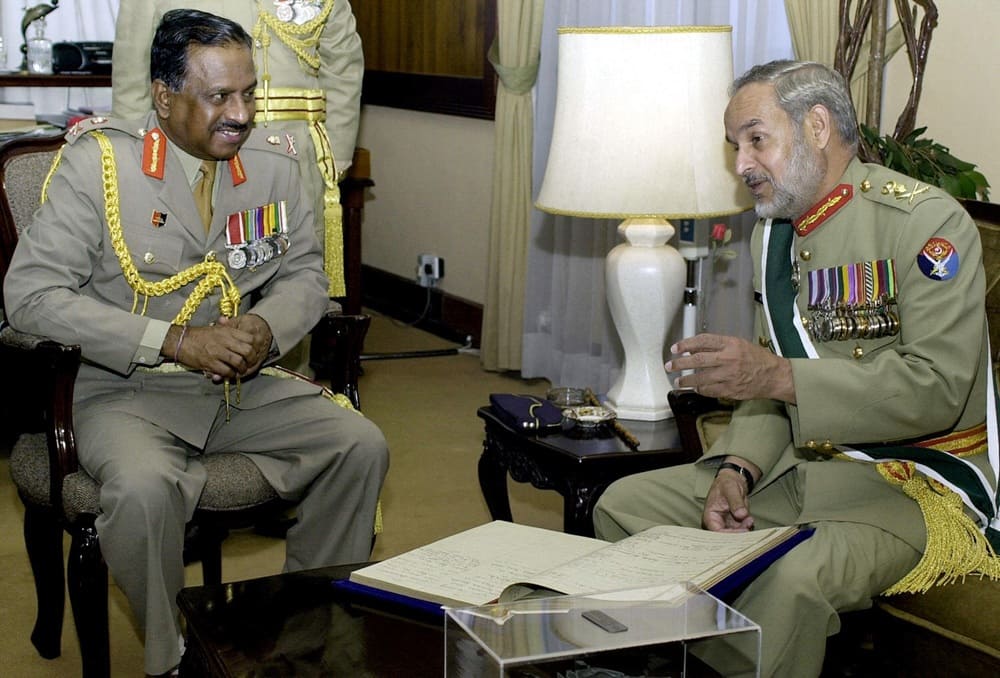
Another of the most important details is also less dramatic than claims of Pakistani combat involvement: ammunition sustainment. When India refused to give offensive weapons, Colombo turned to China and Pakistan. Sri Lankan Army commander General Sarath Fonseka said in an interview later reproduced by Indian defense journalist Nitin Gokhale, “The Pakistani contribution was the purchase of emergency ammunition,” he said. This development is of operational significance. Sri Lanka used 81 mm and 120 mm mortars along with medium artillery guns.
Its artillery establishment also included 130 mm guns, systems which are especially useful for providing sustained long-range fires against fortified positions and defensive belts. Current reports said Sri Lanka was scouring the 60mm, 81mm, 120mm and 130mm categories for ammunition and for large numbers of grenades. One Pakistani media report put a proposed ammunition package at about $25 million and a broader procurement list at about $65 million. Its strategic importance was thus not just that it provided yet another weapon system. Pakistan’s support stopped Sri Lanka from finishing its offensive because ammunition supplies could not meet the needs of the operation.
Case Study: The 2000 Jaffna Crisis
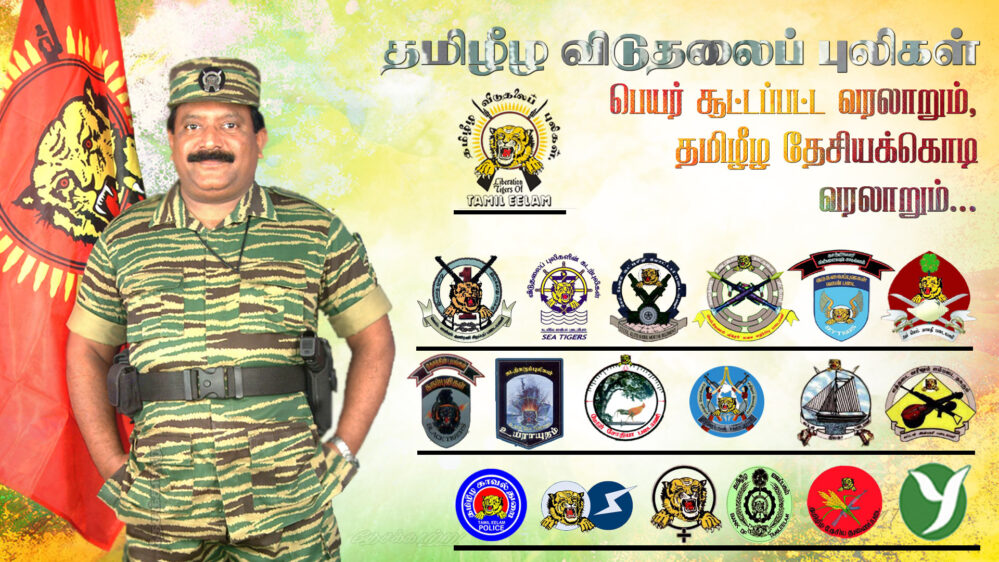
The importance of Pakistan was known almost a decade before the LTTE was ultimately defeated. In 2000, the Tigers captured the strategically important Elephant Pass complex as part of Operation Ceaseless Waves III and threatened Sri Lankan positions around the Jaffna Peninsula. The situation also raised fears that large numbers of government troops would become operationally isolated. Sri Lanka needed more firepower. Contemporary reports indicate that Pakistan reacted quickly with supplies of multi-barrel rocket launchers, artillery ammunition and other military stores.
Equipment was said to be airlifted from Karachi to Colombo. Multiple-launch rocket systems alter the geometry of the battlefield. Tube artillery shoots single rounds. MBRLs can saturate an area with rockets in a short time. That capability means you can effectively suppress troop concentrations, staging areas or prepared defensive systems in a relatively short period of time.” The 2000 episode also established an even more strategically significant precedent: emergency wartime resupply. When Eelam War IV heated up several years later, Colombo knew that Islamabad could be a rapid military supplier.
2008: The Logistics Pipeline Becomes Crucial
General Fonseka visited Pakistan in May 2008, when Sri Lankan forces were squeezing LTTE territory. Later reports from Pakistan said Sri Lanka had ordered large amounts of weapons and ammunition. There were even reports of arrangements for frequent shipments as Colombo’s forces moved toward Kilinochchi. The move was accompanied by a campaign that was increasingly intensive in firepower. Sri Lankan forces had stopped conducting isolated counter-guerrilla operations.
They were attempting to destroy LTTE field formations, punch through defensive earthworks, gain territory and at the same time prevent the Tigers from withdrawing. Great momentum for operations. An offensive force that has to stop for weeks because of ammunition shortages gives an opponent time to build defensive belts, move up reserves and reinforce. Hence, reliable foreign suppliers were an indirect multiplier of operations.
Pakistan’s Contribution to the Firepower System
| Capability | Operational relevance |
|---|---|
| Mortar ammunition | Immediate infantry-level indirect fire |
| Medium-calibre artillery ammunition | Suppression and destruction of defensive positions |
| MBRL support | Rapid area saturation and battlefield suppression |
| Small-arms ammunition | Sustaining expanded infantry formations |
| Military training | Long-term institutional interoperability |
| Defense cooperation | Alternative procurement channel during restrictions |
Pakistan therefore influenced the sustainment layer of Sri Lanka’s military system rather than replacing Sri Lankan operational command. That distinction explains why measuring its contribution by counting Pakistani weapon platforms alone can be misleading.
Pilots, Advisers and Al-Khalid Tanks
Some of the more sensational claims about Pakistan’s role require a lot more caution. Pakistani media reports after the war stated that Pakistani Air Force pilots flew combat missions, Pakistani military advisers were in Sri Lanka, and 22 Al-Khalid main battle tanks worth some $100 million were supplied. These claims are widely circulated, but the public record does not support them to the same level of evidentiary support as it does for ammunition sales and defense cooperation.
Fonseka himself pointed to the emergency ammunition from Pakistan but said China was the more important source of heavy weaponry. Likewise, credible public evidence of the operational deployment of 22 Al-Khalids during the Eelam War IV is not available. Consequently, claims about Pakistani fighter pilots or battlefield command should be treated as intelligence-age reporting rather than history. No responsible open-source analysis can replace speculation with classified information.
Why Pakistani Support was Pivotal
Pakistan’s greatest strategic asset was its availability. The Sri Lankan government wanted to turn the war from a long-term struggle into a campaign of unrelenting pressure. But domestic political constraints within India did not permit it to openly provide offensive weapons. Western governments also placed various restrictions and political pressures. That provided strategic access to China and Pakistan. Fonseka later admitted that Sri Lanka had resorted to other sources when India refused to supply offensive equipment.
China’s main export was heavy weapons, while Pakistan met large demands for ammunition and defense cooperation. In Pakistan, the government still describes its historical defense relationship with Sri Lanka as important. Pakistan’s Foreign Ministry said in a statement it has helped build capacity for Sri Lanka’s armed forces. In 2016, Pakistan’s defense production minister explicitly stated that Pakistan had helped Sri Lanka defeat terrorism and spoke of cooperation ranging from small arms to heavy weapons.

The Decisive Factors Were Sri Lankan
However, Pakistan alone cannot be completely credited for the defeat of the LTTE. Sri Lanka built an army of nearly 200,000 men, perfected its small-unit tactics and maintained pressure on several fronts. The LTTE’s navy was gradually choked by its Navy’s naval supply chains, and the Tigers were internally weakened by intelligence penetration and the earlier split in the Karuna faction. In the final stage, the LTTE was increasingly pushed into conventional defensive fighting. That robbed it of much of the asymmetric advantage it had enjoyed for decades. The last campaign was an encirclement in which the superior manpower and firepower of Sri Lanka proved decisive, according to an RSIS assessment.
Conclusion
The last campaign remains highly controversial. Human rights investigations have implicated both the LTTE and Sri Lankan government forces in serious violations, including allegations of the LTTE’s use of civilians as human shields and allegations of indiscriminate government shelling. However, a professional military analysis of the campaign must differentiate battlefield effectiveness from issues of international humanitarian law. So Pakistan’s contribution should be taken for what it is: a helping hand in providing the ammunition, defense relationships and strategic supply resilience that enabled Sri Lanka to maintain operational tempo. Sri Lanka provided the manpower, command structure and the campaign blueprint that eventually destroyed the LTTE as an organised military force.
References
- Australian Army Research Centre — Strategy and Adaptation in Counterinsurgency: Lessons from the Defeat of the Tamil Tigers. (Australian Army Research Centre)
- Nitin A. Gokhale — Sri Lanka: From War to Peace and accompanying account of foreign military assistance. (Nitin A. Gokhale)
- Business Standard / Press Trust of India — Pakistan Played Major Role in LTTE Defeat: Sources, 28 May 2009. (Business Standard)
- Pakistan Ministry of Foreign Affairs / Ministry of Defense Production — official material on Pakistan-Sri Lanka defense cooperation. (Ministry of Foreign Affairs Pakistan
About the Author


An impressive share! I have just forwarded this onto a co-worker who
has been conducting a little research on this. And he
actually bought me lunch because I found it for him…
lol. So let me reword this…. Thank YOU for the meal!! But yeah, thanx for spending time to talk about this topic here
on your website.