

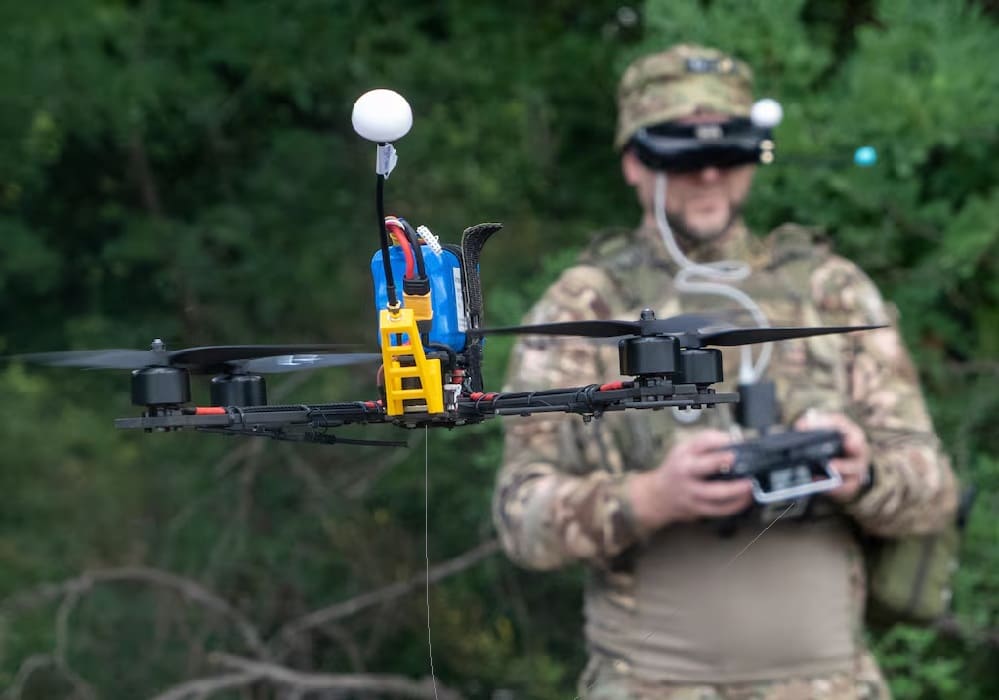
Why Fiber-Optic Drones Defeat Jamming
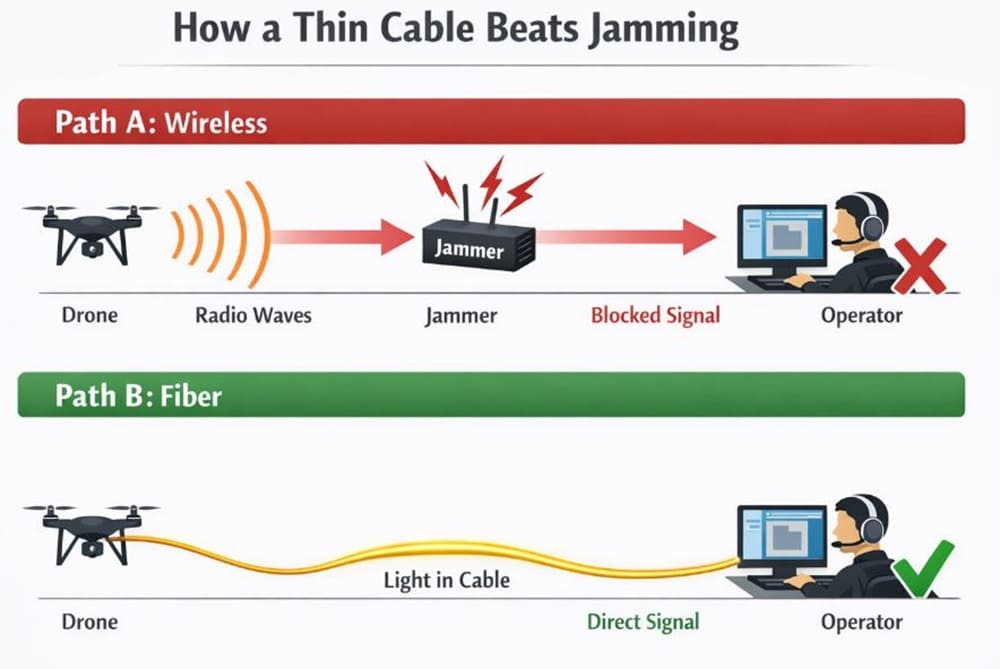
Fiber-optic drones beat jamming because they don’t use the radio-frequency path most electronic warfare systems target. Wireless control and video typically control FPV drones, which often have GNSS support. So a jammer can swamp the control channel, blind the camera feed, or corrupt satellite navigation. A fiber-optic drone changes the math. It sends pilot commands and live video through a physical cable so broadband RF noise can’t easily take over.
That is why the technology is now drawing serious attention from the military. Reuters reported in July 2025 that both Russia and Ukraine are using short-range fiber-optic drones resistant to electronic jamming. The U.S. Army later identified spool-fed fiber drones as a major counter-UAS challenge because they exist outside the traditional RF attack surface.
Fibre-Optic Link Working
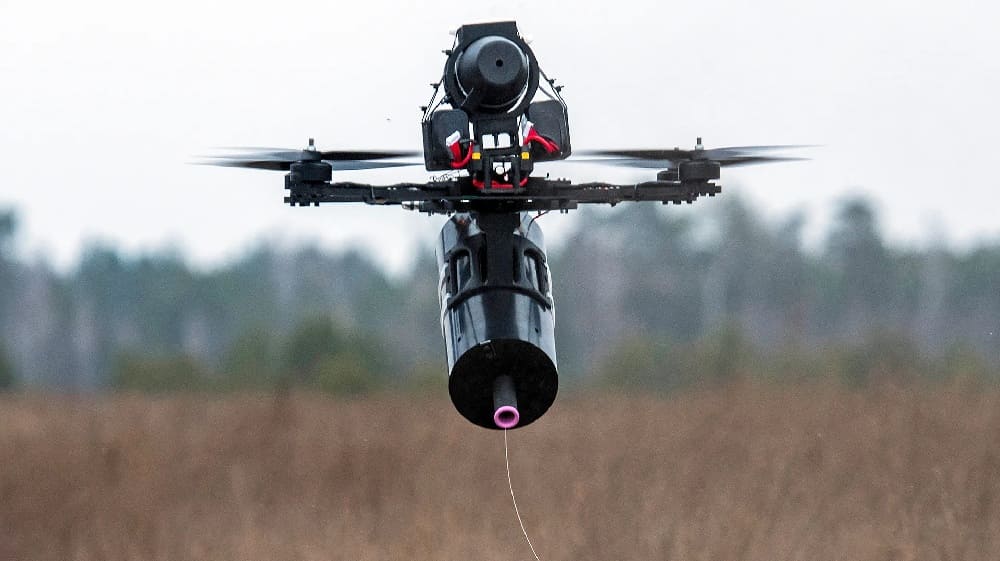
A fiber-optic FPV drone with a thin cable on a spool. Designers typically locate the spool underneath or at the rear of the airframe. Once airborne, the drone unwinds the cable from the back of the plane as it approaches its target. It uses light instead of radio waves, sending data down the fiber line.
This design allows two key functions. First, the operator has control authority in heavy jamming. Secondly, there is a stable stream of video in the terminal phase. The last phase is the most important one, as the pilot has to locate the correct vehicle, trench, antenna, bunker opening, or moving target.
The link is still physical, so the drone also lowers its electromagnetic signature. It makes some noise out of the motors and power electronics. However, it no longer emits off a strong command or video signal. So one of the easier clues for RF direction-finding teams is gone.
Struggle of Conventional Jammers
Counter-drone jammers usually focus on command links, video downlinks, and satellite navigation. Fiber-optic drones overcome jamming because they remove the first two dependencies from the air. In manual flight using real-time video, GNSS denial is less important.
That doesn’t make the drone immune to damage. The aircraft still has to contend with drag, cable breaks, weather, small arms fire, nets, and visual detection. But in many ways, the cheapest of defensive responses, broadband RF noise, defeats it. That’s a big tactical problem for infantry forces that rely on backpack jammers.
It also connects to larger electronic warfare lessons. Defense News Today has reported on the impact of GPS jamming in the vicinity of the India-Pakistan border on aviation, drones, tactical positioning, and networked command systems. The opposite reaction is fiber-guided drones that abandon a radio link instead of hardening it.
EW-Denied Combat Edge
First, be believable. A normal FPV drone can lose video or control meters away from the subject. A fiber-guided aircraft, on the other hand, can keep its feed intact to impact. This allows the pilot to make late corrections to his aim and feel more confident about hitting moving targets.
The second advantage is penetration. Electronic warfare bubbles are protecting vehicles, depots, and trenches. Fiber-optic drones can penetrate inside those bubbles and attack the jamming device itself. Typical FPV drones could catch the jammer while it’s falling. This makes the fiber drone a good first-strike tool.
The third advantage is psychological: Jammers are often employed for protection by troops. When a wired FPV still comes through, confidence drops fast. Drivers slow down, convoys disperse, and evacuation teams hesitate. In drone warfare today, hesitation can be fatal.
Technical Trade-Offs
Fiber optic drones can’t be jammed, but they do add weight and handling issues. The spool adds weight, possibly reducing payload or endurance. The cable can snag on trees, buildings, power lines, and debris on the battlefield. It also tends to cause drag over difficult turns.
Range varies with quality of cable, spool, drone power, and terrain. Longer cables give you more reach but can also add weight and a higher chance of breakage. The designers have to compromise between range, payload, speed, and survivability.
The cable also leaves a physical trace. Repeated launches of fiber strands can create visible battlefield trails. According to Business Insider, fiber-controlled drones were leaving long cable trails in some battle zones by the end of 2025. Cable clutter can reveal routes, launch zones, and tactical habits.
Countering Beyond Jamming
Defenders need layered counter-UAS tactics now. No longer can they rely upon jamming. Instead, they will have to integrate acoustic sensors, short-range radar, optical tracking, thermal cameras, nets, physical barriers, decoys, and rapid kinetic interceptors.
High-power microwave weapons might also be mentioned. In January 2026, Epirus said its Leonidas system had shown effects against fiber-optic-guided drones. Should such systems mature, the drone’s electronics could be targeted instead of the control link.
This layered approach is a basic tenet of air defense; one threat usually requires a series of engagement options. As Defense News Today’s analysis of the Multiple Kill Vehicle pointed out, a single missile-defense layer could not solve all the target discrimination problems.
NATO has certainly noticed the shift. As the Atlantic Council noted, the 2025 NATO Innovation Challenge was supposed to address fiber-optic drones. The emphasis here is on how quickly cheap adaptation can force high-end militaries to rethink doctrine.
The Limits of Jamming
Fiber optic drones won’t make electronic warfare go away. They reveal its limits. If the target is dependent on the electromagnetic spectrum, then jamming is effective. If a drone is sending commands and video over glass fiber, the defender has to locate and kill it another way.
The bigger lesson is plain. Now drones are more about adaptation than platform prestige. Cheap FPV airframes, fiber spools, and trained pilots can challenge expensive protection systems. Therefore, armies should regard counter-drone defence as a layered combat function.
Fiber-optic drones beat jamming by moving the game from spectrum control to physical interception. That shift will change how forces fight, how convoys move, how bases are defended, and how NATO procures in the future.
References
- https://www.reuters.com/business/aerospace-defense/enter-kill-zone-ukraines-drone-infested-front-slows-russian-advance-2025-07-17/
- https://www.army.mil/article/287737/fiber_optic_drones_posing_a_significant_c_uas_challenge
- https://www.atlanticcouncil.org/blogs/ukrainealert/fiber-optics-drones-have-emerged-as-critical-kit-for-both-russia-and-ukraine/
- https://defensenewstoday.info/intense-gps-jamming-near-india-pakistan-border/
About the Author