

FSB: A Mere Shadow of the KGB’s Former Glory?
People frequently describe the Federal Security Service of the Russian Federation, or FSB, as the institutional heir of the Soviet KGB. That description is accurate only in part. The FSB inherited much of the KGB’s domestic counterintelligence machinery, security culture, and institutional traditions, but it did not inherit the KGB’s extraordinary concentration of intelligence, military, and political power. At its late Cold War peak, the Committee for State Security combined functions that modern states normally distribute among several organizations.
Western estimates placed total KGB manpower somewhere between 490,000 and 700,000 personnel during the 1970s and 1980s. In 1989, estimates placed the KGB’s Border Troops alone at approximately 230,000 personnel. The modern FSB remains formidable. Yet compared with its Soviet predecessor, it represents a narrower component within an increasingly fragmented Russian intelligence architecture.
The KGB Intelligence Empire
The KGB was much more than a conventional security agency. Its first chief directorate conducted foreign espionage, clandestine operations, and intelligence collection. Its domestic directorates conducted counterintelligence and political security. Other components handled government communications, signals intelligence, leadership protection, and border security. Most importantly, the organization integrated all these capabilities into a single structure. The First Chief Directorate was responsible for Soviet international clandestine operations, separate from the military-intelligence responsibilities of the GRU. The KGB also operated its own armed formations and maintained an institutional presence throughout the Soviet military and state bureaucracy. This concentration created extraordinary intelligence synergy.
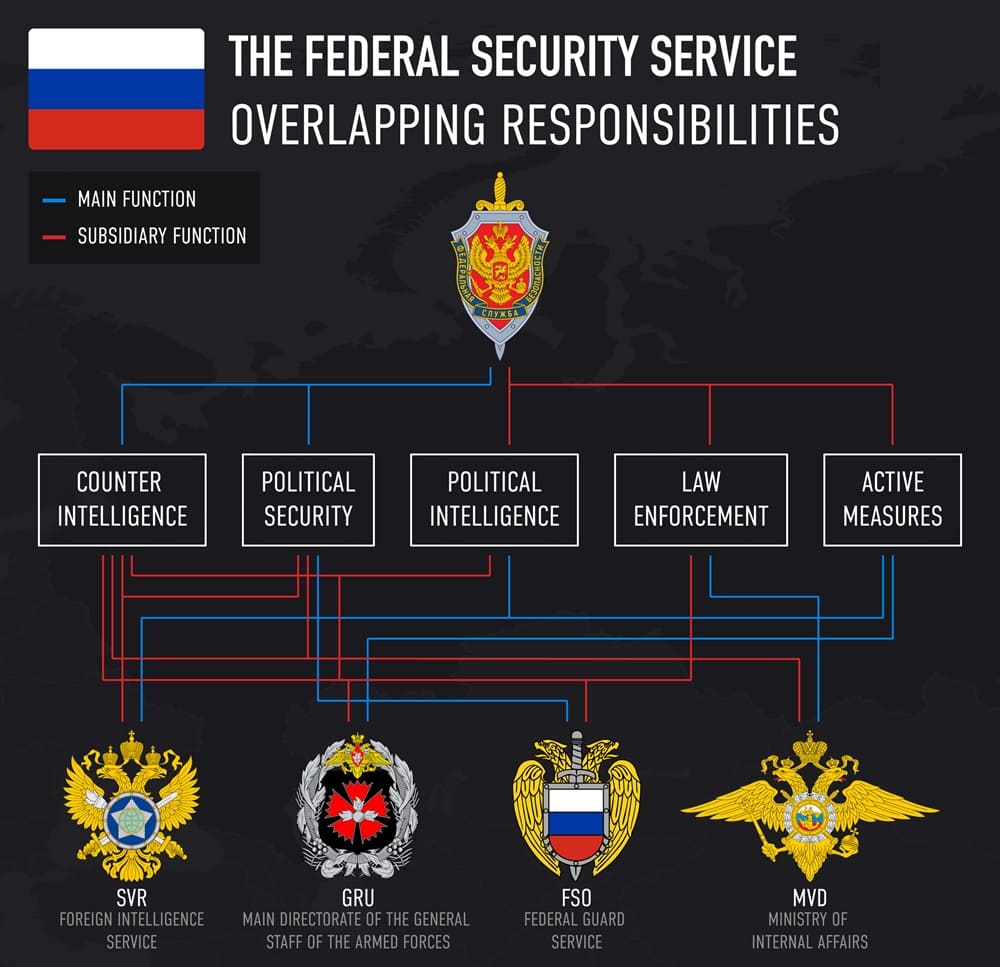
A foreign intelligence officer could theoretically benefit from SIGINT, counterintelligence databases, diplomatic reporting, border surveillance, and political-security information flowing through the same enormous bureaucracy. After the Soviet collapse, Moscow deliberately dismantled that concentration of power. Foreign intelligence became the SVR. Government protection functions ultimately became associated with the Federal Protective Service, or FSO. Government communications were transferred into separate structures, including FAPSI, before later reorganizations. Military intelligence remained under the GRU/GU. The residual domestic counterintelligence organization eventually became the FSB in 1995. As a result, Russia replaced this intelligence colossus with several competing organizations.
FSB Fragmentation Weakness
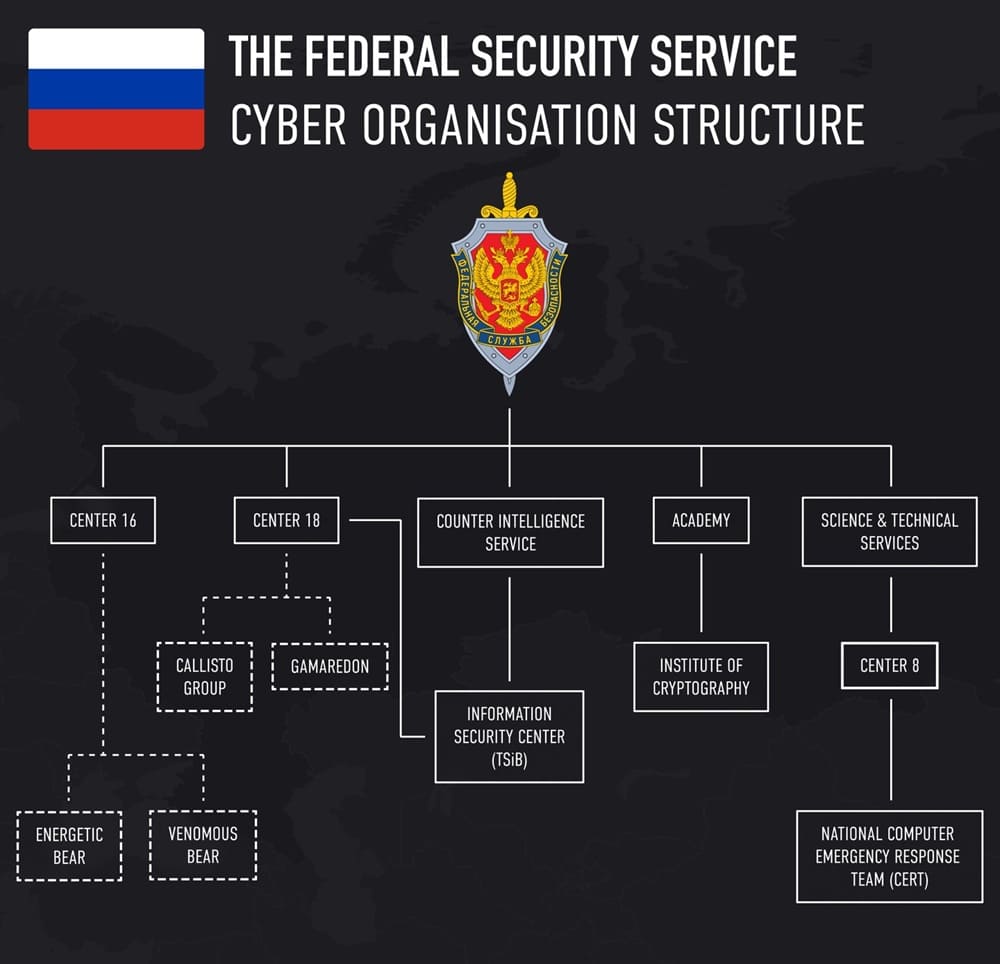
The modern Russian intelligence system consists principally of the FSB, SVR, military GU/GRU, and FSO. Congressional Research Service assessments describe bureaucratic competition between these organizations, including overlapping responsibilities and duplicated intelligence collection. The FSB has increasingly conducted operations abroad, particularly in former Soviet republics, bringing it into territory traditionally associated with the SVR and military intelligence. This competition has advantages.
Rival services can provide alternative assessments and prevent any one organization from monopolizing intelligence. It also produces friction. Paralel agent networks may pursue the same targets. Organizational interests can influence assessments. Intelligence organizations competing for Kremlin influence may have incentives to provide conclusions that align with their political interests. This situation represents a major difference from the institutional architecture of the mature KGB.
Case Study: The FSB and Ukraine
Russia’s February 2022 invasion of Ukraine provided perhaps the most important modern test of FSB strategic intelligence. The FSB’s Fifth Service, formally associated with operational information and international relations, had significant responsibility for Ukraine. RUSI subsequently examined surveys reportedly commissioned in February 2022 by the Ninth Directorate of the Fifth Service to assess Ukrainian political attitudes.
These surveys constitute an unusually revealing publicly documented glimpse into Russian intelligence preparation. The problem was not necessarily an absence of data. It was interpretation. Russian analysis appears to have treated public dissatisfaction with Ukraine’s political leadership as evidence that sections of Ukrainian society might remain passive during a Russian intervention.

According to RUSI’s assessment, the analysis failed adequately to distinguish dissatisfaction with a government from willingness to accept foreign military occupation. The difference was a strategic calamity. Russian planners clearly had in mind the political destabilization, the rapid paralysis of the government, and the more effective use of the existing networks. Rather, the invasion shifted minds, creating massive resistance.
The episode is a reminder to intelligence professionals of the difference between collection failure and assessment failure. Even an intelligence service with plenty of HUMINT, polling, comms intercepts, and political reporting can arrive at a wrong strategic conclusion. This situation is especially dangerous when analysts are working in authoritarian decision-making systems, where questioning the assumptions of the leadership can be professionally perilous.
FSB Remains Technologically Capable
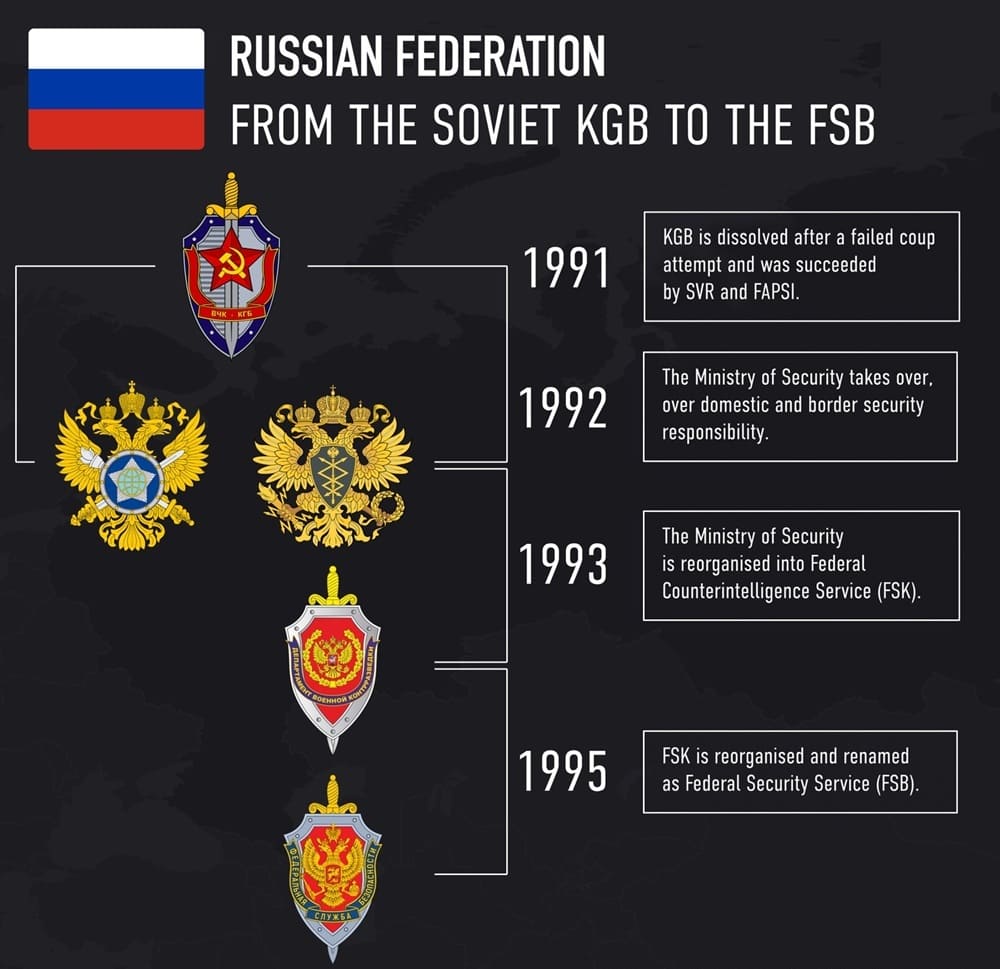
However, describing the FSB as a weakened KGB underestimates it. The cyber operations provide the organization with capabilities that the old Soviet intelligence services could only have dreamed of. A particularly illustrative case is FSB Center 16, which is responsible for signals intelligence. Center 16 was formed in a reorganization of government communications functions in 2003, a U.S. Justice Department affidavit says. The FSB then developed an advanced cyber-espionage platform called Snake, or Uroburos. The FBI tracked Snake to a unit of the FSB Center 16, also known to cybersecurity researchers as Turla. By 2023, Snake had reportedly breached hundreds of systems in at least 50 countries over nearly 20 years.
Targets included NATO governments, journalists, and organizations with information that Moscow finds particularly valuable. More unusual, though, was the court’s release of material that revealed operating patterns usually invisible to outsiders. US investigators said there was snake-related activity during the hours when an FSB facility in Ryazan was in operation, usually from 07:00 to 20:00 Moscow time. The technical attribution shows how modern counterintelligence can combine malware analysis, infrastructure mapping, traffic patterns, and human organizational behavior. Operation MEDUSA finally took down the Snake infrastructure. This operation was not evidence of an inefficient intelligence service. Maintaining a complex espionage platform for almost 20 years in an operational status is a significant technical capability.
Energy Infrastructure Operations
Another cyber operation by the FSB indicates a shift from traditional espionage to prepping the cyber battleground. The officers, from the FSB Center 16, Military Unit 71330, were involved in operations targeting organizations in the energy sector from 2012 to 2017, U.S. prosecutors said. It was reported that its targets were oil and gas companies, nuclear facilities, utilities, and power-transmission organizations. The goal of the campaign was long-term access to SCADA and industrial-control networks.
Industrial-control systems are a bridge between digital commands and physical machinery, and access is strategically important. If they were compromised, then an intelligence operation could go beyond the stealing of information to the ability to cause physical disruption. The campaign reportedly included supply chain compromises and the exploitation of legitimate industrial software environments. Such an operation is the modern equivalent of laying sabotage infrastructure behind enemy lines, but with the difference that cyber access can be established years before a crisis begins.
The FSB’s Strategic Paradox
Though the FSB seems weaker than the KGB, it is also stronger, depending on the measure. It is weaker at the institutional level. It does not control Russia’s foreign intelligence, military intelligence, or executive protection structure. Russia’s intelligence system consists of several services competing for operational territory and political influence.
Technologically, however, the FSB can conduct surveillance, cyberespionage, data processing, and network exploitation on a scale unknown to Soviet intelligence. Thus, the greater weakness may be intellectual, not technological. An intelligence organization can collect vast amounts of information and still be wrong if analysts misinterpret political behavior or if senior leaders reward assessments that confirm their preconceptions. This was the exact danger Ukraine demonstrated.
Conclusion
The FSB is not the KGB in a new suit of clothes. The Soviet KGB was a tremendous concentration of HUMINT, SIGINT, counterintelligence, political policing, border forces, communications security, and foreign clandestine operations. No Russian organization of today has such a spectrum in isolation. But the FSB remains one of the most capable security services in the world, especially in counterintelligence, cyber operations, signals intelligence, and operations in the former Soviet space.
A cyber-espionage platform in use in at least 50 countries for almost two decades demonstrates institutional relevance. Otherwise it is weak in other areas. Russia broke up the intelligence empire of the KGB into several powerful but rival services. The outcome may be technologically sophisticated operations, but it may also be marred by duplication, inter-agency rivalry, and politically skewed strategic appraisals. So the FSB is a shadow of the KGB, more in institutional scope than in operational lethality.
References
- Congressional Research Service, “Russia’s Foreign Intelligence Services,” updated December 3, 2025.
- U.S. Department of Justice, “Justice Department Announces Court-Authorized Disruption of the Snake Malware Network Controlled by Russia’s Federal Security Service,” May 9, 2023.
- Royal United Services Institute, “The Intellectual Failures Behind Russia’s Bungled Invasion,” 2022.
- Federal Research Division / publicly archived Soviet security assessment, “KGB Functions and Internal Organization.”
About the Author