

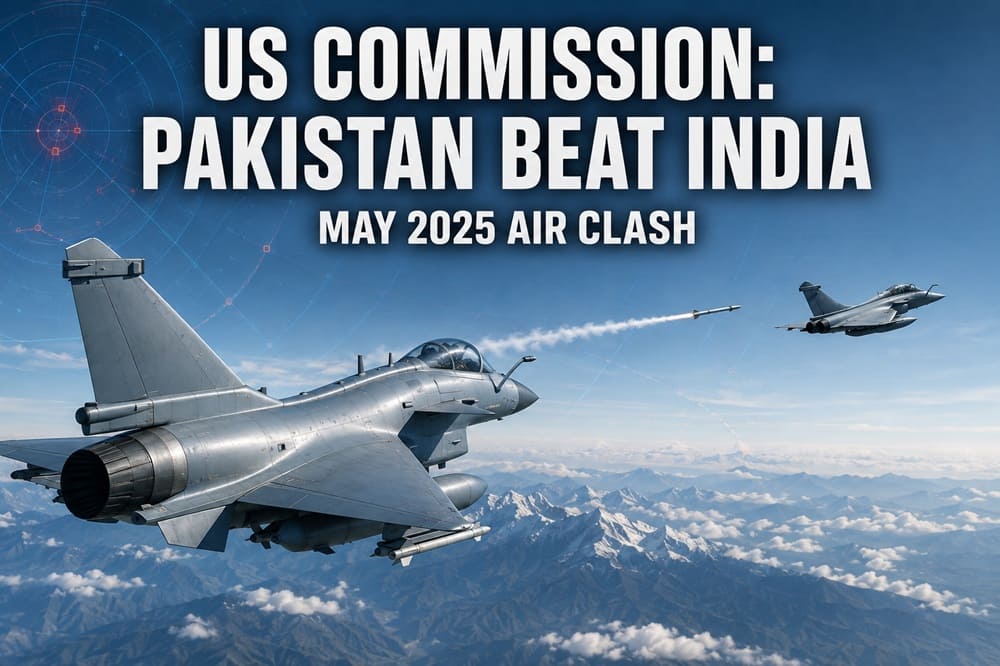
US Commission: Pakistan Beats India in May 2025 Clash
The Commission’s 2025 Annual Report to Congress provides a stark, uncharacteristic assessment of the May 2025 India-Pakistan confrontation. The largest significant air battle after World War 2, where almost 110+, 4 and 4.5 generation fighters were involved. The U.S.-China Economic and Security Review Commission submitted it in November. Page 109 states, “Pakistan’s military success over India in its four-day clash showcased Chinese weaponry.”
The finding comes from a commission created by Congress, a body of the U.S. legislative branch. However, it’s not a congressional resolution, a Pentagon assessment or an independent six-to-0 scorecard. That is a significant difference. The Commission did not verify each report of aircraft shot down but evaluated Pakistani military success. Its main argument is on China’s battlefield wins and exports.
The Four-Day Clash
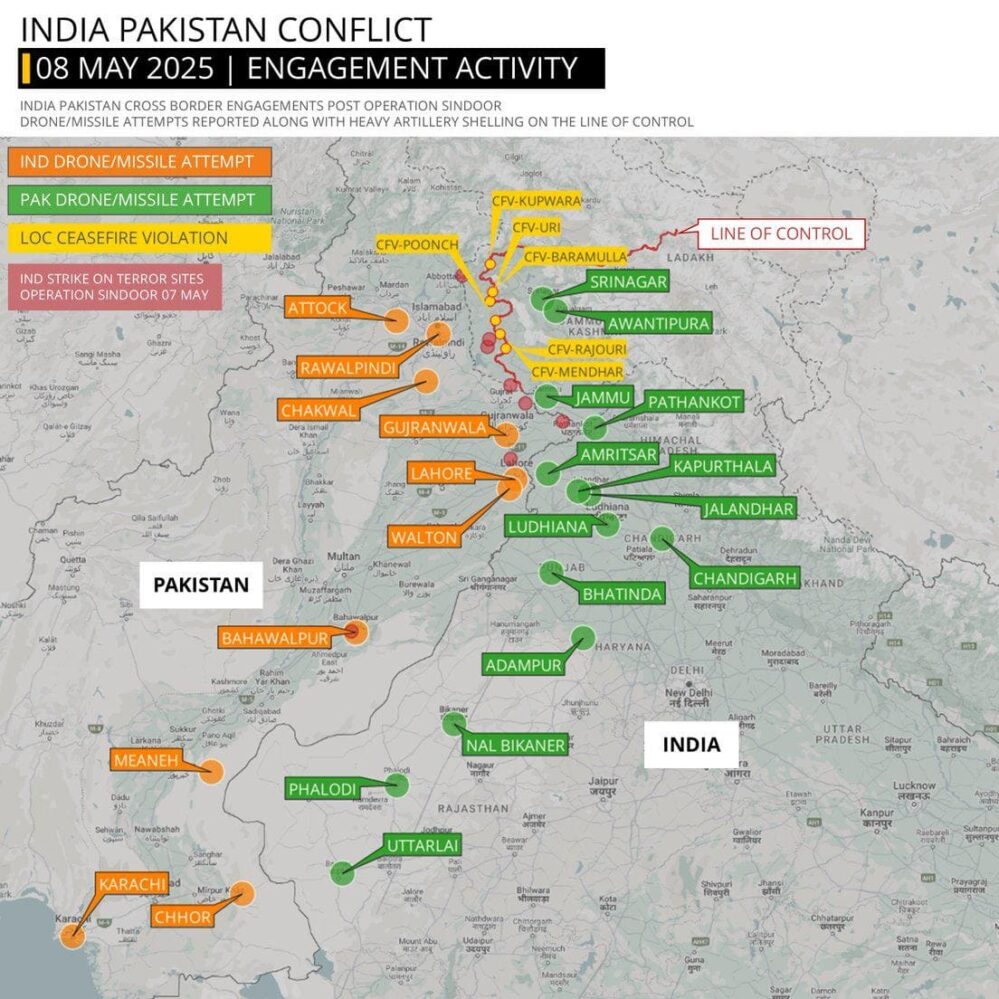
The crisis followed the attack in Pahalgam on 22 April 2025, which killed 26 civilians. On 7 May, India launched “Operation Sindoor”, targeting nine sites in Pakistan and Pakistan-controlled Kashmir. New Delhi has branded them as terrorist infrastructure. Islamabad rejected India’s justification and proceeded with counteroperations.
The confrontation expanded to include beyond-the-horizon combat, drone strikes, missile launches, artillery duels and attacks on military infrastructure. The range of missiles and networked targeting became even more crucial, as crewed fighters had to remain within national airspace. Reuters compiled a later account of the first air battle from Indian and Pakistani officials.
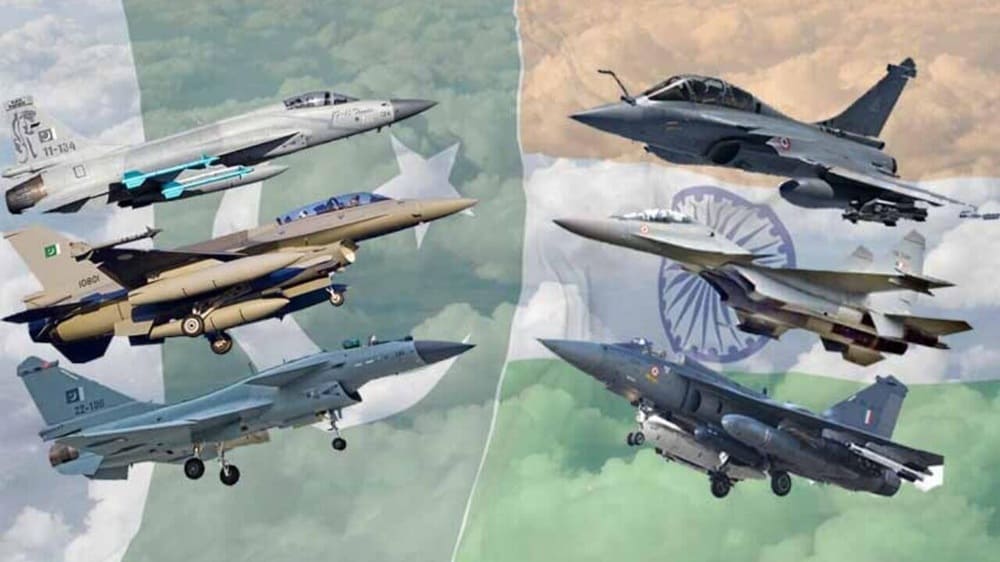
Its probe described some 110 aircraft operating over a broad battlespace. A Pakistani J-10C fired a PL-15 series missile at an estimated range of about 200 kilometres, hitting an Indian Rafale. One of the Rafales was lost, the first known combat loss of the type. Pakistan claimed it shot down six Indian aircraft, including three Rafales, one Su-30MKI, one Mirage 2000 and one MiG-29.
India admitted to the loss of aircraft but denied that the number was six. Evidence pointed to three losses, the chief of the French Air and Space Force, General Jerome Bellanger, later said. He saw one Rafale, one Su-30 and one Mirage 2000. Neither side has provided full radar tracks, telemetry or wreckage logs for independent analysis, and attribution is disputed.
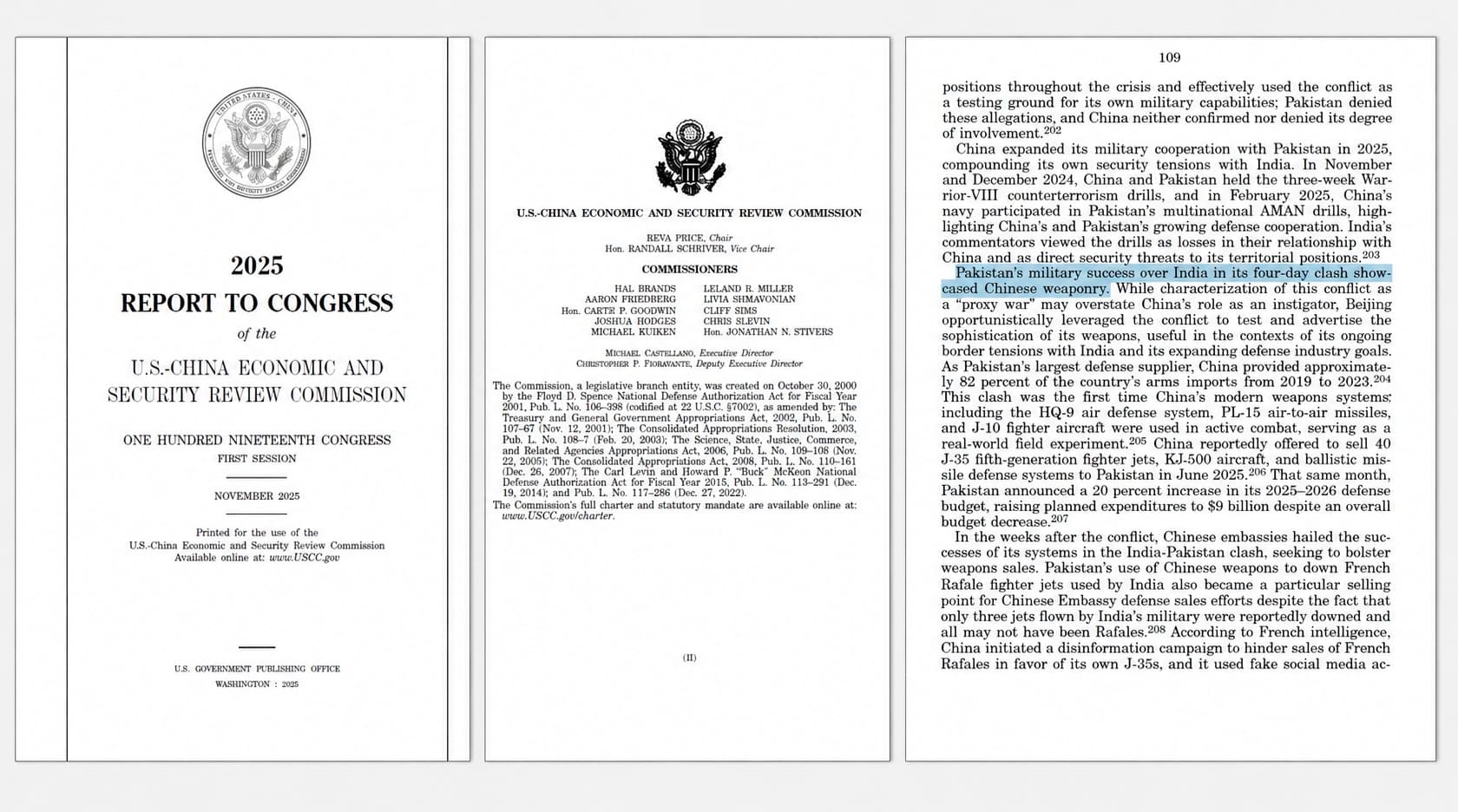
Link to Complete Document
2025 REPORT TO CONGRESS of the U.S.-CHINA ECONOMIC AND SECURITY REVIEW COMMISSION
May 2025 Clash Reshapes U.S.–India Ties
The May 2025 India-Pakistan war might have made Washington rethink the utility of India as a strategic counterweight to China. A US commission’s study of Pakistan’s battlefield performance shows that American policymakers are closely following the outcome of the conflict. India can deny or downplay information about its losses, but modern warfare has a huge intelligence signature. Satellites, electronic intelligence, radar data, communications intercepts and allied surveillance can reveal far more than official statements have disclosed. The United States, China, Russia and other big powers will probably have their own ideas about what happened and influence future strategic calculations about both India and Pakistan.
Case Study: The J-10C–PL-15 Kill Chain
The tactical lesson here is not that one fighter is superior to the other. In the first engagement, it looks like Pakistan has built the better sensor-to-shooter chain. It reportedly linked together airborne early-warning aircraft, ground radars, electronic-support measures and fighters with secure data links. This allowed a shooter to obtain an off-board track without having to constantly radiate its radar.
The J-10C is equipped with active electronically scanned array radar, modern electronic warfare systems and digital connectivity. The PL-15 has inertial navigation, mid-course updates, and an active radar seeker in the terminal phase. Another sensor can provide accurate data on the target state. The fighter can then fire before its radar can develop a track of weapons quality. One should treat the reported launch distance of 200 kilometres with caution, as it is not the same as the intercept range.
The practical no-escape zone is still less than the maximum kinematic reach. The terminal energy depends on the altitude, speed, aspect and defensive manoeuvring. Indian planners are reported to have pegged the export PL-15’s range at close to 150 km. That estimate may have influenced the strike package. Indian crews may have believed they were still outside the Pakistani engagement envelope.
The J-10C formation then achieved a favourable firing geometry. Meanwhile, Rafale crews concentrated on carrying out their strike tasks. The Rafale is still a pretty serious fighter, with its SPECTRA electronic-warfare suite and Meteor beyond-visual-range missile. However sophisticated the equipment, it cannot make up for poor threat intelligence, restrictive rules of engagement or inferior situational awareness. Air combat is still a battle of integrated systems, not a laboratory duel between aircraft specs.
Why Pakistan Succeeded
The main success of Pakistan was to stop India from carrying out a free punitive operation. It resulted in the loss of combat aircraft, maintained an operational counterstrike capability, and proved Chinese system integration in wartime conditions. The Commission noted the first combat use of the PL-15, the HQ-9 and the J-10.
This was a strategically important outcome, given China’s defence relationship with Pakistan. China accounted for 81% of Pakistan’s major-arms imports in 2020-24, according to SIPRI. Updated data for 2021-2025 set the share at 80%. Meanwhile, India had a good long-range strike capability.
Indian officials said they carried out raids on Pakistani radars, command facilities and several air bases. A ceasefire came into effect at 1700 hrs IST on 10 May. India also later claimed kills of Pakistani aircraft, including five fighters and one larger military plane. Pakistan denied that it lost any aircraft. There is no public evidence to settle those competing claims.
Thus, the “military success” should be read as an assessment of the campaign, rather than as an indication of an uncontested strategic victory. Pakistan had, however, a clear edge over India in open-air combat and also denied India any unilateral escalation dominance. India said it had retained the capability to strike deep into Pakistan and that it had met its counterterrorism goals. No territory was captured, and both nuclear-armed countries agreed to a ceasefire after four days.
Neutral Fighter Count
Later, in the aftermath of the air clash in May 2025, Pakistan challenged India to allow a neutral third party to verify the strength of the fighter fleets of both countries. Pakistani officials said comparing inventories of aircraft before and after the fighting could help substantiate or disprove rival claims of losses. Islamabad argued that combat losses were difficult to hide over time, because fleet numbers, squadron strength, replacement activity, satellite imagery, maintenance patterns, and intelligence monitoring could all reveal discrepancies. Pakistan suggested independent verification as a practical method of establishing the facts. India denied and continued to challenge the Pakistani claims about the number of Indian aircraft destroyed in the confrontation.
What is credibly established?
- India said it had lost some aircraft initially but did not say how many. But Chief of Defence Staff General Anil Chauhan said that Pakistan’s figure of six aircraft was “absolutely incorrect”. Reuters
- “The available evidence points to three Indian losses: one Rafale, one Sukhoi and one Mirage 2000, not three Rafales plus a MiG-29,” French Air Force Chief General Jérôme Bellanger said. Associated Press
- The Washington Post independently found wreckage consistent with one Mirage 2000 and one Rafale. Visual evidence establishes crashes but cannot determine their cause alone. Washington Post
- “At least two Indian planes, including at least one Rafale, were shot down by Pakistani J-10 fighters,” two US officials told Reuters. Later reports attributed the loss of the Rafale to a PL-15 fired from a J-10. Reuters, May 2025, Reuters technical investigation
- PIB Fact Check directly contradicts the claim that Keshav Yadav died.
China’s Real Battlefield Dividend
Information on the electronic order of battle is least visible and most militarily important. The Chinese military keeps the radar modes, jamming effectiveness, data-link latency, missile-seeker behaviour, and target-allocation rules classified. Indian officials said Pakistanis were getting intelligence from China in real time. Pakistan denied the charge, and Beijing declined to comment.
This meant analysts could not take the claim as fact. Even without the input of the Chinese, the clash gave useful data on performance. Engineers can look at detection range, track continuity, missile profiles and countermeasure response. Chinese diplomatic missions pushed these systems, said the Commission. French intelligence also accused China of circulating fake images of Rafale losses.
Conclusion
Page 109 buttresses the argument that a US commission evaluated Pakistani military success against India in May 2025. It does not back all Pakistani claims. There are strong indications that Pakistan won an initial networked air-warfare advantage and destroyed at least one Rafale. It also revealed problems with Indian threat assessment. India adapted, hit harder, and restrained much of its combat power.
The simple, killer lesson for military planners is that platform prestige matters less than kill-chain quality. The first engagement involved distributed sensing, off-board targeting, electronic warfare and realistic missile-range intelligence. The Chinese built an operational architecture, and Pakistan’s success proved it. Later, analysts revealed that combat effects now reach into global arms markets and strategic influence.
References
- U.S.-China Economic and Security Review Commission, 2025 Annual Report to Congress, p. 109
- Reuters, “How Pakistan shot down India’s cutting-edge fighter using Chinese gear,” 2 August 2025
- Government of India Press Information Bureau, “Operation SINDOOR: India’s Strategic Clarity and Calculated Force”
- SIPRI, “Trends in International Arms Transfers, 2025,” March 2026
- Operation Sindoor: Pakistan Demands International Aircraft Audit to Debunk Indian Air Force Kill Claims
About the Author

1 thought on “US Commission: Pakistan Beats India in May 2025 Clash”