

The $3 Million MiG-31 Kinzhal Hijacking Plot
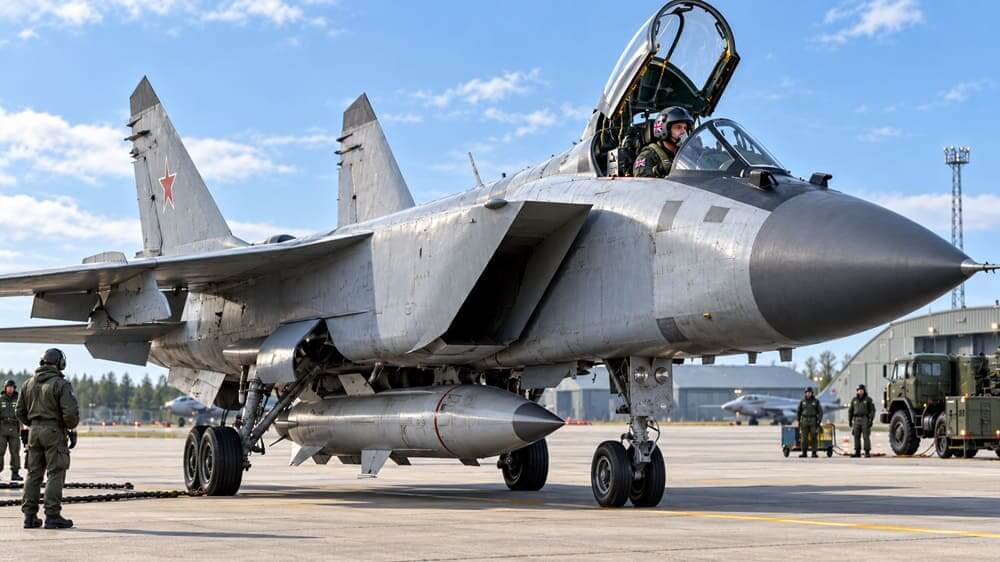
In November 2025, the Russian Federal Security Service (FSB) said it had foiled a supposed Ukrainian-British intelligence operation to take out a MiG-31 plane carrying a Kh-47M2 Kinzhal hypersonic missile. Moscow says foreign intelligence services promised Russian military pilots $3 million, foreign citizenship and assistance with relocation if they delivered the planes. But the alleged operation was more than traditional military spying.
Russian authorities said the plane would enter Romanian airspace near a NATO installation and could potentially cause an international military incident. The claims raised questions about aviation security, intelligence recruitment, hypersonic weapons technology and the risks of escalation. However, independent investigators have challenged key parts of Moscow’s account. Reuters also said it could not independently confirm the Russian account.
FSB’s $3 million offer claims
On November 11, 2025, the FSB accused the Ukrainian Main Directorate of Intelligence (HUR), allegedly with the support of British intelligence, of attempting to recruit Russian military personnel. Russian state TV aired alleged recruitment messages and recordings. The material reportedly offered big bucks and citizenship in the West. More details came from Russian reporting. It claimed that recruiters offered $1 million upfront for the aircraft and a $3 million reward if the MiG-31 was armed with a Kinzhal missile.
The FSB also said recruiters had approached a MiG-31 navigator after failing to recruit the aircraft’s commander. The same account said the operatives reportedly proposed to knock out the commander during the flight. The alleged plot also included a scheme involving the commander’s oxygen equipment. Those details are not verified. Their publication confirms what the Russian authorities said, not what the Ukrainian or British intelligence really tried.
The Strategic Importance of the MiG-31K
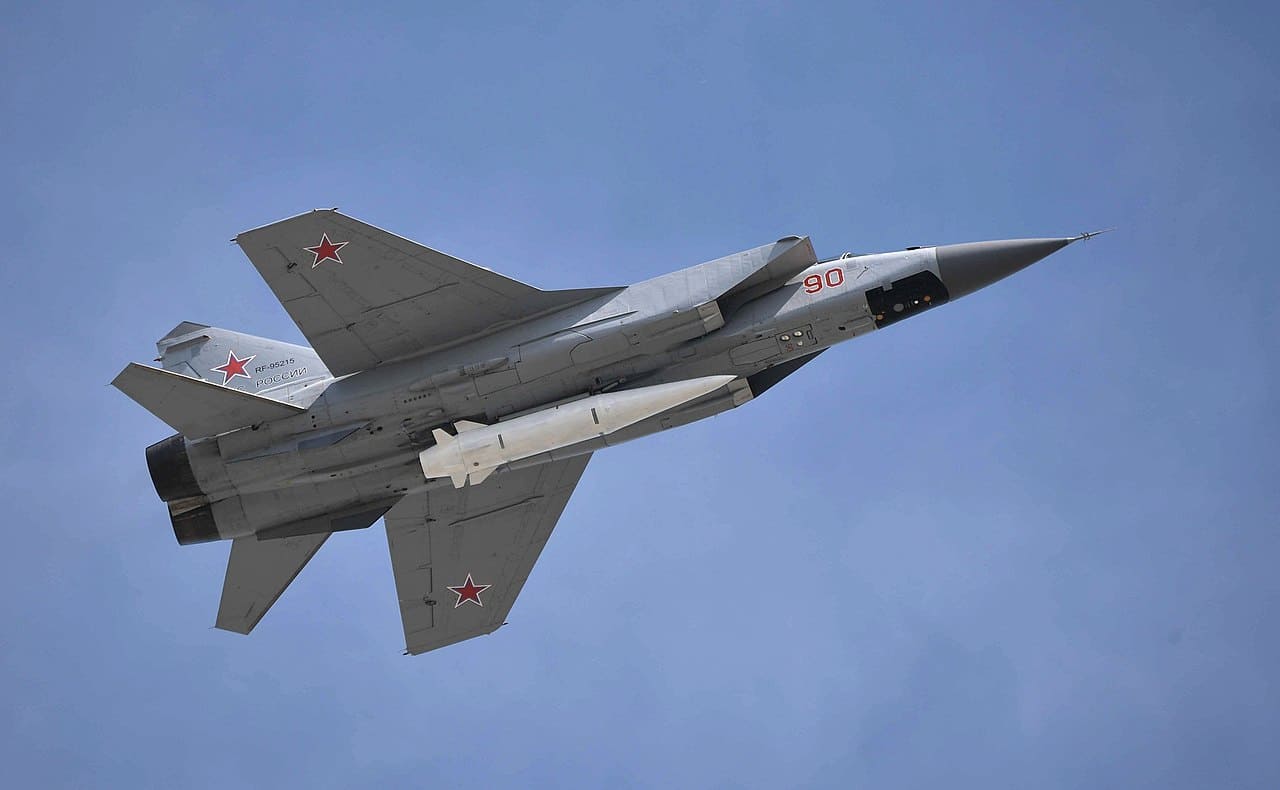
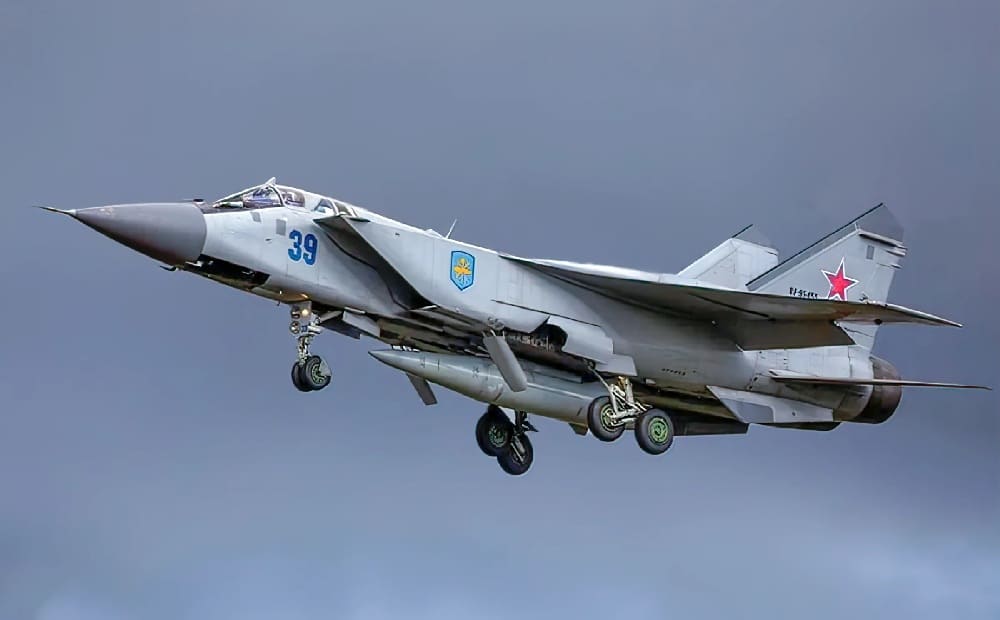
The MiG-31K is a specialised version of the Soviet-designed MiG-31 Foxhound interceptor aircraft. Unlike the fighter aircraft, which are conventionally designed to be effective in aerial combat, the modified aircraft is used as a high-speed launching platform for the Kinzhal air-launched ballistic missile. The missile system has greater operational flexibility because it is capable of carrying a large weapon at high speed and altitude. The Kinzhal is a nuclear-capable missile based on the Iskander-M ballistic missile family, according to the Center for Strategic and International Studies (CSIS).

Kinzhal Technical Characteristics
| Parameter | Published estimate |
|---|---|
| Designation | Kh-47M2 Kinzhal |
| Missile classification | Air-launched ballistic missile |
| Approximate length | 8 metres |
| Diameter | 1 metre |
| Launch weight | 4,300 kg |
| Payload | 480 kg |
| Reported range | 1,500–2,000 km |
| Reported maximum speed | Up to Mach 10 |
| Warhead compatibility | Conventional or nuclear |
| Primary launch platform | Modified MiG-31 |
CSIS Missile Threat. Figures represent published estimates rather than independently verified operational limits. The missile uses an aeroballistic flight profile. Aircraft launch conditions provide an initial energy advantage before the missile accelerates along its trajectory. Its reported manoeuvrability and high velocity can complicate missile defence calculations. However, hypersonic speed does not guarantee immunity from interception. Moreover, published Kinzhal range claims sometimes blur the distinction between missile flight distance and the aircraft-missile system’s combined operational reach.
Mig-31 Foxhound Technical Characteristics
| Specification | MiG-31 Foxhound |
|---|---|
| Manufacturer | Mikoyan (USSR/Russia) |
| Role | Long-range supersonic interceptor |
| First flight | 16 September 1975 |
| Entered service | 1981–1982 |
| Crew | 2 (pilot and weapons officer) |
| Length | 22.69 m |
| Wingspan | 13.46 m |
| Height | 6.15 m |
| Empty weight | 21,825 kg |
| Maximum takeoff weight | 46,200 kg |
| Engines | 2 × Soloviev D-30F6 turbofans |
| Engine thrust | 152 kN each (afterburner) |
| Maximum speed | Mach 2.83 (3,000 km/h) |
| Sea-level speed | 1,500 km/h |
| Service ceiling | 20,600 m |
| Ferry range | Up to 3,300 km |
| Combat radius | Approximately 720–1,200 km |
| Maximum G-load | +5 G |
| Radar | N007 Zaslon (PESA) |
| Upgraded radar | Zaslon-M (MiG-31BM) |
| Main air-to-air missiles | R-33, R-37/R-37M (upgraded variants) |
| Cannon | 23 mm GSh-6-23, 260 rounds |
Major variants
The basic MiG-31 entered service in the USSR as a long-range, high-speed interceptor, armed with the Zaslon radar and R-33 missiles. The MiG-31B featured improved avionics and electronic countermeasures and carried R-33S missiles. Earlier aircraft were upgraded to a similar standard to the MiG-31BS. The MiG-31BM was equipped with an upgraded radar, modern mission computers and R-37M long-range missiles.
With the MiG-31K, the interceptor became a platform for air-launched ballistic missiles capable of carrying the Kh-47M2 Kinzhal. The newer MiG-31I is said to have automated missile-launch systems and better navigation to improve Russia’s long-range precision-strike capabilities. These changes show that the Foxhound can be used for both interception and strike missions.
| Variant | Primary role |
|---|---|
| MiG-31 | Original long-range interceptor |
| MiG-31B/BS | Improved interception and avionics |
| MiG-31BM | Modernised radar and long-range missiles |
| MiG-31K | Kh-47M2 Kinzhal missile carrier |
| MiG-31I | Further-developed Kinzhal carrier |
Value to Intelligence of Capturing a Kinzhal
The whole Kinzhal missile would provide a lot of technical intelligence. Foreign weapons labs could study its propulsion architecture, structural materials, guidance components and manufacturing standards. Such access would allow analysts to differentiate between Russia’s claimed capabilities and the actual engineering characteristics of its weapon. Analysts would focus particularly on the missile’s terminal guidance accuracy, manoeuvrability constraints, electronic systems’ resilience and manufacturing quality.
Much of the information is still classified or unverified in the open literature. The aircraft itself could also provide information on weapon integration, mission systems and the changes needed to launch an air-launched ballistic missile. Meanwhile, catching a missile doesn’t provide a complete picture of how it will perform. Analysts would still need flight test data, context for software, and trusted operational data. This difference makes intelligence valuable but difficult to quantify.
MI6 and the Silent Courier operation
The charge came amid a period of intensified recruitment by British intelligence. On 19 September 2025, Britain’s Secret Intelligence Service launched Silent Courier, a dark-web communications platform, allowing secure contact with MI6. The service hoped to recruit intelligence assets in countries including Russia, which Britain’s government singled out. The platform was a reflection of a wider change in human intelligence collection. Intelligence services are increasingly using traditional recruitment techniques alongside secure digital communications.
There is one important chronological difference. Russian sources say the first contact with the alleged MiG-31 crew was in 2024, prior to the public release of Silent Courier. The existence of Silent Courier is therefore not evidence that MI6 controlled the alleged aircraft operation or operated that specific platform. Just because you can recruit online does not prove the existence of a particular covert operation.
Romanian Airbase Mission
The most contentious issue was where the aircraft was intended to go. The intelligence officers from the FSB aimed to bring the MiG-31 close to the area of the Mihail Kogălniceanu military airport in the vicinity of Constanța, Romania. The base is in a strategically important region near the Black Sea and bolsters NATO’s defense posture in the southeast. Moscow said foreign intelligence planners believed NATO air defences would stop the incoming Russian aircraft, which would lead to a major international incident. But the hypothetical scenario is fraught with large operational uncertainties.
If a military aircraft was to intrude into NATO airspace, there would be procedures for identification, command-and-control and threat-assessment. Depending on the circumstances, it could be an interception, a diversion, a forced landing or an engagement. Destruction was not inevitable, and just because there’s a nuclear-capable Kinzhal doesn’t mean that the plane is carrying an armed nuclear warhead. Thus, under the FSB interpretation, substantially more evidence is needed than the published recruitment allegations offer.
Historical Case Studies Aircraft defections
The history of military aviation explains why intelligence agencies are interested in plane defections. On 6 September 1976, Soviet pilot Viktor Belenko defected to Japan in a MiG-25P Foxbat interceptor. Western specialists had a rare chance to study the aircraft’s design, avionics, propulsion technology and radar architecture. The incident showed how the capture of an intact aircraft could yield strategic intelligence without traditional warfare. It also cited the risk of losing sophisticated military equipment because of decisions by individual personnel.
Operation Synytsia, 2023
A Russian pilot, Maxim Kuzminov, flew a Mi-8 helicopter into Ukrainian-held territory in August 2023, in an intelligence operation orchestrated by Kyiv. Ukraine hailed the defection as an intelligence coup. Kuzminov later appeared in public before leaving the country. His body was found in Spain by authorities in February 2024. His killing highlighted the continuing security threats to military defectors, even abroad. The FSB later referenced this case in the discussion of the alleged MiG-31 operation. These historical examples show that aircraft defections are operationally feasible. They do not make the 2025 claims accurate.
The MiG-31 Navigator issue:
One major technical inconsistency is the proposed function of the navigator in the MiG-31. The MiG-31 is a two-seater; the pilot and the systems operator in the rear seat have different tasks. The rear-seat crew member does have important mission functions to perform, but that doesn’t automatically qualify him to fly and land the aircraft by himself. Russian accounts say the alleged recruiters said the navigation can be taught remotely because the navigator has limited piloting experience.
Experts in military aviation were sceptical about the feasibility of this option. To safely operate a heavy, high-performance aircraft, extensive training, knowledge of aircraft systems and hands-on experience are required. So the alleged plan didn’t seem excellent, operationally, at least if it depended on a navigator to make a critical landing on his own in strange territory.
Information Counterintelligence and Warfighting
The charges also underline the difficulty of evaluating intelligence claims in wartime. The FSB cited recordings, statements and purported communications as evidence of foreign involvement. However, the material published did not independently corroborate the identities, affiliations, or operational authority of the alleged recruiters. The Insider, an investigative outlet, challenged the story, pointing to inconsistencies in the alleged defection plans. It also said investigator Christo Grozev challenged the alleged involvement of Bellingcat and the authenticity of the material shown.
During times of war, the real challenge for intelligence analysts is to distinguish between actual recruitment activity and disinformation, counter-intelligence operations by adversaries, and influence campaigns. Without authenticated communications, corroborative testimony, or independent operational evidence, there is no way to reconstruct the incident definitively.
Market Strategic Analysis
The purported theft of a MiG-31 for $3 million raises three major military-intelligence issues: the defection of an aircraft, a potential security breach of advanced missile technology, and an incident that could raise tensions involving NATO territory. If we had independent proof that the operation was underway, the strategic implications would be significant. The whole Kinzhal may be a technical intelligence bonanza. A Russian combat plane flying into Romanian airspace could also provoke a dangerous confrontation.
However, the reporting does support a more modest conclusion. Russia says it thwarted an Anglo-Ukrainian operation. The plot unfolded as Moscow described, but the incident has not been verified independently. The incident thus constitutes a key case study on military counterintelligence, aerospace security, and the role played by contested intelligence disclosures in modern warfare.
References
- Reuters. (11 November 2025). Russia says it foiled a Ukrainian-British plot to steal a MiG-31 jet, state media reports.
- Center for Strategic and International Studies (CSIS). (Updated 23 April 2024). Kh-47M2 Kinzhal — Missile Threat.
- UK Foreign, Commonwealth & Development Office and the Secret Intelligence Service. (19 September 2025). A new dark web portal launched to recruit spies to support UK security.
- The Insider. (14 November 2025). FSB tries to spin new fake claims, claiming it foiled the British-Ukrainian intelligence plot to hijack the MiG-31 jet.
About the Author