
Sudarshan Chakra — India’s All-Domain Air Shield
India’s Sudarshan Chakra air-defense system, a decade-long, national-scale effort, marries sensors, shooters, command networks and AI into a single, layered shield. Prime Minister Narendra Modi announced the mission on 15 August 2025, terming it as a self-reliant, all-weather protective architecture for critical sites and cities. Later, Chief of Defense Staff Gen. Anil Chauhan called the Sudarshan Chakra a shield and sword, implying not just interception but also quick and accurate counter-strike options by 2035.
‘Mother of all Air Defense Systems’
Sudarshan Chakra was described as the “mother of all air defense systems combined together” by Air Marshal Ashutosh Dixit (CISC) at a conference on counter UAVs and air defense held in New Delhi. He described the layers of counter-drone, counter-UAV, and counter-hypersonic systems, with counter-drone at the bottom and deeper interceptors and effectors above.
Significantly, Dixit stressed the need for an innovation race with cheap drones causing expensive losses and advised Indian industry and think tanks to stay “two steps ahead”. The pressure of speed and iteration is at the core of planning the Sudarshan Chakra air defense system.
Sensors to Shooters: Layered Design
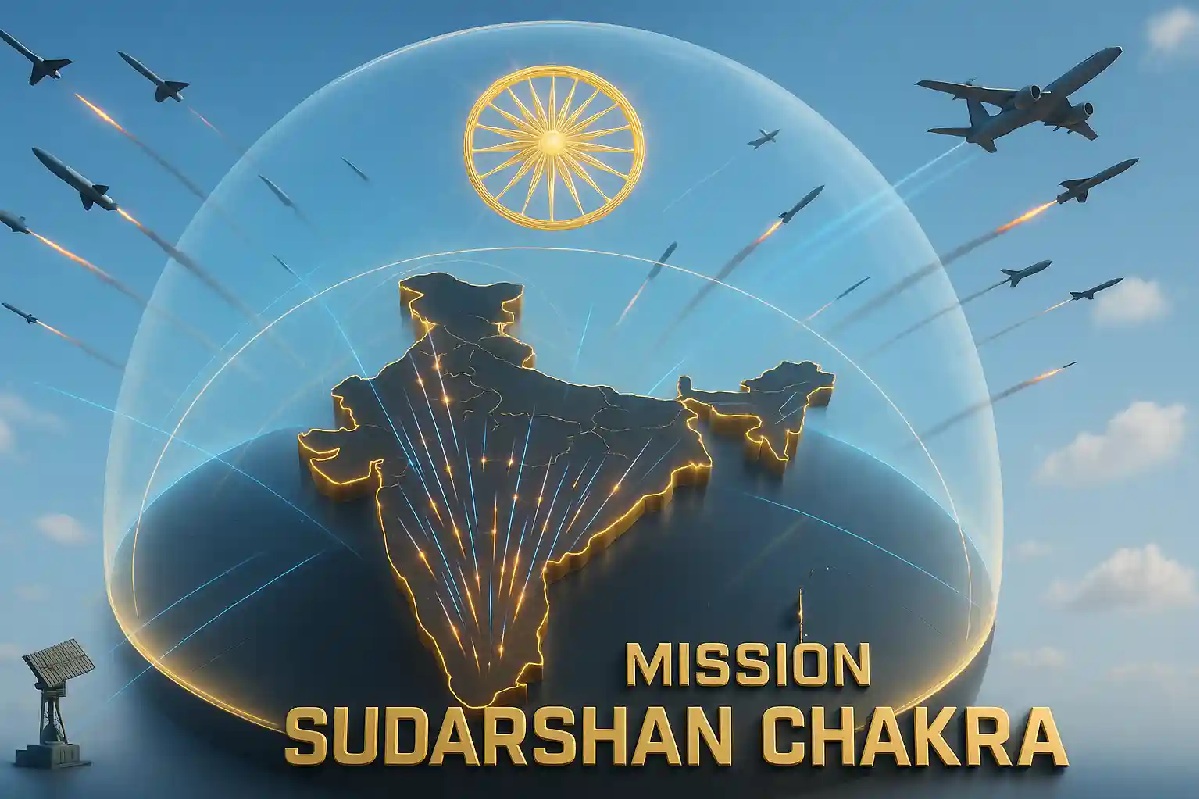
The Sudarshan Chakra project is still in its infancy, but the vision for it is clear. Planners see a multi-domain kill chain built for speed and resilience. We will have widely distributed radars sharing data in real time. If emitters turn off, passive EO/IR sensors will silently watch. RF analytics will look for suspicious patterns in noisy skies. Cyber and space cues will inform a single trusted operating picture. AI will triage tracks, identify threats and match to effectors.
It will also assess fratricide risk before the final engagement order is given. The first soft-kill tools will be the GNSS spoofing, jamming and RF takeover. Directed-energy options could blind seekers without shooting a missile. Hard-kill layers will follow guns, missiles and hit-to-kill interceptors. Together they should be able to take down swarms, cruise missiles and tough hypersonic threats.
Lessons from Operation Sindoor
Operation Sindoor witnessed extensive use of counter-UAS systems and electronic warfare by Indian forces. Opponents have caught up with AI navigation and visual guidance. Planners say the countermeasures of today may not work tomorrow. That is why Sudarshan Chakra is about fast upgrades and sovereign IP. Fast refresh cycles give tactics the edge over the evolving threat. Domestic IP control also protects supply chains and prospects for exports.
The 2035 Vision
The aim is to create an integrated air and missile defence network by 2035 that protects strategic and civilian infrastructure – bases, rail hubs, oil facilities and religious sites – and is cost-effective in a protracted crisis. This calls for modular open systems, hot-swap sensors, sovereign supply chains and a doctrine that integrates Air Force, Army Air Defense, Navy, DRDO and private industry efforts.
Costs and Strategic Trade-Offs
The economic reality, Air Marshal Dixit said, is that “you cannot go bankrupt by fighting a war.” The Sudarshan Chakra air defence system must optimise the cost per threat intercepted. Cheap weapons for cheap targets. Disposable drones. AI that does not fight when it does not need to. Moreover, training and wargaming must take into account the adversary’s counter-moves, as any “surprise element” only works once.
Hypersonic Defense Limits
Counterhypersonic defense is a goal, but the state of the art worldwide remains challenging. India will likely take a hybrid approach, mixing extended-range sensing, improved battle management and more energetic interceptors, while electronic and cyber effects will be a supporting player. The Sudarshan Chakra air defense system will be tested in stages, covering ballistic and cruise envelopes and subsequently hypersonic regimes.
Industry opportunity and risk
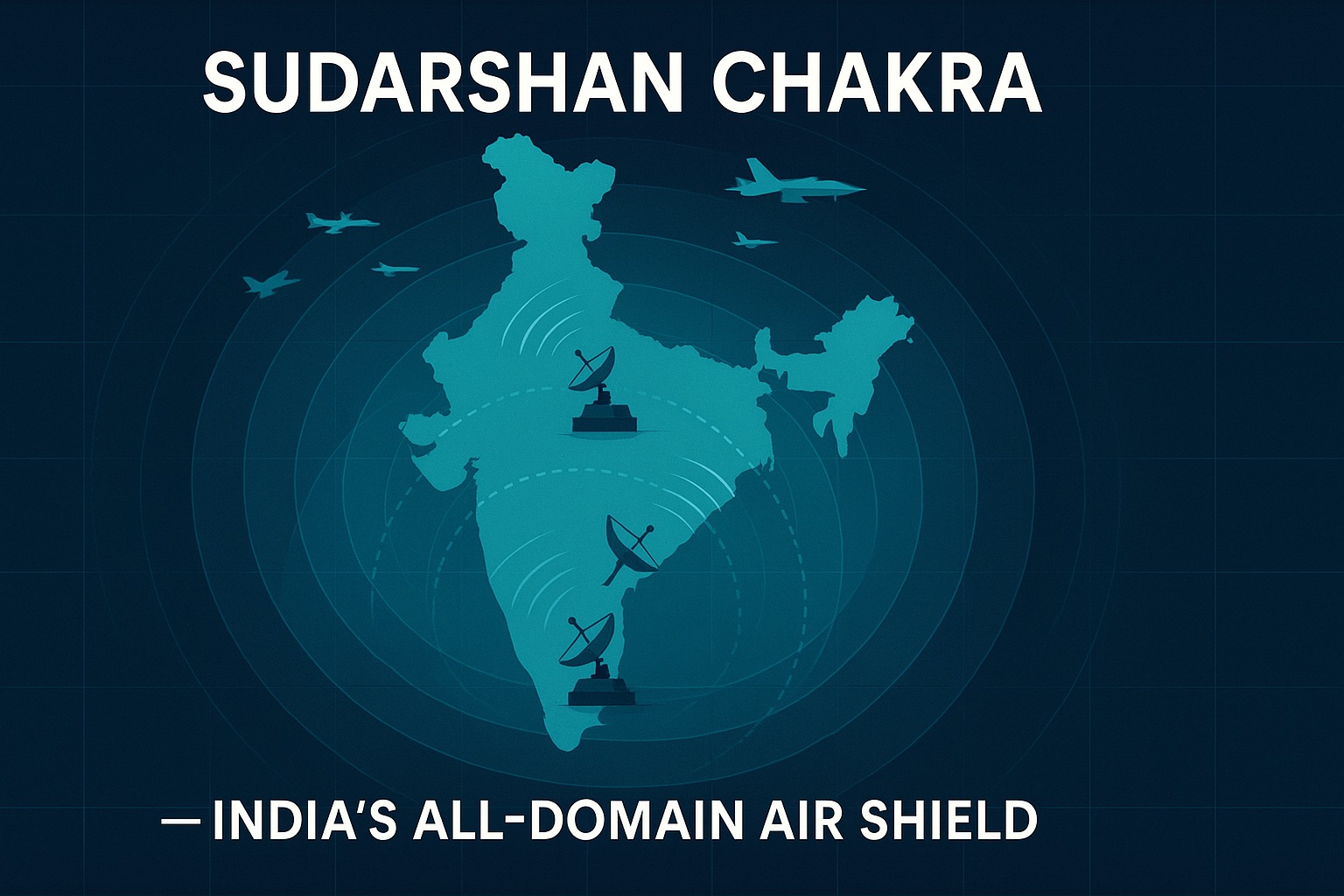
This mission is a once-in-a-generation industrial catalyst for Indian companies. Open architectures and spiral upgrades create export opportunities and lower lifecycle costs. But the price of integration is steep. Interoperability, latency budgets, and cybersecurity should be designed from the beginning rather than added on later. A strong test regime with live-fire, SIL/HIL and digital twins will be crucial.
Conclusion
In the near term, large-scale drone and counter-drone exercises will benchmark tactics, sensors and effector mixes across the services. Seek signs of procurement for layered interceptors, truck-based close-in systems, directed-energy pilots, and AI battle-management software. Together, these exercises and systems will demonstrate how the concept translates into a real order-of-battle reality by the early 2030s.
References
- https://www.ndtv.com/india-news/sudarshan-chakra-mother-of-all-air-defence-systems-combined-together-top-military-official-9331453
- https://theprint.in/defence/a-sword-a-shield-cds-gen-chauhan-explains-what-pm-modis-sudarshan-chakra-is-meant-to-be/2729380/
- https://ddnews.gov.in/en/pm-modi-announces-mission-sudarshan-chakra-to-secure-key-establishments-with-indigenous-technology/
- https://www.reuters.com/world/india/india-hold-its-biggest-drone-exercise-seeking-air-defence-boost-2025-09-23/
About the Author