
From SLV to ICBM: The Dual-Use Rocket Pathway
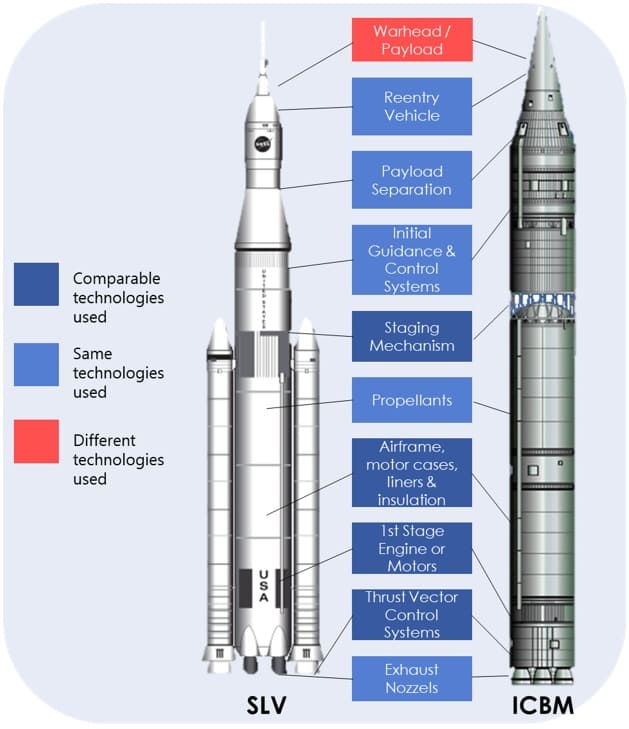
The same laws of physics apply to a satellite launch vehicle as to an intercontinental ballistic missile. They both have to be high thrust, drop empty stages, work outside the atmosphere, and deliver a payload at high velocity. This overlap makes every advanced space program strategically important. But an SLV is not necessarily an operational ICBM, though a pace launch proves several key technologies.
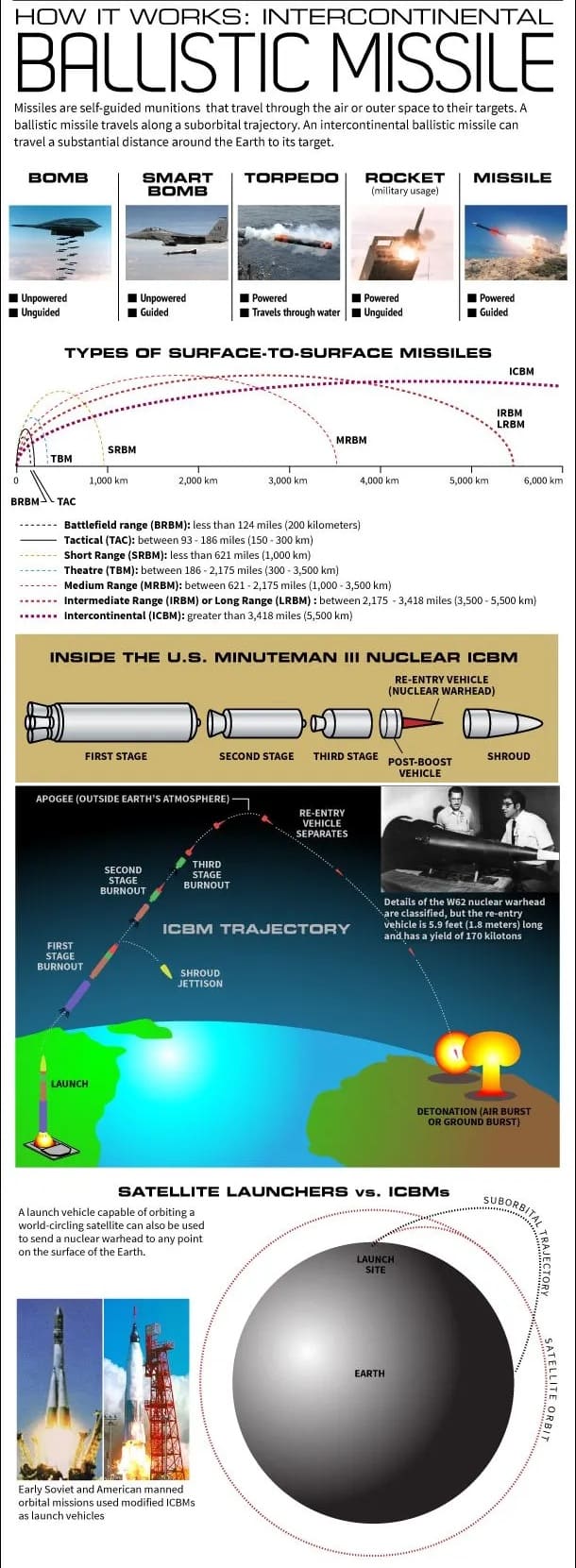
Military deployment requires more capabilities. They include fast launch, secure basing, accurate reentry, warhead integration, and long-term readiness. An ICBM is defined by the United States as a ballistic missile with a range of more than 3,400 miles. Most ICBMs use two or three powered stages before releasing their payloads. A 2019 US Government Accountability Office report confirms these classifications.
Shared Rocket Physics
The Tsiolkovsky rocket equation governs both systems:

This equation relates the change in velocity to the engine efficiency and the mass ratio. That is why lightweight structures, energetic propellants, and staging are still required. A low earth orbit satellite moves at something like 7.8 km/sec. The launcher must provide extra velocity to overcome gravity and atmospheric drag. An intercontinental missile is suborbital, but it still flies at several kilometres per second.
Therefore, any country capable of reaching orbit has already demonstrated several strategically important technologies:
- High-thrust propulsion
- Multistage ignition and separation
- Lightweight propellant tanks and motor casings
- Inertial navigation
- Flight-control software
- Ground tracking and telemetry
- Large-rocket production and testing
NASA notes that propellant can represent about 90% of an orbital rocket’s initial mass. The payload may represent only 1%. Small improvements in structural weight can consequently produce major improvements in range or payload. NASA’s rocket-equation analysis explains this unforgiving relationship.
Limits of SLV Technology
An SLV is usually launched from a known launch center. Engineers can stare at it for days, and if they find a fault, they can delay the mission. Many launchers also use liquid oxygen, which must be fueled shortly before launch. A strategic missile probably will not have such a favorable environment. It must survive surveillance and perhaps a first strike from an enemy. The missile crew has to get it off fast, under wartime pressure. Solid propellants are a big military payoff.
They are stored in the engine, which eliminates long refueling procedures. Canisters also shield the missile from moisture, temperature changes, and mechanical damage. Mobile launchers improve missile survivability by enabling dispersal, concealment, and relocation. Re-entry is another major obstacle. An orbital launcher only has to place a satellite out of the atmosphere. A warhead has to survive reentry from an ICBM, which means surviving extreme aerodynamic heating and still being structurally sound. The re-entry vehicle must protect its payload, control its center of gravity, and resist vibrations.
Meanwhile, it has to deploy cleanly or fall away from the final stage. A country’s ability to put satellites into orbit does not mean it can develop a dependable nuclear re-entry system. Another difference is precision. A space launcher can tolerate relatively large insertion errors. A counterforce missile might have to be far more accurate. Its inertial sensors have to be resilient to acceleration, vibration, temperature variations, and long storage periods.
The Soviet and American Experiences
Early Cold War programs took a different direction. Engineers converted military missiles into space launchers. The Soviet R-7 first successfully flew intercontinental range on 21 August 1957. Its dummy warhead flew some 6000 km but disintegrated on re-entry. But the booster can already put a satellite into orbit. On 4 October 1957, the Soviet Union launched Sputnik 1 into orbit using a modified R-7. That showed a big, but until now unknown, difference.
Soviet engineers were able to put satellites into orbit before they solved all the problems of military re-entry. NASA’s historical account records the R-7’s early failures and subsequent success. The United States followed in suit. Atlas was the first operational ICBM developed by engineers in America.
Modified Atlas rockets later carried Mercury astronauts, including John Glenn, in February 1962. Conversion from weapon to space was easier because the missile already had demanding military specifications. These programs illustrate the asymmetry of the conversion process. Adapting an ICBM-derived booster for satellite launches can be relatively straightforward. Converting an SLV into a reliable military ICBM may require additional work on reentry, deployment readiness, accuracy, and survivability.
Case Study: India’s SLV-3 and Agni
India provides one of the clearest examples of direct technology transfer. The SLV-3 was a four-stage, solid-propellant launcher. It measured 22 metres, weighed approximately 17 tonnes, and could place a 40-kilogram payload into low Earth orbit. India successfully launched the Rohini RS-1 satellite on 18 July 1980. ISRO lists the SLV-3’s official specifications. India later added a solid booster derived from the SLV-3 to the Agni technology demonstrator and attached it to a modified liquid-propellant upper stage.
The first successful flight of Agni was carried out on 22 May 1989. The early Agni was more than an armed SLV. It was a test bed for guidance, staging, and re-entry technology. Later versions of Agni had dedicated military platforms, improved solid motors, mobile launchers, and sophisticated navigation. Thus, India shows how a space program can generate an industrial base. The military program still needs to translate that base into a deployable weapon system.
Case Study: North Korea
Repeated space launches can support a broader missile program, as North Korea has demonstrated. The Unha-3 successfully put an object into orbit on 12 December 2012. The United Nations condemned the launch, citing the use of ballistic-missile technology. UN Security Council Resolution 2087 condemned North Korea’s December 2012 satellite launch because it used ballistic missile technology in violation of existing UN sanctions. The launch proved clustered propulsion, multi-stage separation, guidance, and long-range tracking.
Five years later, in July 2017, North Korea launched two Hwasong-14 ICBMs. It then tested the larger Hwasong-15 on Nov. 28, 2017. The US Department of Defense estimated the Hwasong-15 could reach the continental US on a normal trajectory. However, the Hwasong series was more than an Unha with a warhead. North Korea developed more engines, transporters, launch procedures, and re-entry systems that are militarily useful. The North Korean example implies that space launches can reduce technical risk. They also provide political cover for testing technologies with potential military applications.
Iran and the Simorgh Question
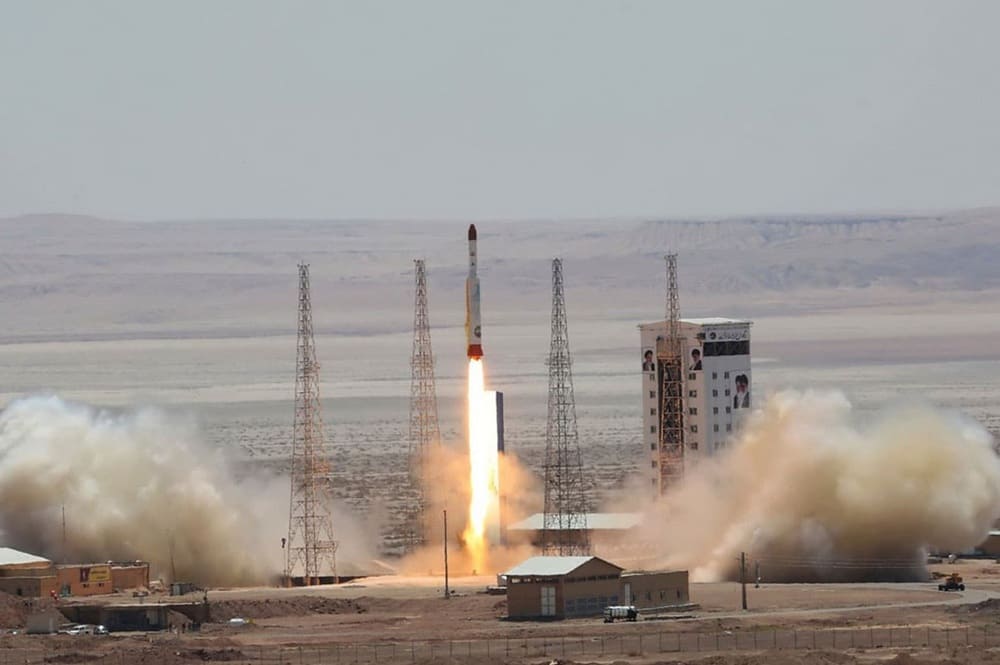
Iran’s Simorgh is an example of the gap between the potential and the actual capability of a technology. The Simorgh is a liquid-propellant rocket about 27 metres long and weighing between 70 and 87 tonnes. Published estimates of its capability are that it can carry a 250-kilogram satellite to a 500-kilometre orbit. The first stage uses four engines from the Shahab missile family.
The US intelligence community believed the development of the Simorgh could speed up Iran’s march to an ICBM. Nevertheless, the launcher is not suitable for immediate military usage. It needs a large permanent installation, long lead-time preparations, and vulnerable support equipment. The 2024 US Annual Threat Assessment made this distinction explicit. Iran would still require a compact re-entry vehicle, military-grade guidance, rapid preparation, and survivable basing.
The Intelligence Indicators
Engine thrust is just one of many factors that intelligence agencies consider when assessing an SLV program. They analyse the length of time it takes to prepare a launch, the storage of propellant, the encoding of telemetry, re-entry tests, the development of mobile launchers, and the manufacture of heat shields. They also look for underground facilities, canister tests, stage-separation debris, and unusual downrange recovery operations.
Testing a re-entry body without announcing a satellite launch reveals more than just the public launch of that satellite. The biggest caution sign is the convergence of the program. The space launch engineers, the military missile organisations, the propulsion factories, and the warhead laboratories all begin swapping personnel and infrastructure, and the worry builds.
Conclusion
An SLV is NOT a stealth ICBM. It is something more strategically ambiguous: an industrial and technological base that can overcome several obstacles to ICBM development. The final change is a function of re-entry, readiness, survivability, accuracy, and weapon integration. It is these less visible capabilities that differentiate a successful space launch from a credible strategic deterrent.
References
- NASA – Ideal Rocket Equation
- ISRO – Satellite Launch Vehicle-3
- NASA – Korolev, Sputnik, and the R-7
- US Intelligence Community – 2024 Annual Threat Assessment
About the Author