

THAAD vs Arrow-3 vs HQ-19 vs S-500: Limits
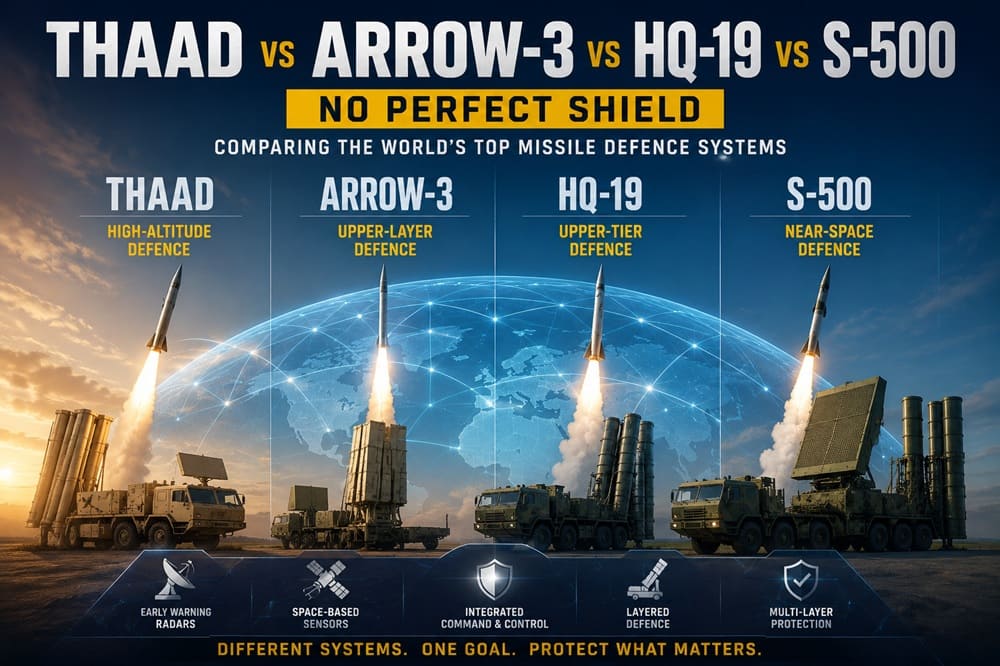
THAAD, Arrow-3, HQ-19 and S-500 are not shields that can completely stop incoming missiles. They represent approaches to intercepting missiles, operate at different levels, use different radar systems, and serve different strategic goals. When it comes to missile defense it’s all about spotting the missile early, accurately tracking it, having interceptors that can move fast, identifying the target correctly, managing the battle effectively, having enough interceptors ready, and calculating the best way to engage multiple targets.
No defense system can guarantee 100% protection. It’s like killing a bullet with another bullet. With advanced technology, an interceptor can fail if the radar system loses track of the target, the target suddenly changes direction, decoys confuse the interceptor, or the attacker launches more missiles than the defender can handle. That’s why serious planners invest in defense networks, not just one system.
THAAD High-Altitude Defense
The THAAD system, or Terminal High Altitude Area Defense, is used to protect against long-range, medium-range, and limited intermediate-range ballistic missiles during their terminal phase. According to the CRS, the THAAD system can engage targets from about 150 to 200 kilometres away. A standard THAAD battery includes 95 soldiers, six launchers, 48 interceptors, one AN/TPY-2 radar, and fire control communications. The THAAD system uses hit-to-kill technology, which means it does not use a warhead. The THAAD system is really good at intercepting targets at altitudes. It can engage targets inside or just outside the Earth’s atmosphere. This system provides the defended forces a larger area of protection than the Patriot batteries. However, the THAAD system still has a limited range, covering only a region and not the entire nation.
Seekers on the System
The seeker on the THAAD system is critical. The company BAE Systems says that the THAAD infrared seeker can lock onto ballistic missiles that are moving at speeds of up to 17,000 miles per hour, approximately Mach 22 to 26. The company Lockheed Martin says that the THAAD system has a record in flight tests, with 100 % of intercepts being successful, and they have delivered 900 interceptors so far. Even with these impressive statistics, the THAAD system still has some limits.
When many incoming missiles arrive simultaneously, a battery with 48 missiles can quickly use them all up. If commanders decide to fire two interceptors at each missile to ensure they are destroyed, then one battery may only be able to cover 24 incoming targets before they need to be reloaded. The THAAD system has these limits because it is designed to protect against several missiles and can be overwhelmed if too many missiles are fired at it in a salvo.
THAAD and Arrow-3 vs Iranian Missiles
The United States and Iran had a fight recently, and Israel and Iran were also exchanging missiles. THAAD and Arrow-3 did a job. They were not perfect when it came to stopping ballistic missiles. The Arrow-3 system helped Israel deal with threats that were outside the Earth’s atmosphere, which gave them time and space to react before the missiles came back down. At the time, the United States had set up THAAD in the area, which added another layer of protection, especially against fast missiles that were coming in during the last part of their flight.
People who examined the available information about the June 2025 war saw that Israel and the United States launched many Arrow-3 and THAAD missiles. This shows that both of these systems were really critical to the fight. However, when Iran launched many missiles at the time, it showed that defending against missiles can be costly and that there are limits to how many missiles a country can launch before it runs out. So the main thing we can learn from this scenario is that having layers of defense is a beneficial idea, but it is not a guarantee that everything will be okay.
Arrow-3 Upper-Layer Defense
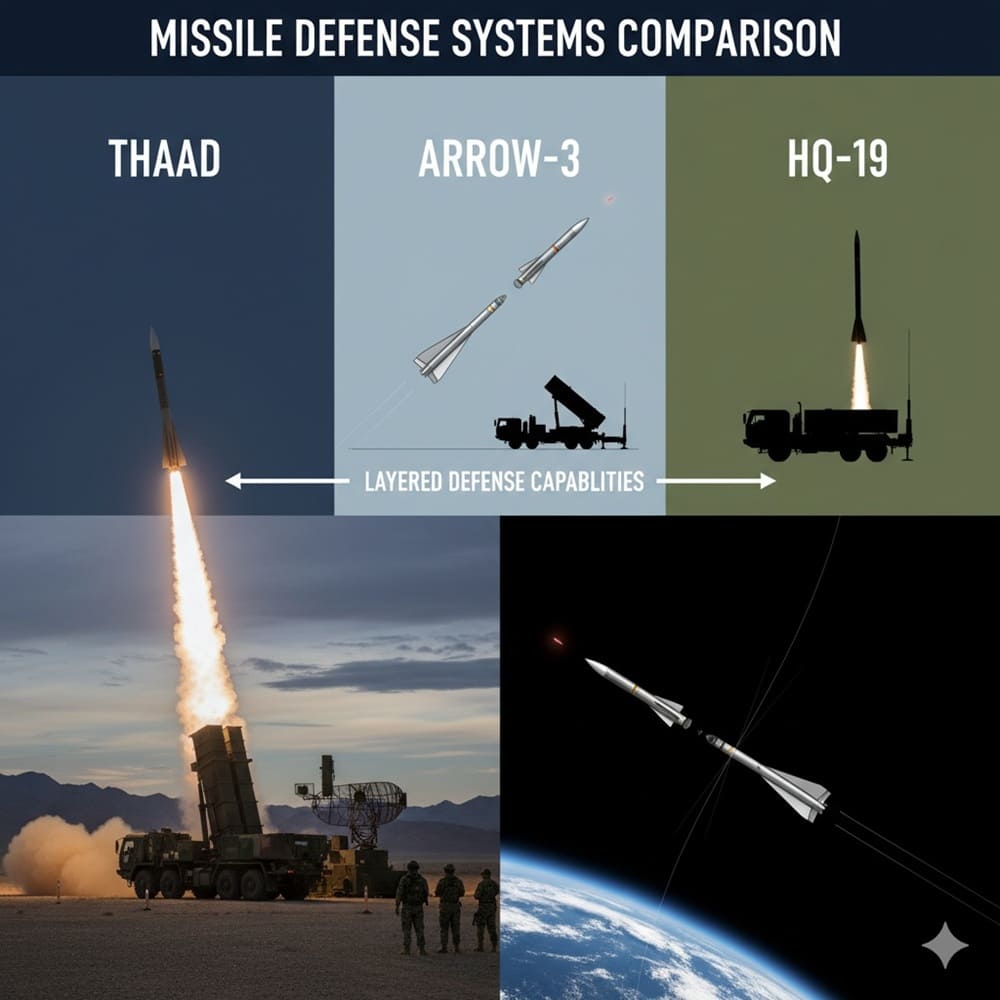
Arrow-3 works on a lower level than THAAD. Israel Aerospace Industries says that Arrow-3 is a two-stage interceptor that destroys its target on impact and protects a large area. The Missile Defense Advocacy Alliance also describes Arrow-3 as a system that intercepts missiles in space and was ready for use on 18 January 2017. This makes Arrow-3 much better at dealing with long-range ballistic missiles. It can hit threats earlier before they enter the atmosphere, which takes pressure off defense systems like David’s Sling, Patriot, or Iron Dome. The IAI ELTA Green Pine radar and battle management system help Arrow-3 track. Engage targets over a wide area.
Arrow-3 is also important for countries outside Israel. Reuters reported that Israel and Germany agreed to expand their deal in December 2025 making the total worth about $6.7 billion. Germany chose Arrow-3 because it worries about Russian missiles threatening its cities and critical infrastructure. However, defense systems like Arrow-3 that work in space face a challenge: telling targets apart from non-targets. In space, junk, fake targets, and other objects can move in various ways. So Arrow-3 needs sensors and battle management to decide which object to intercept. Arrow-3 needs to be able to make these decisions to be effective. The Arrow-3 system relies on this technology to work well.
HQ-19 Upper-Tier Defense
HQ-19 is not very open about how it works compared to others. China showed off the HQ-19 ballistic missile system on land at Air Show China 2024. The 2025 U.S. Department of Defense China report says HQ-19 can possibly intercept mid-course and glide vehicles. A 2020 U.S. Office of the Secretary of Defense fact sheet said the HQ-19 is effective at fighting Medium-Range Ballistic Missiles or MRBMs, and might get better at fighting longer-range missiles. Some analysts think HQ-19 is similar to THAAD. The Atlantic Council says HQ-19 is like HQ-9 but can hit missiles that go up to 3,000 km during midcourse and terminal phases.
They also say the HQ-19 has not shown it can hit Intercontinental Ballistic Missiles, or ICBMs. So experts are careful with their words: The HQ-19 seems to be China’s way to deal with missile threats that are high up, especially medium-range ballistic missiles, or MRBMs, and maybe Intermediate-Range Ballistic Missiles or IRBMs. However, we know little about the HQ-19’s radar, its effectiveness, China’s interceptors, or its actual deployment. Such uncertainty makes it difficult to compare to THAAD or Arrow-3.
S-500 Near-Space Defense
The S-500 Prometheus is Russia’s ambitious entry in this comparison. The Centre for Strategic and International Studies, or CSIS describes the S-500 Prometheus as a surface-to-air and missile defense system designed to counter aircraft, cruise missiles, and ballistic missiles, while it can also target low-orbit satellites. The S-500 Prometheus has a reported range of 500 to 600 kilometres. The S-500 Prometheus system is different from the S-300 and S-400 systems. The CSIS says the S-500 Prometheus can use the 40N6M missile for aircraft and cruise-missile roles, and the 77N6 and 77N6-N1 interceptors can target missiles or satellites. The CSIS also notes that the S-500 Prometheus has four radar vehicles per battery with reported detection ranges of up to 2,000 kilometres for targets and 800 kilometres for airborne targets.
Prometheus Extensively Tested
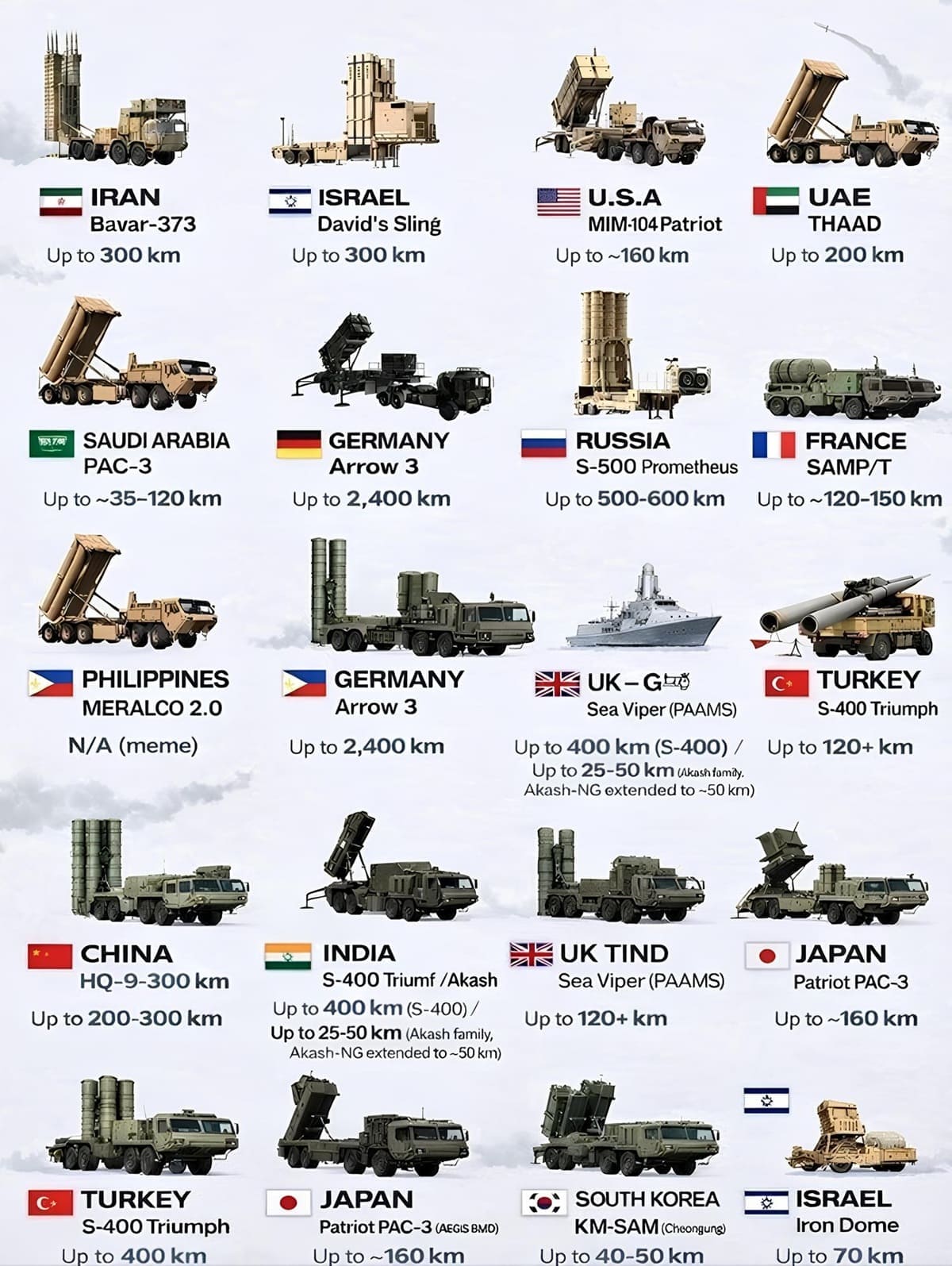
The Atlantic Council provides information about the S-500 Prometheus. It says the first S-500 Prometheus deployment went to the Moscow-area air and missile defense force in 2021. The S-500 Prometheus was previously tested at 481 kilometres, and its claimed flight ceiling is around 100 to 200 kilometres. The Atlantic Council also notes that the first operational version of the S-500 Prometheus reportedly has reduced capabilities. So the S-500 Prometheus may become a strategic layer, but analysts should not treat Russian claims about the S-500 Prometheus as fully proven. The real value of the S-500 Prometheus depends on production scale, radar survivability, integration with A-135 and A-235 defenses, and the number of 77N6-family interceptors for the S-500 Prometheus.
Ukraine’s Drone Strike Damages S-500
Ukraine did something in Crimea. They stopped Russia’s S-500 from working. They did this by hitting the 98L6 “Yenisei” radar. This radar is special. Radar is placed aside with the S-500 Prometey system. Ukraine did not destroy a launcher, but they did stop the radar from working. Ukraine’s HUR released a video that showed drones attacking radar sites. People who study these things found out that the target was the Yenisei radar.
This target is not the S-400 radar. The radar is important because it helps find and track things that are far away. It can see ballistic targets. Ukraine used relatively inexpensive drones to attack a crucial radar. This impaired Russia’s air defence. It indicated that very advanced systems can be less susceptible to damage from ones that can hit their targets precisely. Ukraine used drones to disable Russia’s S-500. This is a deal because the S-500 is a very advanced system.
Technical Comparison Table
| System | Country | Main Mission | Intercept Layer | Guidance System | Kill Method | Range | Altitude | Exports |
|---|---|---|---|---|---|---|---|---|
| THAAD | United States | Countermeasures to SRBM, MRBM and IRBM threats in terminal phase | Endo-atmospheric and exo-atmospheric terminal layer | AN/TPY-2 X-band radar, fire control system, IR seeker | Hit-to-kill kinetic impact | 150–200 km | Around 150 km often cited | UAE, Qatar approved; Saudi Arabia also approved/deploying THAAD-related systems |
| Arrow-3 | Israel / United States | Upper-tier defense against medium- and long-range ballistic missiles | Exo-atmospheric / space-layer interception | Ground radar, Arrow battle-management system, gimballed electro-optical seeker | Hit-to-kill kinetic kill vehicle | Up to 2,400 km estimated fly-out range | Exo-atmospheric, above 100 km | Germany confirmed |
| HQ-19 | China | Reported capability against ballistic missiles and hypersonic gliders | Reported high-altitude terminal / possible mid-course layer | Reported radar network; exact seeker and fire-control details not fully public | Reported kinetic hit-to-kill | Not officially confirmed; some estimates claim 1,000+ km | Reported 200+ km, unverified | No confirmed export. Pakistan links are still reported and speculative. |
| S-500 Prometey | Russia | Strategic Air and Missile Defence against Ballistic Missiles, Aircraft, Cruise Missiles and Potential Low Orbit Targets | High-altitude / near-space air and missile defense layer | Multi-radar network including acquisition and engagement radars; 77N6 interceptor family | Reported kinetic hit-to-kill for ballistic missile role | 500–600 km reported | Claimed 100–200 km | No confirmed export; India/China are cited as potential future buyers |
No System Is 100%
The math of missile defense is tough. If one interceptor can destroy a target 80% of the time, two interceptors make it 96% likely to work. That is really good. If one shot works 90% of the time, two shots make it 99% likely. However, using two interceptors at once means you have half as many left. That is why it matters how many interceptors you fire at once. A THAAD battery has 48 interceptors, which sounds like a lot. If many targets arrive simultaneously, using multiple interceptors at once can deplete them quickly. It can also take time to get more. The launchers need supplies and protection. An attack with big types of weapons can be difficult to defend against. It can force defenders to use up their interceptors.
Conclusion: Networks Beat Missiles
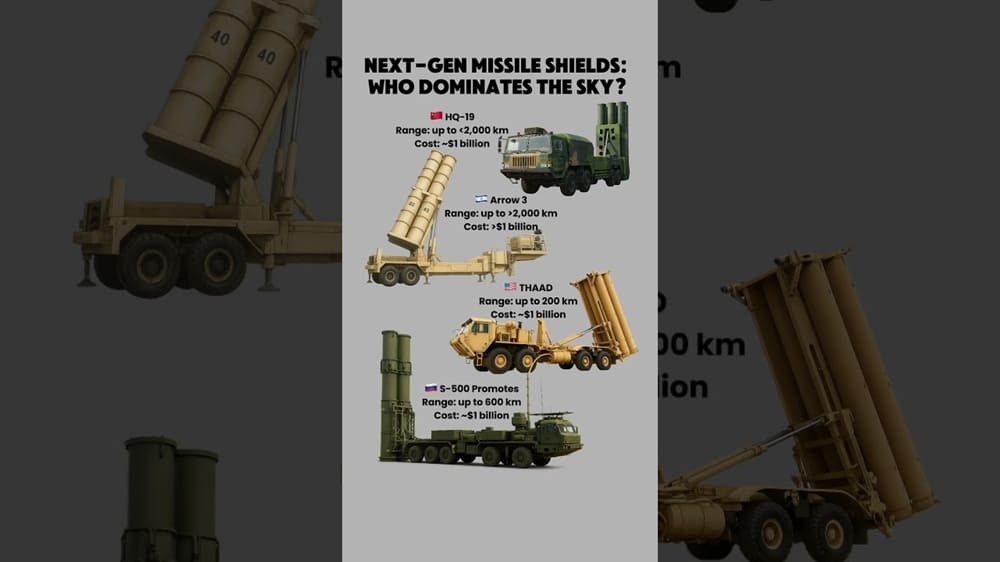
THAAD, Arrow-3, HQ-19 and S-500 are four approaches to the same problem. THAAD offers a proven shield that works well at altitudes. The Arrow-3 system adds a layer of protection in space to counter threats from a longer range. The HQ-19 system shows China’s progress in developing a regional missile defense that can reach high altitudes. The S-500 system represents Russia’s goal of combining air defense, missile defense and intercepting objects in space.
However, none of these systems can work effectively on its own. A strong defense requires a combination of early-warning satellites, long-range radars, reliable command networks, electronic protection, lower-tier interceptors, and regular battle drills. In today’s missile warfare, the best system is not the one that looks the best on paper. It is the one that still works properly after the attack. The key to a defense is not just one system but how well all the systems work together. THAAD, Arrow-3, HQ-19 and S-500 all have their strengths. They need to be part of a larger defense strategy. That is what makes a defense system truly effective.
References
- Congressional Research Service — THAAD system data.
- Israel Aerospace Industries / MDAA — Arrow-3 system data.
- U.S. Department of Defense / Atlantic Council — HQ-19 assessment.
- CSIS Missile Threat / Atlantic Council — S-500 assessment.
About the Author



2 thoughts on “THAAD vs Arrow-3 vs HQ-19 vs S-500: Limits”