

Anti-Satellite Weapons: Counterspace Systems Explained
Anti-satellite weapons have gone from Cold War experiments to today’s counterspace doctrine. States use these systems to deny, disrupt, degrade or destroy satellites supporting C4ISR, ISR, SATCOM, PNT, missile warning and nuclear command networks. Space is no longer a sanctuary of strategic protection but a military domain of contestation. The military logic was clear. Modern forces use satellites for targeting, navigation, communications, weather data and battlefield awareness. However, those satellites move in predictable ways. This creates an opportunity for adversaries to employ kinetic, electronic, cyber or directed-energy effects.
ASAT Interception Physics
Orbital mechanics shape every anti-satellite engagement. A satellite in low Earth orbit, or LEO, normally travels at about 7.8 km/s. Its circular orbital velocity follows:
[v_{orbit}=\sqrt{\frac{\mu}{r}}]
Here, (\mu) means Earth’s gravitational parameter, while (r) means orbital radius. Because orbital velocity is so high, even a small interceptor can produce significant destructive energy.
The basic kinetic energy formula is:
[E_k=\frac{1}{2}mv^2]
For example, a 20 kg kill vehicle impacting at 10 km/sec delivers almost (1 \times 10^9) joules. That’s roughly 100kg TNT. Therefore, many ASAT systems depend on hit-to-kill physics, not explosive warheads.
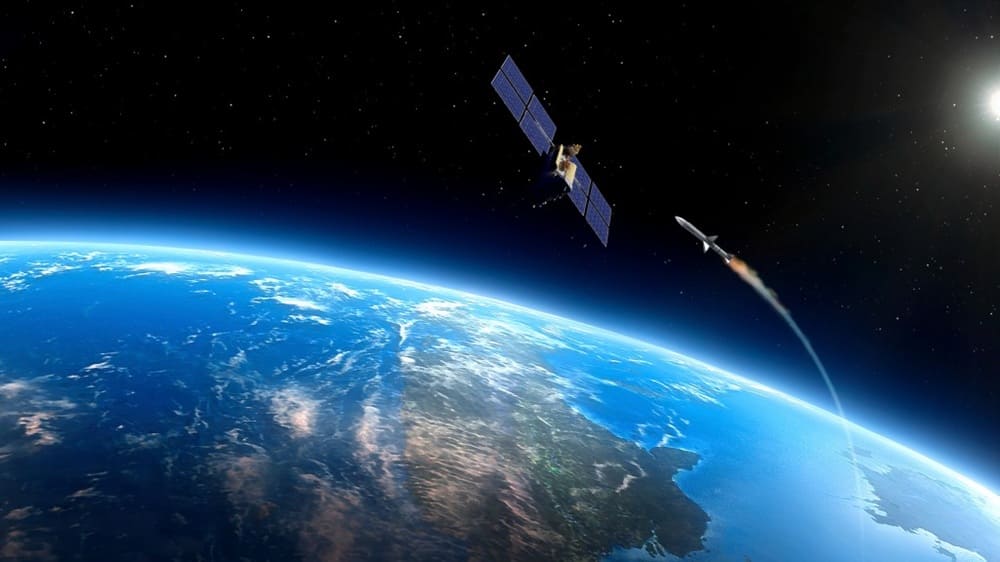
Types of ASAT Systems in the World
| ASAT weapon name | Country | Active / Experimental | Range / Altitude | Warhead / Guidance |
|---|---|---|---|---|
| ASM-135 ASAT | United States | Retired / tested | 555 km intercept altitude | Kinetic kill vehicle / IR guidance |
| SM-3 / Burnt Frost | United States | Active missile family / ASAT demonstrated | 270 km intercept altitude | LEAP kinetic warhead / hit-to-kill |
| SC-19 | China | Demonstrated / likely developed further | 850+ km intercept altitude | Kinetic kill vehicle / terminal homing |
| PDV Mk-II / Mission Shakti | India | Demonstrated / experimental | ~300 km intercept altitude | Kinetic kill vehicle / hit-to-kill |
| PL-19 Nudol | Russia | Demonstrated / status unclear | LEO: exact range unclear | Kinetic DA-ASAT interceptor |
| Istrebitel Sputnikov / IS | Soviet Union | Retired / tested | ~100–2,300 km | Fragmentation warhead / co-orbital guidance |
| Naryad-V | Soviet Union / Russia | Experimental / unclear | Not publicly confirmed | Suspected co-orbital interceptor |
| Peresvet | Russia | Active / role unclear | Not disclosed | Laser dazzling / directed energy |
| Tirada-2S | Russia | Active / reported | Not disclosed | SATCOM jamming / electronic attack |
Direct-Ascent ASAT Systems
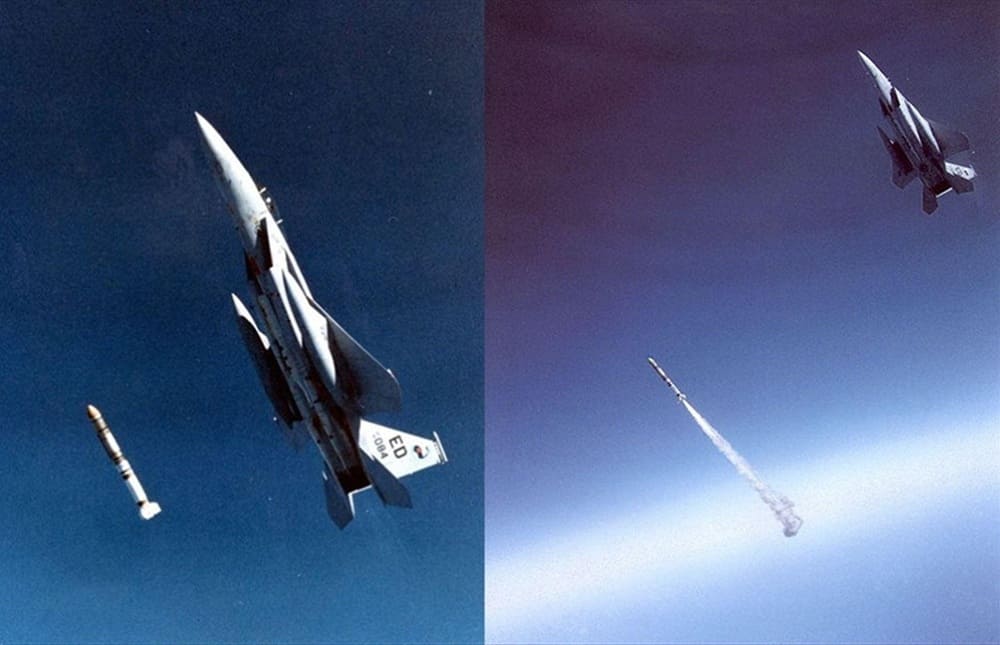
Direct-ascent anti-satellite weapons are fired from Earth and intercept a spacecraft on a suborbital or near-orbital trajectory. Systems of this type include space surveillance, target tracking, fire-control computation, mid-course guidance and terminal homing. The closest analogy to defence is ballistic missile defence interceptors, which are modified for counterspace missions. In 1959, the United States experimented with early concepts with Bold Orion. It later developed the ASM-135 ASAT, fired from an F-15A Eagle. In 1985 a missile blew up the Solwind P78-1 satellite, about 345 miles up. The test proved that a kinetic kill vehicle launched from an aircraft could strike and destroy a satellite.
In 2008, the United States used an altered version of the RIM-161 Standard Missile-3 in Operation Burnt Frost. The missile struck the USA-193 satellite before it could re-enter the atmosphere. Washington described the mission as a safety operation, but it was a demonstration of a naval exo-atmospheric intercept capability. China joined the ASAT club in 2007, when a SC-19-type killer destroyed the Fengyun-1C weather satellite at an altitude of about 850–865 km. Then, in 2021, Russia demonstrated the PL-19 Nudol system in action against Cosmos 1408. In 2019, India responded with Mission Shakti, intercepting Microsat-R with a PDV Mk-II-derived interceptor at an altitude of about 300 km.
Co-Orbital ASAT Weapons
Co-orbital systems work differently. Instead of coming directly from Earth, they go into orbit first. Then they perform rendezvous and proximity operations, or RPO, close to a target satellite. This class can collide with a target, release fragments, interfere with sensors or manipulate the satellite physically.
Their manoeuvre potential depends on delta-v. Engineers often express this capability through the rocket equation:
[\Delta v = I_{sp}g_0\ln\left(\frac{m_0}{m_f}\right)]
The Soviet Union pioneered this category with the Istrebitel Sputnikov, or “satellite destroyer” programme. The legacy of the Polyot and IS-series became evident in the 1960s and matured in the following Cold War tests. These systems would approach a target and use fragmentation effects rather than pure direct collision. Today, co-orbital systems represent a serious attribution problem. A satellite inspection vehicle can assist with peaceful servicing, diagnostics and debris inspection The same spacecraft, however, can also damage antennas, blind sensors, interfere with propulsion lines or intentionally collide with a target. This dual-use behaviour complicates strategic warning
Directed-Energy Counterspace Systems
Directed-energy anti-satellite weapons employ either a laser or high-power microwave system to affect a satellite without physical impact. They can blind imaging payloads, blind optical sensors or damage sensitive electronics. Ground-based lasers contend with atmospheric turbulence, absorption, beam spreading and line-of-sight restrictions.
Beam divergence follows this simplified diffraction relationship:
[\theta \approx 1.22\frac{\lambda}{D}]
Here, (\theta) is the beam divergence, (\lambda) the wavelength and (D) the diameter of the aperture. A shorter wavelength and a larger aperture can help to focus the beam. In practice, clouds, aerosols and the limitations of adaptive optics degrade performance. In the 1990s, the United States tested the MIRACL laser against a satellite-related target. Russia has associated the Peresvet laser system with strategic counterspace missions. China has also developed ground-based laser-dazzling systems. These tools have reversible and deniable effects, particularly against electro-optical reconnaissance satellites.
EW in Counterspace Warfare
Electronic warfare systems are often the most usable counterspace option. They don’t have to blow up a satellite. Instead, they attack uplinks, downlinks, telemetry, GNSS signals and SATCOM channels. Jamming denies communications and spoofing feeds false signals to receivers.
A simplified jammer-to-signal relationship is the following:
[J/S \propto \frac{P_jG_jR_s^2}{P_sG_sR_j^2}]
In this model, (P) means power, (G) means antenna gain and (R) means range. Military EW units use these relationships to estimate link denial, burn-through distance and signal vulnerability. One often hears about Russia’s Tirada-2S as a system for jamming satellite communications. Others employ mobile GNSS jammers, SATCOM denial systems and cyber tools against ground stations. Cyber ASAT operations also can target mission-control networks, software supply chains, command authentication and telemetry databases.
Assessment
Kinetic anti-satellite weapons send a clear deterrent signal but pose serious orbital debris risks. China’s Fengyun-1C test in 2007 created one of the largest debris fields in space history. The 2021 Russian Cosmos 1408 test generated more than 1,500 trackable debris objects. These fragments imperil satellites, human spaceflight and commercial constellations. The debris problem ties ASAT weapons to Kessler syndrome.
Spacecraft at orbital velocity can be disabled by centimetre-sized fragments. This means that one destructive test can increase the risk of collision for years. Reversible methods are likely to be favoured in future counterspace warfare. Cyber intrusion, electronic attack, laser dazzling and co-orbital inspection have lower political cost than debris-generating intercepts. Yet hard-kill ASAT systems will still be important symbols of strategic power.
References
- https://www.swfound.org/publications-and-reports/2026-global-counterspace-capabilities-report
- https://aerospace.csis.org/aerospace101/counterspace-weapons-101/
- https://www.armscontrol.org/act/1997-10/press-releases/us-test-fires-miracl-satellite-reigniting-asat-weapons-debate
- https://www.armscontrol.org/act/2007-03/chinese-satellite-destruction-stirs-debate
- https://www.popularmechanics.com/military/weapons/a32173824/nudol-missile-anti-satellite/
- https://www.spacecom.mil/Newsroom/News/Article-Display/Article/2842957/russian-direct-ascent-anti-satellite-missile-test-creates-significant-long-last/
- https://www.whiteeagleaerospace.com/bold-orions-asat-mission/
- https://defensenewstoday.info/defense-news/cyber-security-ai/
About the Author




I really like your blog.. very nice colors & theme.
Did you create this website yourself or did you
hire someone to do it for you? Plz reply as I’m looking to construct my own blog and would like to find out where u got this from.
appreciate it