Western vs Eastern Tank Design Philosophies
Main battle tanks are a lot more than just competing mixes of armour, fire power and mobility. Their architecture is a function of national doctrine, geography, industrial capacity, manpower policy and expected operational tempo. Thus, the well-known ‘Western’ and ‘Eastern’ tank divisions represent two traditions of engineering rather than two geographical categories.
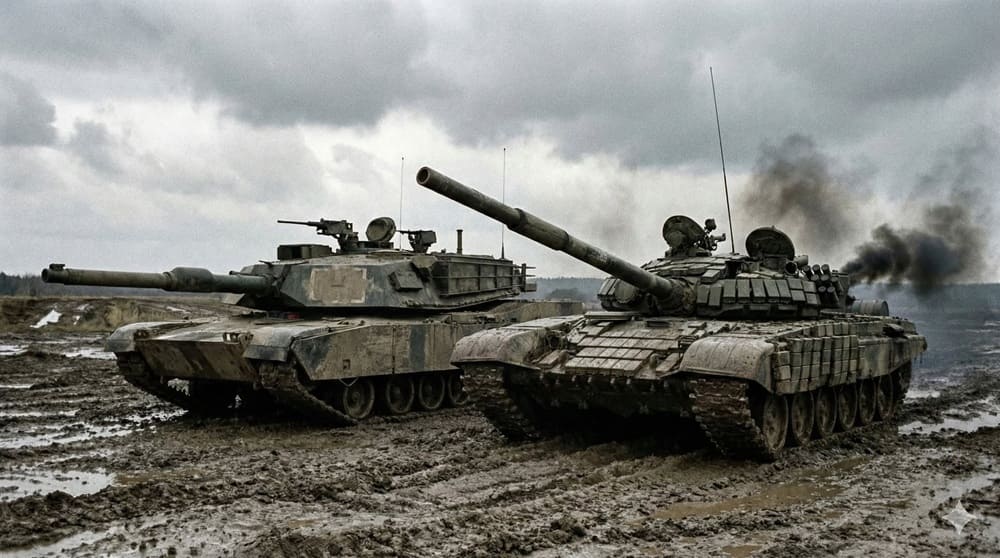
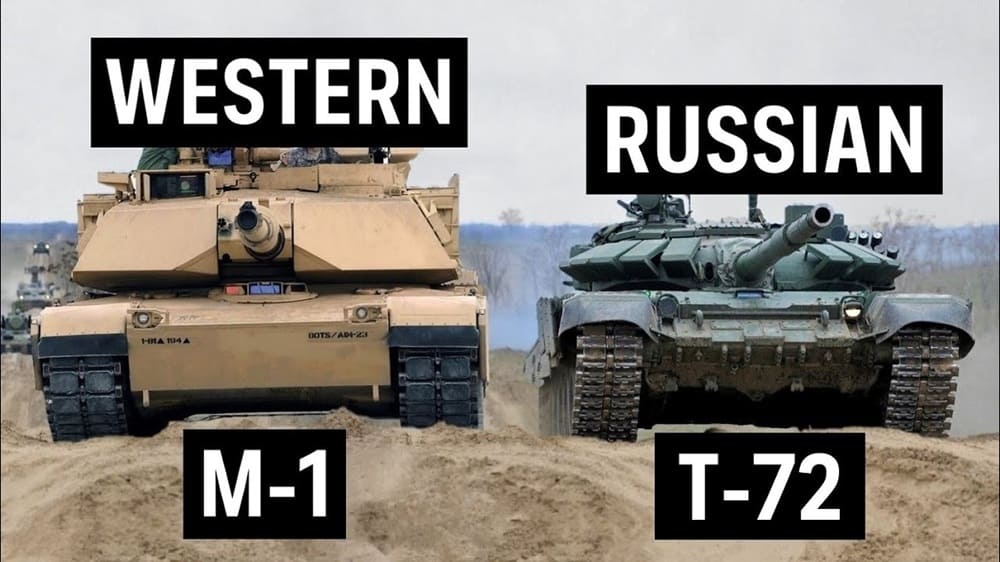
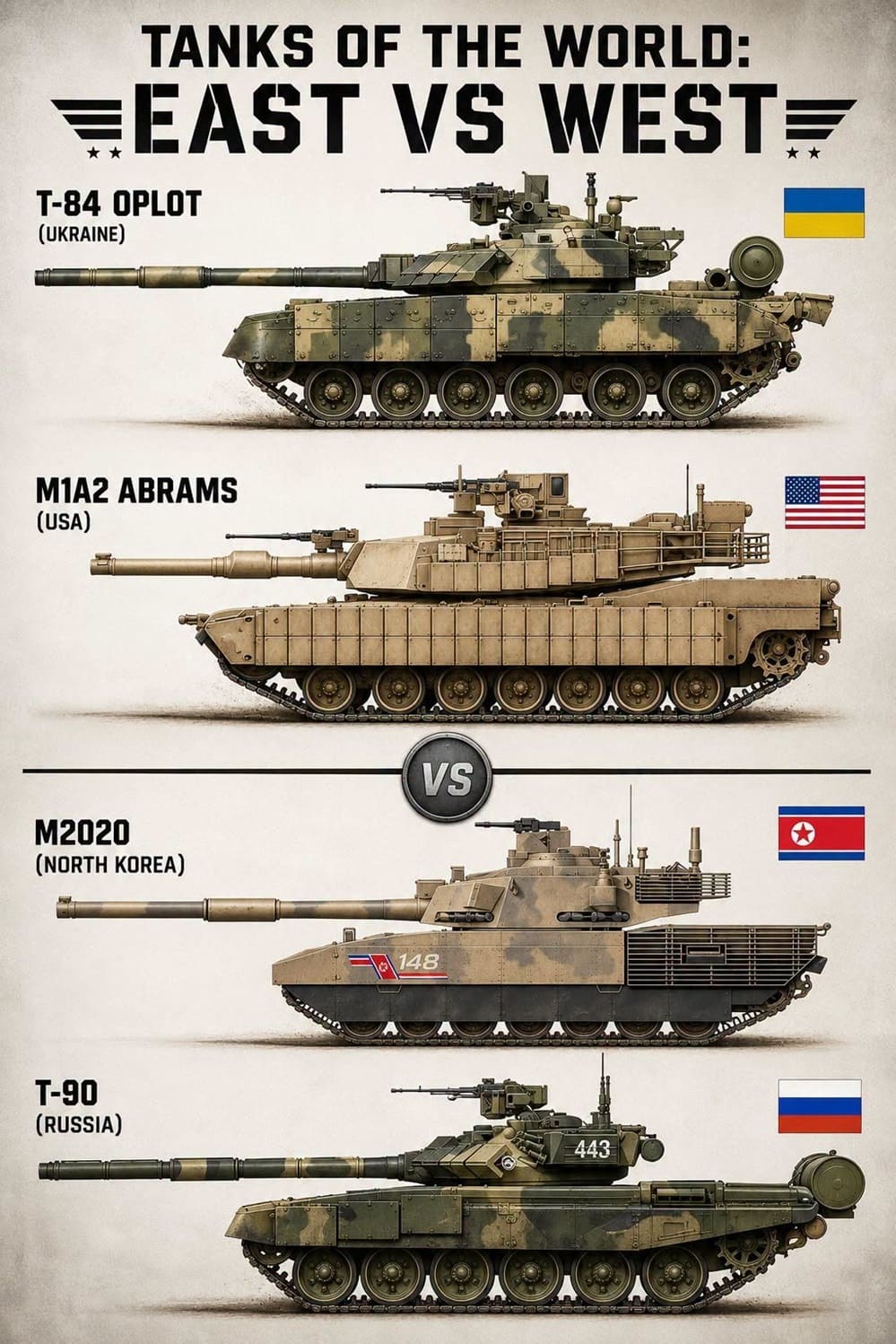
Western tanks like the M1 Abrams, Leopard 2 and Challenger families tend to focus more on crew survivability, sensor performance and sustained tactical effectiveness. The T-64, T-72, T-80 and T-90 are Soviet and Russian tanks emphasising compactness, operational mobility, ease of production and numerical concentration. Neither philosophy will produce a bullet-proof tank. Each carries different risks.
The Protected-Volume Problem
The tank’s armouring is essentially a volume problem. The larger the internal crew compartment, the larger the area of surface that needs protection. That increases the mass, which in turn requires a bigger engine, beefier suspension, and a heavier gearbox. Soviet engineers reduced protected volume by replacing the human loader with an automatic loader. The three-man turret allowed for a smaller hull and turret, which in turn reduced the overall weight. The T-90MS is said to weigh some 48 tonnes and have a crew of three.
It is claimed to reach a maximum speed of 70km/h. By comparison, the Leopard 2A7V weighs just under 69 tonnes and has 1,500 horsepower. It is travelling at 70 kilometres per hour but needs much more transport and recovery capacity. The difference is a tale. The engineers of the East achieved mobility through compactness. Western engineers just poured more engine power into moving a bigger, more heavily protected vehicle.
| Design characteristic | Western approach | Soviet/Russian approach |
|---|---|---|
| Typical combat mass | 60–75 tonnes | 42–50 tonnes |
| Standard crew | Four personnel | Three personnel |
| Main armament | 120 mm, usually manually loaded | 125 mm with autoloader |
| Ammunition | Mostly unitary rounds | Separate projectile and propellant. |
| Protection priority | Crew survival and ammunition isolation | Small frontal profile and concentrated armour |
| Internal volume | Comparatively large | Extremely compact |
| Operational concept | Qualitative overmatch | Massed, mobile formations |
| Logistical demand | High | Comparatively lower |
Ammunition Layout Defines Survivability
Most Westerners store their ready ammunition in an armoured turret-bustle compartment. Sliding doors separate the ammo from the crew. If enemy fire ignites the propellant, roof-mounted blow-off panels direct the explosion away from the fighting compartment. It is not intended as a survival guarantee, but it can turn a catastrophic destruction into a recoverable vehicle and surviving crew. The Soviet carousel autoloader, which holds 22 rounds under the turret, stores the projectiles and propellant charges close to the crew.
This arrangement reduces the turret height and the number of personnel required while also providing a fairly regular loading cycle. However, any tear in the hull side or roof can set off exposed propellant. In Chechnya, Iraq and Ukraine, violent turret blowouts have occurred from rapid ammunition deflagration or detonation. The autoloader doesn’t “throw” the turret. The pressure of the gases produced from the burning of the ammunition exceeds the structural limits of the turret ring.
The danger was known to the Russian designers. The T-90M featured additional protected ammunition stowage in the turret bustle, improved fire-suppression systems and Relikt explosive reactive armour. However, the carousel remains in the fighting compartment. The original tight architecture is kept, and the engineers have a limited range of movement regarding the crew. According to RUSI’s technical assessment, the design is an intentional engineering compromise, not a defect.
Firepower and Crew Load
Western 120mm guns generally use single-piece ammunition. A trained loader could shoot fast at first, maybe 8 to 10 rounds per minute. Performance decreases with fatigue, violent manoeuvres and injury. But the loader also watches, keeps, secures and manages the ammo. Russian 125mm systems use separate projectiles and separate propellant charges.
The autoloaders generally provide a repeatable loading cycle while on the move, although the timing may be affected by the position of the selected round in the carousel. The system reduces manpower but leaves only three soldiers to do track repairs, refuelling, observation and security. Western design has nothing against autoloaders. The Leclerc of France, the K2 of South Korea and the Type 10 of Japan all have automatic loaders but still offer a relatively sophisticated level of crew protection.
So the real difference is not between “manual” and “automatic” systems. The question is whether ammo is segregated from people. Gun performance is also a function of fire-control computation, barrel condition, stabilisation and ammunition quality. A bigger calibre does not mean a better penetration. Modern armour-piercing fin-stabilised discarding sabot rounds are dependent on penetrator length, material, impact velocity and geometry of the target armour.
Sensors and Command Doctrine
Western tanks have had stabilised panoramic commander sights, independent thermal channels, laser rangefinders and digital battlefield networks for decades. These systems can facilitate hunter-killer engagements, where the commander is looking for the next target, while the gunner is firing on the current one. The original Soviet doctrine had aimed for more centralised control of tank formations.
Individual vehicles could therefore have communications and observation equipment that is less sophisticated. There is much tech convergence here, with modern T-90M and T-90MS designs bringing more and more panoramic sights, thermal imaging and digital communications. The four-person Western crew also spreads the cognitive load more evenly. The loader assists with observation and allows the commander to concentrate on tactical command. In a three-man tank, casualties or equipment failures can easily outnumber the remaining crew.
The Cost of Western Protection
Heavy armour is just as vulnerable as the enemy’s weapons. Bridges, railroads, transporters and recovery vehicles become limiting factors. However, a public review by the U.S. Army Science Board found that the weight of the M1A2 negatively affected tactical and operational mobility. Its terrain modelling indicated that a combat-loaded M1A2 could not realistically conduct manoeuvre warfare in the selected Latvian study area.
In the studied Lithuanian terrain, operations were possible only under dry conditions. The study also showed an average distance to failure of about 200 miles and warned that refuelling could put entire formations within the range of enemy fire. Some of the analysis in the engagement range was classified, but the mobility results were declassified.
The unclassified assessment shows maximum protection against deployability. The Eastern approach exhibits the opposite trade-off. A 48-tonne tank can cross more bridges, requires lighter recovery equipment and uses less railway capacity. The lower mass allows an army to spread more vehicles around a theatre. But the advantage of easier replacements only occurs when trained crews and repair systems are still available.
Case Study: 73 Easting
The Battle of 73 Easting, fought 26 February 1991, appears to vindicate Western tank design. Poor visibility meant that many Iraqi crews did not know the direction of the attack until U.S. M1A1 Abrams and M2 Bradley crews could see and fire at Iraqi armoured vehicles. But the engagement was not an apples-to-apples comparison of similar tanks. Iraqi T-72s had inferior ammunition, sights and training compared to elite Soviet units.
Better reconnaissance, communications, artillery and air support also gave the Coalition forces an edge. The decisive advantage lay in the total combat system: thermal observation, stabilised firepower, mission command, crew proficiency and combined arms coordination. The battle showed that a tank’s performance is inseparable from the formation using it.
Ukraine Blurs Design Categories
Ukraine has exposed the shortcomings of both philosophies. Soviet tanks have suffered catastrophic ammunition fires when penetrated on the top and sides. Western vehicles have generally been better on crew survivability, but their weight makes recovery after mine strikes or mobility kills difficult. Now drones, mines, artillery and top-attack missiles go around the heavily protected forward arc.
Even for active-protection systems, intercepting capacity is limited, and electromagnetic signatures can be exposed. Future tanks must therefore be lightweight, have isolated ammunition, be multispectrally camouflaged, and have electronic warfare and counter-drone protection.
The most successful future design will no doubt be a synthesis of both traditions: Western crew protection, sensor fusion and decentralised command, plus Eastern compactness and strategic mobility. The real battle is no longer East versus West. The distinction lies between tanks designed as isolated gun platforms and those designed as survivable nodes within a networked combined arms force.
References
- KNDS — Leopard 2A7 Technical Specifications
- Rosoboronexport — T-90MS Main Battle Tank
- U.S. Army Science Board — Next Generation Armour/Anti-Armour Strategy
- RUSI — Technical Reflections on Russia’s Armoured Fighting Vehicles
About the Author