

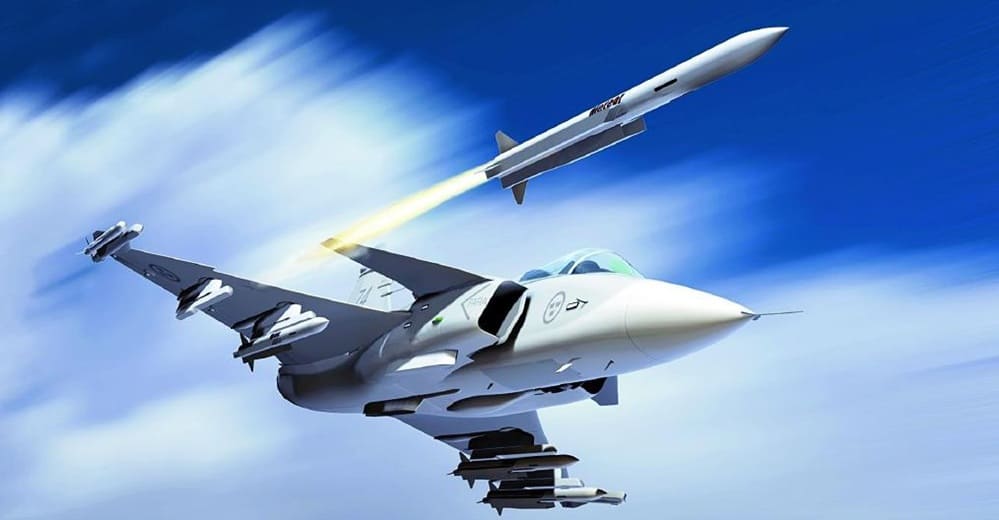
A BVR missile No-Escape Zone
For the vast majority of the public, the lethality of a beyond-visual-range (BVR) missile is distilled into a single headline figure – “110 km range” or “160 km range” – on a fact sheet and regurgitated uncritically in air show brochures. Any fighter pilot, weapons officer or tactics instructor will tell you that number means nothing in itself. What actually decides whether a missile kills or misses is called the No-Escape Zone (NEZ). It is the envelope in which the target cannot outmanoeuvre or outrun the missile’s residual kinetic energy. Maximum range does not separate real tactical assessment from marketing literature; it is NEZ.
How to Compare BVR Missiles
You can’t judge a better BVR missile on its max range. The advertised number is usually how far it can go in perfect conditions, not how it performs against a fighter that turns, dives, jams or runs away. The first factor to compare is the no-escape zone, which shows the distance at which the target has little chance of avoiding the missile. Compare speed, altitude performance, type of motor, and amount of energy retained by the missile near the target. And guidance is key.” For the modern seeker with secure data links and a good resistance to electronic jamming, a few more kilometres of range may be of less account.
The launch aircraft also must be able to accurately detect, track and update the target, so radar quality and aircraft integration matter for the missile’s real performance. You also need to look at reliability, warhead effectiveness, reaction time and combat testing. Finally, the two missiles are compared under the same conditions, including launch altitude, target speed and direction, and defensive manoeuvres. In reality, the best missile isn’t necessarily the one that can go the farthest. It is the one that reaches the target with sufficient speed, accurate guidance, high jamming resistance and a better chance of killing it.
Four Bands, Not One Number
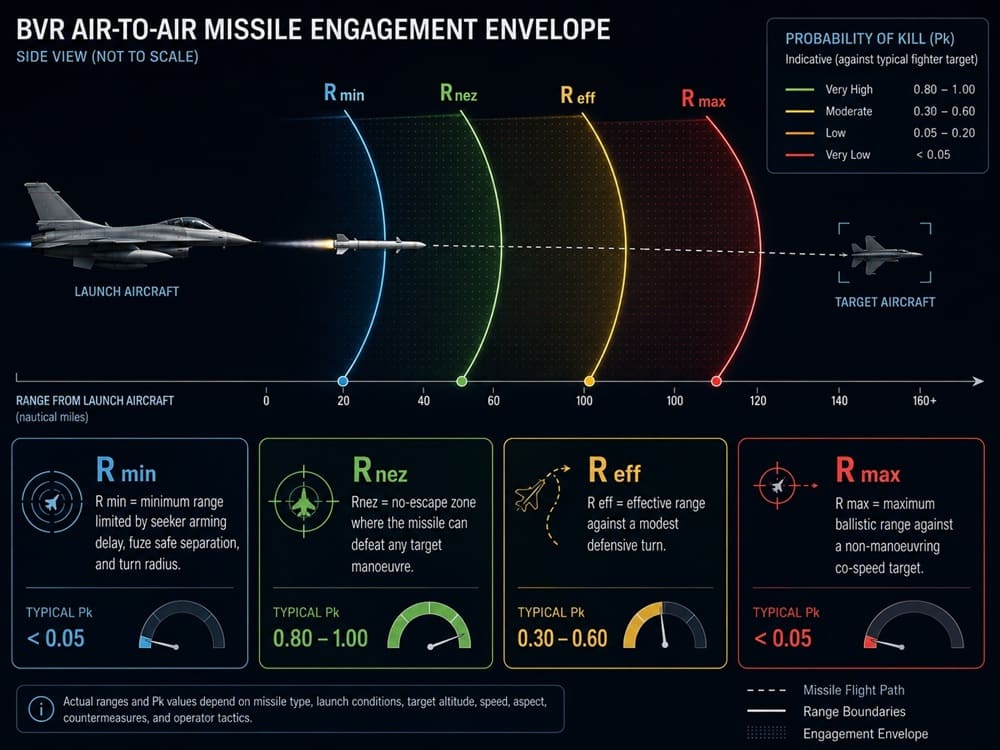
A BVR missile’s engagement envelope is conventionally divided into four bands:
- R max (maximum/ballistic range): The distance the missile can travel in a purely ballistic flight against a non-manoeuvring, co-speed target with no defensive reaction This range is the figure usually quoted in open literature and is in itself of almost no tactical significance.
- R eff (maximum effective range): The distance at which the missile still possesses sufficient terminal energy (airspeed and manoeuvrability) to intercept a target performing a moderate defensive manoeuvre but with a substantially reduced Pk.
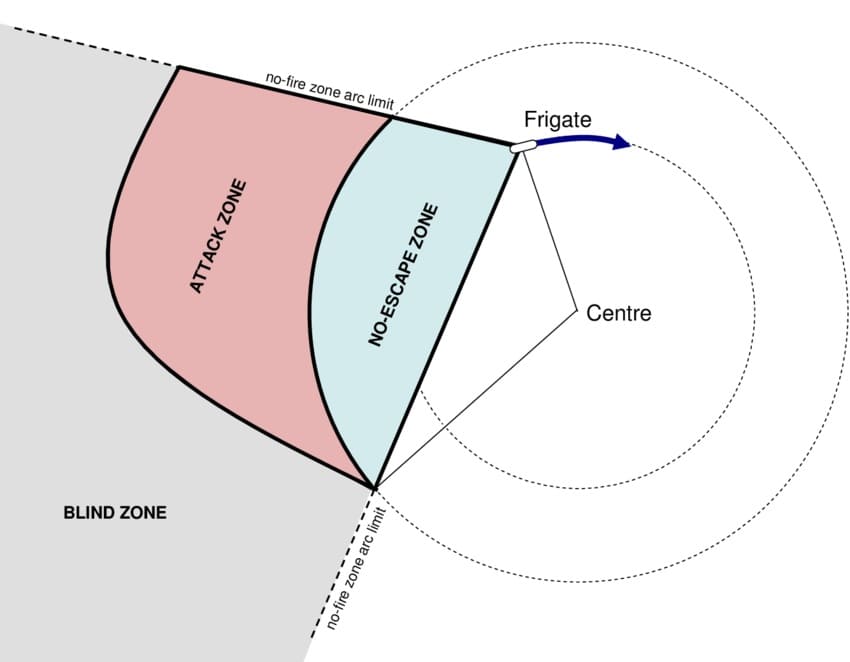
- Rnez (no-escape zone): The range band within which the missile has sufficient terminal velocity, available normal acceleration (g) and seeker track margin to defeat any target manoeuvre, including a maximum performance break turn or notch. Open aerospace engineering literature generally models Pk within the true NEZ to be in the 0.7–0.9+ range versus below 0.2–0.3 near R max.
- R min (minimum range) is the inner boundary set by the seeker arming delay, fuze safe separation distance, and minimum turn radius of the missile, within which intercept geometry is physically impossible.
Therefore, the NEZ is not a fixed radius. It changes with the missile’s terminal kinematics and the target’s motion at interception. Open-source estimates for modern active-radar missiles include the AIM-120D, Meteor, R-77M, and PL-15. In head-on, co-altitude engagements, their NEZ is estimated at roughly 35–50 per cent of maximum range. In tail-chase or beam geometries, this ratio may fall below 20 per cent. Therefore, a missile advertised with a 160-kilometre maximum range may offer a 55–70-kilometre NEZ. This scenario applies against a manoeuvring, radar-warning-equipped fighter that reacts quickly.
The Physics: Why NEZ Shrinks Faster Than Rmax
A single- or dual-pulse solid rocket motor will normally burn for 3 to 6 seconds after launch. When the motor burns out, a rocket-motor missile begins to lose energy. For the remainder of the missile’s flight, drag (proportional to the square of the velocity) and gravity are constantly sapping the missile’s budget of kinetic and potential energy. By the time the missile has travelled 70-80% of its R max, it may be well below corner velocity and unable to generate the 25-40 g instantaneous turn rates needed to run down a target that is pulling a 6-9 g defensive break turn.
So Rmax and Rnez are entirely unique. Rmax is a measure of range, and Rnez is a measure of energy state. Two missiles with very different Rnez can achieve the same Rmax depending on the type of sustainer: single-pulse rocket, dual-pulse rocket, or dual-pulse rocket vs air-breathing ramjet/scramjet.
- Launch platform energy state — altitude, Mach number, and closure velocity at launch.
- Engagement geometry — target aspect angle at the moment of intercept.
- Target countermeasures include notching, chaff, jamming-induced seeker reacquisition delay, and altitude/vertical manoeuvres.
Three Engagement Phases
The missile accelerates from launch speed (often Mach 0.8–1.2 from the launching aircraft) to a peak of roughly Mach 4 for a solid dual-pulse design before burnout. Thereafter, it is an unpowered glide vehicle, continuously shedding energy to aerodynamic drag and to any manoeuvring demanded of it by the seeker. This produces three distinct engagement phases:
- Boost/mid-course phase — the missile is under inertial or data-link guidance, often supported by the launching aircraft’s radar or an AWACS track, conserving fuel and flying an energy-efficient climb-and-glide profile.
- Pitbull/active phase — the seeker goes active, typically between 15 and 20 km from the predicted intercept point, and the missile transitions to terminal homing.
- Terminal manoeuvre phase — if the target manoeuvres, the missile must pull lead-pursuit or proportional-navigation corrections, each of which costs airspeed disproportionately, as drag scales with the square of both velocity and angle of attack.
A missile that arrives at Pitbull with only Mach 1.2–1.5 of residual energy has very little margin left to correct for a severe 6–8 g defensive break. This phenomenon is precisely why R_nez shrinks so aggressively with range: the missile is not just travelling farther but also arrives with progressively less energy to spend on manoeuvring.
The F-Pole and the Defender’s Countermove
Defensive tactics often centre on the F-pole, which is the distance created when the target turns away after launch. The target may also notch perpendicular to the missile’s approach, forcing a longer and more energy-intensive intercept. Pilots time this manoeuvre to be close to the missile seeker’s expected active acquisition point. This can push the intercept beyond the missile’s remaining energy envelope, turning a no-escape shot into a clean miss.
Altitude therefore receives heavy emphasis in BVR combat. At 40,000 feet, air density is roughly 28 per cent of sea-level density. A missile launched high retains more kinetic energy because thinner air creates less drag. Therefore, its no-escape range against a high, fast target may nearly double. Against a low-altitude, subsonic target, the same missile loses energy much faster. Weapons instructors often consider altitude the single most important factor shaping engagement geometry. It can matter more than the missile type itself.
Seeker Basket and Guidance Corrections
The practical NEZ is further reduced by the terminal seeker’s field of view, which open literature cites as approximately 45-60 degrees of gimbal limit for modern active radar seekers. A target that demands a large off-boresight correction late in the engagement effectively drains energy the missile no longer has to spare, especially past the halfway mark of R_max.”
Statistical Reality Check
Based on open post-conflict assessments of engagements over the last three decades, historical BVR employment data has consistently shown that the vast majority of successful BVR kills occurred well within the theoretical R_max, typically in the 40-60% range, reaffirming that R_nez, not R_max, is the operationally relevant figure. The steep fall-off in Pk (probability of kill) curves in unclassified RAND and IISS assessments also illustrates the non-linear nature of the energy-bleed problem, often showing a drop from >80% Pk near R_nez to <20% Pk near R_max, rather than a linear decline.
Top 5 BVR Missiles
| Missile name | Country | Company | Maximum range | Guidance | Engine | Year of induction |
|---|---|---|---|---|---|---|
| AIM-120 AMRAAM | United States | Hughes originally; Raytheon/RTX currently | Around 160 km for AIM-120D; official range classified | Inertial navigation, mid-course datalink and terminal active-radar homing | Solid-fuel rocket motor | 1991 |
| R-27ER Alamo-C | Soviet Union/Russia | Vympel, now part of KTRV | Up to 130 km, depending on launch conditions | Inertial navigation, radio updates and terminal semi-active radar homing | Solid-fuel rocket motor | 1987 |
| Meteor | European multinational programme | MBDA-led consortium | Beyond 100 km officially; precise range classified | Inertial navigation, two-way datalink and terminal active-radar homing | Variable-flow solid-fuel ducted ramjet | 2016 |
| PL-15/PL-15E | China | AVIC Air-to-Air Missile Research Institute | Around 200 km for PL-15; 145 km for PL-15E | Inertial and satellite navigation, datalink and terminal active-radar homing | Dual-pulse solid-fuel rocket motor | Around 2016 |
| R-37M Axehead | Russia | Vympel NPO, part of KTRV | Reportedly 300–400 km; export RVV-BD rated at 200 km | Inertial navigation, mid-course datalink and terminal active-radar homing | Dual-pulse solid-fuel rocket motor | 2019 |
The Tactical Takeaway
The no-escape zone turns BVR missile capability from a single range figure into a multidimensional performance measure. It depends on propulsion physics, launch energy, and engagement geometry. Missile marketing has long exploited the gap between maximum range and the no-escape zone. However, this gap is shrinking as developers adopt ramjets and dual-pulse rocket-ramjet hybrids. Sensor fusion also enables earlier launches from higher-energy conditions.
This has direct implications for fighter tactics, cockpit decision-making and the wider BVR force employment calculus. However, the defense geek’s lesson is simple: missile range specs alone are a poor proxy for lethality. It’s never just about how far it can fly. what is the physical distance the target can’t get out of? That number is the actual currency of modern BVR combat – silent, rarely published and highly geometry-dependent. That’s why fighter tactics are so much about managing energy and geometry as they are about the missile.
References
- Alkaher, David, and Amiram Moshaiov. “Dynamic-Escape-Zone to Avoid Energy-Bleeding Coasting Missile.” Journal of Guidance, Control, and Dynamics, Vol. 38, No. 10, 2015. Explains how an unpowered missile loses energy and how escape zones change dynamically during an engagement.
- Kaplan, Joseph A., Alan R. Chappell, and John W. McManus. “The Analysis of a Generic Air-to-Air Missile Simulation Model.” NASA Technical Memorandum 109057, 1994. Examines missile fly-out modelling, target manoeuvres, closing rates, guidance, propulsion and engagement geometry.
- MBDA. “Meteor Beyond Visual Range Air-to-Air Missile.” MBDA states that Meteor’s ramjet maintains thrust towards interception, increasing terminal energy and enlarging its No-Escape Zone.
- NASA. “U.S. Standard Atmosphere 1976.” Provides authoritative atmospheric-density data supporting the relationship between altitude, aerodynamic drag and missile energy retention.
About the Author


Wow great analysis