

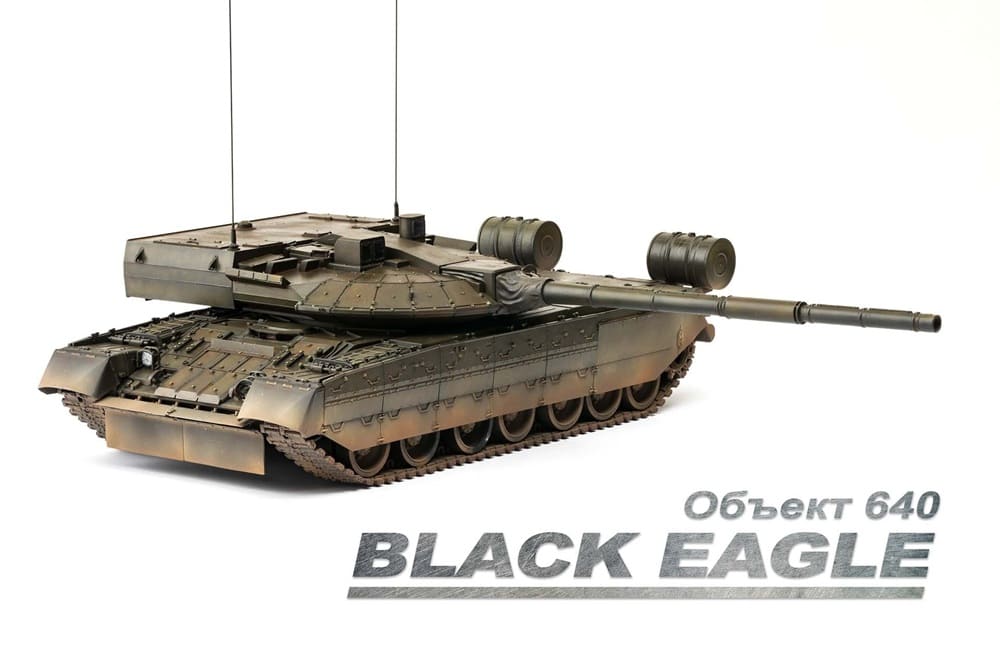
Object 640 Black Eagle: Russia’s Tank That Never Took Flight
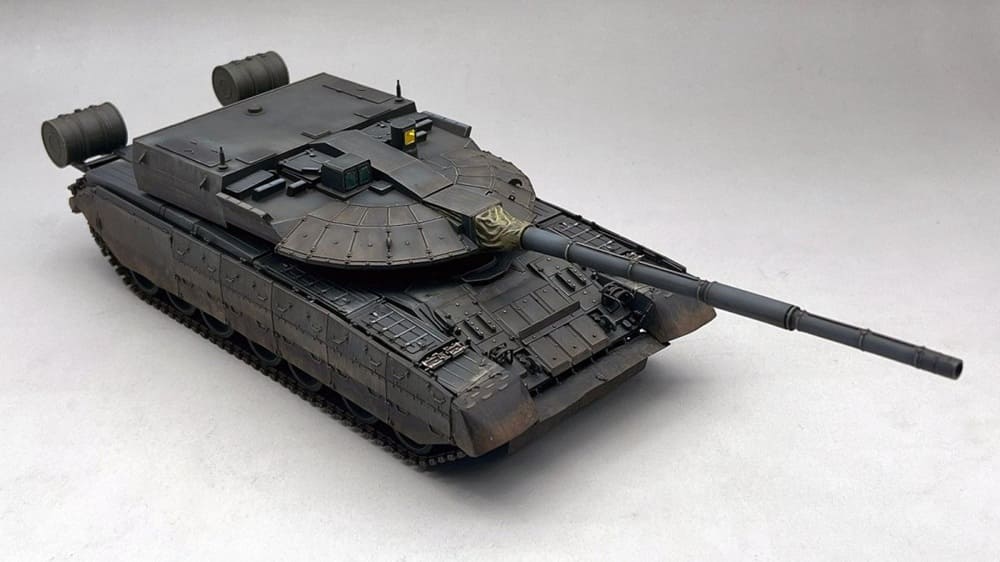
Observers regard the Russian Black Eagle tank programme as one of the most misunderstood armoured programmes of the post-Soviet era. Formally designated Object 640, it was based on a modified T-80U chassis and fitted with an entirely new turret. Omsktransmash developed the vehicle in the financially turbulent 1990s. Their engineers sought better crew survivability, more firepower and improved mobility, without building a whole new platform.
Black Eagle, however, never entered production as a main battle tank. The Russian Federation developed an experimental demonstrator for testing the technology and attracting investments from the state or from abroad. The secrecy of the programme, the camouflaged demonstrations and the ambitious promotional claims subsequently created a “super-tank” mythology.
From T-80U to Object 640
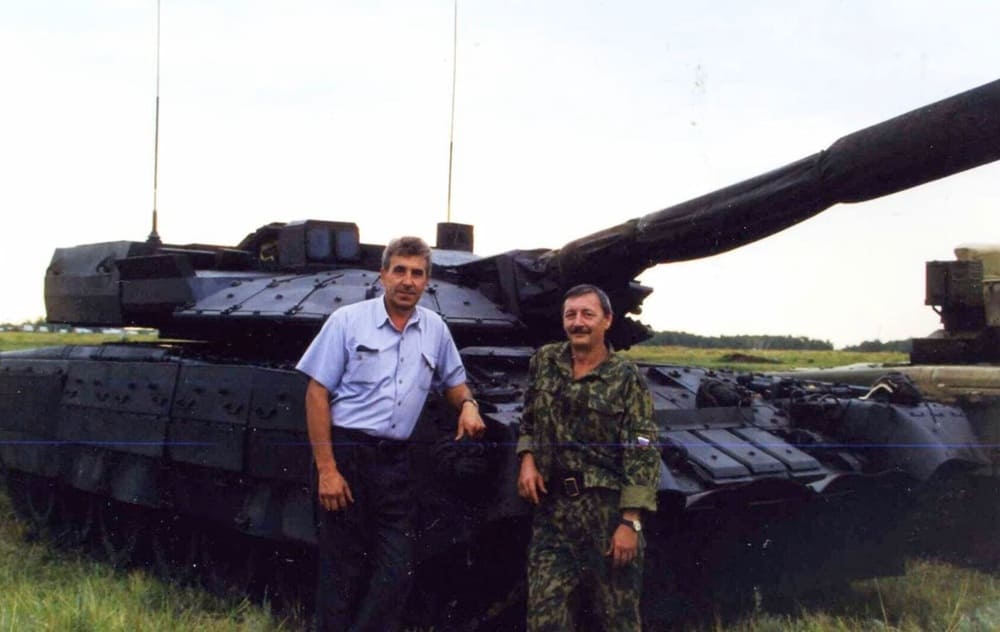
Object 640 is a deep modernisation of the T-80U, developed by the Omsk design bureau. The first demonstrator was shown at the VTTV-Omsk exhibition in September 1997. According to reports, this vehicle was based on a standard six-wheel T-80U chassis and fitted with an experimental, heavily camouflaged turret. A more sophisticated demonstrator appeared in 1999. It had a long hull with seven roadwheels on each side.
The seventh wheel added weight to the turret and the area of contact with the track. The longer hull also gave more room inside for separating fuel, accommodating the crew and housing future electronic systems. Now Rostec describes the Black Eagle as an experimental platform with enhanced protection, mobility and combat effectiveness. But Russia never provided a complete, verified technical specification.
| Characteristic | Publicly established or estimated data |
|---|---|
| Designation | Object 640 Black Eagle |
| Developer | KBTM, Omsktransmash |
| Configuration | Experimental main battle tank |
| Crew | Three |
| Combat mass | Approximately 48 tonnes |
| Chassis | Lengthened T-80U with seven road wheels |
| Engine | GTD-1250 turbine on demonstrator; stronger turbines proposed |
| Main armament | 125 mm smoothbore gun |
| Secondary weapons | Proposed 7.62 mm coaxial and 12.7 mm roof weapon |
| Loading system | Isolated bustle-mounted automatic loader |
| Estimated road speed | 70–80 km/h |
| Operational status | Never entered service or production |
Ammunition Outside the Crew Space
The most important innovation of Black Eagle was its ammunition architecture. Soviet T-64, T-72 and T-80 designs stored mechanised ammunition in the fighting compartment. This set-up shrank the size of the vehicles and allowed for crews of three. But such hits could trigger exposed propellant charges. The deflagration or detonation could blow the turret up and kill the crew.
The Omsk engineers stowed the finished ammunition in a detachable, armoured box behind the turret. From the module, there was a protected passage to the gun’s breech. This arrangement kept much of the ammo out of the crew’s way. A Russian patent on this formerly secret system reveals an unusual amount of detail. It describes a bi-directional endless conveyor, ammunition cassettes, electric drives and locking mechanisms and a chain rammer.
The module could carry both projectiles and single propellant charges. The patent also outlines that technicians can remove and replace the entire container. This feature enabled quick refilling and straightforward maintenance. It also allowed more room inside for electronics and safety gear. Most secondary sources say that Black Eagle had fully working blow-off panels. The patent confirms that the design isolated the ammunition, but it does not prove that all protective features worked on the demonstrator.
A Low-Profile Crewed Turret
The Black Eagle did not have the fully automatic turret that would be seen later on the T-14 Armata. It was to carry a crew of three: commander, gunner and driver. The commander and gunner had adjustable seats. In the fighting, their seats dropped, lowering their bodies below the turret ring. This arrangement reduced the chance of a penetrating hit in a turret. Inside, Omsk was split into protected areas for fuel, crew and weapons. Armoured bulkheads separated fuel tanks from occupied spaces.
It was a concept somewhere between the old Soviet-style layouts and the later armoured crew capsules. The turret was a modular welded construction with frontal protection. Public images show large interchangeable armour packages and large amounts of explosive reactive armour. Analysts often identify the reactive armour system as Kaktus, but conclusive ballistic data do not confirm its effectiveness. The designers also suggested a laser warning system, electro-optic countermeasures, and an active protection system. There is no public evidence of a fully integrated combat configuration.
Firepower Without Proof
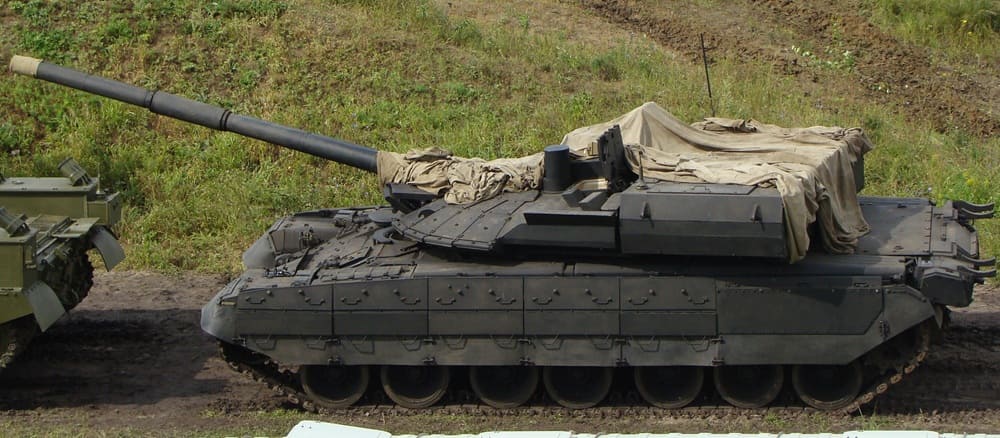
Engineers fitted the demonstrator with a 125 mm smoothbore gun, apparently a variant of the 2A46 family. The external autoloader could handle longer ammunition than the standard Soviet carousel systems. This is important, as longer armour-piercing fin-stabilised discarding sabot rounds can accommodate higher length-to-diameter penetrators. A longer penetrator can increase sectional density and armour penetration without increasing the calibre. Omsk also worked on related turret designs for guns from 105 mm to 130 mm.
There are no confirmed reports of a 152 mm Black Eagle. Object 640 is often confused with Object 195, which was armed with the 152mm 2A83 gun. The fire-control system reportedly had a digital ballistic computer, a commander’s panoramic sight and thermal imaging. Such equipment could be used in hunter-killer operations. The commander would pick a target; the gunner would shoot at another. No reliable public records of full fire control trials, firing accuracy or sustained loading rates exist. Therefore, analysts can only conjecture its superior engagement performance.
Turbine-Powered Mobility
The display vehicle probably retained the T-80U’s 1,250-horsepower GTD-1250 gas turbine. The vehicle was estimated to weigh about 48 tonnes and to produce about 26 hp per tonne. Omsk engines were available in the range of 1400 to 1500 hp. With these units, the ratio would have been 29.2 to 31.3 hp/tonne. That was more than many contemporary Western tanks that often operated at between 20 and 25 horsepower per tonne.
It was a turbine, with rapid acceleration, small size, and reliable starting in cold weather. However, it burnt a lot of fuel and needed special maintenance. The financially constrained Russian Army considered these disadvantages highly consequential during the post-Soviet period. The longer chassis also meant increased resistance to turning, vehicle length, and logistics complexity. So higher power did not necessarily mean better operational mobility.
Case Study: Grozny’s Armoured Disaster
The battle of Grozny points to the operational problem with the Black Eagle’s survivability concept. 31 December 1994 Russian armoured columns entered the city without enough infantry support or awareness of the situation. Chechen teams isolated vehicles, firing rocket-propelled grenades into their sides, roofs and backs. The 131st Maikop Brigade lost 20 of its 26 tanks and 102 of its 120 infantry vehicles. It is reported to have lost about 1,000 personnel from its original strength of roughly 1,000 personnel.
The Black Eagle’s isolated ammunition may have improved crew survival after armour penetrations. Better panoramic views may have increased local awareness. But no tank design could hide the basic tactical flaws of Grozny. Armour needs dismounted infantry, reconnaissance, communications and co-ordinated fires. The case demonstrates that survivability engineering can enable combined-arms tactics but not replace them.
Why Black Eagle Failed
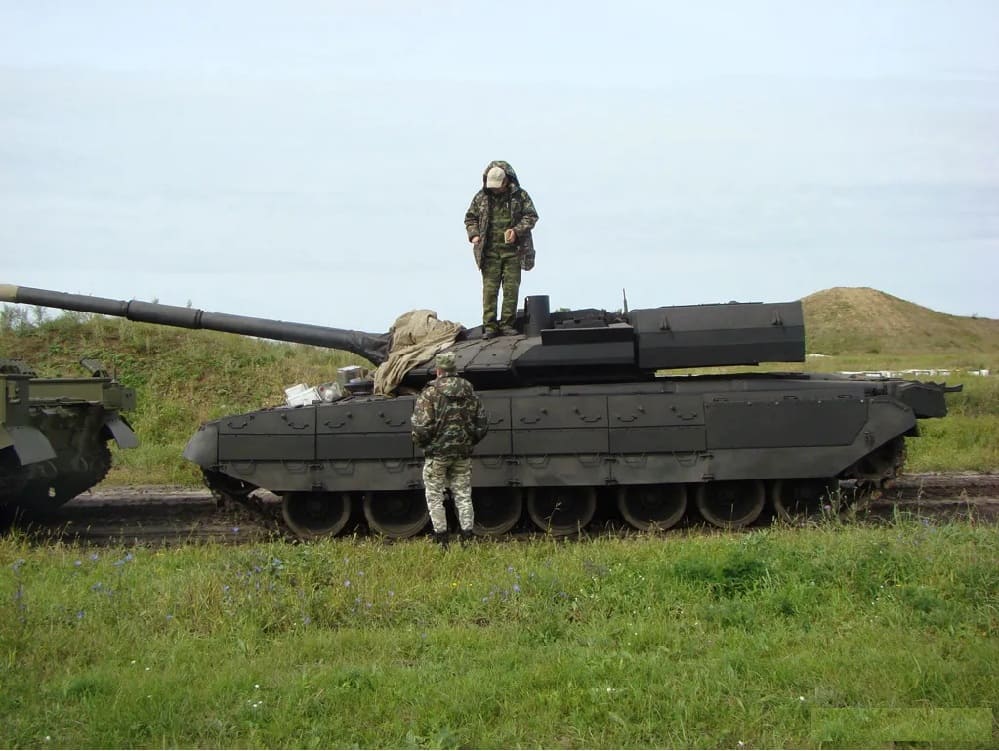
Russia did not fund Object 640 as a formal production programme. Omsktransmash set the vehicle against the cheaper T-90 family and other experimental projects. “There is no operational Black Eagle tank,” said Colonel Vladimir Voytov of the Russian Defence Ministry in September 2009. He would admit to nothing more than an experimental vehicle and that the turret had no working internal equipment.
This comment strongly suggests that the public demonstrator never attained the production prototype maturity. The state trials in Russia failed to prove the reliability, lifecycle cost or combat effectiveness. Black Eagle failed because of high technical aspiration and poor funding, industrial fragmentation, and uncertain military demand.
Strategic Legacy
Object 640 did not become the next main battle tank of Russia. It considered several ideas that remain relevant. These included modular armour, separated ammunition, longer penetrators, panoramic sights and improved crew protection. Later Russian programmes aimed for similar goals, but with different engineering solutions.
So the real importance of Black Eagle is not its mythical performance claims. It was an experimental link between the small Soviet tank and the 21st-century survivability-based armoured vehicle. Its biggest lesson is still a simple one: you cannot save a program with revolutionary subsystems without money, industrial capacity, testing and military sponsorship.
References
- Rostec — Russian Experimental Tanks: Object 640 Black Eagle
- Russian Patent RU2195617C1 — Automatic Gun Loading Mechanism
- U.S. Army University Press — Breaking the Mould: Tanks in the Cities
- RBC — Russian Defence Ministry Statement on Black Eagle
About the Author

Hi, I think your website might be having browser
compatibility issues. When I look at your blog in Firefox,
it looks fine but when opening in Internet Explorer, it has
some overlapping. I just wanted to give you a quick heads up!
Other then that, wonderful blog!