
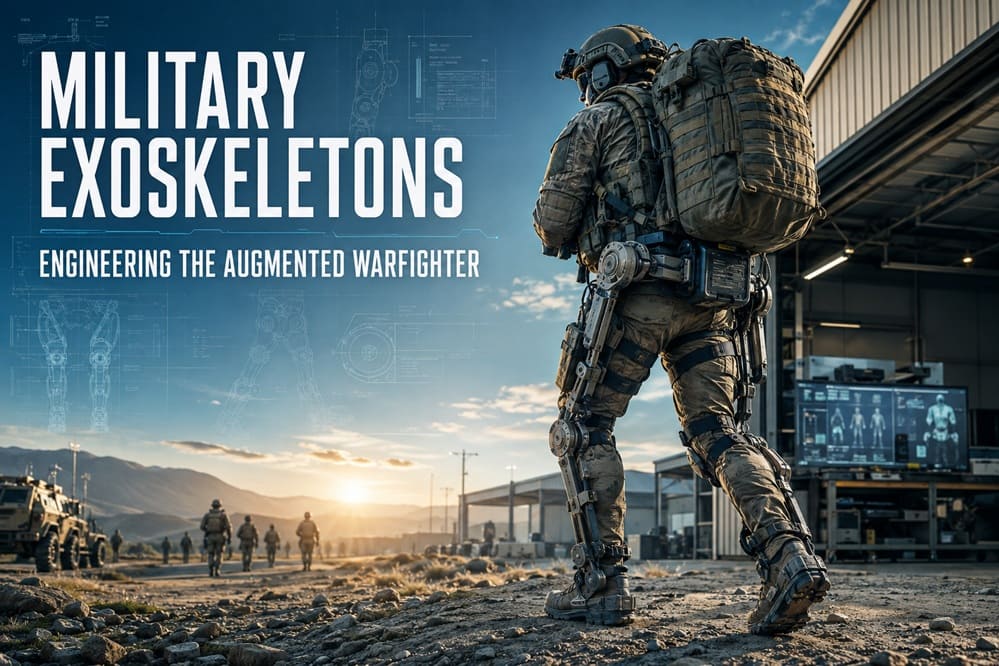
Military Exoskeletons: Engineering the Augmented Warfighter
Today’s military exoskeletons do exist, but the armoured ‘super-soldier’ of popular imagination has yet to be realised. The real engineering goal is a more pragmatic one: reduce metabolic expenditure, transfer payload forces away from vulnerable joints, increase endurance, stabilise weapons and maintain combat effectiveness under heavy loads.
“There is a giant demand. “On difficult terrain, a dismounted warfighter can carry more than 100 lb (45 kg) of gear,” DARPA says. Such loads put stress on the ankles, knees and lumbar spine, and at the same time they accelerate fatigue. Consequently, for military planners, the exoskeleton is more a wearable biomechanical force-management system than it is power armour.
Three Classes of Military Exoskeleton
Military systems generally fall into three engineering categories.
- Passive exoskeletons do not rely on powered actuators. Springs, elastic elements and stiff load paths transmit forces from the torso to the ground. They have a remarkable range because they do not require a battery, but they only inject mechanical energy into human motion intermittently.
- Powered exoskeletons have electric, hydraulic or other actuators placed at the major joints. Sensors anticipate the operator’s actions, and a controller applies torque to enhance those motions.
- Soft exosuits replace much of the rigid structure with textiles, cables and compliant actuators. These systems trade off heavy lifting capability for lower mass, flexibility and less interference with normal gait.
The fundamental problem is not merely producing force. The machine must produce the correct torque at precisely the correct point in the human gait cycle. For a powered joint,
[P = \tau \omega]
Where (P) is power, (\tau) is torque, and (\omega) is angular velocity.
where P is the mechanical power, τ the torque of the actuator and ω the angular velocity. If the actuator applies too much torque a few milliseconds too early or late, it will work against the soldier, not with him. It means that the control architecture is as important as the power of the actuators.
The Human-Machine Battlefield
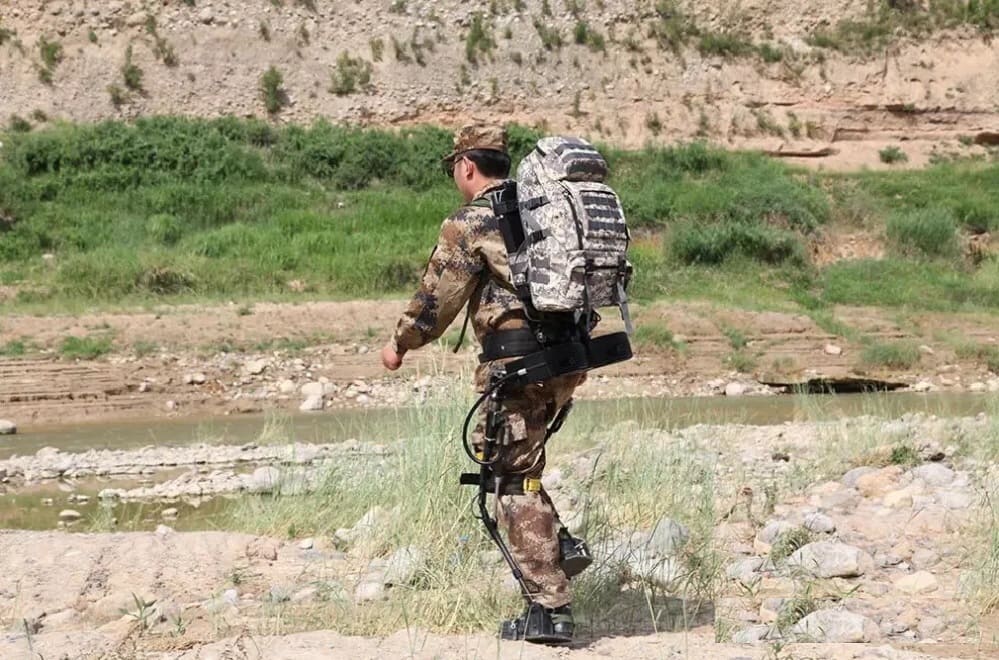
A modern exoskeleton may include joint angle encoders, inertial measurement units, pressure sensors, force sensors and sometimes physiological inputs. The algorithms then estimate whether the soldier plans to walk, climb, crouch, lift, run or move into a firing position. Control strategies can be impedance control, torque control, gait-phase estimation and adaptive human-in-the-loop optimisation. The system must also be backdrivable so that if the electrical juice goes away, the soldier is not trapped inside a rigid machine that limits movement.
This requirement introduces a significant tradeoff. The higher the gear ratio, the higher the actuator torque. However, the tradeoff also increases the reflected inertia and mechanical resistance. Smaller actuators weigh less but may not provide enough instantaneous torque for climbing, casualty evacuation or rapid acceleration. So the ideal military exoskeleton is nearly invisible until you need the help.
Warrior Web: Efficiency Over Strength
The Warrior Web programme was a significant departure at DARPA from the classic idea of powered armour. DARPA wanted a light, conformal system, like an under-suit, not a big machine on the outside. It attacked the ankle, knee, and hip while also reducing injury and metabolic expense. Most notably, DARPA specified that the system should be capable of compensating for both the soldier’s assault load and its own weight, while drawing no more than 100 watts of power from its battery. That number is your power problem.
A continuous 100-W electrical load maintained for eight hours requires:
100 W × 8 h = 800 Wh
This calculation does not account for conversion losses, reserve capacity, electronics, or environmental degradation. So battery mass is in direct competition with combat endurance. If you make the battery bigger so it lasts longer, the system becomes heavier, which means it needs more mechanical help and, in turn, more electrical energy. Engineers easily become caught in a self-defeating spiral of mass power. Rather than brute-force amplification, Warrior Web focused on regenerative actuation, adaptive sensing, injury mitigation and efficient human machine interfaces.
TALOS: Why the “Iron Man” Model Failed
The most ambitious American project was USSOCOM’s Tactical Assault Light Operator Suit, or TALOS, for short. SOCOM initiated the effort in 2013 to develop a complete assault system with next-generation mobility, armour, computing, power and exoskeleton technology. “Trade-offs between weight, protection, power, mobility, cost and subsystem integration exist, as was noted in the original solicitation.
In the end, those variables made the difference. An unclassified USSOCOM paper from September 2015, which has attracted little attention, provides unusually telling insights into the programme’s engineering difficulties. SOCOM hosted an “Exoskeleton Control Theory Sprint” at SOFWORX with government, academic and industry experts. The teams considered human-machine interface sensing, control architecture and the amount of control needed for combat operation. SOCOM was pretty clear that we’ve got to find those big gaps in technology.”
Systems-Integration Challenge
That document also shows that SOCOM was developing a load-bearing passive exoskeleton and conducted an internal user assessment of a powered exoskeleton. Engineers were also working on integrated armour, where the armour and the exoskeleton were not separate systems. This project is of strategic importance. TALOS had not failed because the engineers lacked the knowledge to build a machine that could move the armour. It was a systems-integration problem.”
Protection caused increased mass, which caused increased actuator requirements, which caused increased electrical demand, which caused increased mass again, which caused increased battery requirements, which generated heat in the electronics and motors, which created rigid structures that interfered with natural human movement. TALOS is a particularly compelling example of why military exoskeleton engineering should optimise the whole soldier, not just its subsystems.
Lockheed Martin ONYX
Lockheed Martin’s ONYX programme took a more focused approach. In 2018, Lockheed Martin received $6.9 million from the U.S. Army’s Natick Soldier Research, Development and Engineering Center to develop ONYX for soldier demonstrations. The powered lower-body system included electromechanical knee actuators, sensors and computer-controlled assistance.
Instead of turning the soldier into a heavy-duty robot, ONYX was designed to ease the load of walking, climbing and carrying loads. Lockheed said the tests included users walking uphill with a 40-pound backpack. This architecture is the more probable military path: to upgrade certain joints if biomechanical analysis shows a real operational benefit.
The Metabolic Cost
The exoskeleton can take the mechanical load, but it can also make the soldier less effective. Every extra kilogram on the legs is especially costly in terms of energy cost. That is because, with every step, the operator has to accelerate and decelerate all that mass. Misaligned mechanical joints may also create shear forces on the body.
So engineers must measure more than maximum lift ability. Performance parameters such as oxygen consumption, metabolic power, heart rate, muscle electromyography, joint loading, interface pressure, stride-to-stride variability and time-to-fatigue are useful. The higher metabolic expenditure may limit the tactical advantage of letting a soldier carry an extra 20 kg.
Logistics May Lead Adoption
The most promising application for the military in the near term might be something other than attacking infantry. Artillery teams, ammo handlers, aircraft mechanics, logistics personnel, and casualty-evacuation teams all do repetitive high-load moves in relatively predictable environments. Their tasks make it easier to recognise gait and reduce many of the mobility requirements for close combat.
A warehouse exoskeleton doesn’t have to crawl through mud, climb over rubble, enter into a vehicle, swim, run under fire and then rapidly get into a stable prone firing position. All that combat systems must do is perform these tasks while also surviving rain, dust, electromagnetic interference, shock, and battle damage.
Systems in Use or Under Evaluation
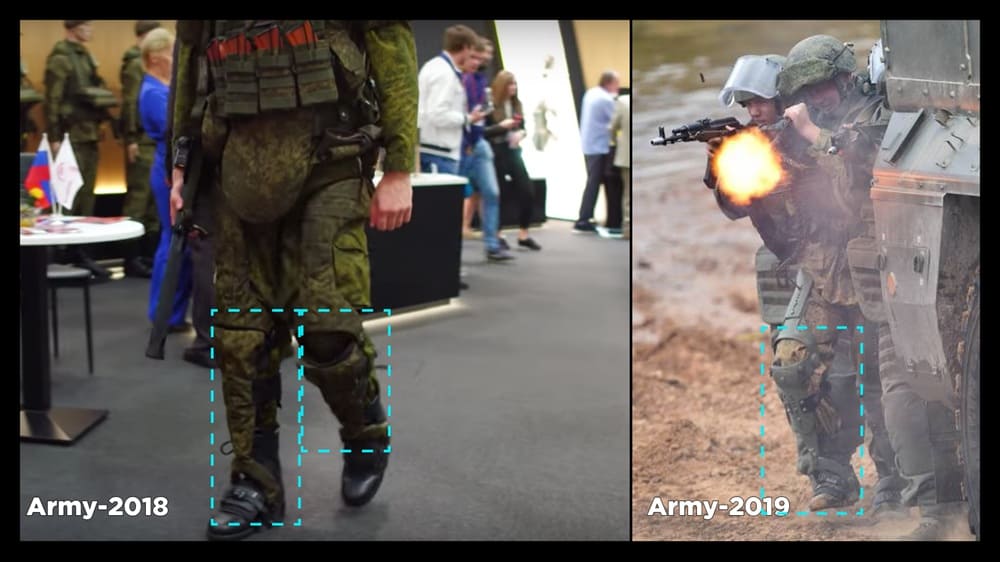
- Russia – K-2: passive exoskeleton for combat engineers and mine-clearance troops. It was reportedly tested by Russia in operational use in Syria. Its rigid frame can carry loads of the order of 50 kilograms.
- China – PLA Border Exoskeletons: PLA troops employed passive load-bearing systems in Tibet and Xinjiang while on patrol and resupply missions. China is also conducting power testing on its versions.
- Ukraine’s powered lower-body exoskeletons: The 7th Air Assault Corps is to trial powered lower-body exoskeletons at the frontline in 2026. They are used by artillery crews who handle 50 kg shells.
- United States – SABER: This 1.2 kg passive exosuit supports the lower back during artillery handling and resupply. Eleven soldiers field-tested it during M119 howitzer operations. 90% reported improved task performance. All 11 said they would likely wear it for their jobs.
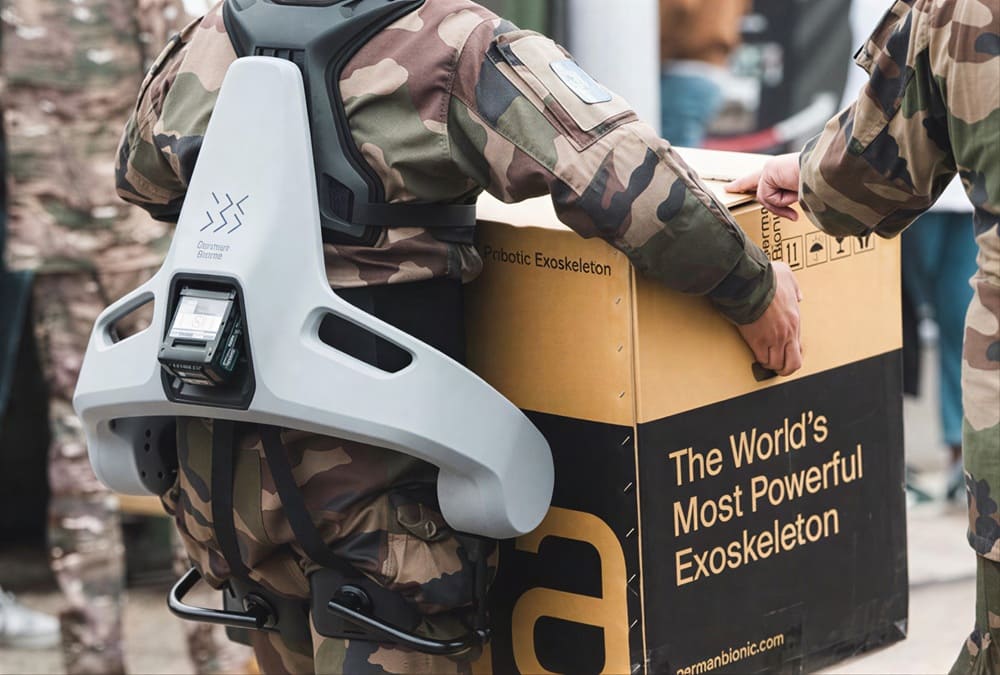
- France – Logistics Exoskeletons: French maintenance units are testing systems from RB3D and German Bionic. These are intended for cargo handling jobs with loads of nearly 100 kilograms.
- Germany – logistics support systems: The Bundeswehr is developing applications for exoskeletons for use in warehouses, maintenance workshops and military logistics.
- The obvious conclusion: passive logistics exoskeletons will be the first to go into practical service. No army has so far issued a reliable, full-body powered combat exoskeleton as standard kit.
Conclusion
“Don’t expect to see armoured super-soldiers running around with military exoskeletons any time soon. What they’re really worth, militarily, is something less flashy but perhaps more valuable: reducing fatigue and injury while maintaining combat power. DARPA’s 100-W Warrior Web goal, SOCOM’s TALOS control experiments, and the Army’s ONYX investment all illustrate the same engineering lesson. The limiting factor is not simply bigger motors.
The breakthrough will come from integrating lightweight actuation, high-density energy storage, low-latency sensing, adaptive control, thermal management and biomechanically transparent interfaces into a single reliable system. So the soldier of the future may not look like Iron Man. The successful exoskeleton may be almost invisible, silently transferring loads, stabilising joints and saving metabolic energy, while still allowing the operator to move naturally. And that might make it a much more military-useful tool in the end.”
References
- Defense Advanced Research Projects Agency (DARPA). Warrior Web: Preventing Musculoskeletal Injuries for Warfighters. DARPA Biological Technologies Office. (darpa.mil)
- U.S. Special Operations Command. USSOCOM Seeks Ideas for Advanced Assault Suit Development, 20 September 2013. (socom.mil)
- U.S. Special Operations Command. TALOS Time Hack, Issue #3, September 2015. Unclassified programme document.
- Lockheed Martin. Lockheed Martin Secures U.S. Army Exoskeleton Development Agreement, 29 November 2018. (Media – Lockheed Martin)
About the Author