
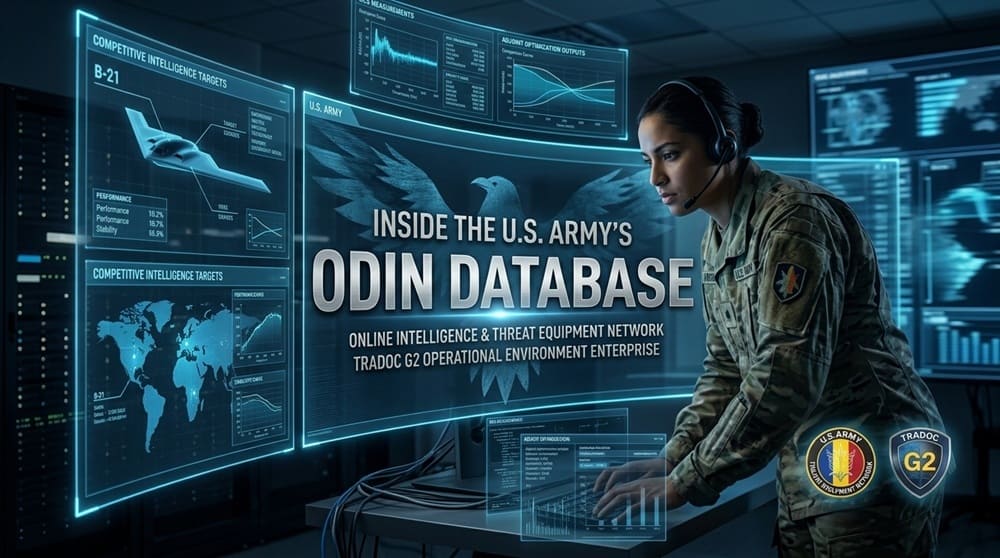
Inside the U.S. Army’s ODIN Database
The U.S. Army ODIN database sounds like an archive. Actually, it’s a lot more than that. ODIN, the Operational Environment Data Integration Network, is the Army’s digital repository of threat data and training materials and resources on opposition forces. This means trainers, planners and soldiers have one place to build realistic exercises instead of having to search across different systems for information.
That’s important, because readiness is as crucial to the situation as the strength of the troops. Units must be able to operate in multiple domains, under changing conditions and against smarter adversaries. Therefore, the Army needs a single place platform that incorporates scenario design, enemy force portrayal, and knowledge of the operational environment. The Army and Military Review articles show that ODIN and DATE are part of a larger movement toward threat-informed training.
Inside the U.S. Army ODIN Database
The first key component of ODIN is the Worldwide Equipment Guide (WEG). WEG helps the U.S. Army train and demonstrate OPFOR in constructive, virtual, live and gaming environments, says the Army. It’s fairly simple; it lets units demonstrate what foreign systems might do that American forces need to respond to now or soon enough. So the WEG is more about standardising the threat picture rather than just collecting random facts.
The second pillar is the Decisive Action Training Environment, or DATE. DATE is the Army’s official scenario-development tool and an unclassified training environment. This framework gives trainers a scalable tool that mimics real operational environments but can be applied to a wide variety of schools, units and exercises. It allows commanders to train in near-realistic conditions without the need to tie every event to a classified intelligence package.
Military Review wrote in 2025 that DATE helps soldiers train constructively, online, and in real life throughout their careers. The same article says that DATE now has twenty-four fictional countries, modelled on real conditions on Earth, with a focus on Africa, Eurasia, the Indo-Pacific and the polar regions. DATE has grown from a smaller army training tool into a larger tool for preparing for combat in many areas and on a large scale.
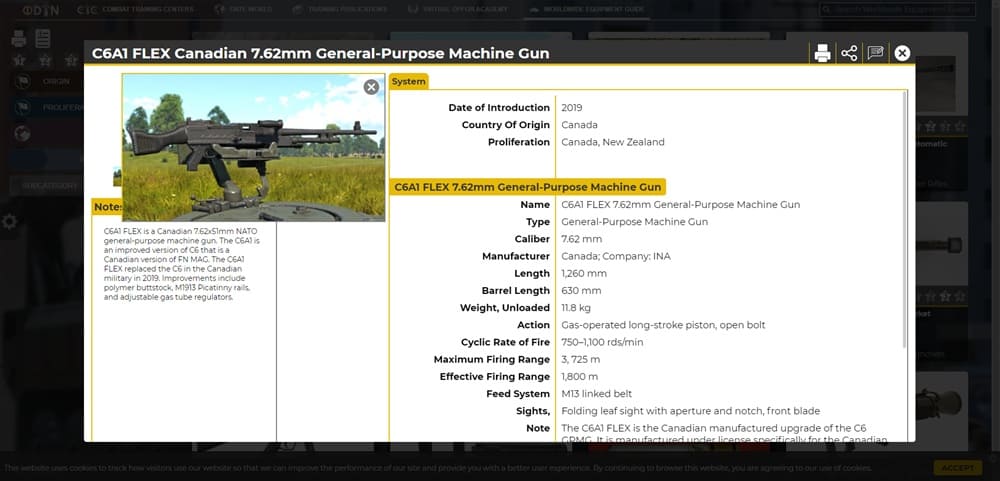
ODIN Is More Than Data
Here’s more on the U.S. Army ODIN database: A regular database keeps track of data. ODIN connects information to training activities. The official Army pages state that the platform is a central hub for WEG, DATE, Threat and OPFOR doctrines, training materials, Virtual OPFOR Academy and Combat Training Center content. The real benefit of that integration is that it allows users to go from equipment to doctrine to scenario design without having to jump between non-integrated tools.
That structure makes things more consistent, too. Without a common framework, one unit may see an enemy in one way, while another unit generates a very different threat model. ODIN provides Army users a common baseline for equipment, doctrine and operating conditions to help ensure things don’t become too far apart. But it does allow trainers to alter a scenario to fit their needs. The same applies to the DATE World material from T2COM: DATE is the context, not the situation per se.
That’s a big difference. DATE gives the background conditions, geography, enemies and tensions, and the trainers give the specific events. To summarise, the U.S. Army ODIN (Operational Data Integration Network) database creates a credible world and then allows units to choose the exact fight they want to rehearse. So, it is better to think of ODIN as a training system rather than a database.
Importance of OPFOR Academy
Another important part of ODIN is the Virtual OPFOR Academy (VOA). The Army says the VOA provides users with the tools and resources to learn, use and replicate OPFOR counter-tasks relevant to their unit’s training objectives. That is effective, not just for appearances. A credible enemy is more than a slide. It has to move, to trick, to react, to have friendly units solve difficult problems under stress.
That’s why doctrine still matters, and so do equipment lists. “A tank, a drone, or an air defense system alone are not realistic enemies. But tactics do. Decision cycles do. Fire control, survivability, and deception do. The U.S. Army’s ODIN (Operational Data Integration Network) database matters because it connects enemy hardware to enemy behaviour, making useful training difficult.
ODIN also supports Combat Training Centers (CTCs) by providing custom content that meets their training needs. Public CTC ODIN pages provide information on force organisation, equipment ordering, and connectivity to major training sites. This allows rotating units to train for the Army’s most demanding group training events from a more common threat baseline.
ODIN’s Wider Strategic Impact
The enterprise of the operational environment behind DATE is expanding. This expansion gives ODIN more meaning than DATE. The scope of the DATE has increased to encompass the joint, multinational and interagency spaces, Military Review reported. The users include the U.S. Marine Corps, the Defense Intelligence Agency and the State Department, the article said. That growth is a reflection of the fact that shared training environments now contribute to interoperability and readiness. The T2COM DATE World material offers another level. DATE World is not a set scenario, it says, but rather the “Army’s official, unified and scalable training environment.”
The user community includes partners outside of the U.S. Army from countries such as the United Kingdom, Australia, Canada, and New Zealand. Military Review also points out that “ABCANZ partners have formal arrangements around DATE use,” which further solidifies its role in coalition training. For those reading about defence, another relevant example of preparing for military service in a digital world is the U.S. Army’s ODIN database. It shows how the Army makes threat-informed training a reusable system.
Final Assessment
However, the ODIN database of the U.S. Army is not just any database. It’s a training system. It combines the Worldwide Equipment Guide, DATE, OPFOR doctrine, training materials, CTC tools and the Virtual OPFOR Academy. The system allows the Army to better threaten, develop better exercises, and train leaders in a way more like actual war, and all of this better prepares them for what they are facing today in combat.
This is where ODIN comes in. It is not only weapons, money or numbers of troops that make a country ready for the modern world. It also depends on whether soldiers train in a realistic operational environment with credible enemies and fresh ideas. That’s something the Army can do in a systematic fashion with ODIN.” It also shows that digital knowledge systems are central to combat preparation.
References
- https://oe.t2com.army.mil/odin-oe-data-integration-network/
- https://www.armyupress.army.mil/Journals/Military-Review/English-Edition-Archives/July-August-2025/Training-Environment-Indo-Pacific/
- https://oe.t2com.army.mil/2022/01/31/date-world-users-blog-2-what-is-date-world/
- https://odin.tradoc.army.mil/WEG
About the Author


Wonderful blog! I found it while searching on Yahoo News.
Do you have any suggestions on how to get listed in Yahoo News?
I’ve been trying for a while but I never seem to get there!
Thank you