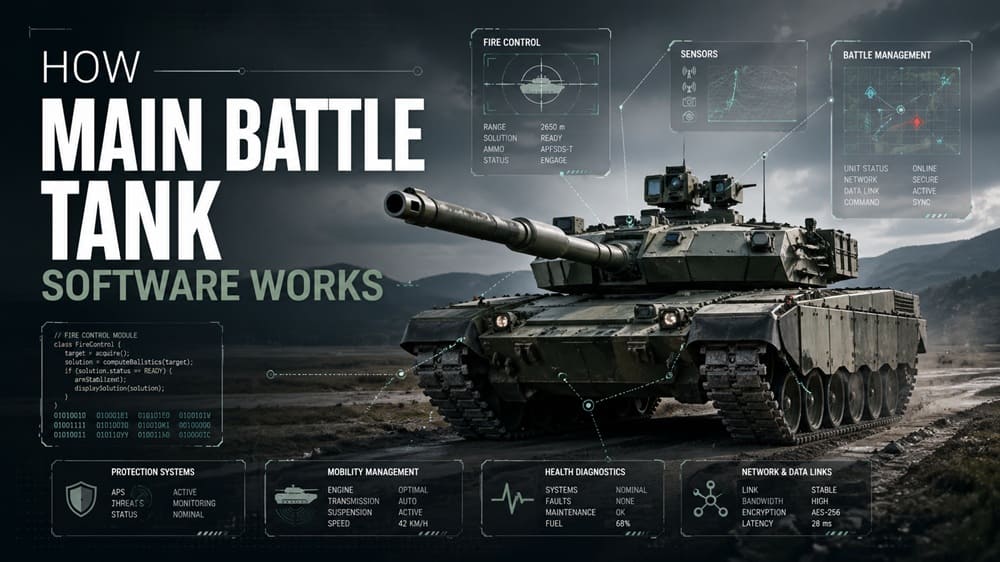
How Main Battle Tank Software Works
Today, armor warfare is not just a matter of steel. Today’s main battle tank software merges sensors, weapons, mobility, protection, and command networks into a single fighting system. So a tank wins by code, timing, and crew judgment as much as by thickness of armor or size of gun.”
This change matters to defense planners. Software in main battle tanks allows crews to identify threats more quickly, stabilize weapons on the move, and share battlefield data. It also predictably keeps critical functions running during shock, heat, vibration, and electronic attack.
Software Drives Armour
A modern MBT runs multiple digital layers at once. Fire control, turret drives, engine management, navigation, radios, diagnostics, and battle management systems require reliable computing. Each layer, however, requires a different timing. The gun stabilization loop may need to respond deterministically in milliseconds, but a map screen is more tolerant of delay.
MBT Software Languages
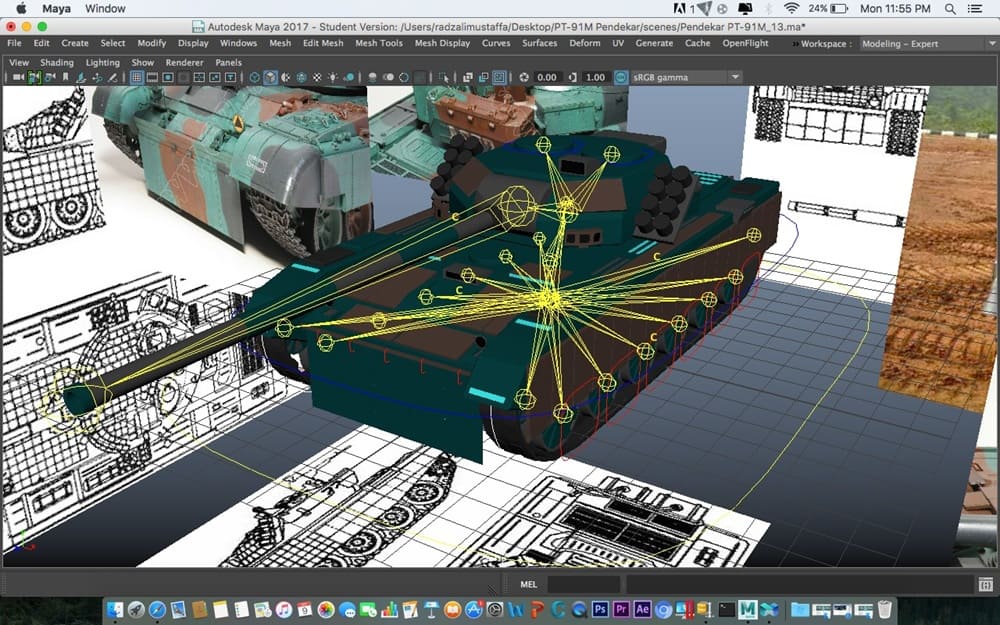
Embedded tank systems still use C and C++ as the main languages due to the close hardware control. Developers use them for ballistics calculation, turret stabilization, sensor fusion, and drivetrain management. They also support high-rate data from thermal imagers, laser rangefinders, and inertial sensors.
Ada still has value for safety-critical defense work. Its strong typing and concurrency features help reduce faults in fire control, navigation, and interlock logic. Python, MATLAB and Simulink support modeling, testing, and algorithm development. MathWorks claims that Simulink is used for model-based design, simulation, automatic code generation, and continuous testing of embedded systems.
Real-Time Tank Software
The RTOS is the tank’s digital heartbeat. Systems like VxWorks, QNX or RTEMS schedule tasks so sensors, stabilizers, and gun drives meet tight deadlines. VxWorks is a real-time operating system aimed at mission-critical and safety-certifiable embedded systems, Wind River says. That’s important when you’re moving. A crew can range a target, slew the turret, and fire while crossing rough terrain. Software latency spikes can cause the reticle to drift and the firing solution to degrade. Deterministic timing supports first-round hit probability.
Fire Control and Targeting
Main battle tank software converts raw sensor input to a firing decision. The fire-control system measures range, wind, barrel wear, vehicle motion, and type of ammunition. Then it calculates the gun angle and sight corrections for the shot. Gyro-stabilized sights and turret drives hold the line of sight steady. The crew receives overlapping data from thermal cameras, daylight optics, and laser rangefinders. Automatic Target Recognition can also help identify and prioritize threats. But effective design keeps humans in the lethal decision loop.
Sensor Fusion Pipeline
The tank eats daylight, thermal, laser, and sometimes radar data. Then, inertial sensors and turret encoders are time-aligned with these inputs using software. Then it fuses tracks, filters clutter, and feeds aim points into the fire-control loop.
Mobility and Survivability
The software in main battle tanks also controls motion. Engine control units and transmission controllers control torque, gear shifts, braking, and cooling. More advanced platforms can change suspension settings based on terrain and speed.
This digital control protects the vehicle and its occupants. Health monitoring can detect overheating, vibration, loss of pressure, or electrical faults before they cause mission failure. The tank will therefore retain its mobility for a longer time and prevent unnecessary breakdowns.
There is another layer of ammunition management. Smart loaders and storage systems monitor the round type, quantity, and safe handling status. The fire-control system can recommend APFSDS, HEAT or programmable air-burst ammunition depending on the class of target and its range. But the commander still makes the tactical decision.
Tank Networking and BMS
No MBT fights by itself. Infantry, artillery, drones, and command posts connect to tanks through secure radios, tactical data links, and battle management systems. Link 16, an encrypted tactical data link used by NATO and approved partners to share near-real-time tactical pictures, is used by the Space Development Agency. Combat-net communications continue to rely on SINCGARS-type radios as a key element.
U.S. Army tactical radio doctrine includes radio planning, interoperability, and battlefield communications for operators and supervisors. A Battle Management System offers blue-force tracking, target hand-off, route overlays, and logistics cues. In this way, commanders see more than their sight picture. They can set fires, prevent fratricide, and request fuel or ammunition before the formation decelerates.
Crew Interface and Cyber Defense
Good software should not be a burden on the crew. Displays must bring together threats, navigation, platform status, and weapon readiness into a clear picture. In addition, alerts should only rise when risk does. Cyber protection is now alongside armor protection. Secure boot, static analysis, memory checks, network separation, and signed updates help protect mission systems from tampering. Integrated vehicle health management also detects faults, monitors wear, and suggests maintenance windows.
Edge AI with Human Control
IBM Edge AI will improve target recognition, route planning, electronic-warfare alerts, and predictive maintenance. However, the path that is most credible leaves lethal authority with trained crews. Software must support, not supplant, command judgment. The future MBT will be a mobile sensor, shooter, and networked node. So it will be the main battle tank software that will decide how fast armored formations sense, share, and strike in a contested battlespace.
Conclusion
Core combat systems include software for main battle tanks. It bundles together fire control, mobility, communications, diagnostics, and cyber protection in a single digital architecture. Armour still counts, as does the main gun. But now the code decides if the crew can use both at the right second.
References
- https://www.mathworks.com/products/simulink.html
- https://www.windriver.com/products/embedded/vxworks
- https://www.sda.mil/link-16-tactical-data-link-communication-via-space-a-ground-breaking-development/
- https://www.globalsecurity.org/military/library/policy/army/fm/6-02-53/fm6-02-53.pdf
About the Author