
The Soviet SR-71 That Never Flew: Tsybin RSR
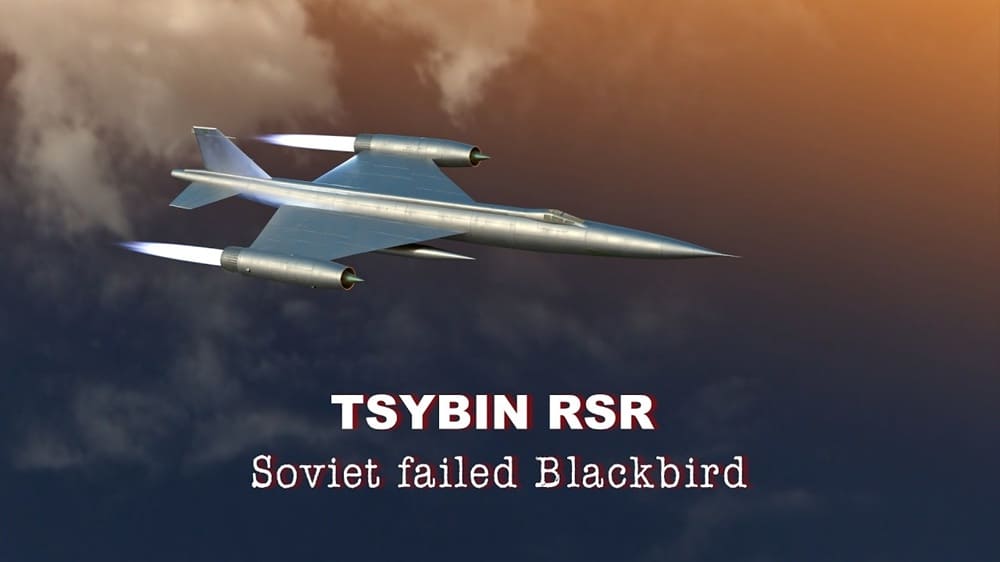
The SR-71 Blackbird was the symbol of strategic reconnaissance, long before Soviet engineers were also seeking a high-speed, high-altitude machine of their own. One of the more ambitious was Pavel Tsybin’s RSR—Reaktivnyy Strategicheskiy Razvedchik, or Jet Strategic Reconnaissance Aircraft. The RSR is best described as the ‘Soviet SR-71’, but this label is not entirely accurate. The Soviet project was developed independently and preceded the US announcement of the Blackbird family.
And more importantly, of course, the production-standard RSR and its refined R-020 derivative never flew. Only the NM-1, a simplified aerodynamic test aircraft, continued to flight test. So the RSR is much more revealing than a failed Blackbird clone. It shows just how close the Soviets came to producing a dedicated strategic reconnaissance aircraft and the critical aerodynamic, propulsion and structural problems that defeated them.
From Bomber to Spy Plane
In the mid-1950s, the OKB-256 design bureau, under the leadership of Pavel Tsybin, studied an ultra-fast strategic bomber, the RS. The requirement was born out of the thinking of the time: altitude and velocity would allow a nuclear bomber to punch through increasingly sophisticated air defence networks. The team developed several versions of the idea before Tsybin’s group moved to the reconnaissance stage.
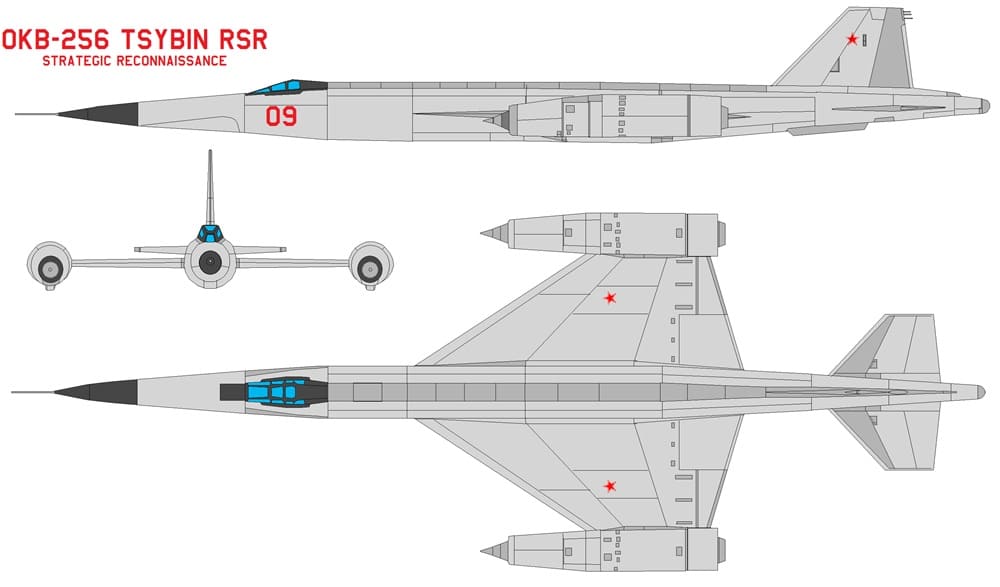
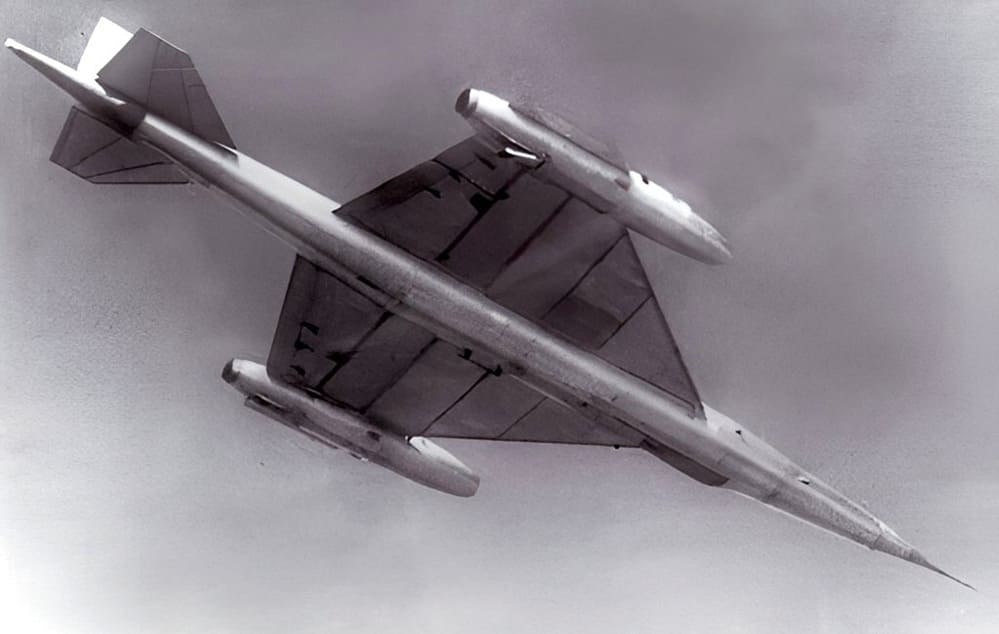
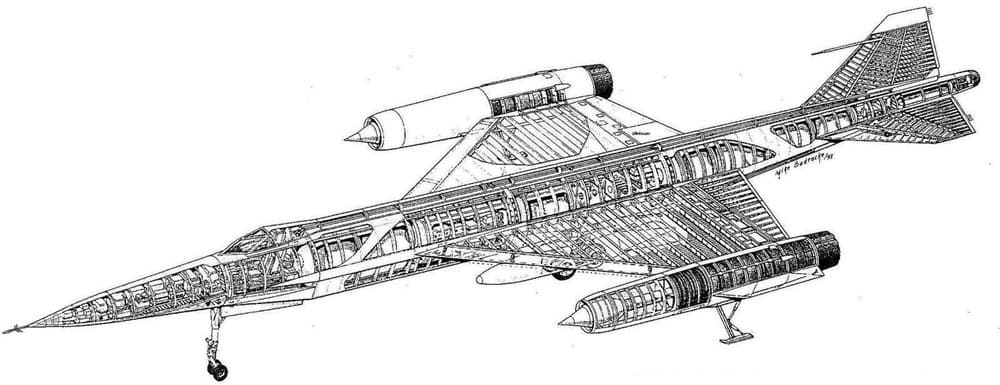
By 1957 the bureau was working on the conventionally launched RSR. The reconstruction of the Soviet design data indicates an aircraft of about 27-28 metres in length and a wingspan of about 10 metres, including its engine installations. The projected takeoff mass was 20-21 tonnes. The design was expected to evolve, and so was the performance, but the aircraft was to be able to fly at speeds around Mach 2.4-2.6, at altitudes around 20 km, with a range of around 4,000 km. Those numbers would be design targets, not proven performance. “The operational RSR was never flight tested.
The RSR’s Extreme Aerodynamic Design
The RSR had a very thin and highly swept wing designed for supersonic cruise. Reconstructed historical designs seem to have had leading-edge sweeps of about 58 degrees and very low thickness-to-chord ratios. That geometry reduced the wave drag but created a dangerous engineering problem: aeroelastic deformation. A slender wing twists under aerodynamic load at high dynamic pressure. If the deformation is sufficiently severe, moving an aileron can twist the wing the other way, reducing (or even reversing) the commanded rolling moment.
The phenomenon of aileron reversal was not a theoretical problem for the Soviet programme. A later technical paper by some of the specialists at Russia’s Central Aerohydrodynamic Institute, TsAGI, specifically mentions the Myasishchev M-50 and Tsybin R-020 as two aircraft whose thin wings led to serious problems of stiffness and aileron effectiveness. The conventional reinforcement led to excessively high increases in structural weight. TsAGI also studied aeroelastic solutions and non-standard outboard control surfaces (AICS). This is an important arcane technical detail. The RSR was lost, more than due to politics or a lack of engines. Its aerodynamic configuration was nearing the structural limits of Soviet aircraft technology.
Battling Extreme Heat
The high-Mach flight itself turns into a thermal-management problem. Later, the Blackbird showed just how serious it got. NASA archives show sustained Mach 3 speeds could result in heat-soak temperatures of more than 600°F, or about 316°C. (NASA) The American way was heavily reliant on titanium. The Soviet RSR was built around a much lighter structure that relied on dominant aluminium-based alloys, including proposed specialised aluminium-beryllium components. This approach reduced the mass but provided a lower thermal margin.
At Mach 2.5 class speeds, aerodynamic heating could bring conventional aluminium structures to temperatures where material strength and dimensional stability were major concerns. This put Soviet engineers in a difficult position. “Add the weight to the structure?” Lower sustained speed? Expensive heat-resistant materials? Or put up with a smaller flight envelope? Eventually, the SR-71 solved the problem, but on a much larger industrial scale. The U.S. Air Force claims the Blackbird could fly Mach 3+ at altitudes higher than 85,000 ft. The SR-71 was powered by two Pratt & Whitney J58 engines, each producing 32,500 lb of thrust.
The Propulsion Bottleneck
The RSR went through many propulsion system changes. High-altitude reconnaissance demands a special kind of engine. It must produce sufficient thrust at take-off, accelerate through the transonic region and be effective where the atmospheric density is very low. This is precisely where the American Blackbird programme achieved its greatest breakthrough. The J58 began to resemble more and more a turbo-ramjet installation as the speed increased. Complex variable inlets managed the supersonic air flow before it reached the compressor.
The earlier A-12 OXCART program did provide a repeatable Mach 3-class, 80,000-ft-plus reconnaissance capability before the SR-71 entered operational service, according to the CIA’s declassified history of Blackbird development. Tsybin did not have a similar mature propulsion system. The improved R-020 resulted in the Tumansky R-11 variants, the same engine used in the MiG-21. That lowered the development risk but also exposed the root of the problem: Soviet engineers were designing an aircraft whose aerodynamic ambitions outstripped the dedicated engine technology at hand.
Tsybin RSR vs SR-71
| Category | Tsybin RSR | SR-71A Blackbird |
|---|---|---|
| Origin, role and status | Soviet strategic reconnaissance project; cancelled before flight | American strategic reconnaissance aircraft; operational from 1966 |
| Crew and production | 1; five incomplete R-020 airframes | 2; 32 aircraft built |
| Dimensions (L × W × H) | 27.4 × 10.23 × 4.75 m | 32.74 × 16.94 × 5.64 m |
| Weight (empty/maximum) | 7,700/21,000 kg | 30,617/78,018 kg |
| Powerplant | 2 × D-21 turbofans; 44–49 kN each | 2 × J58 turbojets; 144.6 kN each |
| Performance | Mach 2.65; 3,760-km range; 26,700-m ceiling | Mach 3.2+; 5,400-km range; 25,900-m ceiling |
| Construction and sensors | Aluminium; cameras, radar and ELINT systems | Titanium; optical, infrared, radar and ELINT systems |
| Defensive systems | Radar warning and active/passive ECM | Reduced radar signature, ECM, speed and altitude |
Important Qualifier
All RSR performance numbers were design estimates. The operational configuration never took off.” Only the slower NM-1 aerodynamic demonstrator got flight tests done. The later R-020 variant was powered by Tumansky R-11F engines and had more moderate performance figures: estimated Mach 2.44, 4,000-km range and 22,500-m ceiling. So the comparison shows that the RSR was much smaller and lighter, but the SR-71 Blackbird had a lot more thrust, speed, range, sensor capacity and operational maturity.
Case Study: The NM-1 Actually Flew
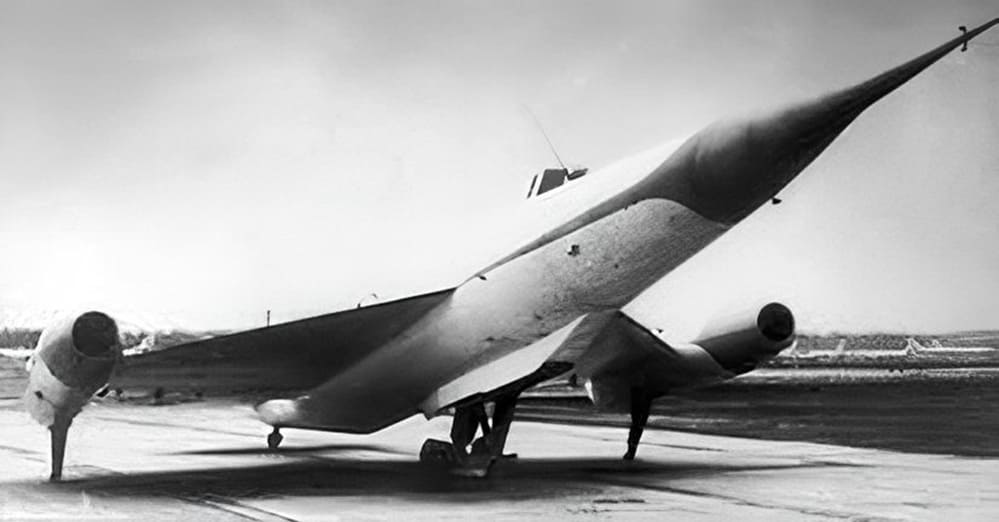
The statement that the Soviet SR-71 never flew therefore requires qualification. The NM-1 was a full-scale experimental aircraft, built by OKB-256 to demonstrate the unusual RSR layout at relatively low speeds. It used engines that were readily available instead of the operational propulsion system proposed. The NM-1 allegedly first flew on 7 April 1959.
It then flew dozens of test flights and produced data that went into the heavily revised R-020 configuration. The test program proved that a basic Tsybin configuration could fly. The tests did not, however, establish the RSR as a supersonic reconnaissance aircraft as designed. That’s a massive difference. The NM-1 confirmed the aerodynamic handling concepts. It never got to Mach 2.5 cruise, operational altitude, reconnaissance-system performance, or survivability against contemporary air defence.
The U-2 Shootdown Turning Point
Then history intervened. On May Day 1960, Francis Gary Powers flew a CIA U-2 high over the Soviet Union. A Soviet surface-to-air missile exploded near the plane over the Sverdlovsk region, destroying the U-2 and capturing the pilot alive. The incident altered the world’s perception of altitude as a defence. At an altitude of some 20 km, aircraft were no longer automatically out of range of Soviet missiles.
This development was important for aircraft such as the RSR. The advantage of speed for survivability was still immense, but the recon plane now required a combination of altitude, velocity, electronic countermeasures, manoeuvrability and preferably decreased detection range. Later, the Blackbird would exhibit those traits to a much greater extent.
The R-020’s Secret Defense System
The interesting thing about the refined R-020 was that it could turn. Soviet historical design records indicate that the engineers wanted much more roll capability at extreme altitude. Apparently, part of the idea was that performing aggressive rolling manoeuvres would make it harder for surface-to-air missiles to lock on.
This requirement becomes of special importance in the light of the TsAGI evidence on R-020 aileron reversal. To achieve high-altitude manoeuvrability, effective roll control was vital, as the aircraft’s thin wings suffered from severe aeroelastic problems. Thus the survivability requirements were pushing the R-020 into a flight-control regime that its lightweight airframe could barely accommodate.
Why the RSR Failed
Eventually the programme fell apart under various pressures. Special engines still in development were needed for the RSR. Its wings were very thin, and that presented tricky aeroelastic problems. Thermal limits complicated the lightweight construction. Meanwhile, Soviet strategic priorities shifted to ballistic missiles, air defence missiles and space-based reconnaissance.
However, organisational disruption also hampered Tsybin’s programme, as design responsibilities were shuttled back and forth between bureaus during the restructuring of the Soviet aviation industry. Several R-020 airframes were said to be well into construction, but none ever saw service. It was one of the great what-ifs of the Cold War in technology.
RSR vs SR-71: The Crucial Difference
The RSR and SR-71 used the same tactic of staying alive by flying higher and faster than the enemy could intercept successfully. But their technology readiness was just scattered all over the place. The RSR was still a well-calculated aero proposition. The Blackbird became a complete weapon-system-level reconnaissance system, built of titanium, advanced inlet control, special fuel, the J58 propulsion system, electronic countermeasures and high-performance sensors. USAF documents state that the operational SR-71 flew at speeds above Mach 3, at altitudes greater than 85,000 ft, and with a range of more than 2,900 statute miles. No Soviet aircraft ever came anywhere near that performance.
Meanwhile, Tsybin’s programme deserves even more praise than the SR-71. This achievement means that Soviet engineers understood the strategic value of rapid reconnaissance at a very early stage. More importantly, the little-discussed R-020 aeroelastic research shows they were dealing with sophisticated problems of structural flexibility, control reversal and supersonic manoeuvrability, not just sketching futuristic aircraft. Neither was the RSR a failure for lack of imagination on the part of Soviet engineers. The project failed because it required several breakthroughs at once. The Americans eventually got those breakthroughs with the Blackbird. The Soviets had turned their resources to other purposes.
References
- S. Kuzmina et al., “Review and Outlook on Active and Passive Aeroelastic Design Concepts for Future Aircraft,” ICAS 2002, including TsAGI research concerning the Tsybin R-020’s aeroelastic control problems. (ICAS)
- Central Intelligence Agency — “May Day Over Moscow: The Francis Gary Powers Story”, documenting the 1 May 1960 U-2 shootdown and its operational context. (CIA)
- Central Intelligence Agency — “Development of the Lockheed SR-71 Blackbird”, declassified history of the A-12/SR-71 Mach 3 reconnaissance programme. (CIA)
- National Museum of the United States Air Force — Lockheed SR-71A Fact Sheet, official performance and propulsion data for the Blackbird. (National Museum of the USAF)
About the Author