Why the F-15 Radar Missed the SR-71
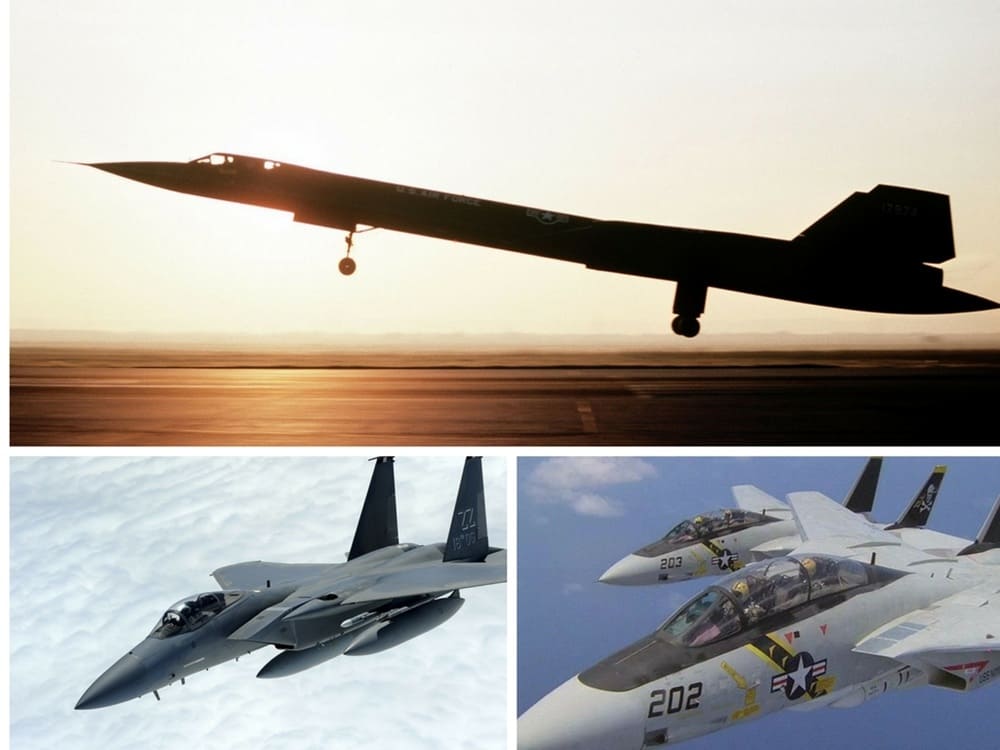
Lockheed’s SR-71 Blackbird posed an unusual engineering challenge to Cold War air-defense systems. It was not stealthy by today’s standards, and it was partially detectable by radar. Instead, it combined a small radar cross-section, very high altitude, electronic countermeasures, and sustained Mach 3 flight into a survivability system that placed extraordinary demands on radars, fighters, and missiles. One of the most telling demonstrations was not in combat but in classified and semi-classified US training exercises, Eagle Bait and Tomcat Chase.
USAF F-15 Eagles and U.S. Navy F-14 Tomcats tried to simulate intercepts of SR-71s during these sorties. “Even if the SR-71 crews told them their route, altitude and arrival time, sometimes the interceptors would still have trouble,” said former Blackbird pilots. But it was more than velocity. The incident showed a fundamental flaw in radar processing: a target could generate a radar return and still be rejected by the radar’s processing logic.
The SR-71’s Extreme Flight Envelope
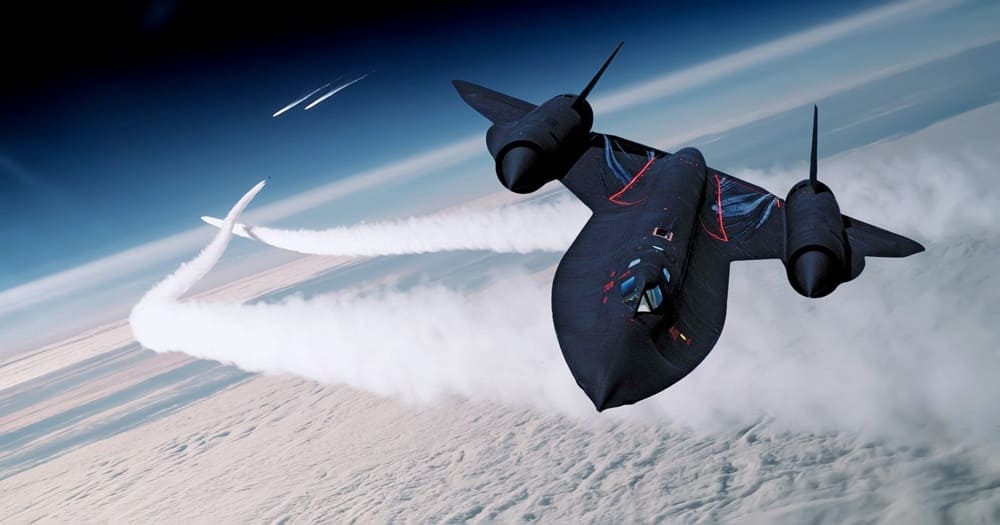
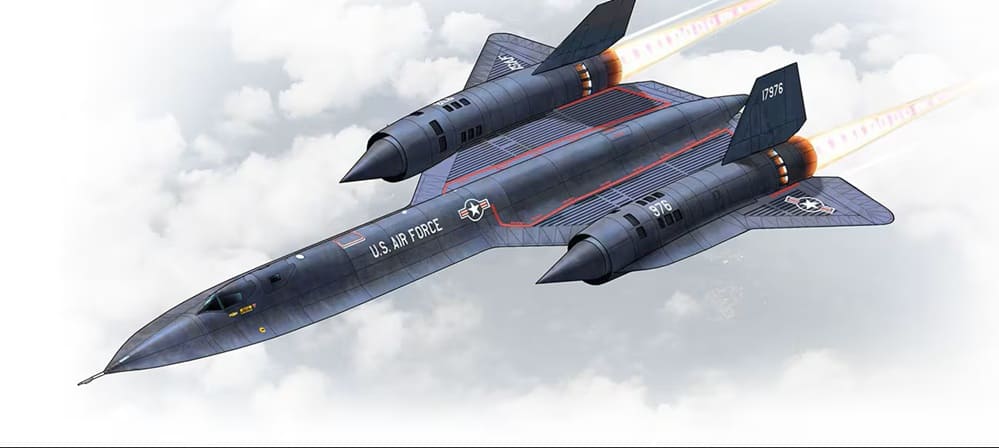
The SR-71 was designed by Lockheed to fly high and fast, at altitudes above 80,000 feet and speeds above Mach 3. NASA lists a design cruise speed of some Mach 3.2, or more than 2,200 mph, and an operating altitude of nearly 85,000 feet. The SR-71 set official records of 2,193.167 mph and 85,068.997 feet in 1976. This was a steady, sustainable pace, not a sprint over a short distance. That was the difference. Any normal fighter could do Mach 2 for a few seconds, but it used a lot of fuel to do it.
The SR-71 could hold Mach 3 for a long time. Later, NASA used Blackbirds as research platforms in part because they could remain aloft at Mach 3-plus for an hour or more. So the aircraft needed an interceptor to solve three problems at once: detect the SR-71, get a stable track, and get a missile into a viable intercept envelope before the geometry disappeared. That was a lot harder than just flying fast.
| Parameter | SR-71 Blackbird |
|---|---|
| Normal high-speed cruise | Approx. Mach 3.2 |
| Maximum demonstrated region | Mach 3+ |
| Operational altitude | 80,000–85,000+ ft |
| 1976 speed record | 2,193.167 mph |
| 1976 altitude record | 85,068.997 ft |
| Engines | 2 × Pratt & Whitney J58 |
| Engine thrust | Approx. 32,500 lb each |
| Crew | Pilot + Reconnaissance Systems Officer |
| Typical surveillance capability | About 100,000 sq mi/hour from 80,000 ft |
The Blackbird as an Intelligence Platform
The SR-71’s operational history proved the plane’s strategic importance. During the 1973 Yom Kippur War, blackbirds gained a wealth of intelligence. They tracked events after Israel’s 1982 invasion of Lebanon, supplied imagery of the 1986 U.S. strikes in Libya, and flew reconnaissance missions over the Persian Gulf in 1987 that identified Iranian Silkworm anti-ship missile sites. This mission profile also reveals a significant misconception.
The SR-71 didn’t need to fly over every target. The aircraft’s optical, electronic-intelligence and side-looking radar systems could gather information at substantial stand-off distances. “Even trying to track the aircraft could be Mach 3 intelligence.” When the enemy turned on search and fire-control radars against the Blackbird, the aircraft’s electronic-intelligence gear was able to record their frequencies, locations and modes of operation. So attempts to find the SR-71 might be valuable intelligence in themselves.
Eagle Bait: SR-71 vs F-15
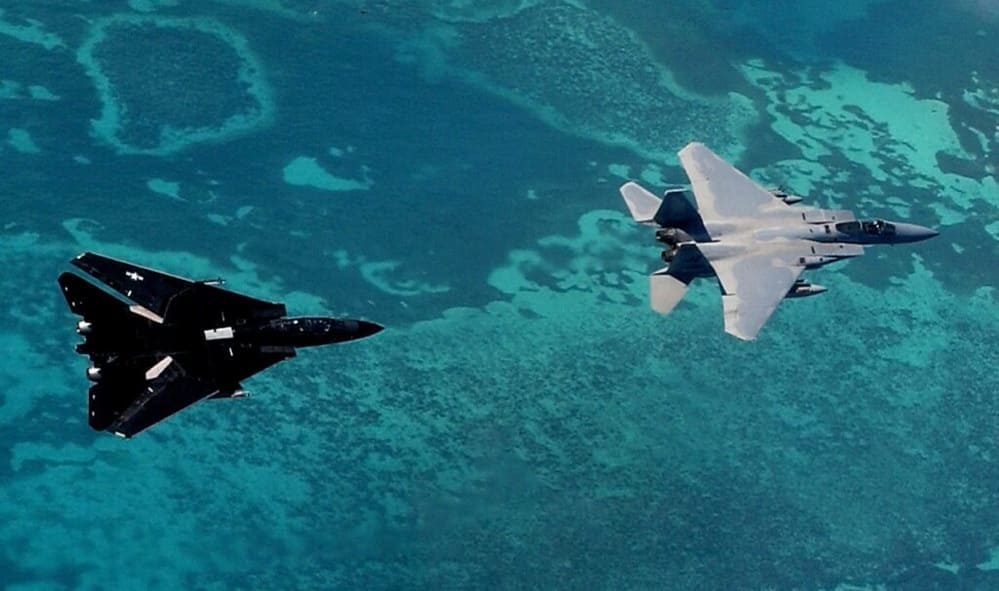
“Blackbirds were targets for special training missions of America’s top fighters,” said former SR-71 pilot Col. Richard H. Graham. F-14s flew Tomcat Chase missions, while F-15s conducted Eagle Bait sorties. The objective was straightforward. Fighter crews needed practice in detection, tracking and simulated missile engagements against an aircraft flying at very high altitude and speed.
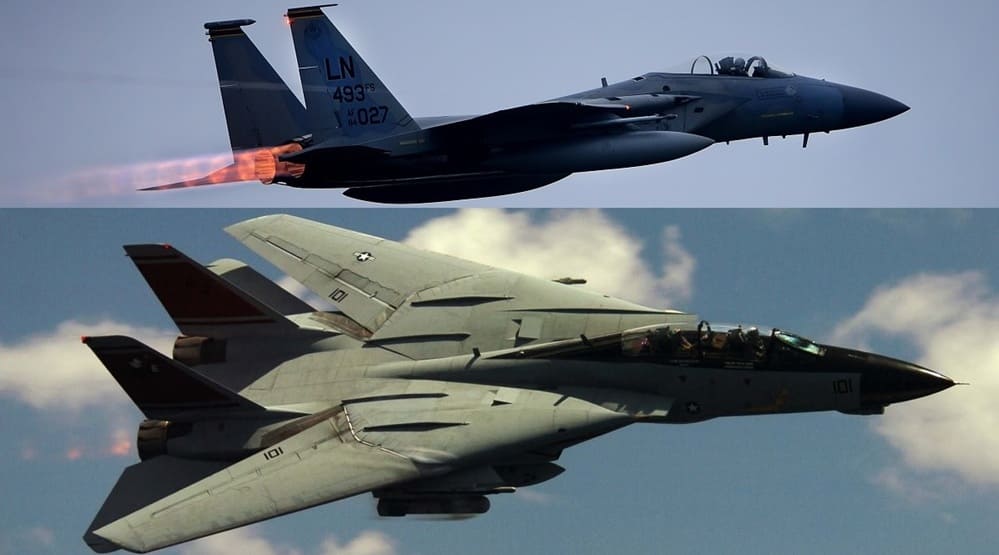
The F-14 relied on its AWG-9 radar and AIM-54 Phoenix missile system, whereas the F-15 was dependent on its AN/APG-63 radar and, for much of the period under consideration, the AIM-7M Sparrow. But the exercises rapidly exposed the gulf between theoretical weapons capability and the full kill chain.
A fighter first had to:
- Detect the target
- Recognise the return as a valid aircraft
- Establish track continuity
- Calculate velocity and altitude
- Manoeuvre into launch geometry
- Establish a weapons-quality solution
- Launch before the target crosses the engagement envelope.
Against an SR-71 moving roughly 30–33 nautical miles every minute, those stages had to happen rapidly.
The F-15 Radar Was Not Blind
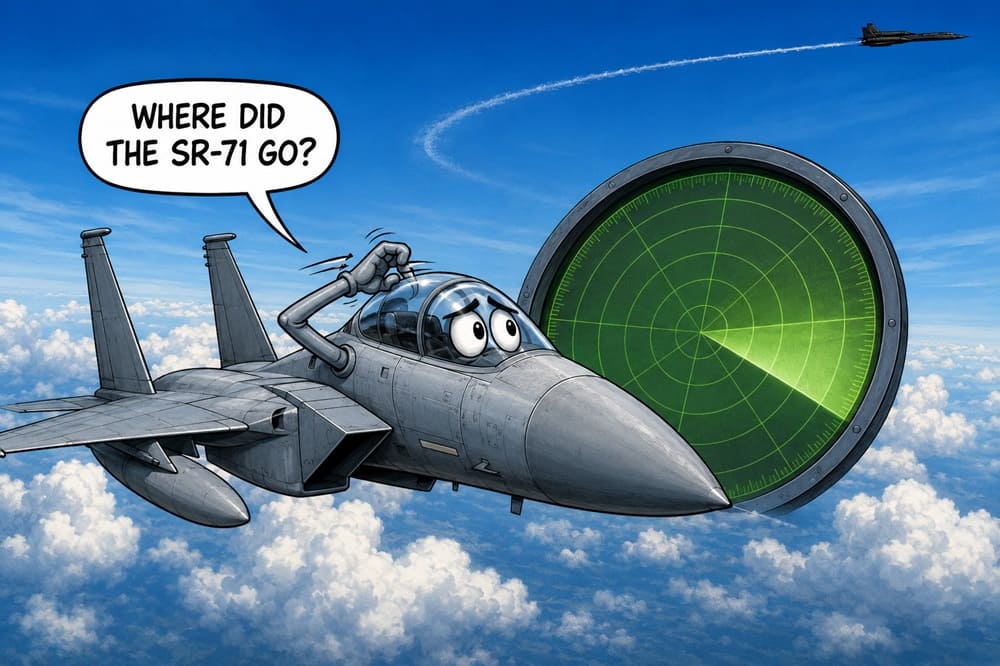
One of the more interesting stories of Eagle Bait perhaps came from former SR-71 pilot Dave Peters. The F-15s had a terrible time finding the Blackbird, Peters recalled, even when the SR-71 crew turned things off and told the fighters where they should expect to see the plane. The F-15 radar had a speed gate of around 1,500 knots, but the Blackbird was travelling at around 1,850-2,000 knots, Peters said.
In Peters’ words, the consequence was effectively that the F-15s could not find the Blackbird, even when the SR-71 crew turned things off and told the fighters where to look.
“For them, we didn’t exist.”
His story has been told in several published histories and interviews, although the 1,500-knot figure should be taken as a crew recollection, not an officially released USAF APG-63 specification. Technically, however, what he described is perfectly possible. However, radar waves would still bounce off the SR-71 and back to the antenna. The problem could be somewhere downstream of the receiver in the signal processing chain.
Pulse-Doppler Radar Limits
The early AN/APG-63 was an X-band coherent pulse-Doppler radar. Pulse-Doppler processing separates moving aircraft from terrain, clouds and other unwanted reflections by measuring the Doppler frequency shift produced by radial velocity.
The basic relationship is:
fᵈ = 2vᵣ / λ
where:
- fᵈ = Doppler frequency shift
- vᵣ = Radial velocity
- λ = Radar wavelength
Take an X-band radar. Wavelength is around 3 cm. A radial velocity of 1500 knots corresponds to a Doppler shift of ~51 kHz. At 2000 knots the shift is nearly 69 kHz. In a head-on intercept, the Doppler shift becomes even more extreme. If you have an SR-71 closing near 2,000 knots and an F-15 closing at about 1,000 knots, then the closure could be near 3,000 knots. That is a 100 kHz signal. The Doppler shift in the X-band depends on the exact geometry and radar frequency. Early fighter radars could not process all possible frequency returns indiscriminately.
Signal processors then employed filters and velocity gates to discriminate true aircraft returns from clutter, noise, sidelobes and ambiguous returns. If a target’s Doppler signature was outside the expected processing window, the radar might reject it or fail to display it properly. Therefore, Blackbird created a curious situation: The more obvious the velocity signature, the easier it was for the erroneous radar filtering logic to mark the return as invalid. The aircraft could be seen with the naked eye. It was outside the assumptions embedded in the target-processing logic of the radar.
The Closing-Velocity Problem
An SR-71 at about Mach 3.2 would take about one second to cover a kilometre. “A fighter coming from the other side would produce an extraordinary closure rate. For example, engagement. An F-15 caught an SR-71 at 100 nautical miles with a closure of about 3,000 knots combined. The separation would disappear at a rate of about 50 nautical miles a minute.
So an intercept of 100 nautical miles only gives you about two minutes before the two aircraft pass each other. The fighter has to detect, classify, lock, manoeuvre, satisfy missile parameters and fire in those two minutes. A 30-second delay in detection could cost about 25 nautical miles of separation. Detection range alone was not enough; that was why. Time to engagement on the Blackbird was as important as radar coverage.
ECM Disrupted the Engagement
Speed was only one component of SR-71 survivability. The Reconnaissance Systems Officer noted that the SR-71 carried advanced ECM systems to jam acquisition and targeting radars. Graham recalled that in fighter exercises the interceptors occasionally had to disable the Blackbird’s defensive systems to obtain satisfactory simulated engagement solutions. The real SR-71 intercept involved a number of interacting variables, including radar cross-section, ECM, altitude, speed, closure rate, fighter position, and missile kinematics.
You don’t judge a man in a hoover. The Blackbird was designed to defeat radar for decades before the stealth fighters came along. Its blended, chined fuselage and canted vertical stabilisers reduced radar returns from certain angles. Special coatings on the black surfaces also helped to control heat and absorb radar energy. However, the SR-71 didn’t rely on stealth alone. Its philosophy was more akin to delayed detection, degraded tracking, throwing off the weapons solution, then outrunning the engagement.
Declassified Records Reveal ECM’s Importance
There is some of the most interesting data on the survivability of Blackbirds in once-classified documents. A prior TOP SECRET CIA assessment of OXCART/A-12 and SR-71 vulnerability also included consideration of radar cross-section and electronic countermeasures. The study indicated that both aircraft have relatively low clean radar cross sections, and the SR-71’s vulnerability to the SA-2 threat depends heavily on how effective the installed ECM is. Another declassified CIA document reveals just how technically aggressive the countermeasure development on the Blackbird had become.
The paper describes threat warning and jamming concepts for S- and C-band threats, including barrage/deceptive techniques and high-power jammer concepts that reach around 20 kW in some configurations. These figures provide a partial snapshot of the ultimate operational SR-71 defensive suite. The aircraft’s career profiles changed dramatically, and parts of the defensive architecture remained sensitive for decades. The papers do show one important thing: the survivability of the Blackbird was purposely engineered as an electronic-warfare problem and not merely as an aerodynamic one.
Why the F-14 Performed Better
“Sometimes the F-14s had better luck finding the SR-71 than the F-15s,” Peters said. This is not entirely surprising. The Tomcat was originally designed as a fleet defense interceptor, intended to kill high-speed Soviet bombers and cruise-missile carriers at very long range. The AN/AWG-9 combined with the AIM-54 Phoenix gave the ability to detect and intercept at long range. The F-15 is a highly capable air-superiority fighter but born out of a slightly different operational requirement. Even the Tomcat, it seemed, needed help.
According to Peters and Graham, successful exercises increasingly involved giving fighter crews the Blackbird’s route and altitude.
- Route
- Altitude
- Speed
- Timing
- Expected: This approach dramatically
This approach dramatically reduced the search problem. Once the fighter already knew where and when to look, its radar no longer had to discover an unpredictable Mach 3 target across a vast volume of airspace.
Tilting the Odds Against the Blackbird
Some accounts also suggest that later training profiles restricted the SR-71 to make fighter intercepts more feasible. This meant, of course, less speed and height, fixed routes, and precise timings. Such conditions are important for evaluating claims that an F-15 or F-14 achieved a simulated ‘kill’. A scripted intercept is one thing; encountering a working Blackbird with no warning is an entirely unique situation. Just imagine the difference.
Controlled exercise
The fighter knows:
- Approximate heading
- Altitude
- Arrival time
- Geographical intercept point
- Target type
Real-world interception
The fighter may have:
- Uncertain target position
- Uncertain altitude
- Delayed ground-radar information
- Rapidly changing geometry
- Active SR-71 electronic countermeasures
- Limited fuel
- Limited missile engagement time
The difference is enormous. Eagle Bait therefore demonstrated that a theoretical missile envelope did not automatically translate into an operationally achievable kill.
Missile Kinematics Were the Final Barrier
Even when the radar obtained the SR-71, the fighter still faced missile-energy restrictions. The target was already at impulsive altitude, velocity and kinetic energy. One AIM-7 Sparrow launched from below had to climb up to the target aircraft, which was fleeing at many times the speed of sound. The missile was heating up, climbing in a stern chase to catch the Blackbird.
A frontal engagement gave more closure but drastically reduced the engagement time. The best solution was thus often to place the interceptor ahead of the expected flight path of the SR-71 and launch into good geometry. That was the turning point in interception: foreknowledge of the Blackbird route. They could work out the geometry before the target arrived. Without that info, the fighter could be in the engagement zone before the SR-71 finished the kill chain.
Why the Blackbird Chose Speed
Traditional fighters avoid missiles by turning hard, using electronic warfare, deploying countermeasures, and taking advantage of terrain. One more thing the SR-71 did. It went faster. Aerodynamic margins were much smaller than those of conventional fighters at around 80,000 ft, so aggressive manœuvring was not desirable. Blackbird crews could instead speed up and climb.
This tactic forced an attacking missile to:
- Climb into thinner air
- Overcome gravitational potential
- Maintain sufficient control authority
- Overcome enormous target velocity
- Preserve enough energy for terminal manoeuvring
Every second of delay favoured the SR-71. The defender therefore weaponised time, altitude and energy.
The Strategic Lesson of Eagle Bait
The lesson of Eagle Bait was that the F-15’s radar was working. The APG-63 was one of the most successful fighter radars of its day. But the exercises highlighted a perennial problem in military technology: systems were built for the threats they expected. The SR-71 operated so far outside the normal fighter-target envelope that some of the assumptions built into radar processing, intercept doctrine, and missile employment became problematic.
If Peters’ story about the 1,500-knot processing gate is accurate, then this incident is an extraordinary example. The radar could have picked up energy reflected off the Blackbird, but its processing architecture apparently did not initially recognise an extreme-velocity return as a normal target. To put it simply, the SR-71 did not really outwit radar by being stealthy. It spoofed the radar by acting like a target that the radar wasn’t programmed to expect. Technically that’s a much more interesting distinction.
The Blackbird’s Exceptional Survivability
The SR-71’s operational survivability ultimately resulted from multiple layers:
- Very high sustained speed
- Extreme operating altitude
- Reduced radar signature
- Sophisticated electronic warning equipment
- Active electronic countermeasures
- Carefully planned routes
- Intelligence on enemy radar systems
- Enormous kinetic-energy advantage
Conclusion
There was nothing invulnerable about the aircraft. Together, however, they formed a reconnaissance platform that was maddeningly difficult to engage. Eagle Bait demonstrated the problem, particularly under conditions that were most favourable for the intercepting fighters. Eagles knew the target was live. They had a vague idea where it would turn up.
Later in exercises, they could get more and more detailed information about its flight profile. But it could be tricky to get a believable simulated kill. This figure may be the best measure of the SR-71’s engineering achievement. Not just fast, the Blackbird was. It was going so high and so fast that it could compress an opponent’s detection-decision-weapons engagement cycle to the point that even some of America’s most advanced Cold War fighters found it difficult to complete at first.
References
- NASA — SR-71 Blackbird Fact Sheet. Technical information on Mach 3.2 cruise, altitude, propulsion and flight performance. (NASA)
- Smithsonian National Air and Space Museum — Lockheed SR-71 Blackbird. The operational history includes radar-signature reduction, reconnaissance missions, and electronic countermeasures. (National Air and Space Museum)
- Central Intelligence Agency, declassified OXCART/SR-71 vulnerability and ECM documentation. Formerly classified assessments concerning radar cross-section, jamming and SA-2 survivability. (CIA)
- Richard H. Graham / Dave Peters accounts reproduced by The Aviation Geek Club — Eagle Bait and Tomcat Chase. Firsthand recollections of F-14/F-15 interceptions and the reported F-15 radar speed-gate problem. (The Aviation Geek Club)
About the Author