
What Soviet vs Western Tanks Really Reveal
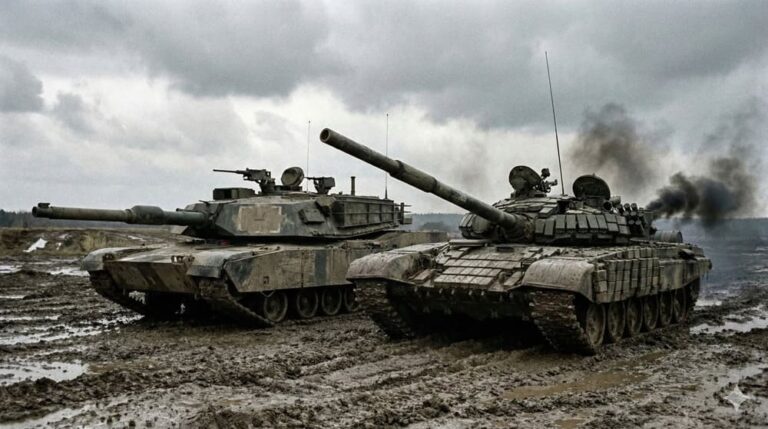
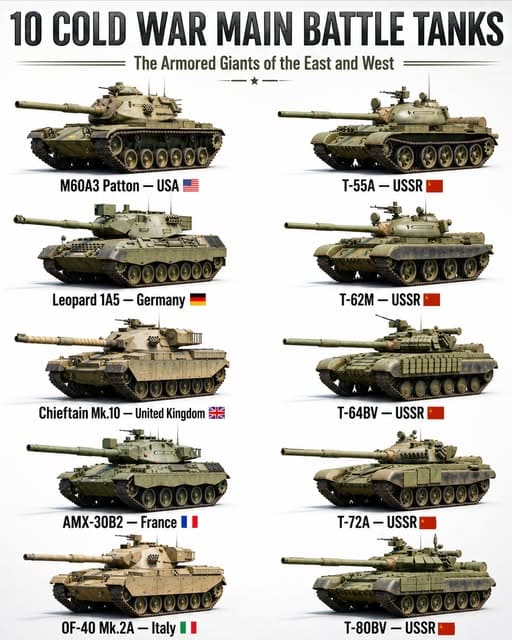
Soviet designers generally prioritised low silhouettes, lighter vehicles, powerful guns and mass production. From the T-64 onwards, autoloaders reduced the required crew from four to three. Western designs, however, emphasised crew safety, optics and long-range fire control. But neither was a guaranteed winner. Even the best tank will be useless without fuel, repairs, recon, or infantry support.
Korean War, 1950–1953: T-34/85 versus M26 and M46
The North Koreans invaded using T-34/85 tanks from Soviet supplies. They brushed aside South Korean troops and beat early American M24 Chaffees. But the arrival of M26 Pershings, M46 Pattons and up-gunned M4 Shermans changed that balance. Their guns could out-range the T-34/85. Better ATGM teams, air strikes, and battlefield control ended North Korea’s early armoured advantage.
Vietnam War, 1965–1975: T-54/55 versus M48
In the 1972 Easter Offensive, North Vietnamese T-54s spearheaded major assaults. They saw South Vietnamese M48A3s around Dong Ha and Quang Tri. But each could also kill the other under optimal conditions. A lot of the North Vietnamese losses were due to mines, artillery, American air power and TOW missiles. So the campaign was not testing the two design philosophies of tanks but whole combat systems.
Yom Kippur War, 1973: T-55 and T-62 versus NATO Tanks
Egyptian and Syrian T-55s and T-62s were used against Israeli Centurions, M48s and M60s. Egypt also crossed the Suez Canal under intense artillery cover, while infantry equipped with anti-tank weapons protected the advancing armour. However, Israeli reserves, artillery, battlefield command and rapid vehicle recovery regained much of the lost ground. Syrian forces exploited surprise and mass in the Golan Heights. The breakthrough resulted from planning, not the T-62.
Iran–Iraq War, 1980–1988: T-72 versus Chieftain and M60A1
Iran had British Chieftains and American M60A1s, while Iraq had Soviet T-72s. In addition, the T-72 had a 125 mm gun, an autoloader and decent mobility. The Chieftain had a powerful 120 mm gun and heavy frontal armour. But there is no clear technical winner as yet in the public record. Later, Iraq held advantages in artillery, logistics, force concentration and operational adaptation. The autoloader alone cannot explain the outcome.
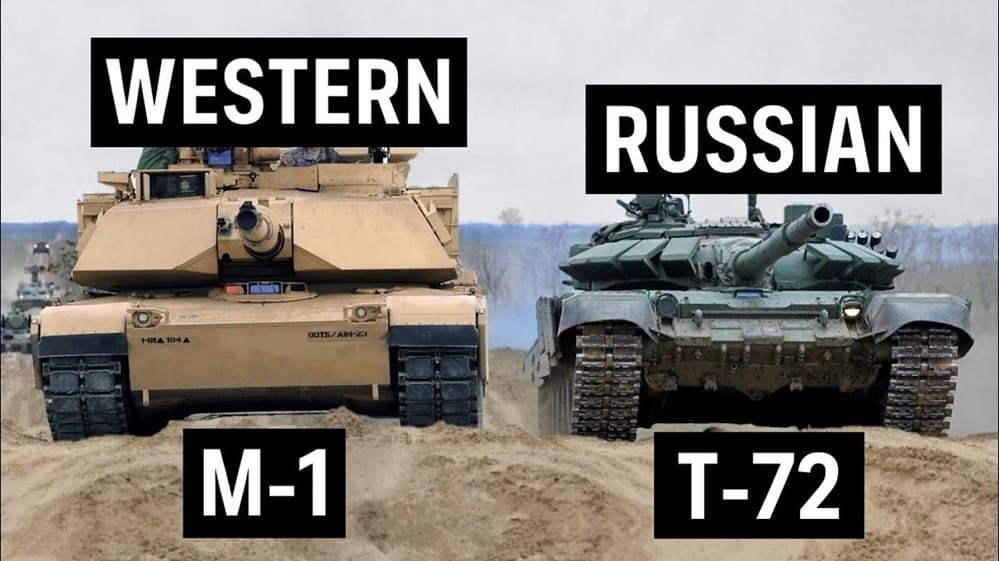
Gulf War, 1991: T-72 versus M1A1 Abrams
The Gulf War revealed the most obvious division between Soviet and Western armoured forces. American M1A1 Abrams and British Challenger 1 crews fought Iraqi T-72s and older tanks at night, from long range. They differed in coalition thermal sights, ammo, training and command networks. Furthermore, air strikes and artillery had already broken up many Iraqi formations. The U.S. Army’s official history records a ground war lasting only 100 hours. Therefore, the result reflected an entire combat system. A related Abrams and Iraqi T-72 analysis examines this technological gap.
Indo-Pakistani Wars, 1965 and 1971: Correcting the Record
India did not deploy the T-54 or T-55 at Asal Uttar in 1965. Its Centurions, Shermans and AMX-13s clashed with Pakistani M47/M48 Pattons and other vehicles. So the victory can’t be attributed to Indian Soviet tanks. Indian forces destroyed, captured or lost some 97 Pakistani tanks. The result was determined by field preparation and defensive tactics. Later, India inducted T-55s. They were used against Pakistani Pattons and Chinese-designed Type 59s in 1971.
Angolan Civil War, 1975–2002: T-55/62 versus Olifant
FAPLA and Cuban forces used T-55s and T-62s against South African Olifants, which were based on the British Centurion. This war had no clear winners. The campaign at Cuito Cuanavale in 1987-88 was a partial success. “South Africa and UNITA stopped the advance of FAPLA and inflicted heavy losses. But later, Cuban and FAPLA troops held the Tumpo defensive line. The wider campaign then paved the way for regional negotiations and withdrawals.
Ethiopian–Eritrean War, 1998–2000: Not an M60 Duel
There are no signs of Eritrean M60s fighting Ethiopian T-55s. Both sides had tanks of Soviet design, predominantly the T-55 family. This means that the conflict is not a basis for comparing western and Soviet tanks. 2000: Ethiopia penetrated major defensive lines with massed artillery and attacks on fixed positions.
Russo-Georgian War, 2008: T-72 against T-72
Russian T-72Bs and T-62s fought Georgian T-72SIM1s, which were upgraded with Israeli help to improve their sights, radio and protection. Georgia had a few new vehicles with better electronics. Russia did not use the T-72B3, which would enter service several years later. Russia, on the other hand, provided more artillery and massive support. Open source estimates put Georgian T-72 losses at about 30, including tanks captured.
Syrian Civil War, 2011–Present: T-90 and Leopard Claims
There are videos of Syrian T-90s getting hit by TOWs and surviving. In those cases, the critical factors were the impact angle, the explosive reactive armour Kontakt-5, and the actions of the crew. No T-90s were destroyed or captured. In 2016–17 Turkey lost Leopard 2A4s and M60 variants near Al-Bab. They fell to IS missiles, mines and homemade and car bombs. Syrian T-90s have never faced a Turkish leopard in a decisive battle.
Yemen War, 2015–Present: Abrams versus Missile Teams
Houthi forces have destroyed a number of Saudi M1A2S Abrams tanks. The videos often feature guided missiles, short-range weapons or attacks on stationary vehicles. There is, however, no evidence of sustained T-72/T-80 vs Abrams fighting. There’s not much to back the T-80 claim. Yemen had Soviet-built tanks before the war. But Saudi Abrams also lacked Trophy active protection, leaving the tanks more vulnerable to guided missiles.
Libyan Civil War, 2011–Present: Shared Soviet Armour
Libya is not a natural T-72 vs M60 test. Both Gaddafi’s forces and the revolutionaries were using Soviet-designed tanks, including captured T-72s and T-55s. Libya had French AMX-30s; there was no sign of rebel M60s. Poor maintenance and logistics also hampered the operation of tanks at the same time. NATO airstrikes destroyed many pro-Gaddafi heavy units back in 2011. Consequently, air power prevented meaningful comparison between the opposing tank designs.
Ukraine War, 2022–Present: T-90M, Leopard 2 and Challenger 2
Russia has fielded T-90Ms, and Ukraine has Leopard 2A4/A6 and Challenger 2 tanks. Western vehicles have decent optics and crew protection, but the T-90M has a lower profile, modern sights, better protection and a 125mm autoloader. But direct tank battles are still not confirmed. Most of the damages recorded are due to mines, artillery, drones and anti-tank missiles. Both sides also have drones for locating and targeting tanks. But the evidence to date is that Russian shells have not negated the West’s design advantages.
Technical and Operational Lessons
Soviet vs Western tanks, infantry, engineers, artillery, air defence, and recon were the best in those wars. The unarmoured support kept running into ambush, minefields or missile engagement zones. But modern protection isn’t just heavy steel. It has composite and reactive armour, active protection, electronic warfare capabilities and roof defences. With the advent of drones, cover and concealment from above are a must. The modern tank armour guide explains this multi-layered approach to protection. And optics often dictate who fires first. Logistics will decide the fight of tomorrow. Spare parts, recovery vehicles, trained personnel and secure radios may be more important than a slight edge in the performance of your guns.
Strategic Assessment
Soviet Tanks vs Western Tanks: history has no permanent victors. Western vehicles generally had better visibility, fire control and crew protection. Soviet designs, however, were smaller, more heavily armed, easier to mass-produce and more generally adaptable. However, it was doctrine and execution that decided the outcome of armies. Korea, the Gulf War, and Ukraine prove the same rule: tanks are just part of the combat system. A RUSI assessment of heavy armour reaches a similar conclusion. Tanks will still have a role, but armies will need to adapt their tactics and their protection. Future armoured formations will need UAVs, active protection, EW and multi-layered air defence. Without these systems, no matter how powerful a tank is, it is vulnerable.
References
- Latest Tank Armour Technologies in 2026
- How Abrams Crushed Iraqi Lions of Babylon
- U.S. Army—War in the Persian Gulf
- RUSI—Heavy Armoured Forces in Future Warfare
About the Author