
Top 3 Anti-Tank Guided Missiles Explained (2026 Guide)
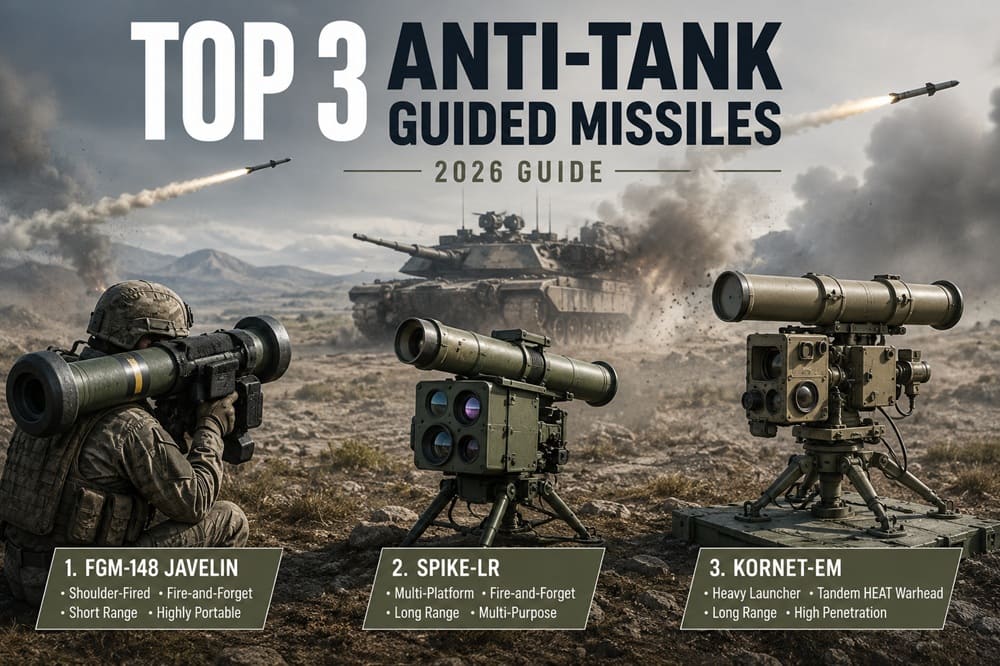
Anti-tank guided missile systems have revolutionised land warfare, enabling infantry and light vehicles to defeat heavily armoured main battle tanks (MBTs). More complex countermeasures are needed against modern armour, including composite plating, explosive reactive armour (ERA), and active protection systems (APS). So now, anti-tank guided missiles sit at the centre of infantry anti-armour doctrine across NATO, Russia and Israel. This article examines three of the most operationally significant systems, the FGM-148 Javelin, 9M133 Kornet and Spike-LR2.
Why ATGMs are Important
Since the 1970s, the anti-tank guided missile has been the primary infantry anti-armour weapon, gradually replacing unguided rockets and recoilless rifles. Early wire-guided systems such as the M47 Dragon required constant operator input while the missile was in flight. In engagement scenarios, these systems put gunners in considerable danger. Recent designs have addressed this vulnerability with autonomous seekers, extended stand-off ranges and tandem warheads to defeat ERA. Today’s anti-tank guided missiles are the result of decades of iteration balancing survivability, penetration power and cost.
Fire-and-Forget FGM-148 Javelin
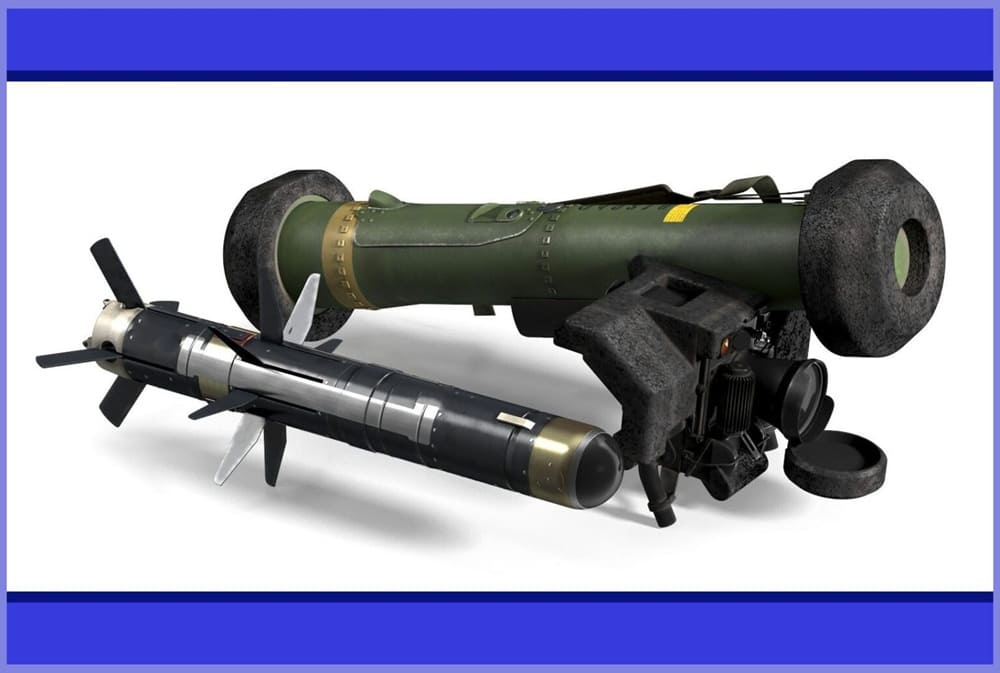
The Javelin was jointly developed by Raytheon and Lockheed Martin and entered US service in 1996. The imaging infrared (IIR) seeker acquires the target prior to launch, so the operator does not have to maintain the line-of-sight after launch. The exposure time of the gunner is thus shortened to about 3–5 seconds, allowing displacement to occur. The Javelin has a tandem charge high-explosive anti-tank (HEAT) warhead. The precursor charge detonates the ERA first. Then the main shaped charge punches through the base armour, which analysts estimate to be equivalent to 600–800mm of rolled homogeneous armour.
Effective range varies from 65m to about 2500m in the Block 0/1 configuration and increases to about 4000m with the introduction of the Lightweight Command Launch Unit in 2020. There is also a soft-launch mechanism which blows the missile out slowly before the main motor ignites so it can be fired safely from enclosed spaces. However, open-source reports from 2022–2024 suggest that the T-80U and T-90A still perform well against older T-72 and T-80 variants, while analysts continue to debate their effectiveness against tanks equipped with hard-kill APS, such as Afghanit.
Range and Penetration of 9M133 Kornet
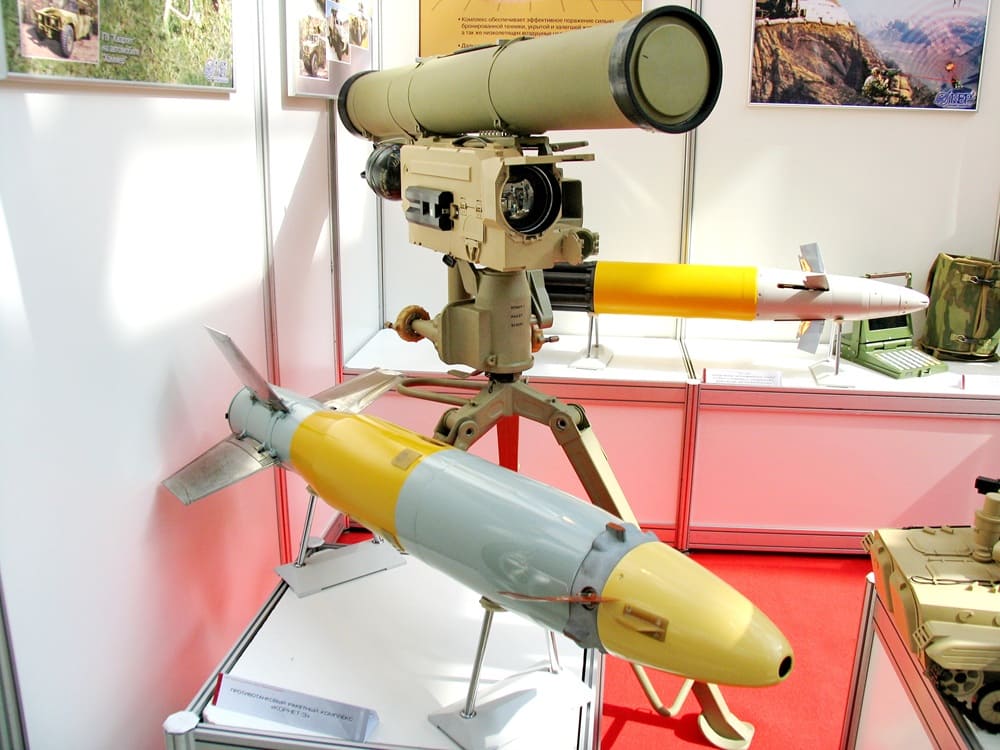
The Kornet, known as the AT-14 Spriggan by NATO, was introduced in 1994 by Russia’s KBP Instrument Design Bureau. It is not the same as the Javelin in that it uses semi-automatic command to line-of-sight (SACLOS) laser beam-riding guidance. So the operator has to keep tracking the target throughout the entire engagement. Survivability trades off for range and lower cost per unit. The standard Kornet-E can target armoured targets out to 5,500 metres, while an extended-range Kornet-EM variant can target static targets out to 10,000 metres.
It has an automated launcher on a turret that can shoot at two targets at the same time. Analysts say the 9M133F-1 tandem-charge warhead can penetrate over 1,200mm RHAe behind ERA, one of the highest figures publicly claimed for any fielded ATGM.
The 9M133F is a thermobaric variant, designed to destroy personnel and light structures. The Kornet-EM missiles are supersonic, reaching speeds of more than 400 metres per second at certain points in their flight, which reduces their time of flight and improves the chances of hitting moving targets. The need for a continuous line-of-sight, however, also exposes the operator to suppression during flight times of more than 20 seconds at maximum range.
Flexible Guided Spike-LR2
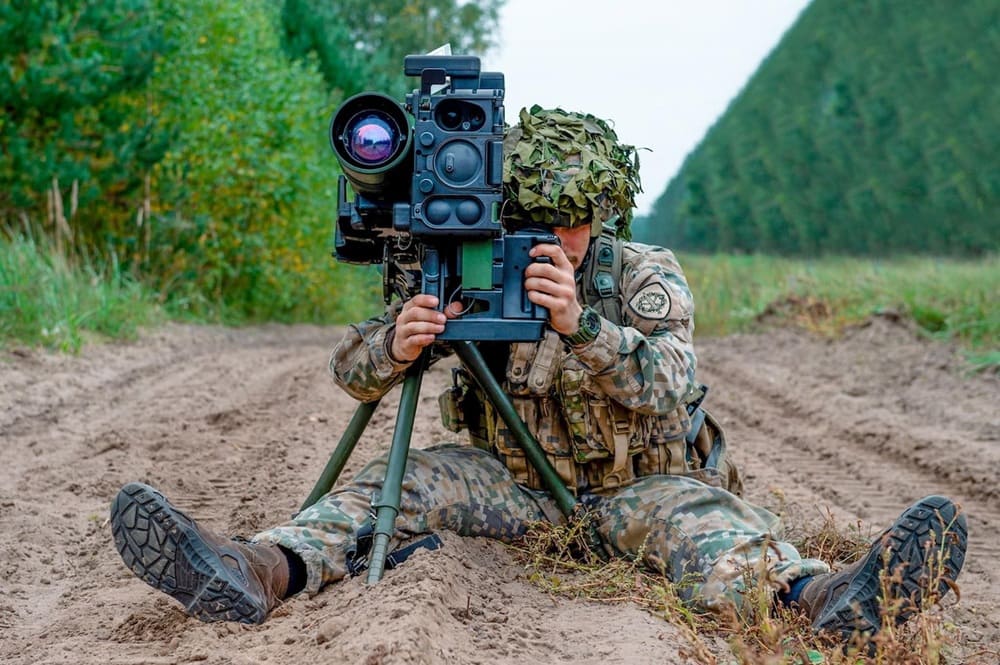
Israel has a wide export of the Spike family, which is now in service in more than 30 countries. The Spike-LR2, the second-generation long-range variant, is manufactured by Rafael Advanced Defense Systems. The Spike-LR2 has an electro-optical/infrared (EO/IR) seeker and fibre-optic and radio-frequency data links, which allow it to use fire-and-forget, fire-and-observe, or fire-and-update modes. The hybrid guidance allows the operator to re-select targets or adjust aim points while in flight.
Its longer range, topping out at 5,500 metres, is an improvement over the original 4,000-metre Spike-LR. Sources estimate its tandem warhead can penetrate 900–1,000mm of RHAe, approximately on par with the Kornet, but exact classified figures vary from source to source. And the data link also sends back real-time video to the command launch unit, giving analysts a battle-damage-assessment capability not found in fully autonomous systems like the Javelin.
Technical and Strategic Analysis
| Parameter | Javelin | Kornet-EM | Spike-LR2 |
|---|---|---|---|
| Guidance | IIR, fire-and-forget | SACLOS, laser beam-riding | EO/IR, fibre/RF hybrid |
| Maximum range | ~4,000m | ~10,000m (static targets) | ~5,500m |
| Penetration (RHAe) | 600–800mm | 1,000–1,200mm+ | 900–1,000mm |
| Operator exposure | Low | High | Low to moderate |
The systems reflect different doctrinal emphases. The Javelin relies on autonomous guidance for gunner survivability. The Kornet maximises range and penetration, but at the cost of prolonged exposure. The Spike-LR2 combines the two approaches with selectable guidance modes.
Operational Impact
The experience of combat since 2022 has shown the significant impact of anti-tank guided missiles on armoured manoeuvre warfare, forcing tank crews to operate at greater stand-off distances and to rely more heavily on active protection systems. However, analysts say hard-kill APS may slowly erode the advantage of legacy tandem-charge warheads, citing the future of anti-tank guided missiles swinging toward higher-penetration or multi-mode seekers.
Final Assessment
There is no single system that is clearly the best. Ultimately, selection is a trade-off between doctrine, threat environment, and the relative importance of fire-and-forget survivability versus command-guided flexibility. Protection from body armour is also evolving, and anti-tank guided missiles will remain a key component of infantry anti-armour strategies for the foreseeable future.
References
- https://www.example-defence-site.com/weapons/anti-tank-systems
- https://www.example-defence-site.com/analysis/armoured-warfare-2026
- https://www.army-technology.com/
- https://www.rafael.co.il/
About the Author