
What Happens When a Nuclear Missile Is Intercepted?
You do not get a nuclear detonation if you take out a nuclear-armed ballistic missile with an interceptor. More than impact, heat, or fire is necessary for full nuclear yield. The warhead has to go through its proper arming, fuzing, and firing sequence. Then its chemical explosives must compress the fissile core to the required supercritical geometry.
Instead of completing the sequence, an interceptor usually breaks it. Never has an incoming nuclear-tipped ballistic missile been intercepted in wartime, at least not publicly. Four possible outcomes of tests, accidents, and nuclear trials are breakup, chemical explosion, radiological dispersal, or nuclear yield.
Why Impact Rarely Causes Detonation
The implosion-type uses a plutonium pit surrounded by shaped high explosives. For nuclear yield, we want one controlled, almost symmetrical inward shock. Intercepting makes loads asymmetric. It usually blows the electronics, burns the circuits, warps the explosive elements, or spreads the pit.
Documentation of American protections presents additional barriers. The W76-1/Mk4A firing system consists of a launch accelerometer and two strong links. Stronglinks open only to the right signals. Weak links are designed to fail first under abnormal stress, disabling the circuit. The U.S. Nuclear Matters Handbook warns, “Not all warheads have all safety features.
Another little-discussed character comes from the Department of Energy’s one-point-safety standard. The probability of exceeding a nuclear yield of four pounds of TNT from a one-point initiation shall be less than or equal to one in a million. However, interception can involve penetration, fire, fragmentation, and multiple effects, depending on the engagement. ry engagement.
The Physics of Hit-to-Kill
Current non-nuclear interceptors are relative kinetic energy based. At 10 kilometres a second, every kilogram you remove from the impact mass is equivalent to 50 megajoules. This is equivalent to almost 12 kilos of TNT energy delivered in milliseconds.
The collision can destroy the re-entry vehicle, but “destroyed” does not mean “vaporised”. Downrange may contain dense fragments. Large pieces have less drag, heat, and ablation. Impact may cause or initiate asymmetric detonation of conventional explosives. It can disperse plutonium, uranium, beryllium, and other materials, but with no significant nuclear yield.
A full nuclear yield could still be achieved under some limited conditions. The warhead can cut off its firing sequence just before impact. Another exception is a nuclear-armed interceptor, where the burst is intentional. Nuclear effects don’t have to make the target explode.
Altitude Shapes the Outcome
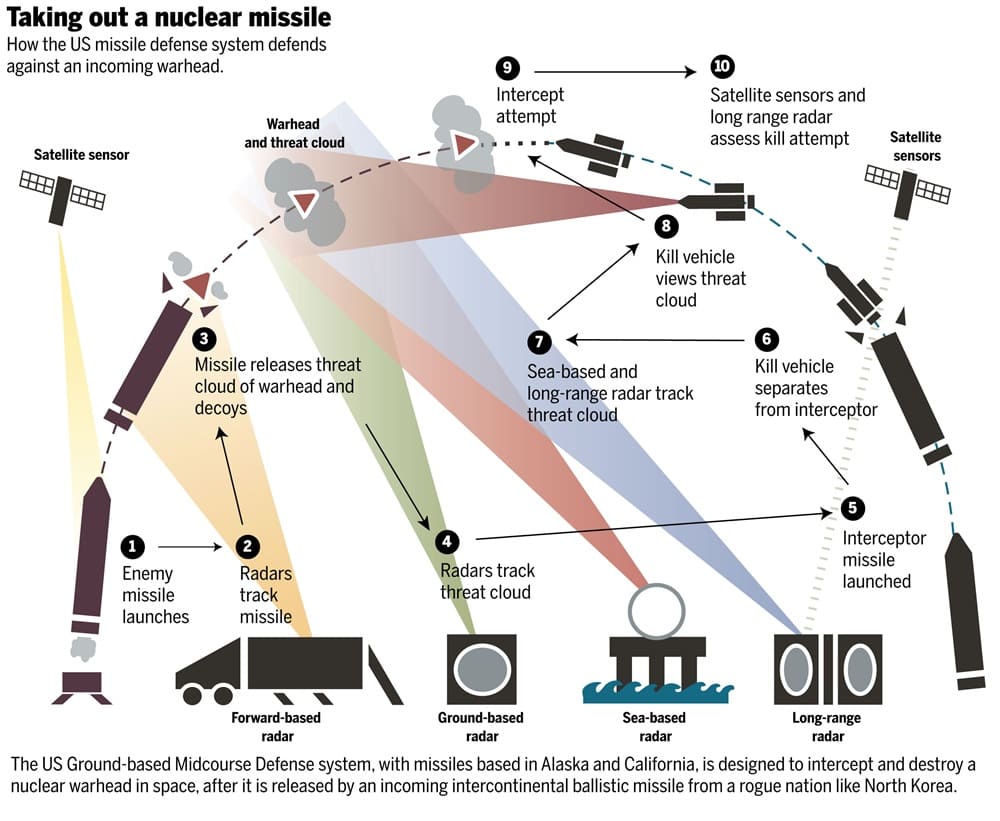
The Missile Defense Agency divides a ballistic flight into three phases: boost, midcourse, and terminal. Boost defense has a limited time frame of one to five minutes. It intercepts during the midcourse phase, above most of the atmosphere. Terminal interception (after re-entry) in the vicinity of the target area.
Conventional blast shock waves cannot propagate through the near-vacuum of space as they do in the atmosphere. Nevertheless, exo-atmospheric kinetic interception remains feasible because the interceptor destroys its target through direct collision rather than atmospheric overpressure. The resulting fragments follow altered trajectories, and some may subsequently re-enter the atmosphere, depending on their velocity, altitude, and ballistic characteristics.
Terminal intercept takes the threat to the target. Debris, explosives, and fissile material could be falling to earth. Commanders are to treat success as air defense and a possible CBRN incident. The response includes plume modelling, monitoring for contamination, exclusion zones, and forensic recovery.
Effects of a Nuclear Airburst
The blast was about 50% of standard nuclear energy, said a joint U.S. military medical handbook. Thermal radiation is 35%, and prompt radiation is 5%. Residual radiation is 10%. These fractions are design- and environment-dependent.
A low airburst provides maximum blast coverage against surface targets. It’s a fireball that bounces on the ground and picks up much less soil. So fallout from an airburst, as defined by the CDC, is relatively minor compared to a surface burst. Fission products are still airborne, and rain can bring about local deposition.
The blast radius is not proportional to the yield. The idealised characteristic distance is the cube root of the yield. Doubling the yield increases the comparable radius by about 26%. Actual damage is modified by terrain, weather, construction, and burst altitude.
Above roughly 50 kilometres, the ground blast diminishes and electromagnetic effects dominate. E1 is an increase of nanoseconds that attacks electronics. E2 resembles a lightning current. E3 couples into long power and communications lines. The DOE EMP action plan identifies large HEMP environments of 30-400 km. The potential fields are of the order of hundreds or thousands of kilometres, with tens of kilovolts per metre.
Three Cases Explain the Risk
The most obvious accident to compare it to is Palomares. 1966: A B-52 crashed into a KC-135 over Spain. Four nuclear bombs dropped without arms. Two didn’t. Two burnt and spread plutonium over farmlands. Contamination occurred, but there was no nuclear blast, according to energy department records. The impact created a radiological emergency, not a nuclear explosion.
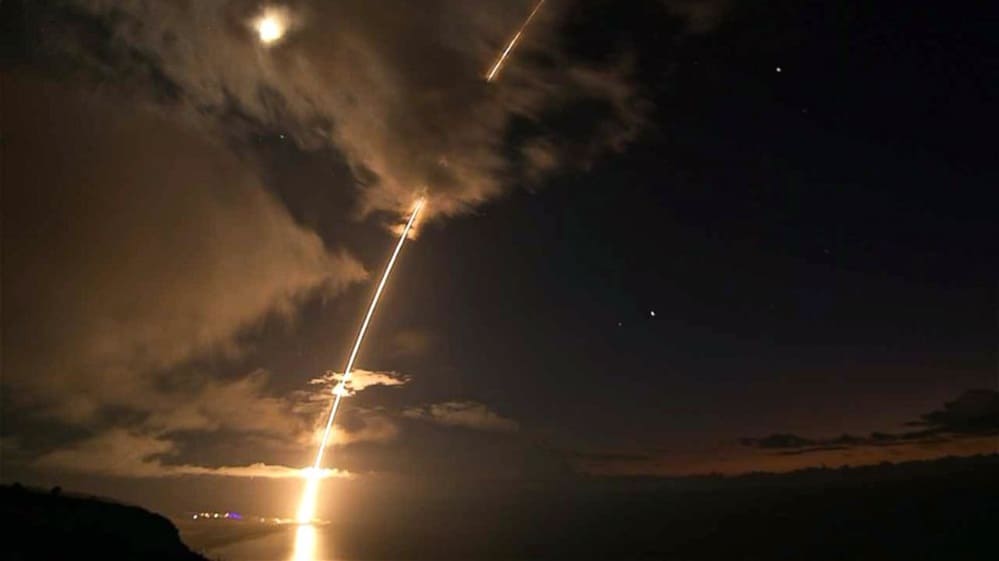
A modern example of interception is the FTG-15. A ground-based interceptor destroyed an ICBM class target in the Pacific on May 30, 2017. It was the first time the class had ever been shot at live. The target did not have a working nuclear package. FTG-15 was a development test of engagement performance, not warhead safety on impact.
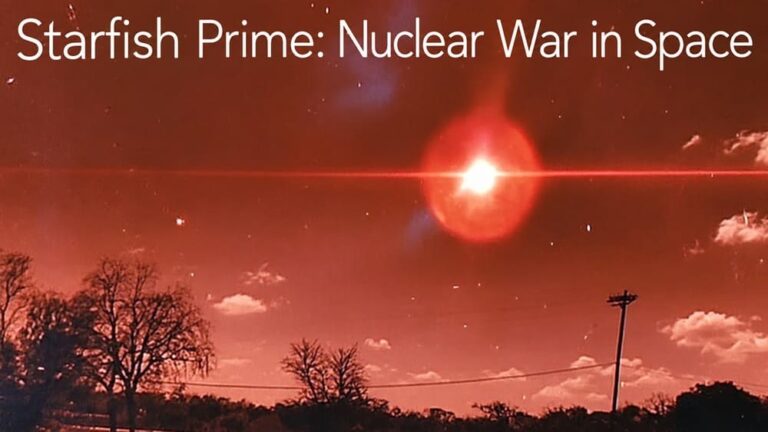
Starfish, in July 1962, represents the other extreme. In July 1962, America exploded a 1.4-megaton device at 400 kilometres. NASA logs: synthetic radiation belt, satellites destroyed. This evidence implies effects of high-altitude nuclear explosions can propagate well outside the engagement volume.
Cold War planners took the chance. Guarded by nuclear-armed Spartan and Sprint interceptors, North Dakota’s Mickelsen complex has 30 Spartan stations and 16 Sprint stations, according to official counts. In subsequent encounters, their measured bursts could have led to EMP, ionisation, and radar blackout.
Operational Judgement
Breakup without nuclear yield is the most likely outcome of conventional interception. Secondary hazards of concern include falling debris and dispersal of radioactivity. For real yield, you need a firing chain, or a nuclear interceptor, or a nearly complete sequence.
Foreign safeguards, fuze logic, and abnormal environment performance are classified. You cannot do an open-source analysis and get one probability for all designs. Early intercept must be the rule, CBRN capacity must be preserved, and “successful kill” must never be confused with “zero consequence”.
References
- U.S. Department of Defence, Nuclear Matters Handbook: Nuclear Surety.
- Missile Defense Agency, Missile Defense Elements, and Flight Phases.
- U.S. Department of Defence, Treatment of Nuclear and Radiological Casualties.
- U.S. Department of Energy, Palomares Public Health Risk Assessment.
- U.S. Department of Energy, EMP Resilience Action Plan.
- NASA, The History of the National Space Science Data Center.
- Library of Congress, Stanley R. Mickelsen Safeguard Complex.
- Sandia National Laboratories, Stronglinks: Mechanisms That Keep Nuclear Weapons Safe.
- U.S. Army, Vigilant and Invincible: Safeguard Missile Defense.
About the Author