
The infamous Neutron Bomb
The neutron bomb, or Enhanced Radiation Weapon (ERW), is a type of thermonuclear weapon designed to release a larger share of its energy as high-energy neutrons rather than blast and heat. The ERW is designed so that within its effective radius, lethal prompt radiation is the main cause of damage, unlike a conventional fission or standard thermonuclear weapon, where shock waves and heat cause most of the destruction.
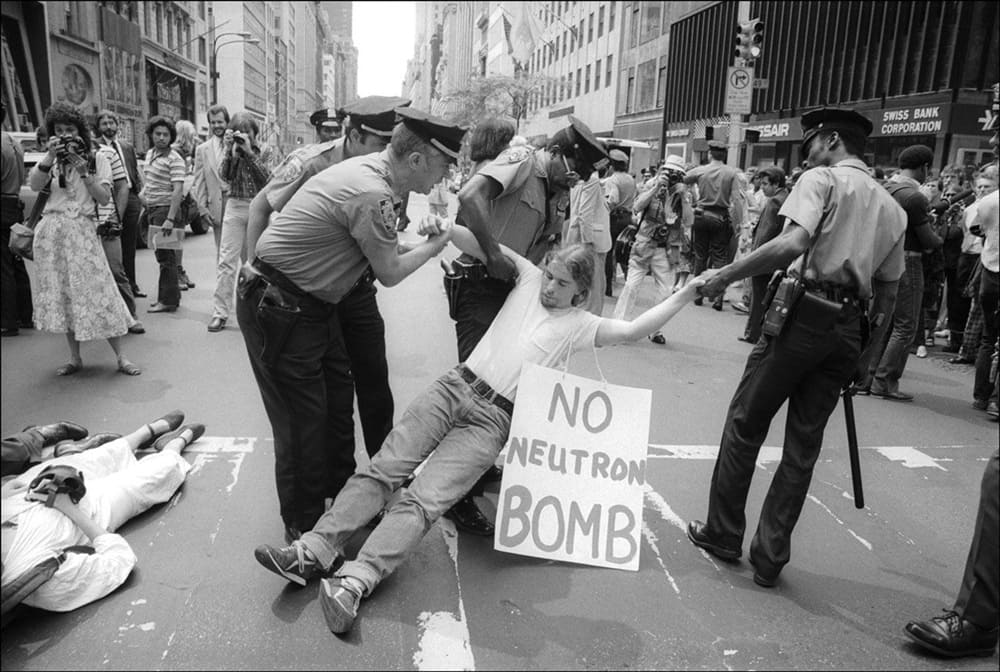
It became “infamous” as a bomb that supposedly kills people with radiation but leaves buildings relatively untouched. The description is simplified, but it accounts for the moral shock and political controversy surrounding the weapon. The weapon was theorised in 1958 by physicist Samuel Cohen at the RAND Corporation but was actually developed and deployed in limited numbers by the United States during the Cold War as a tactical countermeasure against Warsaw Pact armoured formations in Europe.
Fusion Reactions and Energy Split
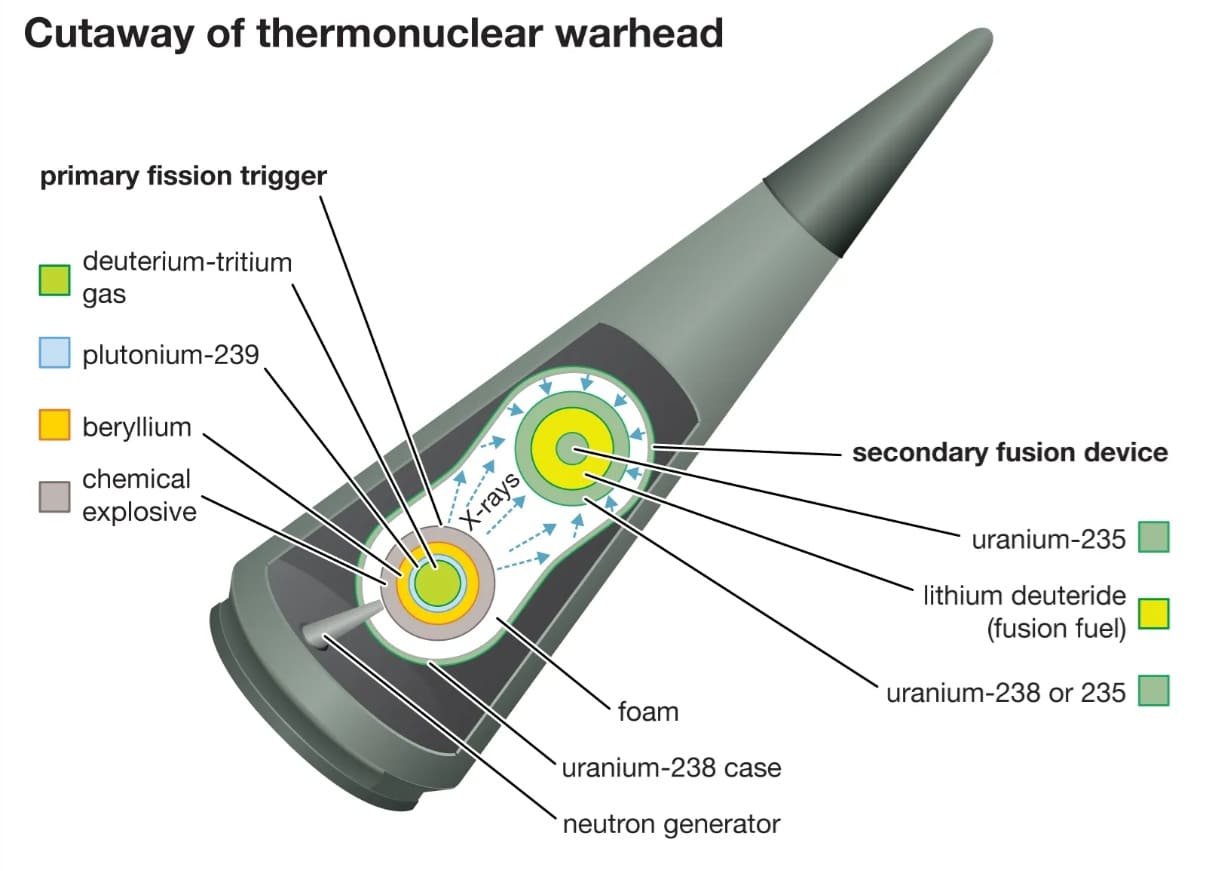
A neutron bomb is a two-stage thermonuclear device: a low-yield fission “primary” compresses and ignites a fusion “secondary” that contains deuterium-tritium (D-T) fuel. The dominant reaction is:
D + T → ⁴ He + n + 17.6 MeV
Each deuterium-tritium fusion reaction releases 17.6 MeV of energy. The emitted neutron carries about 14.1 MeV as kinetic energy. The alpha particle, or helium-4 nucleus, receives about 3.5 MeV. The importance of the energy division is that the neutrons from fusion reactions are around 14.1 MeV, an order of magnitude more energetic than the ~1-2 MeV neutrons from fission reactions. The higher-energy neutrons will penetrate tissue better and have different cross sections for interactions with matter. This is the basis for the weapon’s increased biological lethality per unit of total yield.
In a typical thermonuclear weapon, the fusion stage is surrounded by a dense tamper/casing of uranium-238. The tamper also serves two purposes. It reflects neutrons back into the fuel to increase fission yield through rapid fission of U-238 and absorbs a significant fraction of the neutron flux, converting that energy into additional blast and thermal output.
ERW designers minimise or remove the tamper altogether. They may also replace it with a lighter, more transparent material, such as chromium or nickel. This change allows a much higher percentage of 14.1 MeV neutrons to escape the device. It prevents more neutrons from being captured or moderated inside the weapon. This modification is a contrived decrease in the total explosive yield but preserves, indeed accentuates, the radiation flux.
Nuclear Yield Comparison
Analysts can approximate total device energy release using the mass-energy equivalence relation:
E = Δm·c²
A fusion device with reduced fission contribution usually has a sub-kiloton to low-kiloton yield. Historical estimates place the U.S. W70 Mod 3 warhead at around 1 kiloton. The W70 Mod 3 was deployed on the MGM-52 Lance missile. Strategic thermonuclear warheads usually have yields from tens to hundreds of kilotons. Enhanced radiation weapons have lower total yields. However, their neutron flux per kiloton is much higher. Historical studies suggest ERWs deliver far more neutron radiation than similar-yield fission weapons. At the same distance, ERWs may deliver about 5 to 10 times more neutron radiation.
Radiation Exposure Effects
Biological effect is quantified using absorbed dose in greys (Gy) or the older rad unit (1 Gy = 100 rad) and equivalent dose in sieverts (Sv), which weights absorbed dose by a radiation quality factor:
H = D × Q
The ICRP recommends a quality factor Q of $\sim$ 5-20 for D-T fusion neutrons in the 1-20 MeV range of interest, which is far larger than the Q = 1 for gamma/X-rays. This means that a certain absorbed dose of fast neutrons causes much greater biological damage than a similar absorbed dose of photons. The LD50/60 means a dose that kills 50% of exposed people within 60 days. The acute whole-body radiation LD50/60 in humans is about 4–4.5 Gy without treatment.
Neutron and gamma dose rates could exceed 8 Gy. This is several times higher than the LD50 level. These doses could occur where blast overpressure reaches only 0.5–1 psi. That pressure level usually causes limited, non-structural damage. Such an attack could incapacitate exposed people within minutes. Death could follow within days. The main cause would be destruction of haematopoietic and gastrointestinal tissue. At the same radius, the blast would leave buildings and armoured vehicles relatively undamaged.

Strategic and Political Impact
NATO’s ERW doctrine aimed to counter a larger Warsaw Pact tank attack. The goal was to avoid high-yield strategic nuclear exchange. NATO also wanted to limit blast and fallout damage on allied territory. Neutrons affect tank crews more than they do armour plating. Blast damages vehicles and structures more directly. In theory, a low-yield ERW could kill tank crews through radiation sickness. It could also leave both armour and civilian infrastructure largely intact.
It was a very controversial kind of selective killing — killing people but not property. Critics, including much of the Warsaw Pact propaganda machine and disarmament advocates, labelled the weapon a “capitalist bomb” and said it placed property above human life. 1978: Production delayed by Carter administration. 1981: President Reagan authorises deployment. By 1992, the end of the Cold War had seen the weapons retired from the U.S. arsenal, and no state today maintains an active ERW stockpile. The basic physics remains part of the curriculum in nuclear science and arms control analysis.
Conclusion
The neutron bomb is an example of how a change in the internal energy partition of a thermonuclear device, controlled by fundamental nuclear reaction kinematics and neutron transport physics, may dramatically change a weapon’s damage profile from mechanical to radiological. Its history is a tale at the crossroads of nuclear physics, radiobiology, and Cold War strategic doctrine.
References
- UNTERM — Neutron bomb / enhanced radiation definition.
- U.S. Department of Defense — Nuclear weapon effects and radiation overview.
- Union of Concerned Scientists — How nuclear weapons work, including neutron bombs.
- MIT Press Reader — Effects of nuclear weapons and fallout context.
About the Author