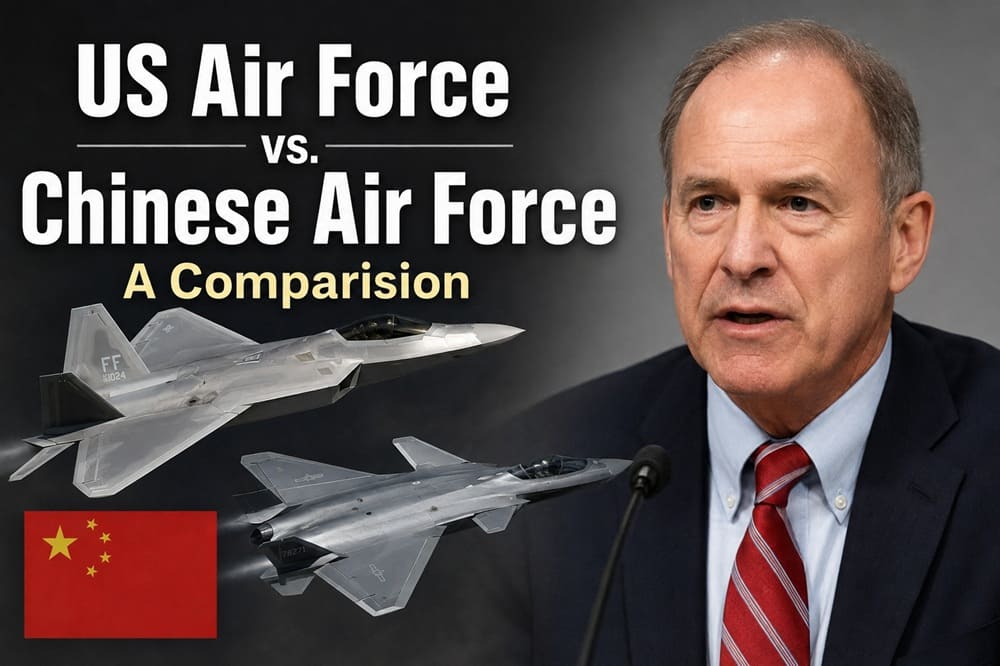
US Air Force vs Chinese Air Force 2026 — Col. John "JV" Venable
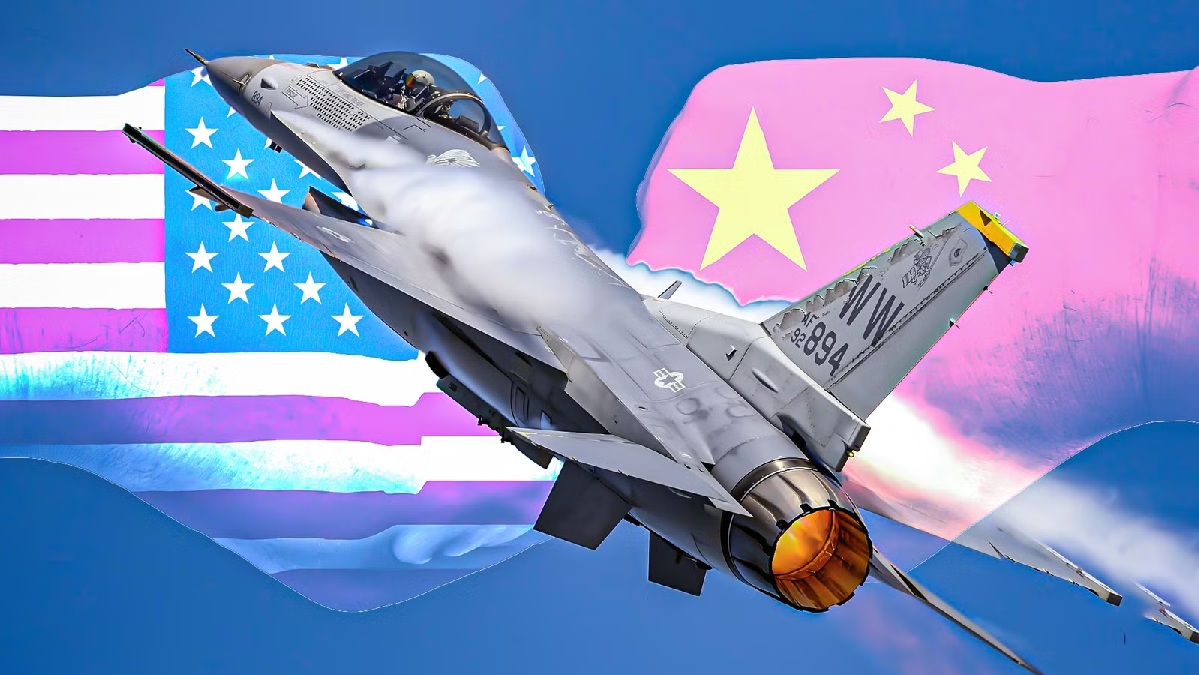
The US Air Force vs. Chinese Air Force debate for 2026 and beyond is no longer a theoretical war game miles away. It now guides serious planning for a Taiwan crisis, Pacific basing and alliance reassurance from Japan to Australia. When a former USAF fighter pilot says America is falling “woefully short” against a peer adversary, that’s a pivotal point, not just rhetoric, for defence professionals. The analysis reinforces Col. John “JV” Venable’s main point: China has an edge in capacity, a capability at the near-edge and a potential edge in operational readiness.
Operational Availability
The Air Force is still enormous on paper. There are more than 2,000 fighters in total. “Only a small percentage of the fighters are in squadrons ready to fight,” says Col. John “JV” Venable, USAF (Ret.), a retired US Air Force F-16 pilot and former Thunderbirds commander who is now an airpower analyst with the Mitchell Institute. He was told two years ago that some 750 US fighters qualified, and the figure has dropped since, he says. In contrast, the Chinese People’s Liberation Army Air Force (PLAAF) has reequipped its entire frontline fleet with fourth- and fifth-generation aircraft.
China now has 1,100 combat-ready fighters that can sortie over Taiwan without refuelling, he said. This means that Beijing has a huge local number advantage in any US Air Force vs. Chinese Air Force 2026 scenario focused on the Taiwan Strait. US forces would fly longer sorties, need more tankers, and have their bases more vulnerable. Capacity has, in effect, shifted in favour of China.
Stealth and Modernisation
Capability is more complicated. The US has some 24% of its fighter fleet stealthy, with F-22s and F-35s at the high-end core. But the United States reached that ratio by retiring older jets, not by flooding the ramp with new aircraft. Still, the Air Force wants to cut about 300 more fighters, saying they are not survivable in a fifth-generation conflict. However, those older jets still have value for secondary theatres, presence missions and lower-intensity contingencies. Planners who concentrate on one high-end fight with China risk leaving gaps elsewhere. Meanwhile, China keeps on building. The PLAAF is reported to be fielding around 120 J-20s annually, alongside another 170 “fourth-plus” generation fighters each year.
The US Air Force, by comparison, is projected to field fewer than 60 fighters total this year, including fewer than 30 F-35s. The FY2026 budget request would buy zero F-15EXs in this cycle. Meanwhile, anecdotal evidence suggests the J-20 is doing better than early Western estimates, especially as China iterates its sensors, engines and weapons. Overall, the US probably still has a qualitative edge, especially in integration and EW. However, in the 2026 balance between the US Air Force and the Chinese Air Force, that edge is eroding as China’s production lines remain busy.

Readiness: Sorties, flying hours, human factor
The starkest warning is about readiness. I flew 350 hours in my first year as an F-16 pilot. The average fighter pilot logged more than 200 hours a year, and the Air Force considered anyone with fewer than 150 hours non-combat ready. The official minimum today is eight sorties a month for the experienced fighter pilot and nine for the inexperienced pilot. The former officer said the service hasn’t met those minimums for several years. Today’s current annual hours are around 110 hours per pilot, which is significantly lower than what earlier generations considered combat-ready.
By comparison, Chinese pilots are said to average only about 200 hours a year. If those numbers are correct, that means the PLAAF is now equal or superior to USAF pilots in actual flying hours, at least in front-line units. The United States’ advantage in readiness, which once proved decisive in the Cold War, is now uncertain. Training is the capacity of the air forces. Hours in the cockpit, the depth of tactics, and exposure to complex scenarios define who actually performs when the first missiles fly.
China Starts J-36 and J-50 Flight Tests
The United States Air Force has entered engineering and manufacturing development for the F-47 NGAD. China is already flight-testing two potential sixth-generation aircraft. Chengdu’s tailless, three-engine platform, unofficially known as the J-36, is now in a prototype-test phase of maturation, with a second revised airframe now in the air following significant changes to the intake, landing gear and exhaust.
Sporadic airborne sightings suggest that Shenyang’s smaller J-50, or J-XDS, is a less mature stage of developmental flight testing. Neither aircraft is in service, and Beijing has not confirmed the designations or capabilities. But the U.S. is proceeding with the F-47 design, and China is already collecting aerodynamic, propulsion and systems data.
Iran War Tests USAF
The war with Iran added more pressure on the U.S. Air Force. High-tempo sustained strike operations demanded fighters, bombers, tankers, surveillance aircraft, and maintenance crews. Longer missions meant there was a need for aerial refuelling, and repeated sorties increased airframe fatigue and reduced the time available for scheduled maintenance.
The campaign also depleted precision weapons and air-defence interceptors more quickly than the industry could replace them. With airborne refuelling so critical to nearly all regional combat missions, the availability of tankers became a priority. This delay in training caused longer deployments and less readiness for aircraft and personnel assigned to other locations. The costs imposed by Iran were thus more than battlefield losses and limited USAF flexibility for future crises.
US Air Losses in the Iran Conflict
As of 1 August 2026, public reporting records at least 43 American aircraft destroyed, lost or damaged. The count includes four F-15E Strike Eagles, one F-35A, one A-10 Thunderbolt II, seven KC-135 Stratotankers, two MC-130J Commando IIs, one E-3 Sentry, one HH-60W rescue helicopter, 24 MQ-9 Reapers and one MQ-4C Triton. It lost another AH-64 Apache near the Strait of Hormuz in June. But the categories are not equal. Some KC-135s, the F-35A, E-3 and HH-60W were disabled, not destroyed. The latest Iranian report of further F-35 losses over Jordan is unverified and should not be added to the confirmed total.
Taiwan or the Western Pacific crisis
In a Taiwan contingency, the US Air Force and Chinese Air Force would fight on three fronts:
- Capacity: China can get more fighters closer to the battlefield, with less transit and turnaround.
- Capability: Both sides would deploy advanced stealth and “4.5-gen” platforms, but China’s pace of production could degrade some of the U.S.’s qualitative advantages.
- Readiness: The levels of pilot training and rates of sortie generation could distort the real-world effectiveness of the forces, especially as a campaign wears on.
US forces would have powerful assets – global ISR, bombers, stand-off weapons and the support of allies such as Japan, Australia and others. But they would fight without the sort of overwhelming theatre-wide dominance that many planners once thought was a given.
America’s Unnecessary Wars
Repeated interventions and strategic overreach, from Iraq and Afghanistan to the Iran conflict, have haunted the U.S. Air Force. Decades of constant deployments have eaten into flying hours, worn out maintainers, hastened airframe ageing and strained the availability of tankers, bombers and fighters. Combat losses, accidents and operational attrition now compound an existing readiness problem.
Meanwhile, China has largely avoided such expeditionary warfare, allowing it to pour resources into expanding fleets, training and advanced research. While Washington replaces losses and keeps ageing aircraft in the air, Beijing is flight-testing prototypes of the J-36 and J-50, showing rapid progress toward sixth-generation air combat capability.
Decision Time
The speaker ends with a blunt message: “Our ability to fight tonight, and the future of our capability, starts today.” It doesn’t start for 7 years. His warning raises several urgent possibilities:
- Will the US retire legacy fighters faster than it can replace them?
- Can the Air Force get pilot training hours back to Cold War levels? Or at least stop the bleeding?
- Can Congress afford the munitions, tankers and hardened bases to sustain operations in the Western Pacific?
Defence professionals should not view the US Air Force vs. Chinese Air Force 2026 and beyond debate as a simple scoreboard. Instead, it should inform sober assessments of force design, pilot pipelines, industrial capacity and alliance integration. But if Washington sees these trends as a wake-up call and not a doomsday story, it can still make a pivot. If not, the quiet building of capacity, capability and readiness by China could define the story of Pacific airpower in the next decade.
References
- Venable, John “JV”, and Joshua Baker. Winning the Next War: Overcoming the U.S. Air Force’s Capacity, Capability, and Readiness Crisis. Mitchell Institute for Aerospace Studies, September 2025.
- U.S. Department of Defense. Military and Security Developments Involving the People’s Republic of China in the 2024 Annual Report to Congress, December 2024.
- Department of the Air Force. Fiscal Year 2026 Aircraft Procurement, Air Force—Volume I. June 2025. The request included 24 F-35As and no FY2026 F-15EX procurement.
- Dahm, J. Michael. “What Satellites Reveal About China’s Military Expansion.” Air & Space Forces Magazine, March–April 2026. The analysis documents flight testing and activity of the J-36 and J-50 prototypes at China’s specialised evaluation facilities.
- Shane, Leo III. “Congressional Report Tallies 42 U.S. Aircraft Lost or Damaged in Operation Epic Fury.” Military Times, 22 May 2026; supplemented by U.S. Central Command’s 9 June 2026 confirmation of the subsequent AH-64 Apache loss near the Strait of Hormuz.
- https://www.rand.org/pubs/research_reports/RR3927.html
- https://media.defense.gov/2024/China-Military-Power-Report
- https://www.globalfirepower.com/countries-comparison-detail.php?country1=china&country2=united-states-of-america
About the Author