Pratt & Whitney XA103 Engine: Inside Adaptive Propulsion
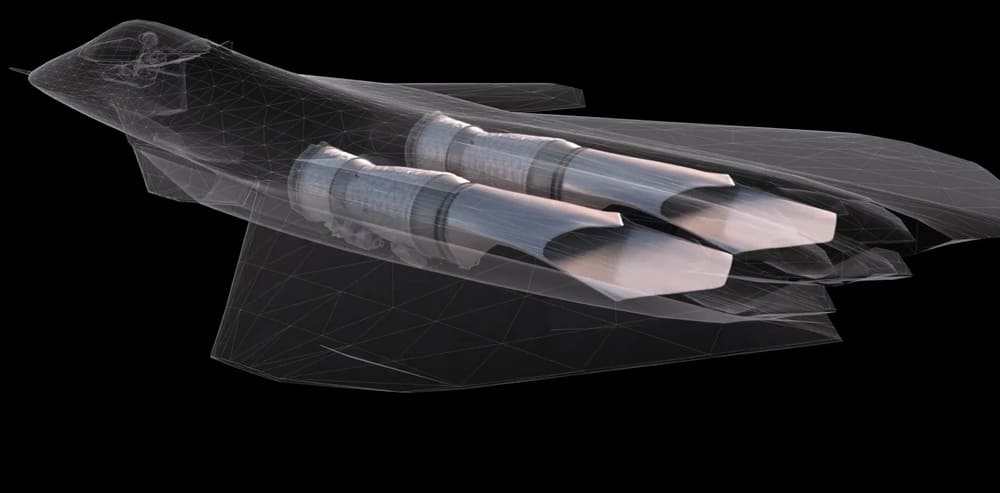
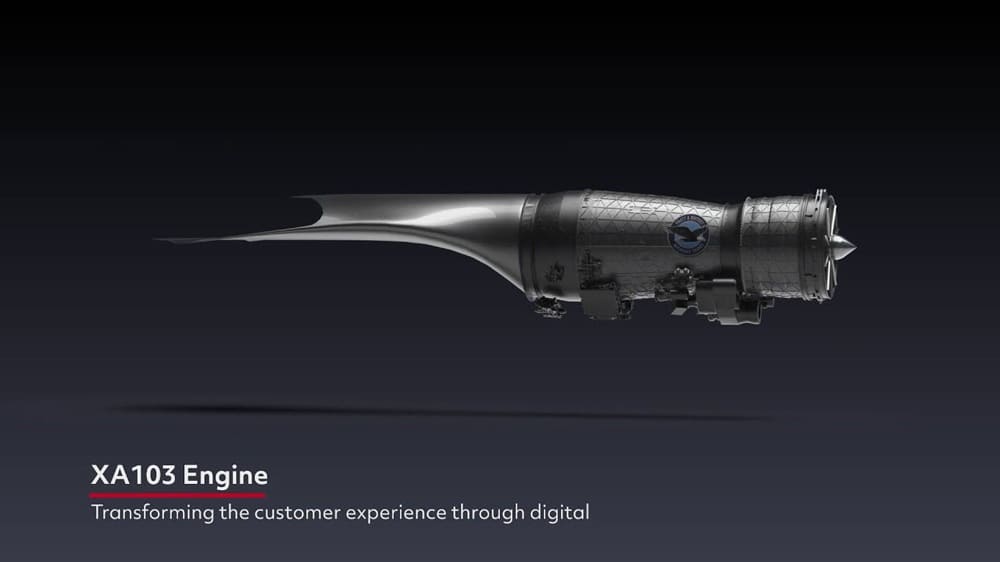
The XA103 from Pratt & Whitney is more than an upgrade to the F119 or F135. It is a variable-cycle propulsion system for future combat aircraft. Pratt & Whitney is developing the XA103 for the US Air Force’s Next Generation Adaptive Propulsion programme. The engine remains a ground-based prototype. The prototype is not a working powerplant.
The precise thrust, airflow, pressure ratio, weight and turbine temperatures are classified or proprietary. Official programme information, however, reveals its engineering goals and likely operating principles. Pratt & Whitney finished the engine’s assembly-readiness review in May 2026. Now the company is building hardware for ground testing in the late 2020s.
The Adaptive-Cycle Principle
The conventional low-bypass fighter turbofan is a fixed compromise. The engine must have high specific thrust to accelerate and to fly transonically. However, high specific thrust also increases jet velocity, exhaust temperature, and fuel consumption. A higher bypass ratio leads to better subsonic efficiency. But it increases the diameter of the engine and reduces specific thrust. Adaptive propulsion seeks to alter this compromise in flight. The public cross-section of the XA103 is not available. But its technological heritage goes back to the three-stream adaptive engines of the AETD and AETP.
The architecture divides inlet airflow among three principal paths:
- Air entering the high-pressure core.
- Air passing through the conventional bypass duct.
- Air entering an additional adaptive stream.
Variable fan geometry and flow-control valves alter the distribution between these streams.
The thrust equation remains:
F = ṁeVe − ṁ0V0 + (Pe − P0) Ae
Here, ṁ represents mass flow and V represents velocity. The final term represents pressure thrust. An adaptive engine can modify thrust without relying entirely on greater exhaust velocity. It can change mass flow, bypass distribution and core operating conditions. This approach improves propulsive efficiency during cruise while preserving high thrust during combat.
Cruise and Combat Configurations
During an economical cruise, the XA103 would direct more air through its bypass and adaptive streams. This produces a higher effective bypass ratio. It also reduces the difference between aircraft speed and exhaust velocity. Simplified propulsive efficiency can be expressed as:
Efficiency rises when exhaust velocity approaches flight velocity. However, available specific thrust falls. During acceleration or combat, the engine can redirect airflow and increase core power. The effective bypass ratio falls, while exhaust velocity and specific thrust rise.
This operating condition supports:
- Rapid acceleration
- High-altitude climb
- Supersonic persistence
- Energy recovery after manoeuvres
- Increased electrical generation
- Greater cooling demand
Thus, the engine does not have a single fixed bypass ratio. It has a narrow range of bypass ratios. Earlier, the US Air Force had asked AETP demonstrators to deliver 25% better fuel efficiency and 10% more thrust. It also wanted significant improvements in thermal management. AETP defined full flight-weight engines in the 45,000-lb thrust class. That number is the prior proof requirement, not a confirmed rating of XA103.
Adaptive Fan Aerodynamics
The adaptive fan must operate efficiently across substantially different corrected-flow conditions. Corrected mass flow is approximately:
ṁcorrected = ṁ√Tt ÷ Pt
Corrected rotor speed is:
Ncorrected = N ÷ √Tt
These correlations allow the engineer to relate compressor performance to various inlet temperatures and pressures. Opening or closing the third stream changes the resistance downstream of the fan. This movement is the fan’s operating point on its compressor map. An improper transition could cause the fan to surge or to operate in a stalled condition. Surge causes large-scale oscillations through the compressor system. Rotating stall causes localised regions of separated flow in the annulus. Both conditions can damage blades, disrupt combustion, or cause an engine shutdown.
The XA103’s control system must coordinate:
- Variable inlet guide vanes
- Variable stator vanes
- Adaptive-stream valves
- Fuel scheduling
- Bleed-air extraction
- Nozzle throat area
- Rotor acceleration
- Turbine temperature limits
These effects should occur during sudden throttle movements and high-angle-of-attack manoeuvres. During the AETD programme, the Air Force tested a Pratt & Whitney three-stream adaptive fan at Arnold Air Force Base. The inlet conditions tested were representative of several points in the flight envelope.
Core Pressure Ratio and Thermal Efficiency
A fighter engine converts chemical energy into shaft power and jet momentum. The ideal thermal efficiency of a fighter engine increases with the compressor pressure ratio. However, higher pressure ratios increase compressor discharge temperature. For an ideal compressor:
Tt3 ÷ Tt2 = (Pt3 ÷ Pt2)^[(γ−1)÷γ]
Real compressors require additional work because their efficiency remains below unity. The compressor power requirement is approximately:
Pcompressor = ṁcp(Tt3 − Tt2)
The turbine has to develop enough power to drive the fan and the compressor. It should also support accessories and generators. The pressure ratio can be increased to reduce the fuel consumption. However, it reduces the cooling margin and increases the mechanical loading. Pratt & Whitney has not yet released the overall pressure ratio of the XA103. It has also reduced compressor stages, spool speeds, and stage loading coefficients. This secrecy prevents a reasonable public estimate of its real thermal efficiency.
Turbine Temperature and Material Limits
The temperature at the turbine inlet is crucial for maximum thrust. More work is done at the higher temperature of the turbine. It also increases creep, oxidation and thermal fatigue damage, however. The gas temperature in modern turbine blades is higher than the melting point of the base materials. This is achieved through internal cooling and thermal barrier coatings. The cooling air is normally drawn from the compressor. This lost air means less efficient core operation and less thrust. That is a significant trade-off for engineers.
They have to cool turbine parts without taking too much high-pressure air from the main cycle. The XA103 probably uses advanced nickel superalloys, ceramic-matrix composites and improved coatings. Meanwhile, Pratt & Whitney hasn’t said where they’re at. The engine also must withstand repeated transitions between cruise and combat modes. Transitions are associated with changes in metal temperatures and thermal gradients. A part may survive a steady maximum temperature but fail with repeated thermal cycling. During prototype testing, engineers will perform low-cycle fatigue, creep-fatigue interaction, and coating spallation analyses.
Thermal Management as Combat Capability
The XA103’s third stream may provide its greatest operational advantage through heat rejection. Future aircraft will carry high-output radars, electronic-warfare systems, processors and communications equipment. These systems convert electrical energy into heat. The basic thermal relationship is:
Q̇ = ṁcpΔT
The bigger the flow of a cool air mass, the more heat it can absorb until it reaches the temperature limit. The adaptive stream can also be used to carry heat to an exhaust mixer or other rejection system. This reduces the dependence on the fuel as the aircraft’s primary heat sink. Before entry into the combustor, the fuel is heated. But the fuel temperature cannot increase indefinitely. Hot fuel can deposit, reduce component life and exceed equipment limits. So an adaptive stream provides extra thermal capacitance for sensor-heavy missions. This could allow for longer radar duty cycles, more electronic attack, and higher onboard computing loads. It also may be useful for future directed-energy systems. But there is no official source to back a requirement for XA103 laser power.
The F-35 Thermal Case Study
The F-35 is an example of what happens when you do not have sufficient cooling margin. The F135 engine provides bleed air for thermal management and power. That air is used to cool the aircraft and other systems. The electronics for Block 4 were a new departure in power and heat demands from what was previously assumed. That means the engine has to work harder to draw in the air for cooling. Such an arrangement means more wear and less life for the components.
According to US Government Accountability Office estimates, the wear would add about $38 billion to lifetime maintenance costs. This case provides valuable lessons for XA103 integration. Cooling cannot be secondary equipment for designers. Propulsion, electrical generation and thermal rejection must be integrated into one system; a very high-thrust engine may still be heating limited.
Infrared and Radar-Signature Integration
The engine must meet survivability requirements. Higher turbine temperatures and higher exhaust velocity tend to increase infrared emissions. Infrared sensors are more sensitive to a large plume of hot exhaust. Designers use mixing, shielding, and temperature control to mitigate this signature. The third stream can bring in cooler air into the core exhaust. It could lower the mean temperature of the plume. But more mixing can mean more pressure losses and less thrust.
The nozzle must also be a compromise between radar signature and aerodynamic performance. Open-air turbines create a powerful return on the radar. Using curved ducts, blockers, and treated surfaces can reduce these reflections. However, these structures lead to pressure losses and air flow distortion. Pratt & Whitney has not said whether the XA103 has a two-dimensional low-observable nozzle or an axisymmetric one. It has also limited the thrust vectoring and exhaust mixing geometry. So, if you see any picture online claiming to be the final nozzle for the XA103, be cautious.
Digital Engineering Programme Significance
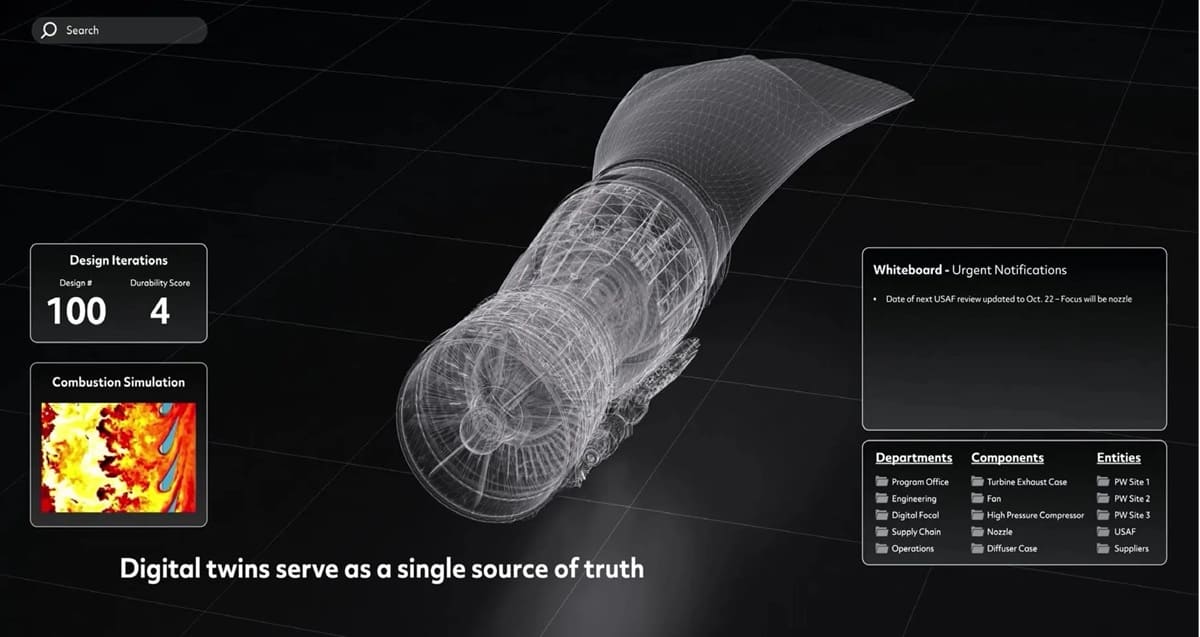
The XA103’s less publicised innovation is its development system. Pratt & Whitney conducted the detailed design review in a collaborative digital environment. Reviewers had direct access to the engineering data. Next, the company performed a digital assembly readiness review before advancing to physical production. This way, the company links aerodynamic models, structural calculations, manufacturing tolerances, and maintenance data. Thus, a change in blade geometry may propagate through several analytical models.
Engineers can assess its effects on:
- Compressor efficiency
- Blade stress
- Vibration modes
- Manufacturing cost
- Cooling flow
- Maintenance access
- Engine weight
Pratt & Whitney said it relied on more than 1,000 engineers and support personnel at more than 100 domestic suppliers. In 2025, the company also spent more than $30 million on its model-based development environment. Digital engineering does not replace physical testing. It reduces the number of late design changes that occur during hardware assembly.
Programme Status and Strategic Value
In August 2022, the Air Force awarded Pratt & Whitney a $975 million ceiling on the NGAP contract. This work will involve analysis, rig testing, prototype engine testing and weapon system integration. The contract will go beyond July 2032. The XA103 is still referred to as being ‘platform-agnostic’ in official descriptions. The production aircraft has not been revealed to the public.
Its technical value lies in combining four functions:
- High specific thrust for combat.
- Reduced fuel consumption during cruise.
- Increased electrical-power generation.
- Expanded thermal-management capacity.
The XA103 will only be successful if it can make these gains without adding weight, complexity or maintenance. Ground tests need to be performed on the surge margin, rotor dynamics, thermal durability and mode-transition stability to the required standards. Engineers also need to show that the adaptive valves are reliable after thousands of high-temperature operating cycles.
However, until those tests are done, the claimed thrust ratings and range improvements are just estimates. The XA103, however, is a significant departure from fixed-cycle fighter propulsion. It converts the engine from a thrust generator into an energy management system for the entire aircraft. And that change could be greater than any published thrust figure.
References
- RTX — Pratt & Whitney Completes Digital Assembly Readiness Review for XA103
- US Air Force — Adaptive Engine Transition Program Contracts
- US Department of Defense — NGAP Contract Awards
- US Government Accountability Office — F-35 Engine and Thermal-Management Modernisation
About the Author