
Iran Exposed the Limits of US Airpower
Iran exposed the limits of US airpower, forcing Washington to fight the wrong kind of air war. The United States and Israel hit the enemy from the air, used precision weapons effectively and degraded key Iranian military capabilities. But Tehran moved the decisive fight to a lower, slower, and more politically costly one around the Strait of Hormuz. The high-altitude campaign went pretty much as planned. But it did not cripple Iran. The new framework agreement, still being worked on, was at best a wash and, in several ways, tilted the playing field in Tehran’s favour. This issue is important because modern air power can destroy targets without revealing the opponent’s strategy.
Iran Revealed US Airpower Limits
The war began with an American plan to destroy key targets. The campaign has involved six weeks of the most intense air operations since the “shock and awe” beginning of the Iraq invasion, in the four months since the US strikes on Iraq. Washington had the clear advantage of an altitude of 20,000 feet and above. U.S. and Israeli forces gained air superiority over much of southern and western Iran, aided by stealth aircraft, precision-guided munitions, and advanced targeting. They destroyed air defenses, sunk much of Iran’s conventional navy and damaged parts of its missile and drone force. Targeting had many successes by Washington’s usual standards. Serious damage occurred, and planners may be able to number DMPIs, or desirable mean points of impact. Iran, however, fought a different kind of air war. It did not need to control the skies over Tehran. It had to prove that American air power was strategically unrewarding.
Hormuz Became Decisive
Iran shifted its focus to the air littoral, the low-altitude airspace over and around the Strait of Hormuz. This 21-mile bottleneck was more important than the high sky over Iranian cities. Naval protection and commercial shipping require continuous, close-in coverage. A drone launched from the Iranian coast within minutes can put a tanker in jeopardy. Thus, the United States needed platforms, interceptors and sensors with persistent range to react in real time. That was the problem. US aircraft could still hit Iranian targets from Israel, Jordan and the Arabian Sea. But those locations would not be well placed to police a narrow maritime corridor that drones and missiles could attack. And so Iran essentially shut the Strait of Hormuz and converted local weapons into global leverage.
Shahed Drones Raised the Cost
Iran’s most devastating weapon of disruption was the Shahed-136 drone. It’s slow, low-flying and relatively straightforward to shoot down by American standards. It also costs tens of thousands of dollars, not hundreds of millions of dollars. But that cheapness was perilous. Shahed-type drones hit expensive radar and command and control sites, disrupted oil production, and hit ports and airfields across the region. In addition, every strike required Washington and its allies to scramble interceptors and to use up time and political capital. This model is not exclusive to Iran. It had tested the idea with Houthi strikes in the Red Sea and militia operations in Iraq. It also saw the $20,000 drones prove their worth after handing them to Russia. So Tehran came into the fight with a proven theory of cheap systems exacting disproportionate costs.
Why Bombing Failed to Coerce Iran
U.S. airpower did cause damage, but the destruction did not translate into coercion. Tehran took bombed airfields, sank ships, damaged infrastructure and caused the loss of leaders and commanders. Those blows harden the regime’s resolve. Washington’s was a different curve of pressure. U.S. interests were small, but the costs started to pile up. War-risk insurance for traffic through the Strait of Hormuz has disappeared. Hundreds of ships found themselves trapped in the Gulf. Meanwhile, US consumers watched fuel prices, European and Asian governments tabulated economic losses and Gulf states quietly wondered how long this crisis would last. The United States then employed a naval blockade to block Iranian oil exports. But the blockade was a war of attrition. ‘The intelligence assessments were that Iran could withstand it for 90 to 120 days and perhaps longer,’ it was said. Washington was not in such good shape to meet that timetable.
US Forces Were Pushed Back
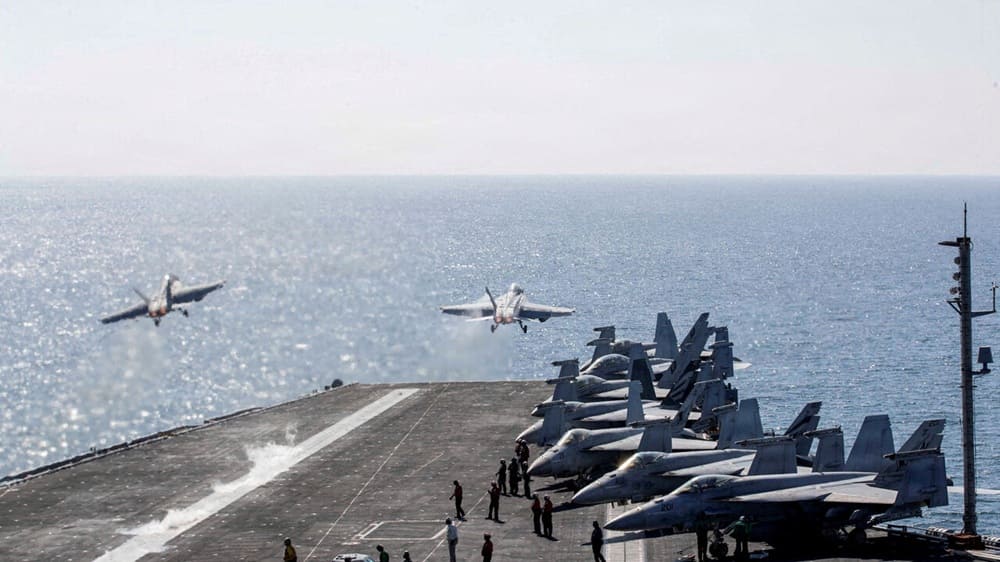
Iran’s missile and drone threat reconfigured America’s regional posture. In 2003 the United States pre-positioned most of its combat and support aircraft in Kuwait, Qatar, the United Arab Emirates, Bahrain and Saudi Arabia. Carriers also operated from the Mediterranean and the Persian Gulf. This conflict was a different war. The threat also diverted command activity away from the Combined Air Operations Centre at Al Udeid. It pushed back carriers, stealth fighters and tankers out beyond Israel, Jordan and the Arabian Sea. The move safeguarded valuable assets. But it did reduce the close-in presence required to reopen Hormuz. The United States might be able to hit Iran from a distance, but it could not ensure safe passage through one of the world’s most important waterways.
Procurement Created the Gap
For decades, the Pentagon had honed US airpower for a war of destruction. It was bought and trained for stealth, long-range precision strikes and the defeat of integrated air-defense systems. These skills are still important. But they did not respond to Iran’s campaign of disruption. More basic were the tools that were missing: aircraft with long loiter times, large magazines, mobile air defenses, mass-produced ship-defense weapons and cheaper interceptors. The fight called for low-level durability and mass, not just high-altitude survivability and range. An Americanised version of the Shahed concept, LUCAS is moving in the right direction. But a $30 million contract for hundreds of drones is a bargain relative to adversaries such as Iran that can produce tens of thousands.
Strategic Conclusion
Iran has demonstrated the weakness of US air power, i.e., air superiority does not mean strategic dominance. More bombs. More targets. They could not conjure a reopened Hormuz, lower the risk of insurance or compel Tehran to accept defeat. So the threats to bomb Iran “very hard again, only harder” are misguided. The campaign was not without heat. It did not work because Washington focused on the war of destruction from the air while Tehran focused on the war of disruption. The most significant lesson is conceptual. That same weakness will return until the Pentagon treats low-altitude drone warfare, chokepoint defense and mass affordable interceptors as first-order planning problems. The real question was never just who controlled the skies above Tehran. The question was who could keep the Strait of Hormuz open under pressure. By that standard, US airpower looked powerful and precise but not enough.
References
- https://defensenewstoday.info/why-iran-chose-missiles-over-fighter-jets/
- https://www.merip.org/2003/06/the-us-military/
- https://defensenewstoday.info/drones-are-making-attack-helicopters-obsolete/
- https://breakingdefense.com/2026/07/iran-was-the-most-successful-failure-in-us-airpower-history/
- https://www.eia.gov/international/analysis/special-topics/world_oil_transit_Chokepoints
About the Author