
F-22 Raptor Stealth Coating Composition
The F-22 Raptor’s stealth coating is part of an integrated system that reduces the aircraft’s detectability. Meanwhile, its detailed chemical formula is still not published in public official sources. But Air Force maintenance documents and manufacturer announcements provide some clues as to how its coating system works and why its composition is important.
A credible technical assessment must differentiate between confirmed features of the F-22 and demonstrated materials in open research. Magnetic powders, conductive fillers, and polymer binders are responsible for radar absorption, but lab formulations cannot define the Raptor’s operational recipe. The evidence is more aligned with engineering analysis than with an ingredient list.
The Verified Coating Layers
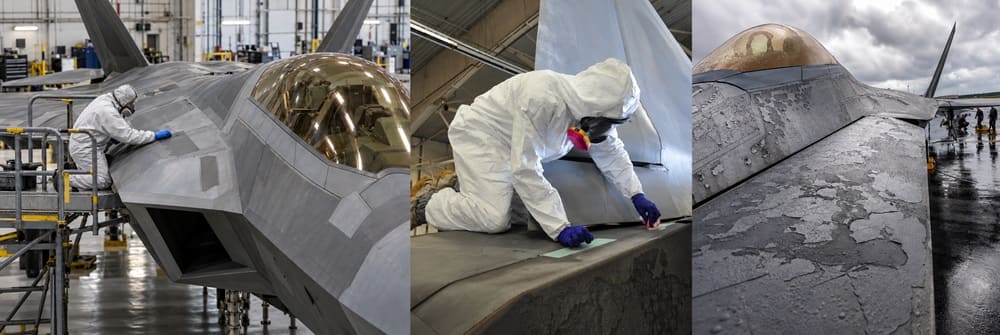
The U.S. Air Force outlines the F-22 repair process, beginning with a radar-absorbing “boot layer” followed by additional paint. Technicians will remove the damaged material, clean the surface, and rebuild the coating system. This implies that the exterior consists of several functional layers rather than a homogeneous paint film. Another Air Force account describes how the coatings also prevent corrosion and other damage.
The maintainers assess the outer mold line of the aircraft and put any defects into a Signature Assessment System. Thus, the surface condition determines whether an aircraft will meet its required low-observable standard. These descriptions provide the general purpose of the coating architecture. They fail to identify all binders, pigments, or fillers, and they do not provide a complete sequence that applies to all aircraft surfaces.
Absorbing Fillers and Polymer Binders
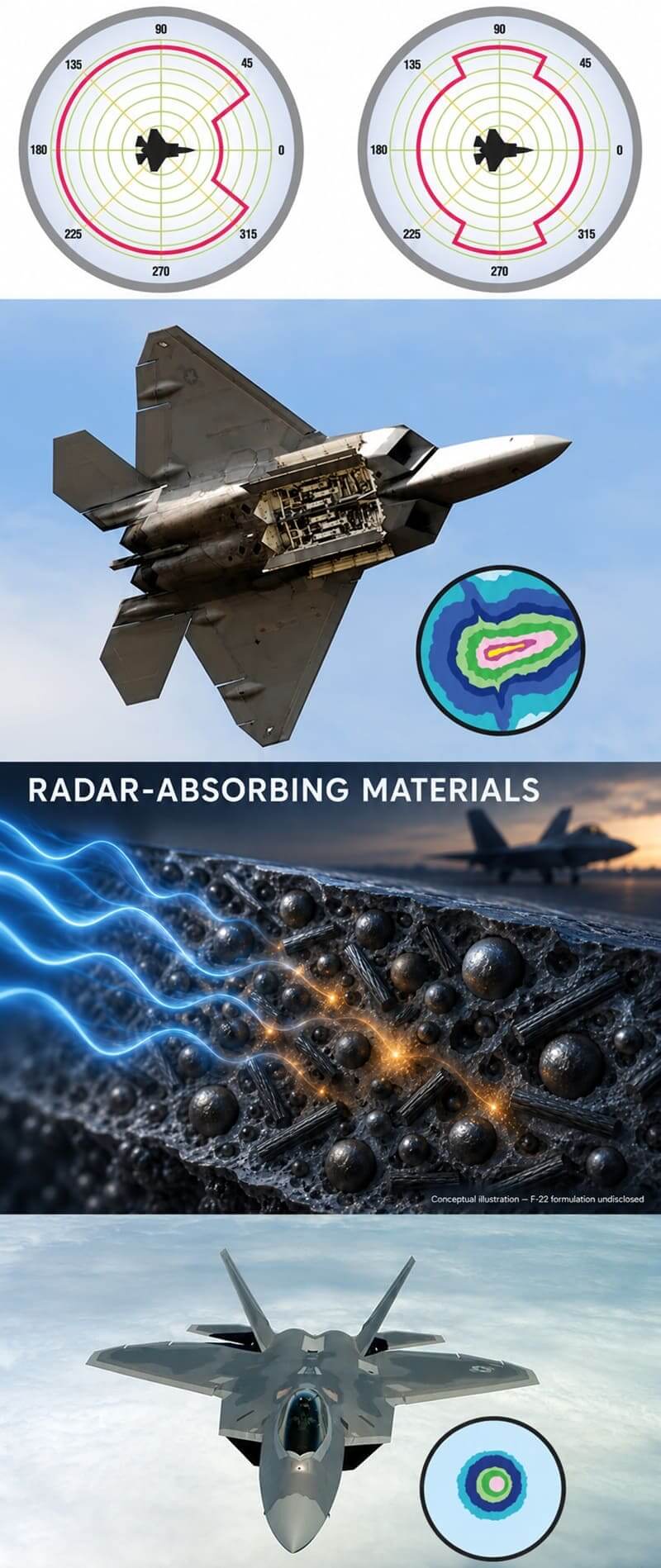
In the publicly available radar-absorbing materials, the functional particles are incorporated into a polymer matrix. The binder influences the filler adhesion, flexibility, and distribution. It also contributes to the composite dielectric properties, thus providing an electrical support as well as a mechanical support for the absorber. The trade-off is mechanical. As a filler, it loads the amount of polymer available to bind particles and accommodate changes in strain.
Thus, in addition to electromagnetic response, researchers also test tensile strength and particle dispersion. The suitability of a composite for service is not determined by electrical performance alone. The research study was conducted on polyurethane paints containing carbonyl iron and polyaniline. Polyaniline is a conducting polymer, and the carbonyl iron is a magnetic material. Scientists also tested polyaniline with silicone sheets. These are examples of different types of electromagnetic absorption. In separate studies, the dispersion of carbonyl iron and SrFe₁₂O₁₉ in liquid silicone rubber has been studied.
Ferrites are ceramic magnetic materials. Carbonyl iron is metallic. Their different electromagnetic responses illustrate how much the type and amount of a filler can influence the behavior of an absorber. Another choice is to use carbon materials. A 2017 RSC Advances paper examined the combination of short carbon fibers and waterborne polyurethane, focusing on fiber content, length, and matching-layer thickness. This is verified research material. It was used in those experiments, but that does not mean it is in the F-22.
How Does Composition Affect Radar Absorption
An absorber must absorb electromagnetic energy and dissipate it before a strong reflection comes back to the radar. So engineers consider impedance matching and attenuation. Even a material with high internal losses can perform poorly if its surface reflects substantial incident energy before penetration. Some of the incident electromagnetic energy is converted to heat because of losses in the material; this process is called absorption.
That’s energy being dissipated in the coating, not the coating absorbing engine heat or making the aircraft thermally invisible to infrared sensors. This behavior is described by two properties, complex permittivity and complex permeability. Permittivity is how a material reacts to an electric field. Permeability is how a material reacts to a magnetic field. Their loss elements are mechanisms of the dissipation of electromagnetic energy. The presence of conductive and magnetic constituents can tune the responses; however, the enhancements are frequency dependent and depend on the overall layer arrangement.
Dependence of the composition and thickness of rubber-based manganese zinc ferrite in the 2-18 GHz range. The results indicated that the filler volume fraction influenced the electromagnetic properties and the calculated reflection loss. This finding implies a basic design limitation: the powder alone cannot determine the performance of a completed coating. Thickness is also important for wave propagation and interference inside the absorber. Thus, performance depends on chemistry as well as geometry and manufacturing consistency. Researchers cannot apply a laboratory result from a single frequency or incidence angle to other radar conditions.
Radar Returns
The radar returns are used by the trackers to identify the type and size of aircraft. The ideal stealth airplane would have no signature on the radar screen. It would look like a small fuzzy ball when it came back, as mentioned in the last picture. Whether an airplane shows on the radar screen depends on which side of the airplane the radar beam hits. The F-22’s stealthiest feature is nose-on.
The open bomb bay of an F-22 Raptor after a strike is more reflective than the bottom of the airplane with its doors closed and much more reflective than its nose-on aspect, as shown in image 2. Classification of shape-based radar returns describes two such shapes, the Pac-Man and the bow tie, as depicted in image 1.
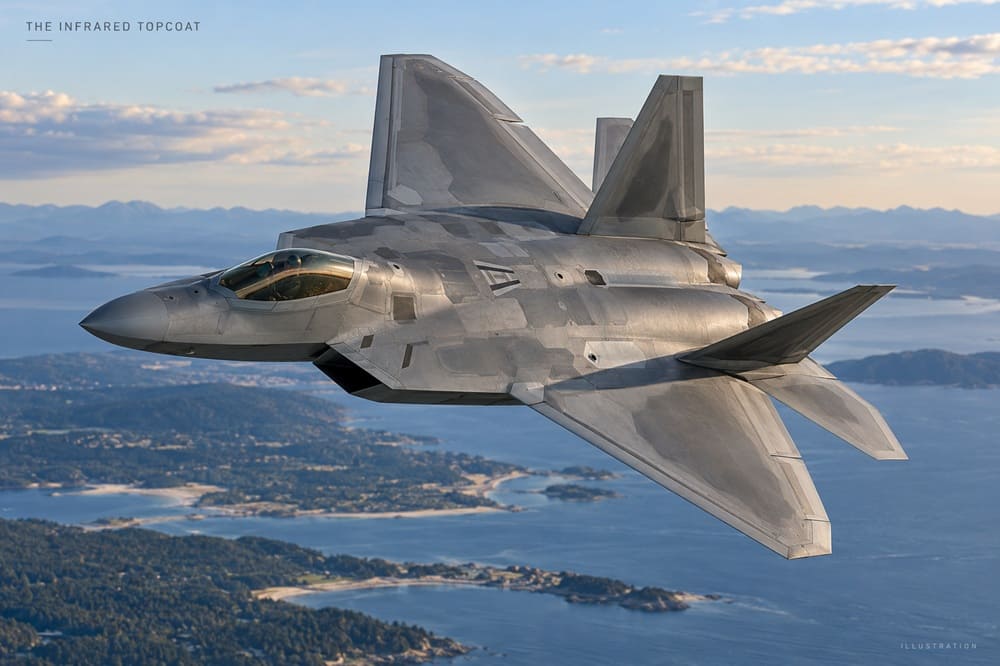
The Infrared Overcoat.
The outer skin of the Raptor also helps to counter infrared threats. At Edwards Air Force Base, Boeing announced on March 23, 2000, that it had applied a special topcoat to the second F-22. It reduced susceptibility to infrared detection, while still offering the environmental protection expected from traditional topcoats, the company said.
Boeing used the F-15 Mod-Eagle scheme as a basis for a two-tone camouflage pattern. The new topcoat did not add weight to the aircraft, it said. The announcement says the coating system meets a number of detection and protection requirements but does not disclose the paint’s chemistry or what its infrared benefit is.
Precision Manufacturing & Service Repair
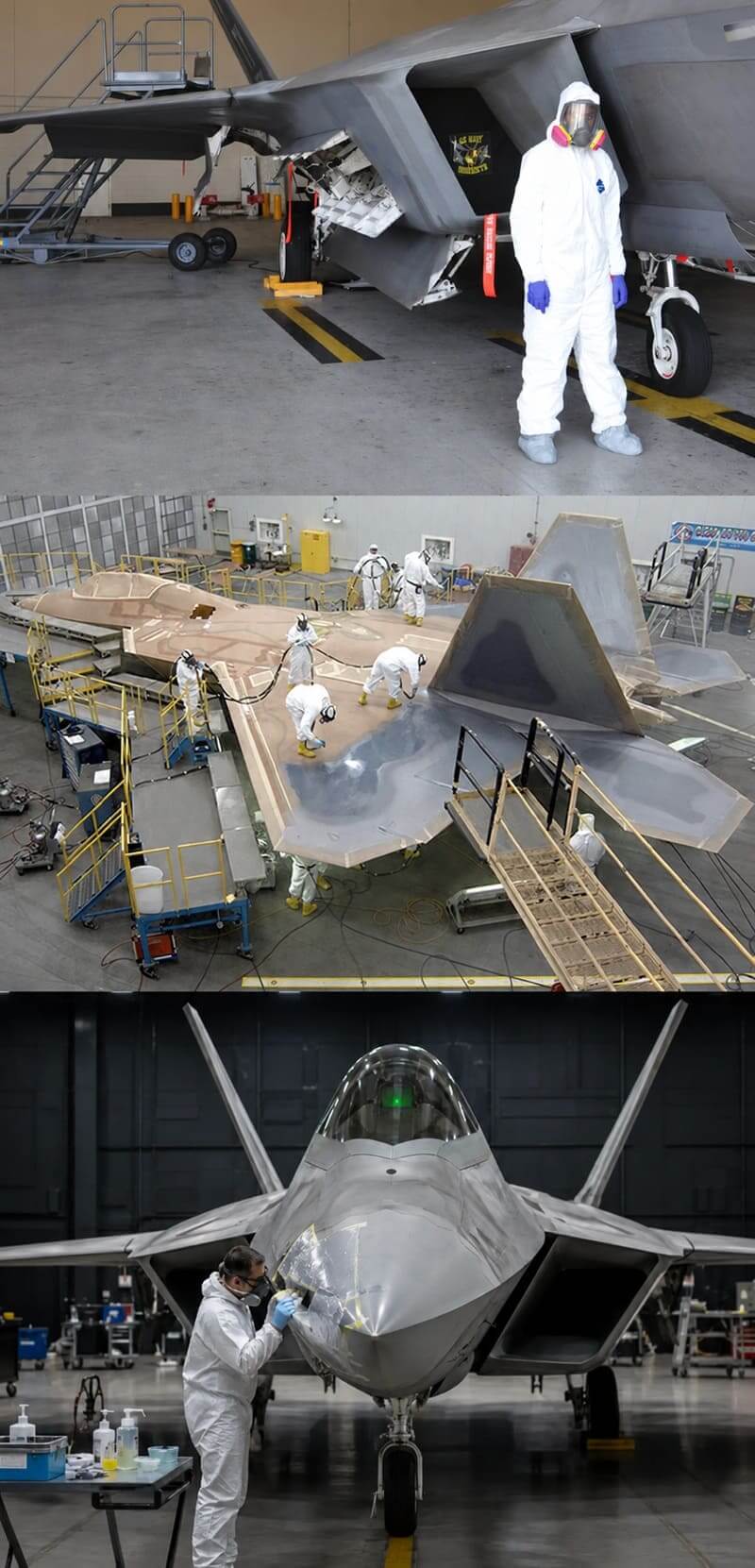
We find evidence of the importance of thickness control in public procurement. The 2019 Air Force SBIR award funded a project to develop non-contact terahertz inspection of specialty coatings inside F-22 inlet ducts. The project was concerned with a more reliable verification of tight thickness tolerances, positioning the sensor using existing spray robots.
This process is why replicating a stealth coating is far more than just identifying its components. Technicians must replicate the manufacturers’ application and inspection procedures. The underlying surface’s chemistry, thickness, and condition influence whether the coating meets its intended requirements. Another case is operational sustainment. In February 2017, Lockheed Martin announced the first aircraft delivery from its Marietta Inlet Coating Repair Speedline. The first order was for twelve planes.
The company linked repair demand to deployments, including combat operations, and said maintaining low observability requires constant maintenance. Likewise, a picture of flaking paint cannot tell you the radar signature of the plane. Maintainers must identify the damaged material, locate the defect, and review inspection criteria to assess how surface damage affects aircraft operations.
What the evidence says
Maintaining the Raptor’s low-observable performance requires far more than identifying chemical ingredients. Specialized multilayer system that includes radar-absorbing material and protective exterior coatings. Public research explains possible families of materials and the physics that govern them. It can’t verify exact F-22 filler percentages, particle specs, or operational absorption numbers.
The lesson to use for military analysts is integration. The performance of coatings is a function of the material selection, the design of the layers, the controlled process of application, and continuous inspection. The engineering required to maintain the Raptor’s low-observable features throughout its operational life includes a list of chemical ingredients.
References
- U.S. Air Force — LO: How the F-22 Achieves Its Stealth.
- Folgueras, Alves, and Rezende—Microwave-absorbing paints and sheets.
- Boeing—Stealthy Topcoat for the F-22 Raptor.
- Lockheed Martin—First F-22 Delivered from the Speedline.
About the Author