Concorde vs Tu-144 — Cold War Rival Supersonic Icons
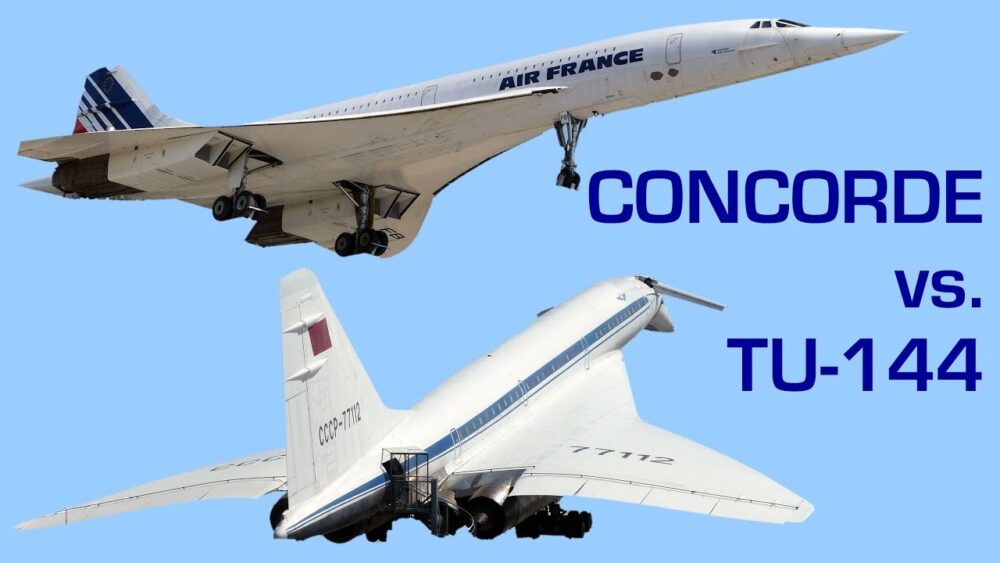
The Concorde and the Tupolev Tu-144 were more than just supersonic airliners. They were technological showcases for rival political systems. Concorde was the result of a unique international aerospace collaboration between France and Britain. The Soviets built the Tu-144 not only as a transport but also as a show of technological superiority.
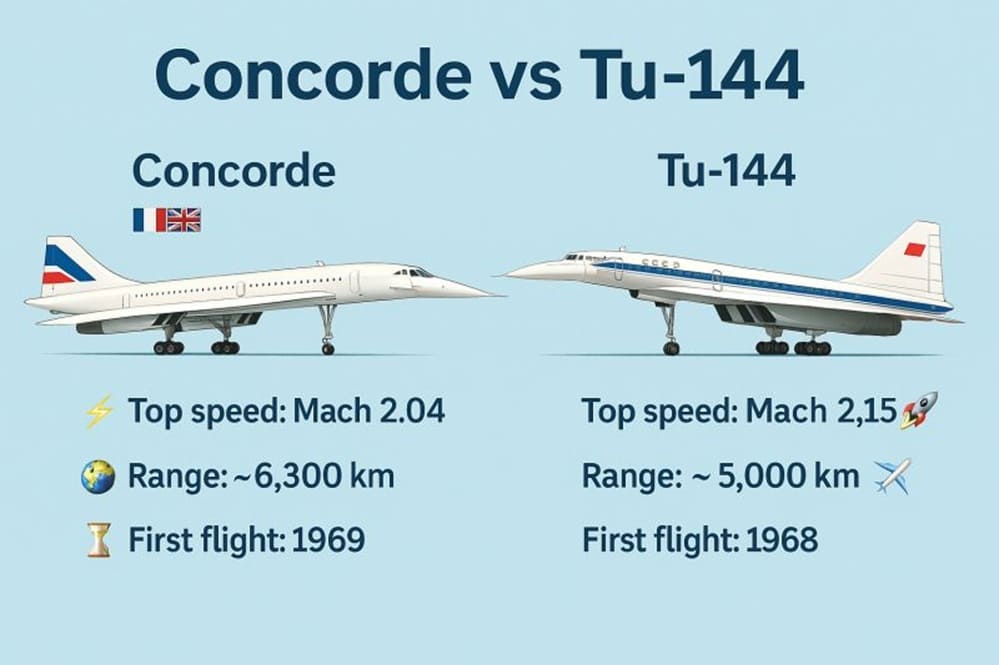
It was to make their rivalry one of the more visible engineering contests of the Cold War. The Tu-144 overcame the first big hurdle: it flew on 31 December 1968, less than two months before the first Concorde flight on 2 March 1969. The Soviet aircraft also became the first civil transport to exceed Mach 2. However, Concorde ultimately became the more mature operational system. Concorde was the more mature operational system.
Two Paths to Mach 2
Both aircraft had slender fuselages and delta wings, as sustained Mach 2 flight presents conflicting aerodynamic requirements. For a supersonic aircraft, a thin wing with low wave drag is needed. However, during take-off and landing, the same wing must provide enough lift at relatively low speeds. Concorde had an ogival delta wing with a carefully calculated leading edge curvature. At high angles of attack, strong leading-edge vortices formed over the wing, giving rise to additional vortex lift. So Concorde didn’t need conventional flaps and still had acceptable low-speed performance.
The production Tu-144 had a different layout. Tupolev engineers added retractable moustache canards behind the cockpit to a modified double-delta wing. These surfaces provided additional forward lift in the approach and contributed to counteracting the nose-down pitching moment caused by the main wing elevons. For military aviation specialists, this represents a significant change. The Concorde was very much reliant on the aerodynamic refinements of its main wing. The use of additional control surfaces increasingly solved the problem of the Tu-144’s low-speed handling.
Propulsion Made the Difference
Each of the four Rolls-Royce/Snecma Olympus 593 Mk. 610 turbojets powering Concorde delivered a maximum reheated thrust in the order of 169 kN. Concorde used reheat for take-off and transonic acceleration but cruised at Mach 2 without continuous afterburner operation. Its production cruise speed was of the order of Mach 2.04, with a quoted range of some 3,900 nautical miles and capacity for some 92–120 passengers. This was an important feature. At Mach 2, the efficiency of the propulsion system is a function not only of the engine core but also of the intake system. The Concorde had variable-geometry inlets that slowed the supersonic airflow before the compressor. You had to feed the engines with a stable subsonic flow, and you had to carefully position the shock waves. The early Tu-144 had a more serious propulsion disadvantage.
Its Kuznetsov NK-144 engines were far more fuel-hungry at supersonic speeds and required afterburning even in cruise conditions. Published technical assessments suggest that the practical range of the early aircraft was only about 2,500 km, which severely limited its usability in comparison with Concorde. Later Tu-144D aircraft were fitted with more powerful Kolesov RD-36-51A engines, but the new powerplant arrived too late to resolve the major operational and political problems that had already beset the programme. The difference is a key military aerospace principle: sustainable speed is more important than maximum speed. A platform that can make a short burst to Mach 2.3 may be less useful operationally than a platform that can cruise efficiently at Mach 2 for hours.
The Heat Challenge
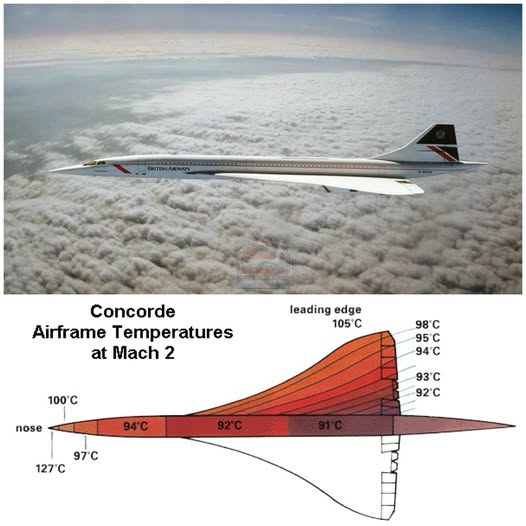
At Mach 2, the aerodynamic heating is a major design constraint. Compression and skin friction heat the nose, engine inlets and leading edges of the front fuselage and wings. The nose and intake of Concorde’s engine are over 127°C hot, and the heat meant that the designers had to use heat-resistant alloys in places where they would normally be subjected to much lower temperatures. The same physics apply to military aircraft like the SR-71, MiG-25 and later high-speed reconnaissance concepts.
So it is not simply an aerodynamic problem to have sustained supersonic flight. It turns into a joint problem of metallurgy, thermal expansion, fuel handling, hydraulic cooling, and structural fatigue. The Concorde’s fuel system was part of the aircraft’s thermal-management and centre-of-gravity control architecture. Concorde pumped fuel between tanks during acceleration to compensate for aerodynamic pressure changes and to maintain the ideal centre of gravity.
The 1973 Paris Air Show Disaster
The rivalry was dramatically revealed at the Paris Air Show in 1973. On June 3, the Tu-144S CCCP-77102 was on a steep climb during its demonstration but then dived and broke up in the attempt to recover. All six crew members and eight people on the ground were killed. The cause is still disputed. The official investigation could find no single sure cause.
One persistent theory includes a French Mirage aircraft operating near the Tu-144. Later reports admitted that a Mirage was somewhere in the area, but what part it played in the accident was never determined. The episode shows how Cold War prestige, demonstration pressure and secrecy complicated technical accident investigation. The Tu-144 finally entered passenger service in 1977, but passenger operations were discontinued in 1978 after it completed only 55 passenger flights.
Intelligence Reveals Political Pressure
Declassified American intelligence material uncovers one especially significant aspect of the programme. The Tu-144 was described as a prestige project, political and technological, in the CIA study “Soviet Supersonic: A Technopolitical Disaster”, and the Soviet SST program was one of the prime targets for Soviet technical intelligence collection in the 1960s. This evidence does not prove that the Tu-144 was a copy of the Concorde.
The aircraft differed greatly in wing geometry, propulsion, landing configuration and systems architecture. But the declassified assessment shows Western supersonic transport technology was a valuable intelligence target. The bigger takeaway is one that is well known in military acquisition programmes: politically driven schedules can distort engineering priorities. However, achieving a headline milestone, such as first flight, maximum speed, or public demonstration, does not mean the system is mature.
Concorde Achieved Operational Maturity
Concorde began scheduled passenger service in 1976 and flew for more than a quarter century. It was not economically viable but a technical success that showed a remarkable operational maturity. Concorde routinely flew at Mach 2 at an altitude of 60,000 feet, reducing the time for trans-Atlantic flights to about half that of conventional airliners. NASA data confirms that Concorde could fly at Mach 2.04 and at altitudes of about 60,000 feet.
On 25 July 2000, Air France Flight 4590 crashed shortly after takeoff from Paris Charles de Gaulle, changing the aircraft’s reputation for safety. The crash killed all 100 passengers, nine crew members and four people on the ground. The French BEA conducted the official investigation. Concorde was returned to service after modifications but was finally retired in 2003 as it became increasingly difficult to continue operations due to operating expenses, fleet age and reduced demand.
An Unexpected Final Chapter
Arguably the most remarkable post-Cold War development was the former Soviet rival becoming an American research aircraft. The Tu-144 airliner was converted into the Tu-144LL flying laboratory by NASA and Boeing, together with Russian aerospace organisations. Between 1996 and 1999 the aircraft undertook 27 research missions, studying high-temperature structures, handling qualities, aerodynamics, cabin noise, boundary layers and other issues related to future supersonic transports. The aircraft was originally conceived as a Soviet technological response to the Concorde, so it ended its career assisting American and Russian engineers in studying the next generation of high-speed aircraft.
Conclusion
The Tu-144 got to fly first and had a higher headline max speed. Concorde won the more difficult battle, that of making a reliable aeroplane capable of flying commercially at Mach 2. Their rivalry shows military aerospace planners that high-speed aircraft must balance propulsion efficiency, inlet stability, thermal management, low-speed controllability and structural life and maintenance burden. Maximum performance is not the only determinant of operating ability. The Cold War produced two identical-looking supersonic icons. However, under their delta wings, they were entirely unique in terms of their levels of technical maturity.
References
- BAE Systems Heritage — BAC Concorde: technical specifications, propulsion, performance and production history.
- NASA — Tu-144LL Flying Laboratory: flight-test programme and joint U.S.-Russian supersonic research.
- CIA Studies in Intelligence — “Soviet Supersonic: A Technopolitical Disaster”: a declassified assessment of the Soviet SST programme.
- France BEA — Air France Flight 4590 Final Investigation: official Concorde accident investigation.
About the Author