

Saudi Arabia and the Houthis: History of a Military Confrontation
What began as a localised border insurgency between Saudi Arabia and Yemen’s Houthi movement (formally known as Ansar Allah) has transformed into one of the most technologically sophisticated asymmetrical conflicts of the twenty-first century. What started as mountain warfare on the Saudi-Yemeni border has grown into an air campaign, a ballistic missile war, a race for unmanned aircraft, a maritime confrontation, and a strategic battle for Saudi energy infrastructure. The war shows a basic problem for technologically advanced militaries.
Saudi Arabia possessed advanced fighter jets, precision-guided munitions, surveillance systems and Patriot air defences. Initially the Houthis used light infantry, mines and captured equipment. But over time, they developed a multi-layered strike capability that could threaten targets hundreds of kilometres inside Saudi Arabia. The Saudi-led coalition said in 2021 that since the start of its intervention the Houthis had fired 409 ballistic missiles and 781 unmanned aerial vehicles at Saudi Arabia. The UN Panel of Experts also said there were an increasing number of attacks in coordinated waves with several types of weapons.
The First Saudi-Houthi War (2009-2010)
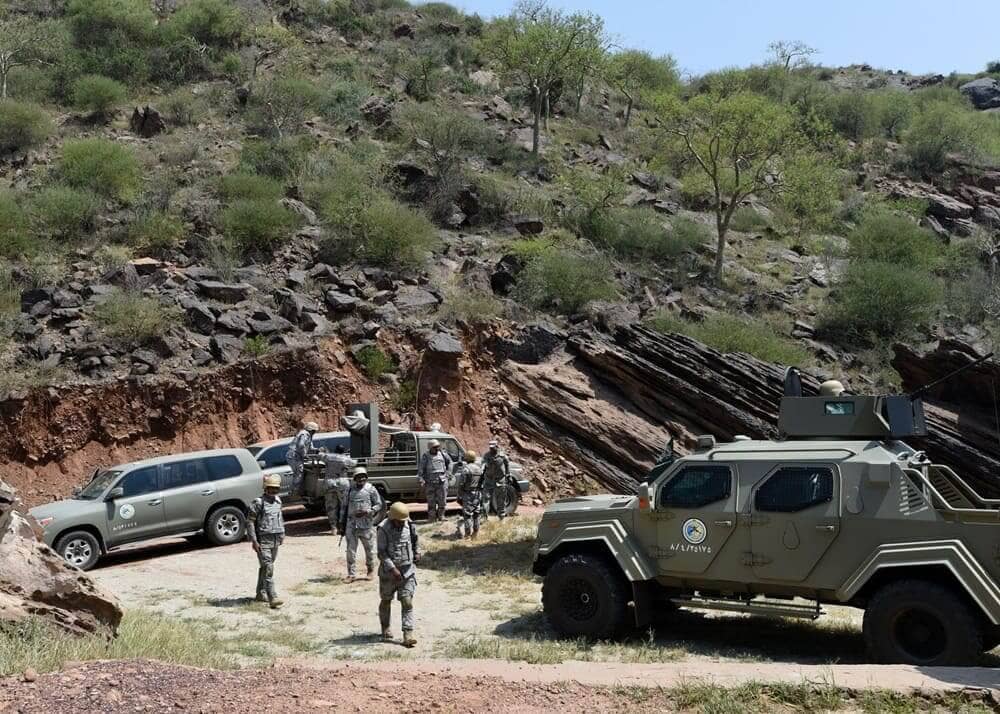
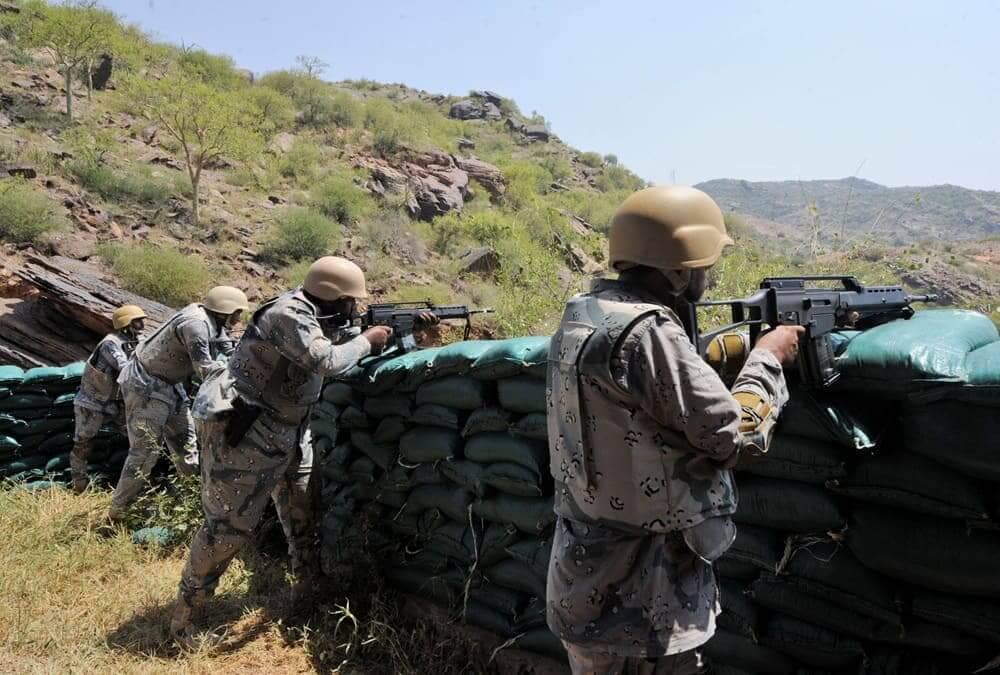
The direct Saudi-Houthi confrontation started in the sixth Sa’dah war in Yemen. In August 2009, President Ali Abdullah Saleh launched Operation Scorched Earth against Houthi positions in northern Yemen. The campaign involved an estimated 40,000 Yemeni troops. The fighting spilt over the Saudi border when Houthi fighters entered the mountainous region of Jizan in November 2009, killing Saudi border guards. Riyadh responded with artillery, ground forces and Royal Saudi Air Force strikes. The terrain immediately exposed a flaw in the Saudi doctrine. The approaches to Jabal Dukhan and the surrounding mountains were narrow, lines of sight were broken, there were concealed firing positions and the terrain was excellent for defense by light infantry. They could not exploit the overwhelming firepower of Saudi mechanised formations, nor could they use their mobility as effectively as they could in the open desert.
Saudi forces fired artillery, dropped paratroopers and used Bradley and Piranha III armoured vehicles. The Royal Saudi Air Force conducted strikes on suspected Houthi positions and supply lines. Saudi naval ships also patrolled Yemen’s Red Sea coast to interdict arms movements. It was a costly campaign. Saudi General Ali Zaid al-Khawaji, commander of the southern Saudi region, reported that the fighting had killed 133 Saudi soldiers. By early 2010, Houthi forces had pulled back from positions inside Saudi territory. The military result was messier than a Saudi battlefield victory. Riyadh may have expelled the Houthis from its territory, but the operation showed that a relatively small insurgent organisation could inflict heavy casualties on a much wealthier conventional military. The Houthis also learned that terrain, concealment, decentralised command and small-unit mobility could at least partially offset Saudi technological superiority.
2015: Saudi Arabia starts a war on Yemen.
The Houthis seized Sana’a in September 2014 and advanced southward, dramatically transforming the strategic environment. By March 2015 Houthi fighters and military units loyal to ex-President Saleh were advancing on Aden. President Abd Rabbuh Mansur Hadi has called for foreign military aid. On 26 March 2015, Saudi Arabia led Operation Decisive Storm. There were reports that Riyadh had committed up to 100 warplanes to the coalition. Saudi airpower consisted of F-15S strike fighters and Eurofighter Typhoons, while Tornado IDS aircraft were also part of the Royal Saudi Air Force’s order of battle. About 170 coalition strike aircraft were reported to have participated in the initial campaign.
Saudi Arabia’s first objective was to secure air superiority and destroy Houthi-controlled military infrastructure. Targets included airfields, aircraft, bases for ballistic missiles, ammunition dumps, command centres and air defense sites. Operation Decisive Storm officially ended on 21 April and turned into Operation Restoring Hope, but much of the air campaign continued. It was a contradiction. Saudi air power would be able to attack identifiable bases and fixed infrastructure. It could not cope with a dispersed insurgent missile force that was more adept at using camouflage, mobility, underground storage and civilian terrain. That issue would be the beginning of the next phase of the war.
Houthis become a missile power.
The Houthis acquired or captured elements of Yemen’s Soviet-era missile stockpile before 2015. However, in time, new variants of missiles appeared, previously unseen. By 2016 and 2017, Houthi forces were firing the Burkan series of longer-range ballistic missiles. The Burkan-2H had features in common with Iran’s Qiam-1 family.
UN investigators and independent analysts have found that Iranian technology and components are at the heart of the Houthi missile programme. The strategic change was huge. Saudi Arabia could no longer view Yemen mainly as a border-security issue. The Houthi weapons could strike strategic infrastructure hundreds of kilometres from the front line.
Case Study: Strike in Riyadh, 2017
4 November 2017 – Houthi forces launch a Burkan-2H missile targeting King Khalid International Airport, near Riyadh. The missile flew a distance of more than 800 kilometres. Saudi air defense forces fired several Patriot interceptors. Saudi Arabia said it intercepted the missile successfully, but independent analysis later cast doubt on whether the missile’s warhead was destroyed before it reached the airport area.
The military point of importance wasn’t that each interceptor did what it was supposed to do. The Houthis had shown they could project ballistic-missile power toward the Saudi capital. However, in March 2018 the Houthis carried out another, larger attack, with seven ballistic missiles targeting Riyadh, Jizan, Najran and Khamis Mushait. Saudi defences fired at the incoming missiles, but debris from them killed one person in Riyadh. The conflict was becoming a strategic missile-defence campaign.
Saudi Arabia’s Air Defense Quandary
Saudi Arabia extensively used Patriot systems to defend cities, military facilities, and strategic infrastructure. The Patriot played a crucial defensive part. But the Houthi campaign has shown the limits of missile defense. Ballistic missiles are based on some rather predictable high-energy trajectories. Another issue is low-flying cruise missiles and small UAVs. They can utilise terrain masking, radar horizons and sensor gaps. This capability was particularly important in the southwest of Saudi Arabia. UN investigators probing the attacks said the mountainous terrain around Abha International Airport and the airport’s proximity to Yemen meant less warning time.
Airport workers got only minutes’ warning of an incoming attack. In the 16 successful attacks that investigators studied, available warnings were only 10. The Houthis are increasingly combining ballistic missiles with UAVs and cruise missiles. These combinations complicated Saudi defensive decision-making, as each threat presented different radar, engagement and interceptor solutions. The larger operational lesson is that, as in modern saturation warfare, the defender must successfully identify and engage almost all dangerous incoming weapons, while the attacker only needs a small percentage to get through.
The Drone Revolution
Most likely the most consequential Houthi innovation was not the ballistic missile but the cheap, long-range UAV. The Houthi arsenal also included systems like Qasef-series drones and Samad-series UAVs in addition to longer-range cruise missiles such as the Quds family. Some Houthi UAVs and explosive unmanned boats were assembled in Yemen from commercially available foreign components, including engines, propellers and servo actuators, UN investigators found.
Investigators also recovered debris from modified Burkan-type ballistic missiles and Quds-series cruise missiles. This finding reveals an important, but often overlooked, aspect of modern warfare. A military organisation does not need the entire domestic aerospace industry to operate effectively. Locally built airframes can be mated with imported electronics, engines, navigation hardware and off-the-shelf components. This greatly reduces the technological barriers to precision or semi-precision long-range attack.
Case Study: 2019 Khurais and Abqaiq
The September 14, 2019, attack on Saudi Aramco’s Abqaiq and Khurais facilities was one of the most consequential attacks on energy infrastructure in modern times. The Houthis claimed responsibility and initially said 10 UAVs were involved in the operation. But UN investigators found serious inconsistencies. At least 18 drones and seven cruise missiles were used, three of which missed their targets, Saudi authorities said. Investigators said the number and types of impact sites did not match the Houthi account closely.
The UN said it could not independently verify that the recovered systems were Iranian. It is important to distinguish these events. The attack represented a major escalation in the Saudi-Iran-Houthi confrontation, although its precise launch origin and operational responsibility became a major attribution dispute. Saudi Arabia, Iran, the Houthis, and international investigators were all involved. Meanwhile, in military terms, Abqaiq showed something bigger: that low-flying weapons coming from unexpected directions could get through a sophisticated national air-defence network and temporarily destroy strategically important energy infrastructure.
The Underreported Technical War
Some of the most important information about the Saudi-Houthi confrontation is not classified; it’s just buried in technical reports. One is the construction of Houthi weapons. Investigators discovered that some of the missile systems entered Yemen as components rather than whole weapons, meaning they could be smuggled in under the radar and then assembled or modified locally. Analysis of debris recovered from Burkan-2H supports the assessment that imported components were incorporated into Yemen-based production and modification networks.
This is why the repeated coalition bombing never managed to permanently get rid of the missile threat. Destroying launchers is not the same as destroying an industrial eco-system of workshops, technicians, smuggling networks, electronics suppliers, storage locations and mobile launch crews. Another feature that the Houthis missed was their targeting philosophy. Many of the long-range attacks on Saudi Arabia seemed aimed at exerting political and economic pressure, the UN Panel said, while the Houthis’ use of missiles inside Yemen was often optimised for direct battlefield lethality. The weapons offered greater range while also serving as instruments of strategic coercion.
From War of Missiles to Dialogue
According to unverified figures from the coalition, the Houthis have fired 1,190 ballistic missiles and UAVs at Saudi Arabia as of October 2021, of which 409 were ballistic missiles and 781 were UAVs. Saudi Arabia had not managed to permanently quell the Houthi stand-off arsenal, despite thousands of coalition strikes and massive missile-defence operations. The Houthis could not beat Saudi Arabia either conventionally. That created an asymmetric sort of deterrence.” Riyadh had huge air power and economic resources.
Ansar Allah had enough survivable missiles and drones to strike costs on Saudi cities, airports and energy infrastructure. The UN-brokered ceasefire of 2 April 2022 halted offensive ground, air and maritime operations and explicitly covered cross-border attacks. U.N. officials said there was an immediate sharp decline in hostilities and no confirmed Saudi airstrikes or cross-border attacks in the early phase. Fighting between the Saudis and the Houthis was still way down. In late September 2023, Houthi representatives travelled to Riyadh for direct talks with Saudi officials.
New Escalation 2026
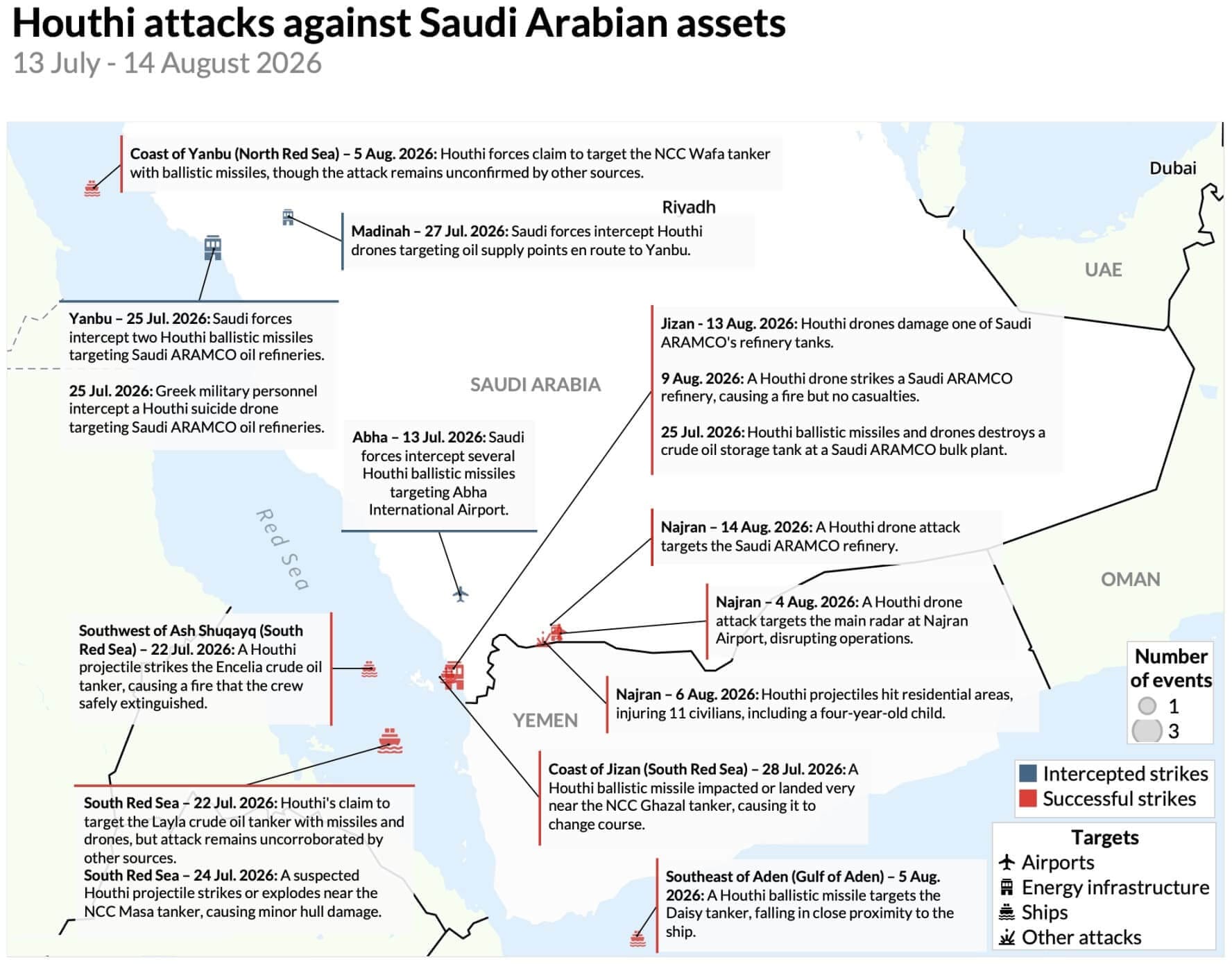
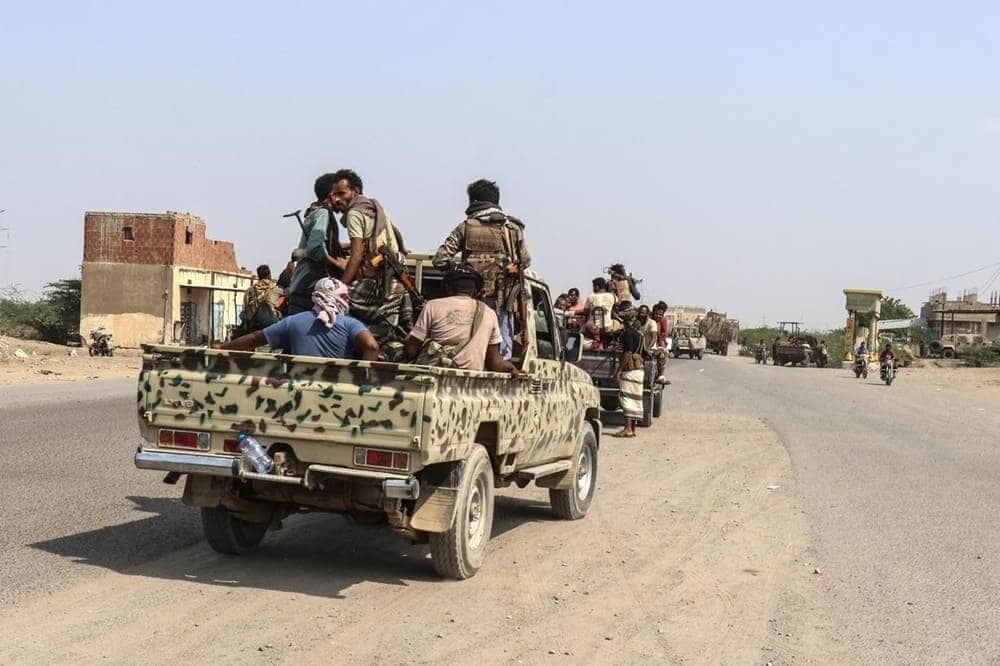
The confrontation did not go away; it lay dormant beneath the surface of regional diplomacy. By the beginning of October 2026, the military situation was again changing rapidly. Saudi Arabia had been preparing to support a major Yemeni offensive related to control of the Bab el-Mandeb and Red Sea approaches, Reuters said. Later reports spoke of renewed Saudi-backed operations and subsequent Houthi missile and drone retaliation.
These developments are still ongoing, so both sides are still verifying their claims. The development underscores the ongoing strategic challenge of the last decade. Saudi Arabia has overwhelming conventional airpower, but Houthi forces have developed enough missiles, UAVs and dispersed ground capability to make large-scale military operations costly.
Mecca Joint Defence Agreement
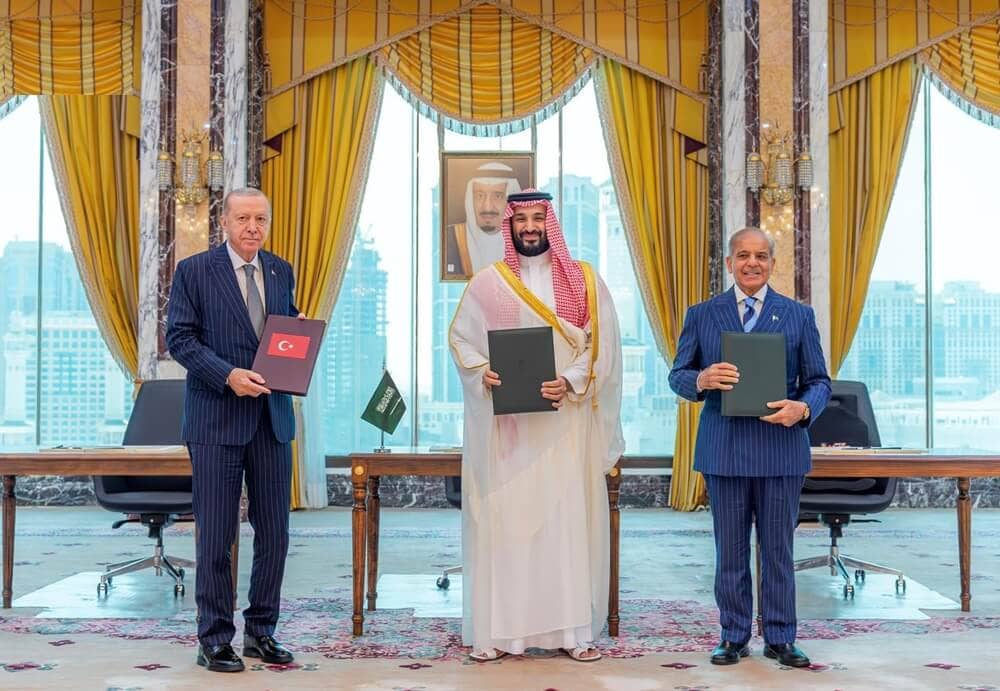
The Mecca Joint Defense Agreement is the latest chapter in the long-running Saudi-Houthi military standoff. The conflict has morphed from mountain warfare into a campaign of ballistic missiles, cruise missiles, long-range UAVs and attacks on Saudi infrastructure since the border fighting in 2009. However, the strategic calculus shifts with the agreement signed between Saudi Arabia, Pakistan and Türkiye on 7 August 2026, which could make future attacks on Saudi territory a broader collective-defence issue. On 5 October, the three states responded to the renewed Houthi missile and drone attacks with collective deterrence measures for the first time.
The escalation continued on 6 October, with Saudi authorities reporting injuries to three people in attacks on airports at Jizan and Najran, while the Houthis claimed strikes against Abha airport and other targets in Saudi Arabia. Yemeni forces backed by Saudi Arabia, meanwhile, stepped up operations against Houthi positions along the Bab al-Mandeb and the Red Sea coast. So the Mecca Pact makes any potential attack by Houthi more costly. Now Riyadh may be able to tap Pakistani and Turkish military capabilities for air defence, surveillance and force protection. The deterrence balance has shifted in the last decade; for the Houthis, Saudi Arabia is no longer a unitary target but an increasingly shielded coalition.
Strategic Lessons of the Saudi-Houthi War
The Saudi-Houthi confrontation has seen a dramatic transformation between 2009 and the mid-2020s. Saudi forces in 2009 fought mountain fighters armed mostly with infantry weapons, mines and captured equipment. Ten years later, ballistic missiles, cruise missiles and long-range UAVs threatened Saudi cities over 800 kilometres from Yemen. Saudi Arabia revealed a huge strike capability, sophisticated combat aviation, and some of the largest operational uses of modern missile defences ever seen. Yet air superiority did not always translate to strategic victory.
The Houthis provided a glimpse of the other side of modern warfare: dispersed groups can use guerrilla tactics, commercial technology, foreign technical support, native adaptation and relatively inexpensive precision weapons to threaten a much wealthier foe. So the key military lesson is not that airpower or missile defense failed. Both cost Saudi Arabia much more than they did before. The fighting suggests that air superiority does not translate into escalation dominance. Saudi could go anywhere in Yemen. But the Houthis developed the ability to strike deep inside Saudi territory. This shared vulnerability slowly turned a conventional campaign into an asymmetric deterrence relationship and is why negotiation became, in the end, as important to Riyadh as airpower.
References
- McGregor, Andrew. “Saudi Military Operations along the Yemen Border Repel Houthist Incursion.” Jamestown Foundation, Terrorism Monitor, 28 January 2010. Jamestown
- Williams, Ian, and Shaan Shaikh. “The Missile War in Yemen.” Center for Strategic and International Studies, Missile Defense Project, June 2020. CSIS
- United Nations Security Council. Final Report of the Panel of Experts on Yemen, S/2022/50. 26 January 2022. Digital Library
- United Nations. Secretary-General’s Statement on a Nationwide Truce in Yemen. 1 April 2022. United Nations
About the Author