

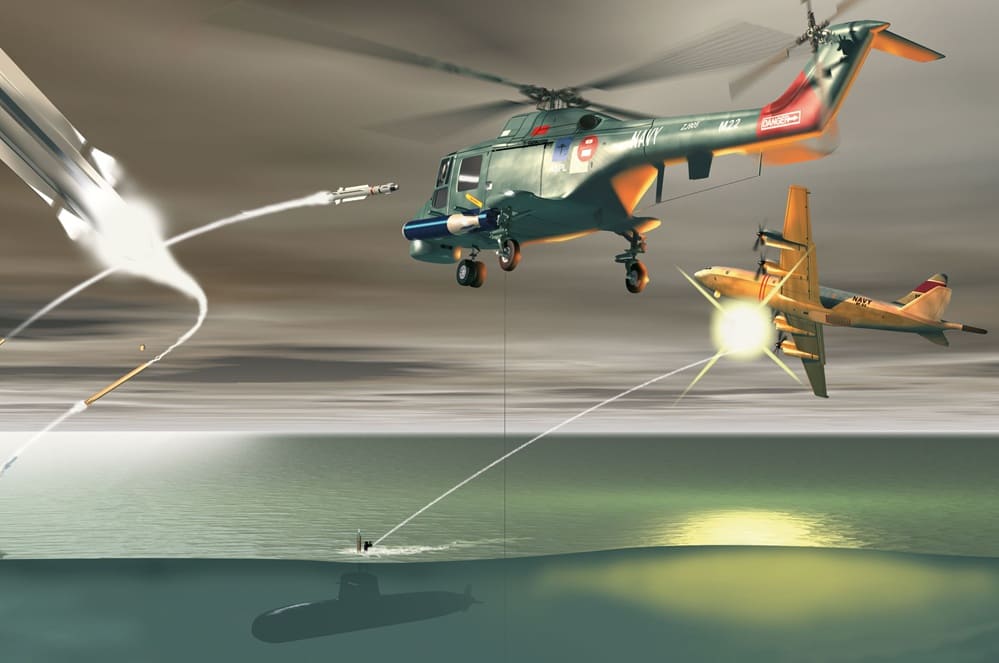
Submarine Air Defense: Why Submarines Rarely Shoot Back
It may not seem obvious that an anti-submarine-warfare (ASW) helicopter could be a vulnerable adversary. It can hover while lowering a dipping sonar and is slower and cheaper than the submarine it hunts. So a submarine-launched surface-to-air missile (SAM) seems to be an obvious countermeasure. The incongruous are guileless. A submerged submarine is at a three-fold disadvantage: it has a poor picture of the air domain; a missile must cross a severe water-to-air boundary; and firing can reveal the position of a platform whose principal protection is concealment. A SAM can help to reduce these problems but cannot eliminate them.
The sensor asymmetry
ASW aircraft appear to be part of a network, not lone shooters. According to Boeing, the P-8A Poseidon can carry 129 A-size sonobuoys, fly at 490 knots and have more than four hours on station at a mission radius of more than 1,200 nautical miles. Its mission system integrates radar, electro-optical/infrared sensors and active and passive acoustic processing. The US Multi-Static Active Coherent system uses source and receiver sonobuoys for wide-area search, detection and localisation. But operational testing revealed that it did not meet all requirements in all environments, serving as a salutary caution against claims that modern ASW makes submarine detection automatic. The MH-60R Seahawk has dipping sonar and sonobuoys, multimode radar, electronic-support measures, and an AN/AAS-44C(V) electro-optical/infrared system.
Thales says its FLASH-family sonar works to a depth of 750 metres. However, magnetic anomaly detection is not a universal MH-60R capability. Lockheed Martin announced that it will incorporate the removable digital MAD-XR system as an upgrade in 2025. There is no view parallel to the sky for the submarine. Radar and normal radio-frequency energy are rapidly attenuated in seawater, and a periscope or optronic mast offers only a limited, narrow field of vision and exposes the submarine. Passive sonar can detect dipping sonar, machinery noise or rotor-induced surface effects, but bearing and approximate range do not automatically provide you a fire control-quality three-dimensional air track. The crew must locate the contact, determine its position and movement, avoid friendly aircraft, and provide usable missile guidance without the continuous radar track available to a surface combatant.
The water-to-air launch problem
Hydrostatic pressure increases approximately as ($$p=\rho gh.$$). For seawater with a density of about 1,025 kg/m³, the gauge pressure at 100 metres is about 1.0 MPa, or 10 bar, excluding atmospheric pressure. A SAM and its launch unit (underwater) have to withstand this load, be waterproof, safely clear a 533 mm torpedo tube, travel through water that is about 800 times denser than air, cross a moving surface and then transition to aerodynamic flight. The submarines have already been proven to launch missiles underwater.
The UGM-84 Harpoon has a booster for surface or submarine launch. The UUM-44 SUBROC, which entered service in 1965, was a standard torpedo tube that flew an airborne trajectory and delivered an underwater nuclear depth charge. The systems show that the transition of the medium is possible. They do not provide for the additional SAM requirement of acquiring and intercepting a moving aircraft with valid identification and sufficient terminal accuracy.
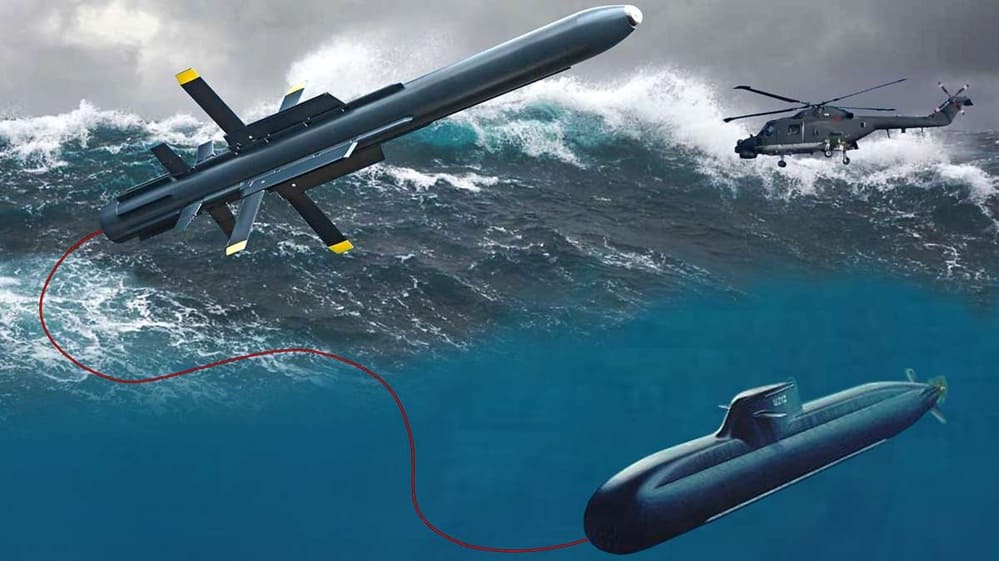
IDAS: the most mature public solution
The most obvious attempt to bridge that gap is Germany’s Interactive Defense and Attack System for Submarines, or IDAS, which uses hydraulic ejection from a torpedo tube, as quoted by the Bundeswehr. As soon as the missile reaches a safe distance, its rocket motor fires while it is still submerged. The missile turns toward its target, breaks the surface and extends its aerodynamic surfaces. The imaging seeker sends images to the operator via a fibre-optic link. Human-in-the-loop control allows for aim point correction, retargeting or aborting the engagement. The plane is hit by a fragmentation warhead.
| Publicly verified characteristic | IDAS figure or status |
|---|---|
| Length | 2.8 m |
| Diameter | 180 mm |
| Launch mass | 140 kg |
| Speed | 240 m/s |
| Launch method | Hydraulic ejection from a submarine torpedo tube |
| Guidance | Imaging seeker with fibre-optic operator control |
| Public programme status | Development and qualification contract awarded at the end of 2024; development continued during 2025 |
The German Type 212A submarine U-33 conducted the first reported launch in May 2008. However, authorities did not award a new development and qualification contract until late 2024. “That long period shows how hard integration is.” The latest public programme reporting suggests that IDAS is a development capability, not a fleet-wide weapon. Some older promotional and open literature often gives IDAS a range of around 20 kilometres and a four-missile torpedo tube magazine. At this time those values are not appearing as qualified performance on the official program pages. Some German naval reporting refers to qualification around 2029, but no binding fleet-entry date is provided on the current official pages. The usual caveats apply to widely circulated numbers for warhead weights. These are estimates, not confirmed operational specifications.
Engagement Geometry and Kill-Chain Timing
IDAS is more suited as a last resort weapon for short range rather than for air defense in submarines. Simple ten-kilometre calculations yield a time of around 42 seconds at the published speed of 240 m/s. This figure is an unofficial time to target and excludes launch transients, acceleration, and manoeuver. This procedure provides a helicopter a chance to manoeuvre, fall back or fire a torpedo. This is the key point. The lightweight Mk 54 torpedo is launched from the water and then independently hunts and strikes. The High Altitude Anti-Submarine Warfare Weapon Capability equips the P-8 with a wing kit that enables the P-8 to release the torpedo from significantly higher altitudes and to steer it to a predetermined water entry point.
Thus, destroying the aircraft after the weapon release may not stop the ongoing attack. A missile launch also generates observables, including an underwater transient, a surface disturbance, and an above-water plume or flash. The fibre link can maintain control without raising a radar mast, but it does not hide the launch. Typically, a helicopter is part of a wider barrier that can include sonobuoys, another aircraft, surface escorts and off-board command networks. Shooting down one node exposes the location of the submarine to all other nodes. There is also an opportunity cost. A Type 212A has six 533 mm torpedo tubes. Each defensive missile package consumes valuable space and handling capacity that could otherwise be used for heavyweight torpedoes, mines or other mission stores.
PNS Hangor Sinks INS Khukri
On 9 December 1971, during the Indo-Pakistani War, the Pakistan Navy submarine PNS Hangor sank the Indian Navy frigate INS Khukri off the western coast of India. The French-built Daphné class submarine Hangor had been tracking an Indian anti-submarine warfare group comprising the Khukri and Kirpan. The first torpedo missed Kirpan, and Hangor fired once more at Khukri. The second torpedo struck the frigate, and she went down within minutes, the damage catastrophic.
The ship’s commanding officer, Captain Mahendra Nath Mulla, chose to stay with the Khukri as she sank. The attack killed 194 Indian sailors and officers. Hangor later escaped a massive Indian hunt and returned safely to Karachi. This was the first successful submarine strike since the Second World War and one of the most significant submarine actions in the naval history of South Asia. It showed the importance of stealth, patience, tracking, disciplined fire control and surprise in littoral warfare in combat conditions.
Falklands: Santa Fe and San Luis
The Falklands War is an example of the complexities of survivability. On 25 April 1982, a British Wessex helicopter spotted and attacked the Argentine submarine ARA Santa Fe, a Second World War-era Balao-class boat, as it returned from a landing and resupply mission near Grytviken, South Georgia. The depth charge ripped up the boat so badly it couldn’t dive. The Wasp helicopters fired AS.12 missiles, and the Lynx joined in the attack. The crew came ashore at Grytviken, the British-commandeered submarine base. The aircraft did not sink the boat during the action but did damage it so that it was easier to capture. So the oft-repeated statement that Santa Fe was “the first submarine sunk by aircraft since the Second World War” is wrong.
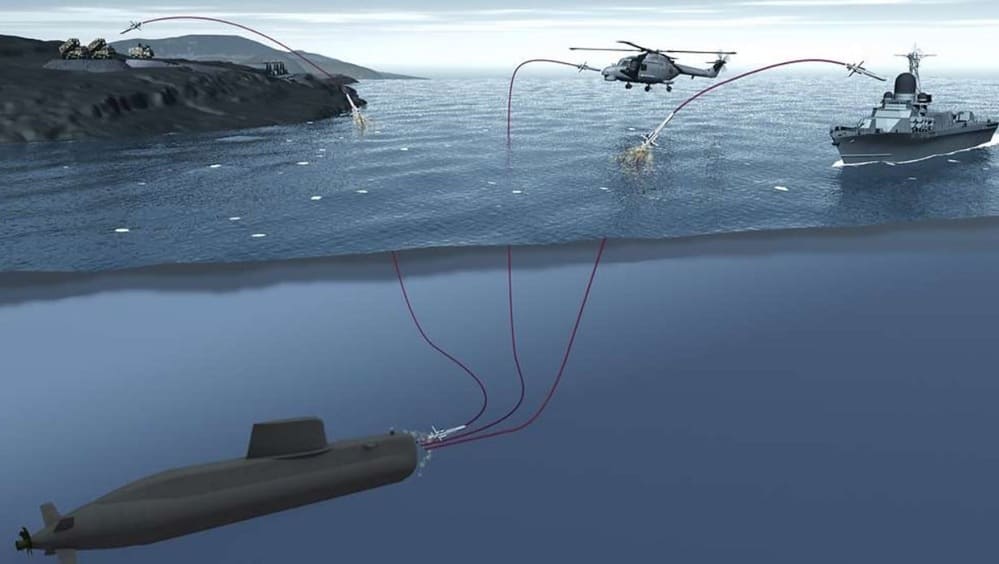
Type 209, ARA San Luis
One example is the diesel-electric submarine of Type 209, ARA San Luis. It was at sea for about 36 days, attempted three attacks and weathered a heavy British ASW effort which included a prosecution of about 20 hours. It lived on in obscurity, in conditions of difficult acoustics, of uncertain contacts and of problems of prosecution by the British. The San Luis’s fire-control and torpedo systems were lacking, and deficiencies in training and preparation caused her attacks to fail to register a confirmed hit.
Open sources vary a lot in their estimates of British weapons expenditure. The popular contention that more than 200 ASW weapons were aimed straight at San Luis should not be accepted as fact. The comparison speaks volumes. Santa Fe lost its main defense, trapped in a place where it could find no shelter. It was dangerous because the British could not keep a reliable track of San Luis. Both cases suggest the value of a submarine SAM. Both show why navies usually prefer evasion, counter-detection, decoys and track-breaking to open-air battle.
What public sources do not reveal
The most important operational employment figures are classified or unpublished – qualified launch depth and sea state limits, seeker acquisition range and spectral bands, fibre-optic link length and strength, permissible target geometry, identification rules, acoustic launch signature, probability of kill, countermeasure resistance and exact range, fragmentation pattern and warhead mass. A responsible analysis should highlight these gaps rather than attempt to clarify what is inherently imprecise.
Strategic assessment
Engineers can make the concept work technically, while commanders may consider it tactically useful within a narrow engagement window, particularly against a nearby helicopter using dipping sonar. It might have some behavioural value: the threat of a missile might cause helicopter crews to do fewer dips, reposition more often or use standoff and cooperative tactics, and that would disrupt localisation.
It can’t change the basic economics of submarine survival. First the submarine has to have a viable track of air. Then fire through two physical mediums. Then defeat the aircraft before or after weapon release. Afterwards, escape a network that has been alerted by the engagement. IDAS can provide a commander an option he has never had before. It does not change the basic principle of undersea warfare that a submarine lives and dies by denying the enemy a stable track, not by contesting the sky.
References
- Bundeswehr — Sea-to-Air Guided Missile System for U212A (IDAS)
- Diehl Defense — Development and Qualification of IDAS
- US Department of Defense — Mk 54 Torpedo and HAAWC Assessment
- Imperial War Museums — Attack on ARA Santa Fe, 1982
About the Author

Inspiring quest there. What happened after? Thanks!