

Why Military Submarines Have No Windows
Modern military submarines, except for a few, generally have no windows, as clear viewports would compromise the pressure hull, interfere with acoustic stealth, and provide little tactical advantage.
Instead, submarines use sonar, electronic sensors, inertial navigation and optical masts to navigate and fight. It’s something more complicated than glass just breaking under pressure. It addresses structural instability, material fatigue, shock resistance and treatment of penetrations of the pressure hull.
Window in Sail vs Hull
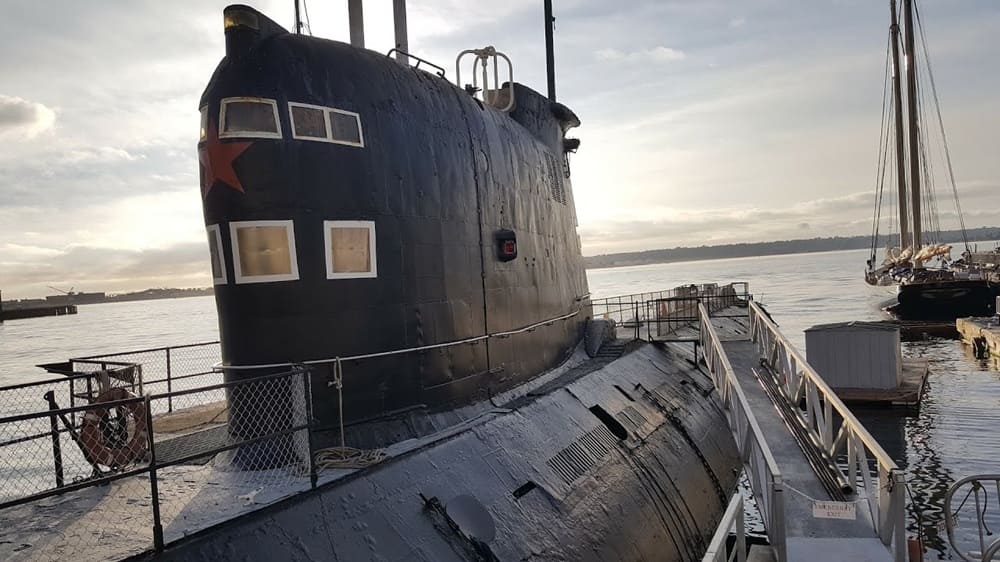
Generally, submarine sails are outside of the pressure hull, so they can have windows in them. The sail is an open-to-the-elements structure with masts, antennas and a navigation bridge. As the submarine dives, seawater flows into the sail, equalising the pressure on both sides of the windows. Therefore, the pressure difference of these windows is low.
However, the pressure hull keeps the crew at near sea-level pressure, countering the full force of the sea outside. If you cut a window in the pressure hull, you break the structural continuity, create stress concentrations, and increase the likelihood of collapse. “The windows in the sail are for surface navigation, and the pressure hull stays solid for underwater survival and acoustic stealth.
Extreme Pressure Loads
Seawater pressure increases almost linearly with depth:
Here, (p0) represents atmospheric pressure, (\pgh) is seawater density, (g) is gravitational acceleration and (h) is depth. Assuming seawater density is about 1,025 kilograms per cubic metre, the pressure difference is about 3.02 megapascals at 300 metres. This is about 30 atmospheres above the internal cabin pressure.
The surface area of a circle with a diameter of 30 centimetres is approximately 0.0707 square metres. At 300 m it would be loaded inwards by approximately 213 kN. This is about 22 tonnes-force. At 500 metres you would be looking at a load of more than 355 kilonewtons, or about 36 tonnes-force. The exact operating, test and crush depths of military submarines are secret.
Windows Weaken the Hull
The outside skin of a submarine is not always the pressure boundary. Many designs have a more streamlined, partly free-flooding structure around a much stronger inner pressure hull. The pressure hull usually consists of cylindrical sections connected by hemispherical or conical ends.
The cylinder is fitted with ring frames to avoid buckling due to external pressure. If the structure is not stable, the submarine hull may buckle under the external pressure before the steel itself fails in simple tension. For an ideal unstiffened cylinder, the elastic buckling strength varies as about
Here, (t) represents shell thickness and (R) represents hull radius. Small changes in geometry can therefore produce large changes in theoretical buckling resistance. Real pressure hulls are never geometrically perfect. Welding distortion, residual stress, corrosion, frame spacing and slight ovality reduce the actual collapse margin.
A window opening destroys the load path of the shell and leads to a concentration of stress around the edge. Engineers would need a forged weight insert, a reinforcement ring and a precisely machined seating surface. These factors add to the complexity of displacement and manufacture. They are also interfaces between materials with different elastic and thermal properties.
Why Some German Subs Have Windows
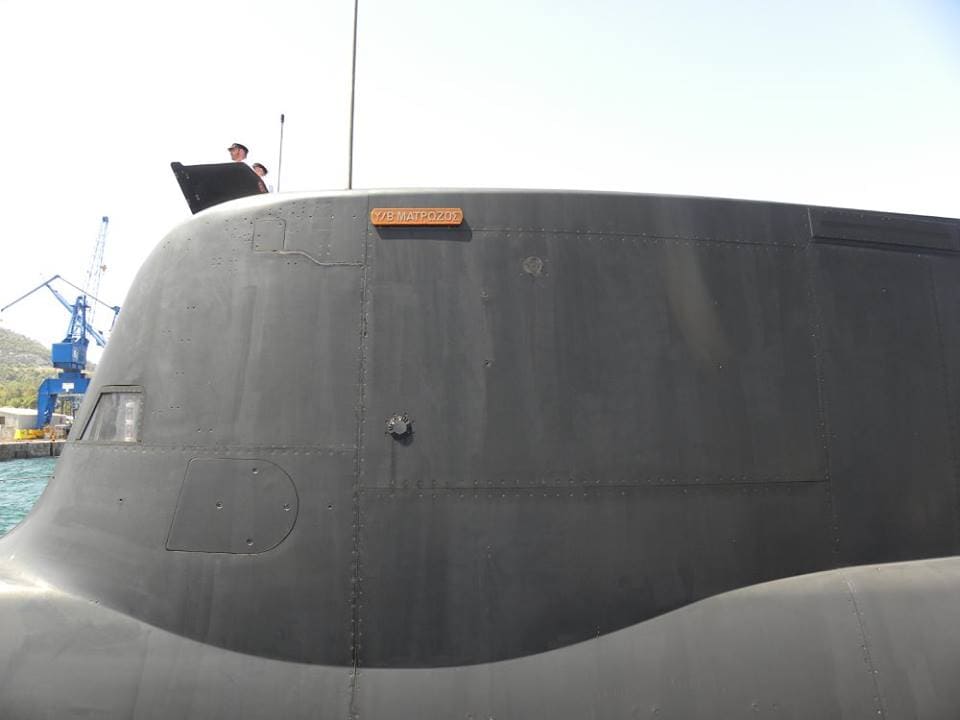
Some German-built Type 212 and Type 214 submarines seem to have windows in the sail. However, they are not windows through the main pressure hull. They are part of a closed-in navigation bridge when the submarine is surfaced, especially during harbour manoeuvres or in heavy weather.
Normally, the sail is an open structure that floods freely outside the pressure-resistant compartment in which the crew lives. So when the submarine goes down, water flows into this space, equalising the pressure on the windows. So they do not have to suffer the significant pressure differential that a real pressure-hull viewport experiences. Underwater navigation still relies on sonar, inertial systems, periscopes, electronic sensors, and external cameras.
Transparent Materials Add Risk
Submarine pressure hulls are usually built from high-strength steels, such as the HY-series alloys, and titanium for special vessels. These materials provide strength, ductility, weldability and predictable fatigue behaviour.
Thick conical optical acrylic viewports can handle extreme compression. But it is a visco-elastic material. It is susceptible to creep, dimensional change, surface crazing and degradation after repeated pressure cycles. It’s harder for glass and transparent ceramics.
Meanwhile, they tend to be more brittle than the metals used for hulls. The reliability of such materials is highly sensitive to microscopic inclusions, edge flaws or impact damage. A combat sub has to survive explosions close by. Underwater explosions create rapid pressure pulses, hull whipping, and bubble pulsations.
A viewport assembly must be capable of withstanding static pressure, repeated cycling and transient combat shock, all simultaneously. A window is not an opaque pane of glass. It becomes a whole pressure-bearing system requiring seals, seats, reinforcement and constant inspection.
Hull Penetrations Receive Strict Control
Military subs already require hull openings for hatches, shafts, torpedo tubes, cables, seawater systems and sensors. Navies certify and minimise these openings with the utmost care. The U.S. Navy Joint Fleet Maintenance Manual requires double closure for most penetrations of the hull below the waterline.
Work on these barriers requires formal isolation, testing and command approval. Such requirements demonstrate the importance attached by navies even to small openings in a pressure boundary. The NAVSEA maintenance manual covers these controls. A window would create a large permanent single-pressure boundary with no operational advantage.
Windows Offer Little Tactical Value
Sunlight, suspended particles, biological material and water clarity all affect underwater optical visibility. In relatively shallow coastal waters, visibility can be reduced to just a few metres. At 200 to 1,000 m, the amount of natural light drops sharply. Submarines above those depths can still encounter darkness, sediment, or biologically rich water. The close-range vision could do with a few more powerful external lights.
However, they would reveal the submarine to optical sensors, unmanned vehicles and nearby forces. They may also light up suspended particles rather than an object at a distance. Passive sonar, however, can locate noise-generating contacts at tactically relevant ranges without transmitting energy. Active sonar, high-frequency obstacle avoidance systems, and external cameras support specialised navigation requirements.
Sensors Have Replaced Direct Vision
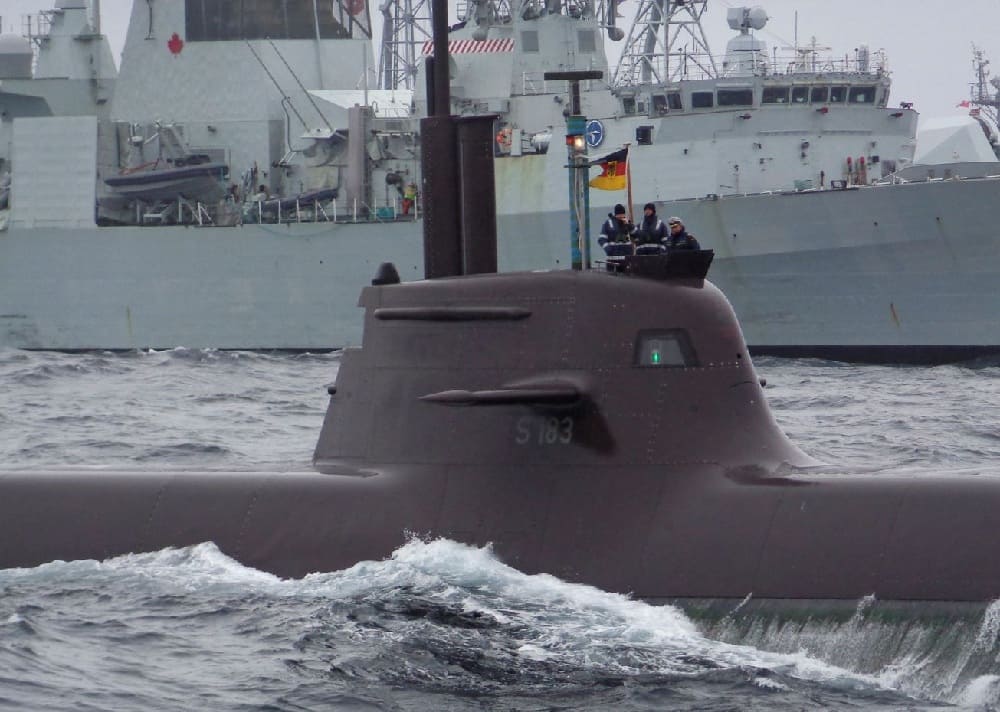
Modern submarines develop their tactical picture with integrated sensor systems. These include bow arrays, flank arrays, towed arrays, intercept receivers, inertial navigation systems and environmental data bases. Optical and infrared masts observe the surface at periscope depth. The Virginia-class submarines replaced conventional, hull-penetrating periscopes with two photonics masts with visible and infrared cameras.
This enabled designers to relocate the control room from the upper curve of the pressure hull. Here’s how the U.S. Navy’s attack-submarine fact file describes this arrangement: Images can also be sent from external cameras through small engineered electrical or fibre-optic penetrations. The loss of one camera does not compromise the crew’s entire pressure boundary.
Case Study: Alvin’s Specialised Viewports
The research submersible Alvin has proven that deep-diving windows are technically feasible. But the scientific mission demands direct observation, and the engineering risk is acceptable. The new titanium personnel sphere has five acrylic conical viewports.
Three have 7-inch inside openings and 17-inch outside diameters. The two smaller windows are five inches in and twelve inches out. The larger outside diameter means the seawater pressure pushes each viewport more tightly into its conical seat.
The geometry makes the seal tighten with depth. The Woods Hole Oceanographic Institution said the viewports were tested at more than 12,000 pounds per square inch. The tests produced about 680 tonnes of force on smaller windows and over 1,300 tonnes on larger ones.
Technicians then examined each viewport for voids, inclusions and permanent dimensional changes. The procedure is costly, but it makes sense, considering that visual observation is an essential part of Alvin’s main mission. It has little utility on an attack or ballistic missile submarine.
Case Study: The Trieste Window Myth
The Trieste dive of 1960 is a major lesson of history. At about 32,400 feet, Jacques Piccard and Don Walsh felt a jolt as a viewing port broke. People often say that the crew’s pressure window almost collapsed due to hydrostatic pressure. Walsh, however, later said the damaged port was part of the entry tube and was free-flooding.
It was not the direct pressure of seawater on the personnel sphere that caused the crack but a change in structure. But the incident still cut their time in Challenger Deep to about 20 minutes. It demonstrates that optical components can complicate deep-submergence operations even if they are not part of the primary pressure boundary.
Classified Design Limits
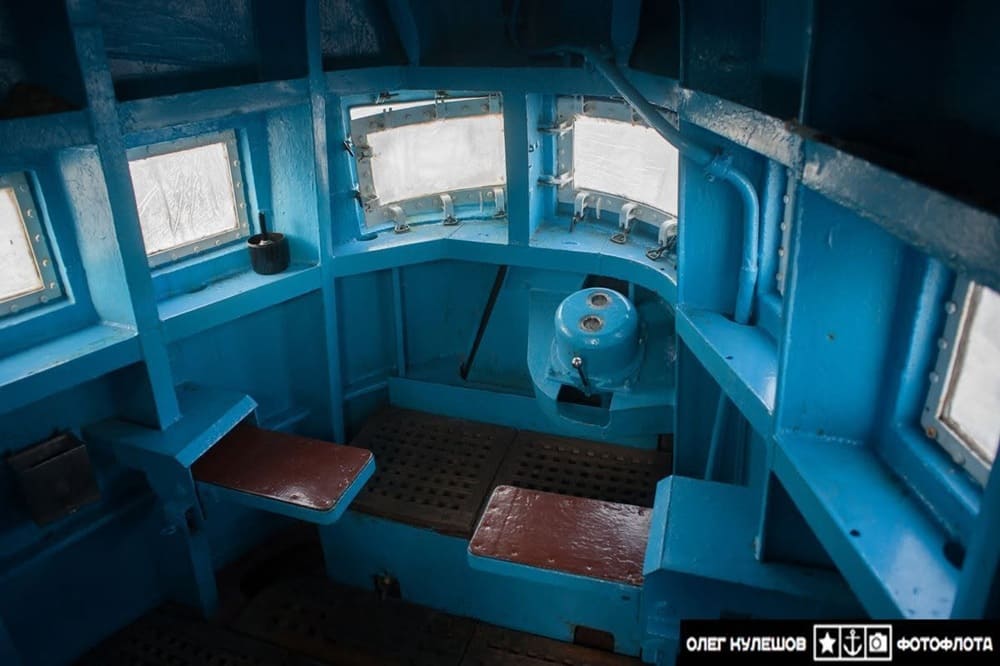
Navies do not publish things like hull thickness, frame spacing, safety factors, test depths or collapse depths. Penetrator locations and acoustic treatments are also sensitive. If you read on the internet that there are X of something, be sceptical.
Public information can describe engineering principles but is not reliably used to demonstrate the true structural limits of a modern submarine. Reinforced windows may also affect local vibration and acoustic reflection around the hull. This is a sensible conclusion for an engineer. Platform-dependent acoustic effects, however, are classified and not presented as confirmed data.
Strategic Assessment
Military submarines lack windows because their missions prioritise pressure integrity, stealth, and survivability over direct observation. Every large hole reduces the structural homogeneity and requires more inspections.
Research submersibles accept the disadvantages because their mission is observation. For combat submarines, sonar and remote cameras are of more use than an easily damaged optical aperture. So underwater warfare is about the strongest possible pressure hull – and the fewest possible holes.
References
- U.S. Navy — Attack Submarines Fact File
- NAVSEA — Joint Fleet Maintenance Manual
- Woods Hole Oceanographic Institution — Alvin Viewports
- USNI Proceedings — The First Deepest Dive
About the Author