

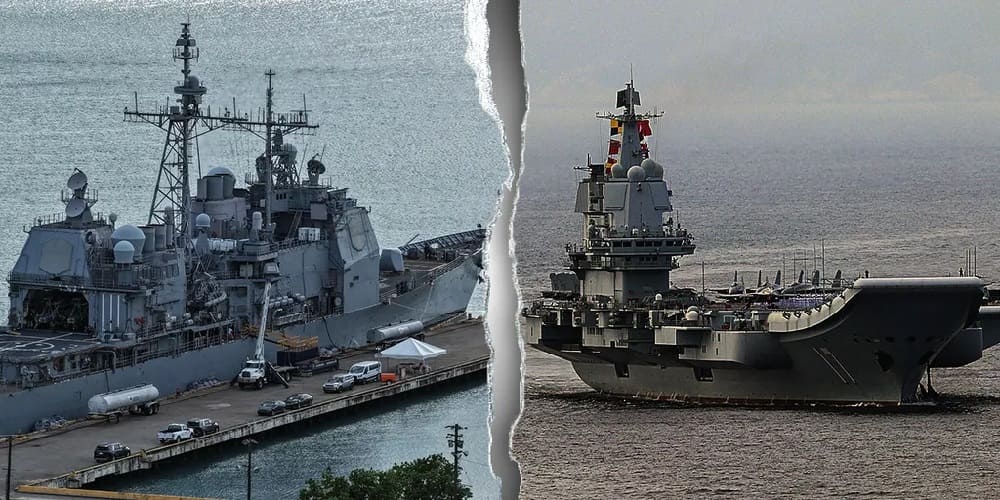
America’s Navy Shrinks as China Surges Ahead
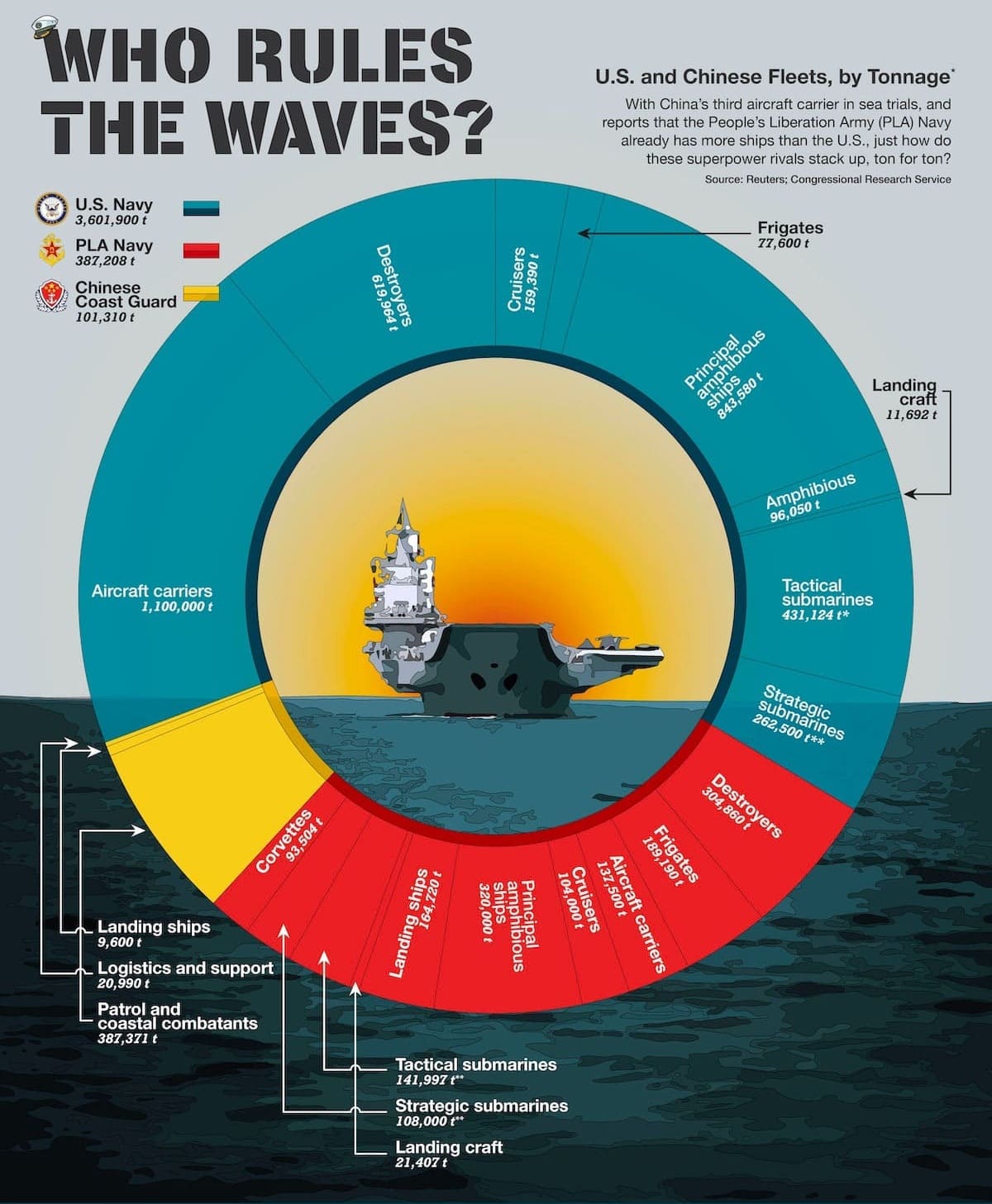
Fleet numbers alone do not capture the full picture of the changing maritime balance of power between the U.S. and China. The key variables are missile capacity, submarine availability, shipyard throughput, repair capacity, sensor coverage and geographical concentration. As of May 1, 2026, the U.S. Navy had 291 battle-force ships and approximately 9,100 vertical-launch-system cells. It also kept 11 aircraft carriers. But the numerical and industrial drift is moving away from the U.S. Navy.
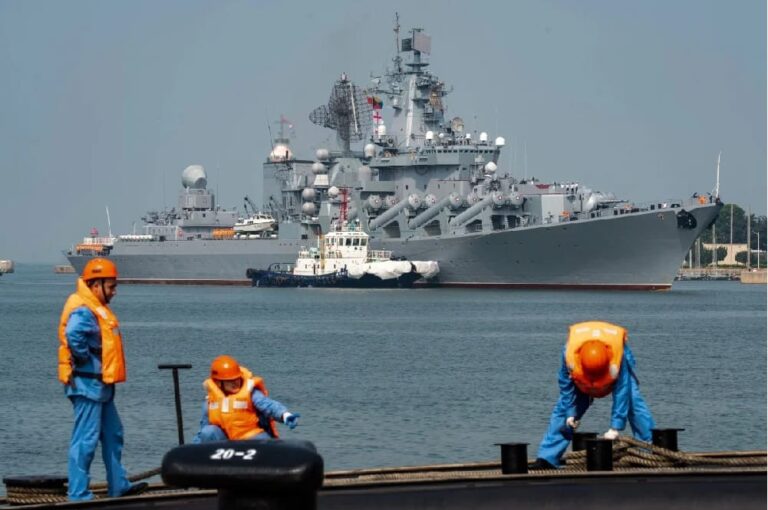
The total number of ships China has depends on how you count them. In 2023, the Pentagon identified more than 370 Chinese PLAN ships and submarines. In March 2026, an expert testifying before the U.S.-China Economic and Security Review Commission estimated the PLAN had more than 400 battle-force ships, including more than 60 submarines. Many Chinese ships are smaller than American carriers, destroyers and nuclear subs. But while the U.S. fleet shrinks, China is adding modern hulls to its own.
America’s Near-Term Fleet Decline
The Navy’s 2025 shipbuilding plan began at 295 battle-force ships, fell to 283 in 2027, and then rose to 390 in 2054. The CBO estimated ship construction will average about $40 billion a year in 2024 dollars. That is 46% more than the average inflation-adjusted dollars appropriated in the past five years.
Adding money is not the only weakness. It is the failure to turn money into delivered ships. Maintaining construction times from the past, CBO estimates the Navy would have 20 fewer ships on average from 2026 to 2030 than it could have had. Most of the missing hulls would be destroyers and submarines, the platforms most relevant to a Pacific conflict.
The plan also includes more than $10 billion in “cost-to-complete” funding for vessels that Congress has previously authorised and funded. These appropriations pay for the cost growth on ships supposedly funded in prior budgets. Changes in design, fragile suppliers, shortages of labour, inflation and immature production planning have repeatedly knocked the delivery schedules.
The Submarine Bottleneck
The Virginia-class attack submarine remains an American asymmetric advantage. The navy conducts intelligence collection, anti-submarine warfare, land attack and anti-surface warfare in contested waters. However, their strategic value is in terms of operational availability rather than in terms of notional inventory.
The CBO said that since 2014, the tonnage of submarines built has increased by more than 70%. The 2025 plan called for a further 70% increase by 2031. That calculation did not include replacement boats for Virginia-class submarines moving to Australia under AUKUS.
The industrial base is building Virginia-class attack submarines and Columbia-class ballistic-missile submarines at the same time. Both require special castings, propulsion components and pressure hull modules and nuclearly qualified welders. Money does not immediately bring about these skills and facilities. So a sub cleared today might not be in service for a decade or so.
Another limitation is maintenance. The GAO reported in March 2026 that attack-submarine maintenance delays persisted despite years of corrective action. Fleet totals include one boat awaiting depot work but not forward combat days. So fleet size can be a distortion of available undersea combat power on an immediate basis.
China’s Shipbuilding Ecosystem
The strength of China’s position is the connection between its naval build-up and its commercial maritime industry. The USA builds less than 1% of the world’s commercial ships. In 2025, the U.S. Trade Representative said that America had built just five ocean-going commercial ships in the previous year. China’s shipbuilding capacity is estimated to be more than 200 times that of the United States.
Just because it is commercially produced does not mean it makes good warships. But it still has dry docks, heavy cranes, steel processing, marine-engine making, naval architects, welders and supplier networks.
The U.S.-China Commission’s research found that around 40% of China’s annual ship production is from shipyards with strong military links. China added 78 warships between 2015 and 2023, compared to 20 added by the United States. The figures show not only a difference in procurement but also entirely different curves of industrial production.
That depth does make a difference in long combat. The opening battle is determined by initial fleet quality, but campaign endurance is determined by repair throughput, ammo replacement and loss absorption. China would be close to the big yards and logistic hubs of the mainland. American forces would have to rely on fewer repair and resupply nodes spread across the Pacific.
Quality Versus Geographic Concentration
The U.S. Navy has the advantage in nuclear propulsion, carrier aviation, undersea warfare and combat-system maturity. It has approximately 9,100 vertical launch cells, providing powerful air defence, land attack and anti-ship capability. Meanwhile, the totals do not reveal the mix of missiles, reload availability, launcher condition, or their distribution across theatres.
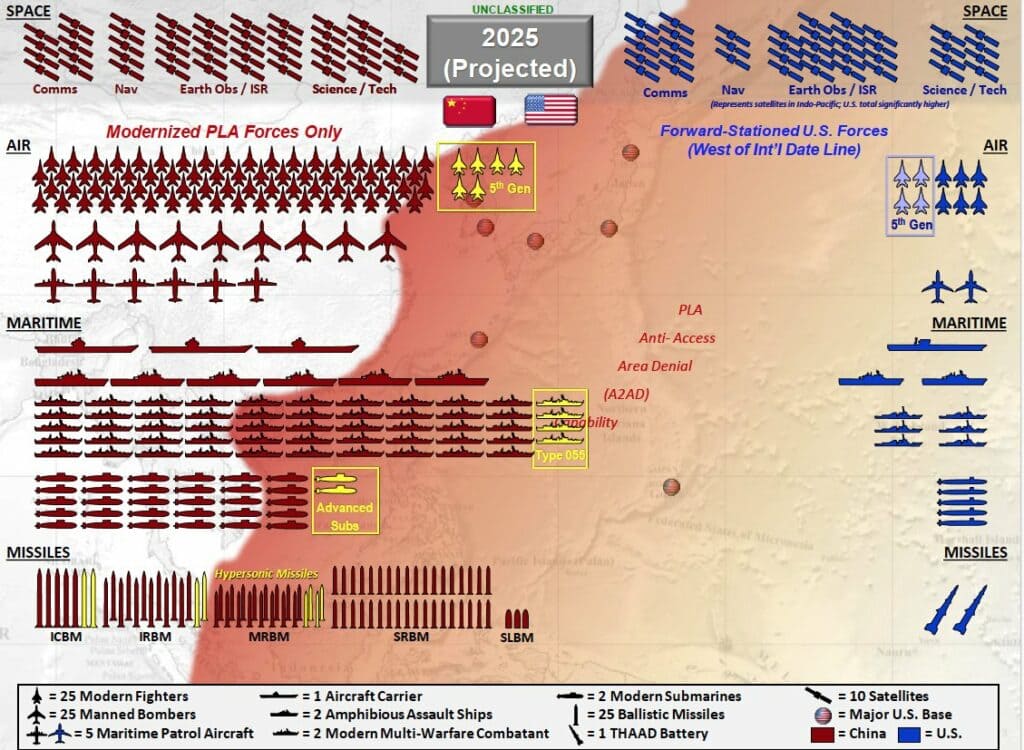
China could use naval forces, coastguard ships, maritime militia, land-based aircraft and missiles around the First Island Chain. The Pentagon determined that the correct number of conventional Chinese strikes could be effective at ranges of 1,500 to 2,000 nautical miles from the mainland.
In 2024, China also launched 67 satellites with intelligence, surveillance and reconnaissance capabilities. The additions expanded its ISR-capable constellation to more than 500 satellites, enhancing maritime detection, communications and long-range targeting support.
Fujian will be fitted with electromagnetic catapults to launch the J-35 stealth fighters, J-15T fighters, J-15D electronic warfare aircraft and KJ-600 airborne early warning aircraft. China plans to have 9 carriers by 2035, with 6 more to be built. This would not automatically translate into American carrier proficiency, but it does show systematic progress toward sustained blue-water operations.
Case Study: USS Carney
The 235-day deployment of USS Carney in 2023-2024 demonstrated American tactical superiority. The Arleigh Burke-class destroyer has engaged and destroyed 51 Houthi cruise missiles, anti-ship ballistic missiles and unmanned aircraft. The ship also carried out two defensive strikes, destroying 20 targets. Carney participated in the interception of Iranian ballistic missiles fired at Israel in April 2024.
Aegis sensors, crew training and layered missile defence, proven in deployment, also revealed a strategic problem. A destroyer dedicated to constant air defence consumes interceptors, equipment life and crew endurance and cannot be used elsewhere. Even if they win every tactical battle, they can be strategically overextended.
Case Study: Joint Sword Around Taiwan
In the Joint Sword-2024A exercise, China dispatched some 20 PLAN warships, seven coastguard vessels and 111 aircraft into Taiwan’s air-defence identification zone. 75 planes crossed the centreline of the Taiwan Strait. Joint Sword-2024B applied more pressure in one day: 14 PLAN ships, 12 coastguard vessels, and about 153 aircraft entries. Of those aircraft, 111 crossed the centreline.
In 2024, Taiwan recorded 2,771 Chinese PLA aircraft in its air identification zone, up from 1,703 in 2023. These operations included blockade, precision-strike, and multi-domain command functions, and they normalised the Chinese presence in the vicinity of likely areas of operations. The US has to cross the Pacific to reinforce the theatre; China is on its doorstep.
Conclusion
America still has a general quality of combat at sea that is superior to or at least equal to other nations. However, the margin is narrowing, and fleet size, maintenance availability and industrial replacement capacity are all moving in the wrong direction. China couples numerical expansion with geographic concentration, commercial shipbuilding depth and an increasingly integrated reconnaissance-strike system.
Total hull is not the determining factor. The key metric is the number of operational submarines, destroyers, missile cells, tankers and repair facilities remaining after the opening salvos. Tactical superiority is not sufficient to guarantee lasting superiority in a campaign unless the US stabilises designs, increases skilled labour, speeds maintenance and rebuilds maritime manufacture.
References
- Congressional Budget Office. An Analysis of the Navy’s 2025 Shipbuilding Plan. January 2025.
- U.S. Department of Defense. Military and Security Developments Involving the People’s Republic of China 2025. December 2025.
- U.S. Government Accountability Office. Military Readiness: Further Actions Needed to Improve Attack Submarine Availability. March 2026.
- U.S. Navy. USS Carney Visits Newport, Shares Warfighting Experiences. July 2024.
About the Author


1 thought on “America’s Navy Shrinks as China Surges Ahead”