

MiG-25 Foxbat Exploitation: What the West Discovered
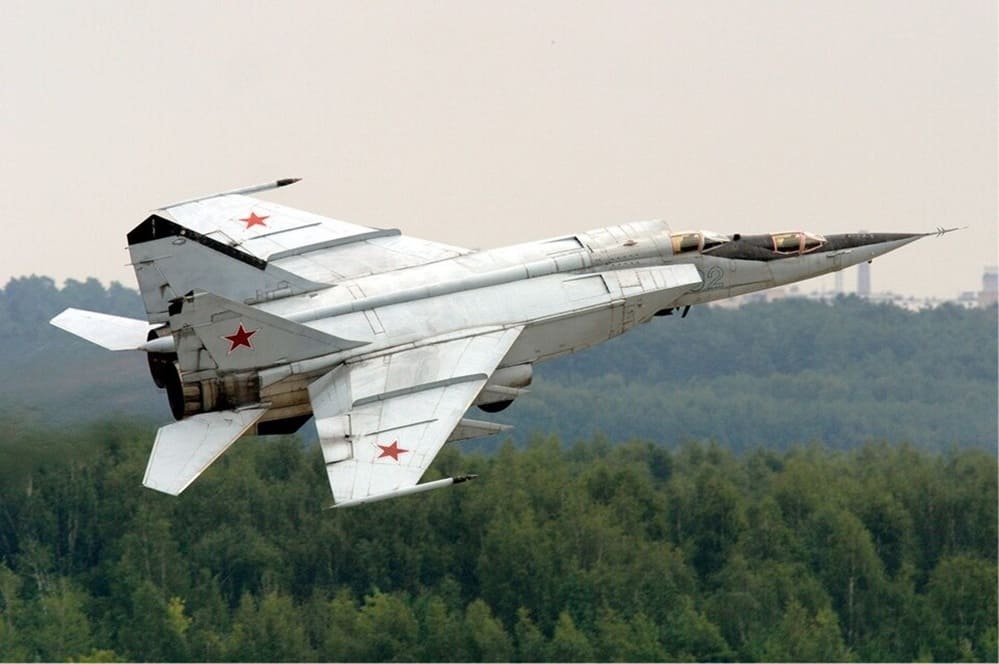
The Mikoyan-Gurevich MiG-25 Foxbat occupied a special place in Western threat assessments for nearly a decade. NATO first saw the aircraft publicly at the 1967 Domodedovo air display. Later reconnaissance flights disclosed extraordinary speed and altitude. Western analysts often interpreted the big wings and powerful engines as signs of a very manoeuvrable Mach 3 fighter, despite having no physical access. Others thought there was a lot of titanium construction too, like the American SR-71 Blackbird.
On September 6, 1976, that view changed. Senior Lieutenant Viktor Belenko defected from the Soviet Air Defense Forces while flying an operational MiG-25P. He took off from Chuguyevka in the southeast and landed at Hakodate Airport in Japan. Later American-Japanese exploitation revealed the Foxbat’s construction, propulsion, avionics, weapons, and operational doctrine. There was no technological failure and no universal ‘superfighter’, as had been feared. Instead, analysts found a highly specialised interceptor built around Soviet manufacturing capability and ground-controlled air-defense doctrine.
Belenko’s Flight to Japan
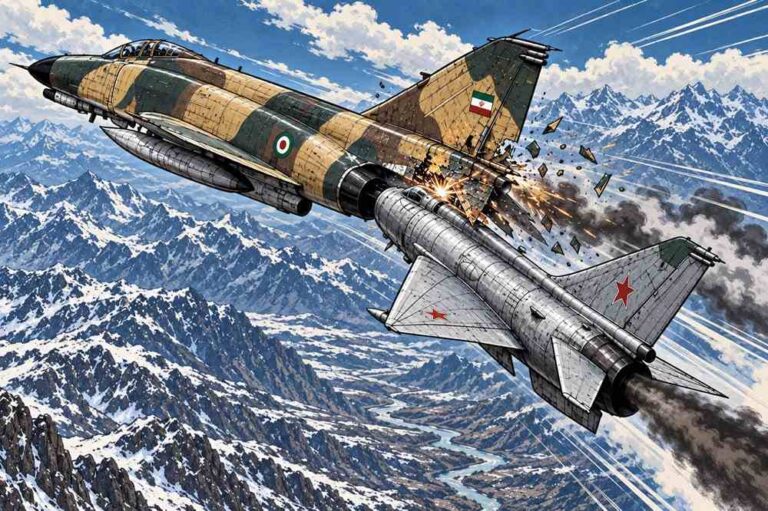
Belenko broke formation on a training sortie and dived to very low altitude. Tens of metres above the sea level, he avoided detection while flying under much of the Soviet radar network. He successfully reached Hokkaido from some 650–700 kilometres away. Now, at last, Japanese radar picked up the aircraft as Belenko climbed. Two Japan Air Self-Defense Force F-4EJ Phantoms scrambled, but adverse weather, radar limitations and the Foxbat’s low-altitude flight prevented them from intercepting it. Belenko was critically low on fuel and heading for Hakodate’s civilian airport. In 1976, the runway was 2,000 metres, not 3,000 metres as it is today. Japan raised it to 2,500 metres in 1978 and then to 3,000 metres in 1999. Japanese government airport records confirm this sequence.
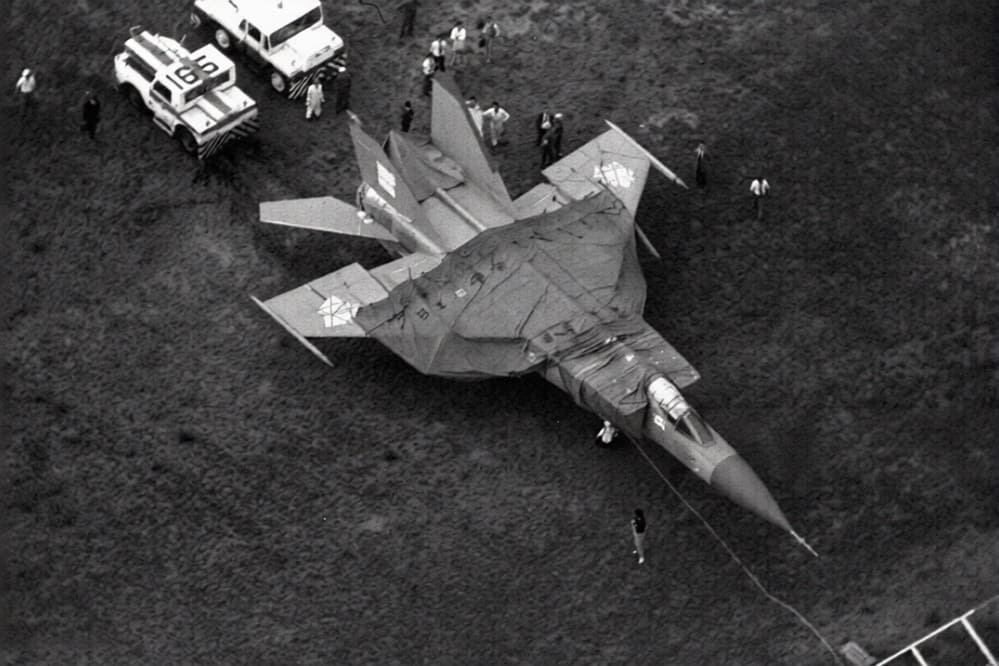
Belenko deployed the drag chute, but the plane veered off the runway after about 800 feet. The nose gear sustained damage during landing, which meant the aircraft could not be flown again immediately. US Air Force C-5 Galaxies flew the aircraft in pieces to Hyakuri Air Base in Japan. Japanese technicians and specialists from the Foreign Technology Division of the US Air Force worked on the exploitation around the clock. Japan banned flight tests. Time limitations also precluded infrared-plume and radar-cross-section measurements. Therefore, the claims that the US performed a full measurement of the Foxbat’s signatures during the incident are incorrect. Some 70 days after the defection, in mid-November, the plane was crated and shipped back to the Soviet Union. The Soviets were said to be asking about $10 million in damages, reports said. Japan responded with a bill for approximately $40,000 for the airfield repairs and transportation.
The Steel Airframe Surprise
The structural analysis destroyed one of the most enduring Western assumptions. Analysts forecast widespread titanium construction to support sustained high-Mach operation. Instead, they found an aircraft mostly made of welded heat-resistant steel. Later technical literature has given the material distribution as approximately 80% nickel-steel, 11% aluminium and 8-9% titanium. However, the first declassified US report did not give an absolute percentage for the whole aircraft. One by one they found the materials. Investigators found steel in the main fuselage skins, landing gear, wing load-bearing panels and structural fittings. Engineers used aluminium for the fins, rudders, ailerons, flaps, landing-gear doors and outer trailing edges. They protected selected high-temperature areas, including the inlet leading edge, first compressor stator and parts of the afterburner nozzle, with titanium.
The Alloy Game
The team did not discover any unknown Soviet wonder alloy. The materials were consistent with alloys previously known to Western intelligence except for the titanium inlet ramp. Some parts of the engine were similar to those used in the older Tumansky R-11. Steel carried a substantial weight penalty. The MiG-25P’s empty weight was close to 20,000 kilograms, versus about 12,700 kilograms for an early F-15A. It cost less than titanium, withstood aerodynamic heating and allowed manufacturers to produce large quantities through spot, seam and manual welding. Skin temperatures could reach 300°C in the hottest areas during sustained Mach 2.8 flight. Without losing strength, aluminium would not survive these conditions. The exploitation team also recorded an unusually thin wing. The thickness/chord ratio was only 3.7% at the root and about 5% near the tip. With the wingtip pods fitted, the span was 13.85 m. These figures demonstrated the optimisation of supersonic efficiency. The big wing provided lift at high altitude, not the turning that Western observers initially assumed.
Powerful Engines with Severe Limitations
The MiG-25P had two Tumansky R-15B-300 afterburning turbojets, each. They had a maximum thrust of 100 to 110 kilonewtons each. So the total thrust with afterburners was about 200-220 kilonewtons. With a maximum operating speed of Mach 2.83, the engines were capable of impressive performance. They also permitted swift ascents above 20,000 metres with heffitediles on board. The National Museum of the US Air Force therefore considers the Foxbat to be one of the fastest operational combat aircraft ever built. Belenko’s debrief laid out the main caveat to that performance. Going any farther out beyond about Mach 2.8 could overheat or overspeed engine parts. Extreme Mach 3-class flights might mean pulling the engine out, then putting it back in.
The Foxbat could achieve speeds that Western radars had detected. But such performance was not sustainable for routine operation by pilots, as such manoeuvres quickly ate into engine life and fuel. At low altitudes fuel efficiency declined. Belenko’s aircraft arrived with almost no fuel reserves left, a clear indication of how much the MiG-25’s range suffered away from its intended high-altitude operating profile. Another problem was manoeuvrability. Depending on fuel load, altitude and configuration, its safe operating limit was around 4.5 g. Modern Western air superiority fighters can take much more structural stress. The MiG-25 was designed by engineers who wanted to accelerate, climb, shoot and disengage. It wasn’t meant to get into a long-turning fight against aircraft like the F-15 or F-16.
The Smerch-A Radar: Crude and Sophisticated
The Smerch-A fire-control radar, NATO’s Fox Fire, was the most misunderstood discovery. The US exploitation report lists their Soviet designations as SMA and SMA-2. Analysts found a mostly analogue processor, made from tiny “peanut” vacuum tubes. Some functions of the power supply and the motor were controlled by means of semiconductors. The architecture looked old-fashioned compared to modern American solid-state electronics.
However, the radar had some sophisticated features. The investigators found separate I-band and J-band channels. The I-band channel offered angle and range tracking and target illumination for semi-active radar-guided missiles. The J-band system also appears to have provided additional ranging information. Inside what looked like a pressurised glass enclosure, the antenna feed had several horns. American analysts considered this set-up to be “far advanced” from known MiG-21 radar systems.
The radar also incorporated several electronic counter-countermeasure features:
- Separate I-band and J-band ranging complicated hostile jamming.
- Dual-channel angle tracking resisted some amplitude-modulated deception.
- A sidelobe-blanking antenna helped reject off-axis interference.
- Four selectable I-band frequencies provided limited frequency agility.
- Range-rate processing helped distinguish targets from chaff.
- Compelling magnetrons increased resistance to noise jamming.
The exploitation team estimated the peak-pulse power of the I-band transmitter at 600-800 kilowatts and the J-band channel at 300-400 kilowatts. Those were peak pulse numbers and not continuous radiated power. Operational sources generally indicate a detection range of approximately 100 kilometres against bomber-sized targets. Short and very dependent on altitude, geometry and electronic countermeasures were tracking and reliable missile launch ranges.
Vacuum Tubes Were Not Simply Obsolete
Vacuum tubes were in the news but made sense to operate. They survived significant changes in temperature, big jumps in voltage, and the extreme conditions of far-off Soviet bases. They also required less environmental conditioning than many early semiconductor systems. Some electromagnetic-pulse effects might be more resistant in vacuum tube circuitry. But no exploitation report has been issued that the Soviet design decision was based on nuclear EMP hardening. The reasons for production convenience, component technology availability, and climatic reliability are equally valid.
The real weakness of the Foxfire radar was its signal processing. Its clutter rejection in the main beam was poor, and it was not really reliable in a look-down/shoot-down role. Inside the lower radome, investigators found a thin radar-absorbing layer. This material reduced ground-side lobe reflections. It did not make the MiG-25 stealthy, nor could it shake ground clutter that came in through the main beam of the radar. Low-flying aircraft could exploit ground returns and terrain. The exact altitude at which a target disappeared was a function of range, terrain and engagement geometry. It was not a blanket 500-metre cutoff.

The Lazur Data Link and Soviet Interception Doctrine
The vacuum tubes received less publicity than one of the most important discoveries of the era. The MiG-25 was part of a larger ground-controlled interception system. It has a Lazurur command data link and SAU-155 automatic flight control system. Some of the Lazur installation was relatively modern, possibly from the mid-to-late 1975 period, US analysts said. Ground controllers could send intercept, heading, altitude and speed commands to the aircraft’s guidance equipment. It reduced pilot workload and placed the interceptor in front of the search on the onboard radar.
This architecture also delayed radar emissions, decreasing warning time for the target. The Foxbat neared the predicted point of interception; the pilot switched on his radar, picked up his target and fired. The design had made the MiG-25 less independent than an F-15. But the ground link improved interception efficiency within a functioning Soviet air defense network. Western analysts knew the aircraft without its radar network was an incomplete picture of the threat.
Missile Armament and Attack Profile
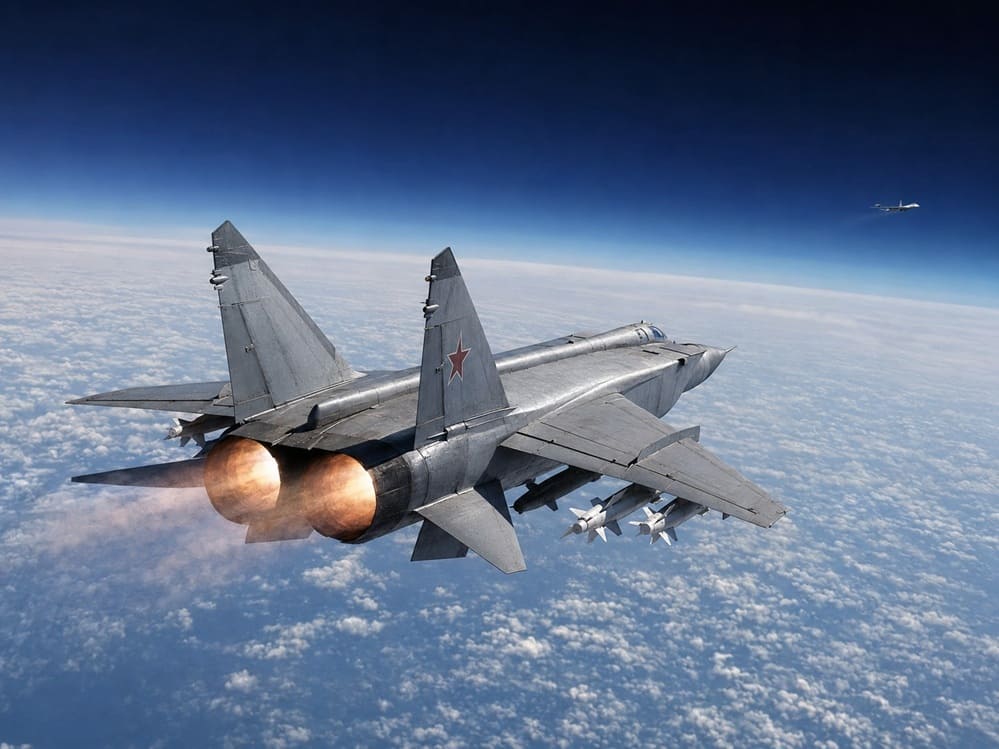
The MiG-25P could carry up to four R-40 missiles, which NATO designated AA-6 Acrid. Individual missiles weighed in excess of 300 kg. The R-40R used semi-active radar homing guidance. An alternative method of engagement was the infrared-homing R-40T. The Foxfire radar gave a reference signal to the missile pylons for the radar-guided weapons.
The Foxbat had no internal gun. Its weapons fit-out reflected its specialised role: intercepting large, fast aircraft beyond visual range and then disengaging. Among its inland victims were the B-58 Hustler, the proposed XB-70 Valkyrie, the SR-71 reconnaissance aircraft, and high-altitude strategic bombers. It was never intended as a multi-role tactical fighter.
Case Study: Sinai Reconnaissance Flights
MiG-25R reconnaissance aircraft flown by Soviet crews from Egypt, 1971-1972. Foxbats returned to the region during the 1973 Arab-Israeli War. They flew at altitudes of between 17,000 and 23,000 metres over Israeli-held territory. Israeli F-4 Phantoms had difficulty positioning for launch. And the surface-to-air missiles that were in existence didn’t have a reliable envelope of interception.
At least one Foxbat was claimed to have reached Mach 3.2 in avoiding interception. These flights certainly reduced engine life, but Western observers could not see the cost. A current US intelligence estimate placed the MiG-25’s mission performance at approximately Mach 3 and 80,000 feet. These apparently invulnerable flights contributed to the Western perception of the ‘superfighter’. The later hand test did not show that the aircraft was at risk of engine damage, poor low-altitude endurance or limited manoeuvrability.
Case Study: Iraq and the Networked Counter
Operation Desert Storm showed that Western forces could overcome the performance advantages of the Foxbat. On 19 January 1991, US Air Force F-15Cs shot down two Iraqi MiG-25s near Mudaysis. The Eagles integrated airborne warning, pulse-Doppler radar and long-range missiles. This network denied the Foxbats the ability to use their speed for a decisive tactical advantage. Captains Richard Tollini and Lawrence Pitts successfully flew the mission, according to US Air Force records.
On 27 December 1992, an F-16 shot down a second Iraqi MiG-25 in the southern no-fly zone. The engagement was the first air-to-air victory for both the F-16 and the AIM-120 AMRAAM. The meetings reconfirmed the 1976 evaluation. The maximum speed was still adequate, but the offboard surveillance, active radar missiles, look-down radar and coordinated control were more important. American forces recovered another Foxbat after the 2003 invasion of Iraq. They found a partially buried MiG-25RB about 250 kilometres west of Baghdad, near Al Taqaddum Air Base. It was wingless, but the fuselage now resides in the collection of the US Air Force Museum.

Strategic Consequences for the United States
The exploitation convinced the United States that the MiG-25 lacked the manoeuvrability expected of a feared air-superiority fighter. But analysts did not dismiss it as useless. The Foxbat was still a formidable high-altitude interceptor. It was a serious threat with excellent conditions of speed, radar power, heavy missiles and integration with ground control.
The results also supported several design priorities for the F-15, such as high thrust-to-weight ratio, manoeuvrability and look-down/shoot-down radar. However, the claim that Belenko’s defection caused the F-15 is chronologically impossible. The Eagle was commissioned in 1972, some four years before the MiG-25 reached Japan. Previously, analysts had derived the threat picture from the Foxbat’s public face and estimated capabilities. The 1976 exploitation further refined that assessment, rather than marking the start of the F-15 programme.
The Soviet Response
The defection compromised radar architecture, missile integration, identification equipment and operational procedures. So the Soviet Union started to speed up the improvements it had already been planning. The result was the MiG-25PD, and it replaced the Smerch-A with the S-25 Sapfir-25 radar. It also introduced an AVM-25 computer, a TP-23 infrared search-and-track sensor and improved R-40D missiles. It could also be armed with smaller R-60s.
The first prototype of the MiG-25PD flew for the first time on 19 November 1977. In 1978 production began in series. Later MiG-25Ps were similarly upgraded and designated MiG-25PDS. The complete upgraded interception complex was undergoing formal tests in 1979–80. The Sapfir-25 also featured enhanced clutter rejection and was constrained in its ability to engage targets against a ground background. It was a big improvement, but not on the level of the Zaslon phased-array radar of the later MiG-31.
Intelligence Beyond the Aircraft
Belenko was worth much more than the aircraft. The Americans debriefed him extensively on Soviet training, readiness, command procedures and PVO doctrine. Declassified reporting indicated his regiment started conversion to MiG-25s from MiG-17s in August 1975. It was still missing its full complement of 36 aircraft and was said to have only five instructor pilots. It took as long as two years for some regiments of the PVO to convert and become fully operational.
This human intelligence placed the captured technology in its working environment. It revealed that there could be considerable variations in aircraft performance, pilot proficiency, maintenance capacity and unit readiness. Then-CIA Director George H.W. Bush publicly hailed the defection as a possible “major intelligence bonanza”. This assessment was a remarkably accurate description, for the West did indeed receive engineering information and direct insight into Soviet air-defense operations.
Strategic Assessment
The exploitation of the MiG-25 did not uncover any deceptive design features. It was a regimented design with different priorities. Soviet engineers sacrificed weight, fuel economy, agility and electronic sophistication for speed, altitude, radar power, ease of manufacture and network integration. Its performance fell short of the exalted role that Western analysts had assigned it, but it served its purpose well.
The episode is the lesson in technical intelligence. Radar tracks tell you what a system did in an event. They do not show component life, thermal limits, fuel consumption, maintenance requirements, or doctrinal limitations. Satellite images can show size and deployment patterns. It cannot determine materials, signal processing architecture or internal quality of manufacturing reliably. Analysts can electronically describe emissions without revealing how crews operate the system. Only by a combination of material exploitation, technical documentation and human intelligence did the complete picture emerge.
Conclusion
The defector MiG-25 flew with five strategically important technologies for the West.
- It mainly used welded, low-cost, high-temperature steel structures.
- It had two powerful turbojets capable of Mach 2.83 but at a cost in fuel and engine life.
- High-power dual-band analogue radar with high resistance to electronic countermeasures.
- The R-40 missile system was designed to intercept at high altitudes.
- It was a Lazur ground-command link that integrated the Foxbat into a larger air defense network.
The important finding was not that Soviet technology was universally inadequate It was that the MiG-25 Foxbat was the very quintessence of tightly focused systems engineering. The Foxbat was never the titanium Mach 3 dogfighter that some in the West imagined it to be. It was still a dangerous interceptor whose effectiveness was dependent on altitude, ground control and carefully managed engagement geometry.
References
About the Author


2 thoughts on “MiG-25 Foxbat Exploitation: What the West Discovered”