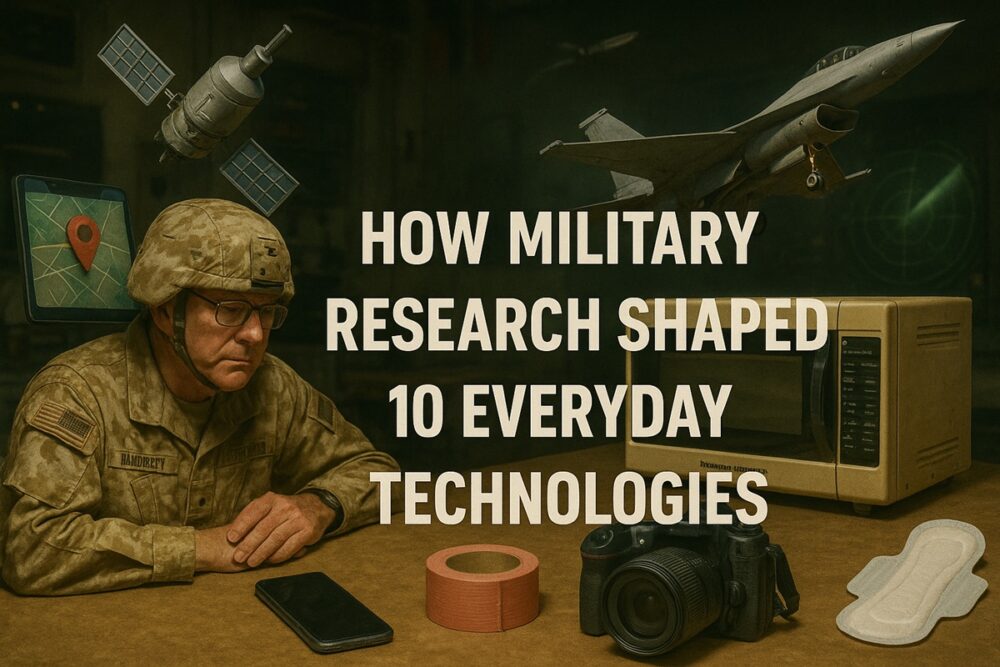
How Military Research Shaped 10 Everyday Technologies
Military labs are not usually in the business of making life easier for people who drive to work, play video games, or cook at home. But decades of military spending have created a long pipeline of common technologies that came from military research and now affect civilian life in ways that most people don’t even notice. To defense analysts, these systems are the perfect examples of dual-use innovation. This phenomenon is when battlefield needs eventually trickle into global markets and consumer devices.
Military Tech in Everyday Life
Navigation, sensing, communication and survival are big expenditures for modern militaries. Thus, they often push new technologies farther and faster than the civilian sector can keep up. And once those systems are mature, governments relax their rules, companies use them, and everyday technologies that began in military research become cheap, reliable and widely available. At that point, tech from the defense industry ceases to look like a secret weapon and starts to look like a feature on a smartphone or kitchen appliance.
10 Everyday Tech Born from Military Research
1. Global Positioning System (GPS)
In the early 1970s, the U.S. Department of Defense started the Global Positioning System (GPS) to help troops navigate and keep time accurately in any weather. Over the years, policymakers have opened up GPS to the general public and have lifted some of the limits. This ubiquitous technology, a product of military research, is the backbone of aviation, shipping, financial markets and every ride-hailing app on your phone.
2. The Internet
It is built on ARPANET, a Pentagon-funded network designed to connect research nodes and survive partial outages. Engineers built packet-switched architectures and later TCP/IP to ensure communications were resilient in a crisis. That same architecture now carries streaming video, banking transactions and encrypted battlefield feeds. Thus, when it comes to the everyday technologies that have spun out of military research, the internet is still the archetype of dual-use networking power.

3. Digital Photography
The point of early digital imaging was not selfies. Instead, militaries relied on digital sensors on reconnaissance satellites and high-end aerial platforms to capture and transmit intelligence, without having to recover film. As resolution improved, the industry repackaged those sensors for commercial cameras and then for smartphones. So every social media image carries within it, quietly, the decades of classified imaging research.
4. Radar and Sensing
Radar was developed in the run-up to the Second World War to detect enemy aircraft and ships from a distance. Then engineers adapted it for fire control, maritime surveillance and air defense. Today, these same principles govern civil air traffic control, storm tracking, and automotive collision-avoidance systems. Radar shows how sensing technologies are moving from threat detection to safety and convenience.
5. Night Vision
Soldiers used night-vision devices to fight, navigate and see in the dark. Instead of fearing the night, militaries equipped themselves with image-intensifier tubes and thermal imagers to exploit it. Today, civilian agencies employ these tools for law enforcement, search and rescue, and wildlife monitoring. So this common technology, invented for military research, improves civilian safety much more than on the battlefield.
6. Microwave Ovens
The story of the microwave oven began in a radar lab. In 1945, an engineer working near a magnetron discovered that the candy bar in his pocket had melted. He tried heating food with stray microwaves and helped develop the first large ‘Radarange’ ovens for use in stores. The early systems were big and expensive, but miniaturisation turned a defense spin-off into a ubiquitous household appliance.
7. Duct Tape
In World War II, U.S. troops needed a strong tape that would seal up ammunition cases quickly and was waterproof. For this purpose, manufacturers developed a tough fabric tape, called “duck tape” in the beginning. After the war, builders used it again for air ducts and general repairs. This common technology, born of military research, can now be found in workshops, garages, and improvised field fixes all over the world.
8. Jet Engine Technology
The military’s search for faster, higher-flying bombers and fighters very much spurred the move of jet propulsion from idea to reality. Britain and Germany (and later the USA) spent a lot of money developing turbojets and turbofans during WWII and the Cold War. Civil aviation would eventually take up these engines, losing out on raw thrust but gaining in reliability and efficiency. Combat technology is now used for international travel.
9. Nuclear Technology
Nuclear fission was first brought into public consciousness in relation to the Manhattan Project and the weapons developed there. Today, nuclear power plants and medical radiation therapy use the same physics. Civilians adopted stringent safety regimes and control systems, and a destructive military breakthrough became a source of baseload power and oncology treatment.

10. Sanitary Products
Absorbent materials and sterile bandaging were developed to meet the needs of wartime medical research. During WW I, manufacturers perfected products that would become commercial sanitary napkins and other hygiene products. The changes did much to improve women’s health and comfort, and they showed how everyday technologies stemming from military research can quietly but profoundly improve society.
From Ballistics to Digital Computing
The military also drove early advances in computing. Artillery units required exacting ballistic tables, and codebreakers needed machines that could test cyphers faster than ever. The military actually paid for some of the first big electronic computers. These machines were the ancestors of commercial mainframes and, eventually, personal computers. It is difficult to separate the modern command system from civilian IT. “Video platforms, for instance, share the same cloud architectures that can host real-time logistics tools and combat-cloud apps.
Military Tech in Everyday Life
Several dynamics explain why everyday technologies that originated from military research continue to appear in civilian markets:
- High budgets and urgency: Defence programmes push early prototypes through technical hurdles that commercial firms may otherwise shy away from.
- Economies of scale: Once the militaries have paid for the development, civil industry can cheaply apply the same ideas.
- Regulatory shifts: In general, once a conflict is over or the systems are mature, governments tend to relax export and usage controls.
- Industrial strategy: States sometimes promote civil adoption to bolster national supply chains and global power.
The Risks Behind Military Tech
The dual-use transitions provide clear benefits, but they also create complex risks. Navigation and communication systems are now essential for civilian infrastructure and for military operations and are therefore an attractive target for disruption. The proliferation of surveillance-grade sensors and data-mining tools also raises issues of privacy, governance and escalation. Consequently, analysts should view everyday technologies born of military research not only as success stories but also as strategic and ethical challenges that require careful regulation and transparent norms.
References
- https://www.gps.gov
- https://www.darpa.mil/node/2092
- https://www.nasa.gov/general/global-positioning-system-history/
- https://medium.com/@Marlon.Books/the-melted-chocolate-bar-that-changed-how-we-cook-d7220fa696f7
- https://www.construction-physics.com/p/how-a-government-think-tank-trained
About the Author