
Harriers vs Mirages: The Aerial Duels of the Falklands War
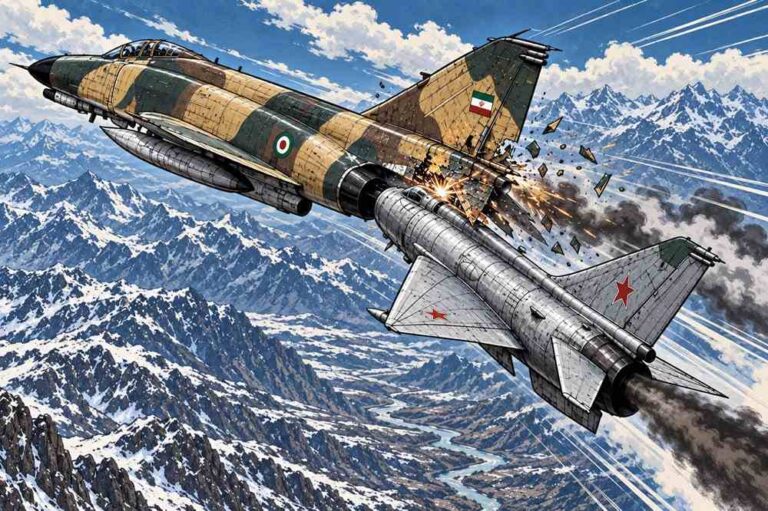
Analysts often depict the Falklands air war as a contest between subsonic Sea Harriers and Argentina’s Mach 2 Mirage fighters. But it was not top speed that decided it. More decisive were the combat radius, the missile technology, and the geometry of the control and engagement of fighters.
The Royal Navy’s Sea Harriers shot down 20 Argentine aircraft in air-to-air combat, without losing a single one to enemy fighters. However, this figure can be misleading. British fighters failed to win complete air superiority. In contrast, Argentine aircraft were able to re-penetrate the fleet’s defenses, inflicting heavy losses.
Different Aircraft, Different Missions
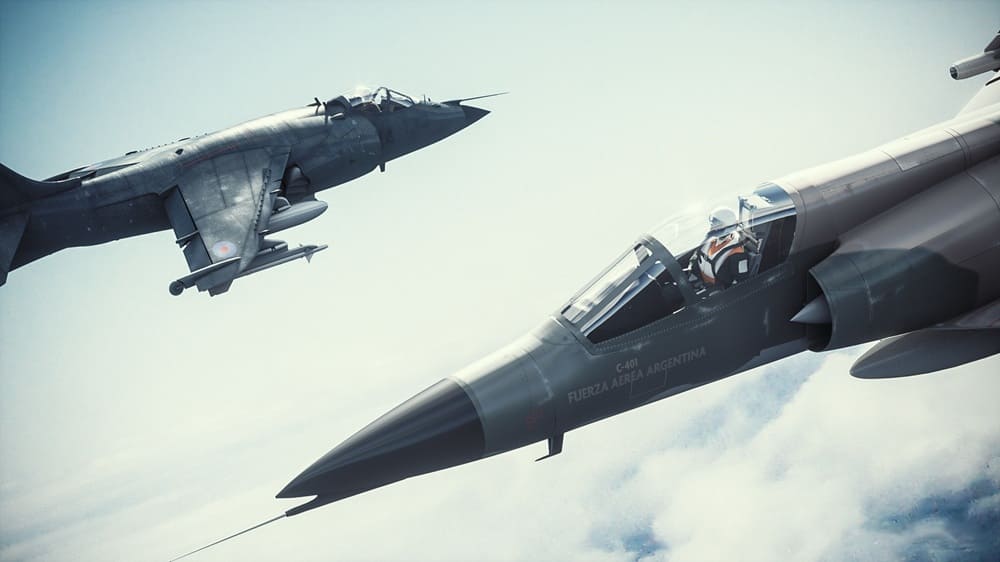
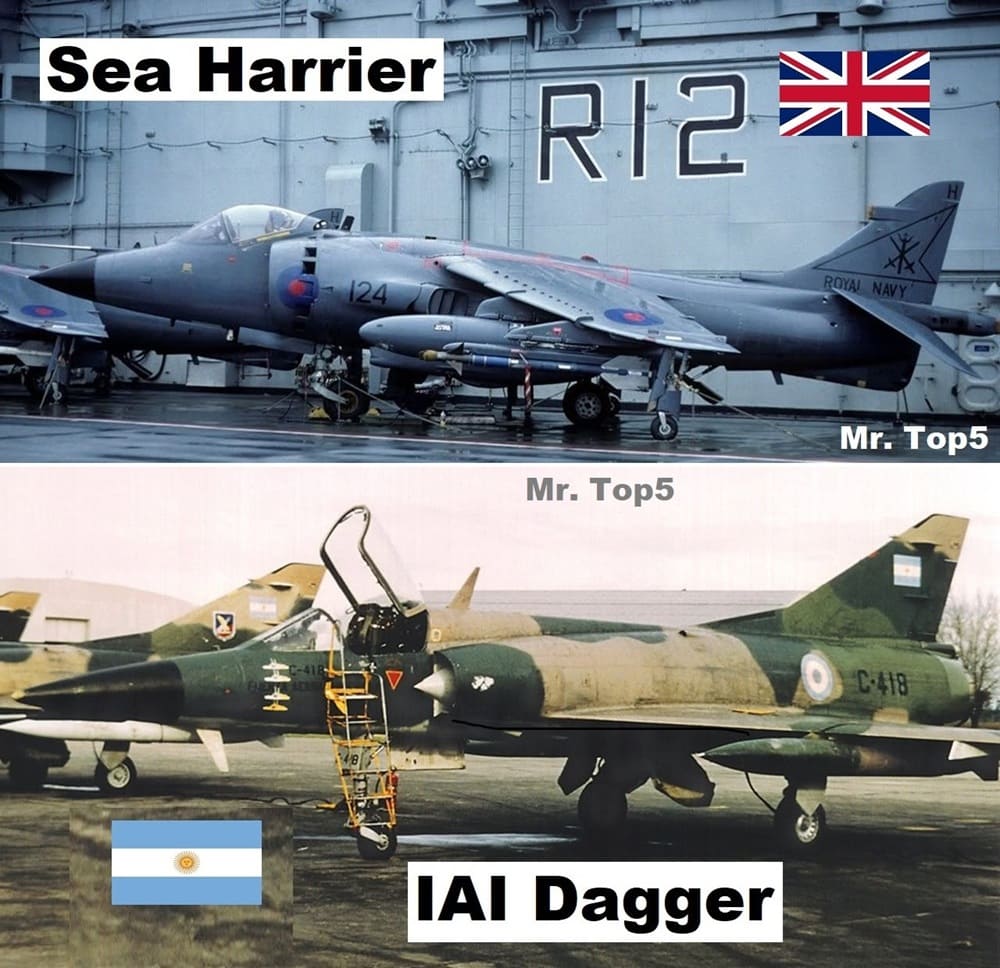
The British Aerospace Sea Harrier FRS.1 was a carrier-based fighter, developed from the Harrier ground attack aircraft. It was powered by a Rolls-Royce Pegasus Mk 104 engine, which produced about 95.6 kilonewtons of thrust. Vertical landings and short take-offs were possible with four rotating nozzles. The aircraft was equipped with Blue Fox radar, two 30 mm ADEN cannon pods and AIM-9L Sidewinder missiles. Its speed, climb rate, and acceleration were lower than a Mirage’s. But it had enormous low-level agility, and it could operate close to the battlespace.
Argentina flew two variants of the Mirage family. The Mirage IIIEA was a pure interceptor with a Cyrano radar, twin DEFA 30 mm cannon and Matra air-to-air missiles. It could go faster than 1,500 miles per hour and operate above 12,000 feet. The IAI Dagger was an Israeli-built version of the Mirage 5. It sacrificed sophisticated interception avionics for increased fuel and attack capacity. Its main role in Argentina was fighter-bomber, armed with bombs, external tanks and Shafrir II missiles. That is a massive difference. The Sea Harriers had very little contact with real Mirage III interceptors. Most of the later “Mirage” encounters involved Daggers with bombs on maritime strike missions.
The Decisive Fuel Equation
Argentina flew its Daggers from Rio Grande and San Julián, about 690-700 kilometres from the islands. The Dagger and Mirage IIIEA were not fitted with aerial refuelling equipment. They were at the extreme end of their combat radius with two large external tanks. British analysis estimated at times that Mirage-family fighters would have only five minutes over the operational area. Simultaneously, Sea Harriers could fly combat air patrols for 40 to 60 minutes. Their carriers stayed very close to the Argentine mainland bases.
The Royal Navy positioned its carriers 70–100 nautical miles east or northeast of the islands, making Argentine planning more difficult. This tactic kept the carriers safe but added another 150–200 nautical miles to every Argentine sortie. Argentine pilots therefore could rarely use their speed. The afterburners were eating up fuel at an alarming rate, threatening their ability to get home. Hence, the Mach 2 advantage was more on paper. US Air University’s operational study describes this range limitation as a central factor.
Missile Technology Changed the Engagement
The Sea Harrier’s greatest technical advantage was the AIM-9L. Infrared missiles had to be fired from behind, usually. The AIM-9L was sensitive enough to detect the infrared energy from frontal and crossing aspects. The missile had improved solid-state electronics, better target acquisition and manoeuvrability and a more effective proximity-fused warhead. Its larger acquisition envelope made it quicker to get into a firing position.
Before the task force headed south from Ascension Island, the United States shipped some 200 AIM-9Ls. The missile then achieved a lethality of over 80%, reports said. US Marine Corps University’s technical history identifies training, fighter direction and the AIM-9L as Britain’s three principal advantages. Argentine Mirage IIIs carried Matra R530 or R550 Magic missiles, depending on aircraft modifications. The Daggers generally carried Shafrir II missiles. These weapons offered narrower engagement opportunities than the AIM-9L.
Sea Harrier FRS.1 vs Mirage IIIEA
| Major detail | Sea Harrier FRS.1 | Mirage IIIEA |
|---|---|---|
| Country | United Kingdom | Argentina |
| Primary role | Fleet defense and ground attack | High-altitude interceptor |
| Engine | Rolls-Royce Pegasus Mk 104 | SNECMA Atar 9C |
| Maximum thrust | 95.6 kN | 60.8 kN with afterburner |
| Maximum speed | Approximately 1,185 km/h | Approximately 2,350 km/h |
| Service ceiling | Approximately 15,500 m | Approximately 17,000–20,000 m |
| Radar | Blue Fox (22 to 25 nautical miles (approx. 40 to 46 km)) | Cyrano II (50 kilometers (27 nautical miles)) |
| Main missile | AIM-9L Sidewinder | Matra R530 and R550 Magic 1 |
| Cannon armament | Two 30 mm ADEN cannon pods | Two 30 mm DEFA cannons |
| Hardpoints | Five | Five |
| Maximum external load | Approximately 3,630 kg | Approximately 4,000 kg |
| Combat endurance near islands | Approximately 40–60 minutes | Often about five minutes due to distant mainland bases |
| Air-to-air refuelling | Available | Unavailable on Argentine aircraft |
| Operating base | British aircraft carriers | Mainland Argentine airbases |
| Principal advantage | Agility, endurance and AIM-9L missiles | Speed, altitude and acceleration |
| Principal limitation | Lower maximum speed | Limited fuel and poor low-altitude performance |
| Falklands combat outcome | Achieved air superiority without air-to-air losses | One lost to a Sea Harrier; another lost to friendly fire |
Case Study: The Battles of 1 May
The first big actions occurred on 1 May 1982. Argentine Mirage IIIEAs were deployed to protect strike formations and engage British combat air patrols. The Dardo Mirage section had a run-in with two Sea Harriers on one mission. First Lieutenant Carlos Perona’s Mirage was hit, and he was forced to eject near Pebble Island. Captain Gustavo García Cuerva kept manoeuvring until his fuel level fell below the minimum needed to return to the mainland. He attempted an emergency landing at Stanley. Argentine anti-aircraft guns mistook his Mirage for a Sea Harrier and shot it down, killing him.
Therefore, British fighters did not directly shoot down either aircraft. A Sea Harrier shot down one Mirage, and friendly fire destroyed the other. In a separate engagement, a British Sea Harrier shot down First Lieutenant José Ardiles’s Dagger, killing him. The Argentine Air Force viewed the Mirage III as having poor endurance and being at a disadvantage in low-level combat. The rest of the force was then used to defend the mainland and to carry out escort and diversion duties. The campaign included a total of 56 combat sorties flown by Mirage IIIEAs. Argentina’s official Mirage history confirms this operational reassignment.
Case Study: The Dagger Ambushes
Argentina heavily committed its Dagger force to maritime strike missions. Its pilots flew low to avoid detection by the British shipborne radar and then raced toward the fleet. This approach reduced the time taken to find them but left the Daggers vulnerable as they retreated. Bombs and external tanks limited the Dagger’s acceleration, manoeuvrability and fuel capacity. On 24 May two Sea Harriers intercepted the Dagger formation Oro off San Carlos.
It did not take them long to blow up three planes. Major Luis Puga and Captain Raúl Díaz ejected, while Lieutenant Carlos Castillo died in the engagement. This engagement revealed the asymmetry. The Sea Harriers had the advantage, with plenty of fuel and all-aspect missiles. The Daggers were in for a fight, and they did not want a long drawn-out battle. But Argentina’s Dagger force flew 115 combat sorties. The losses amounted to eleven aircraft, some 28% of the 39 available before the war. Five Dagger pilots died.
The Scoreboard
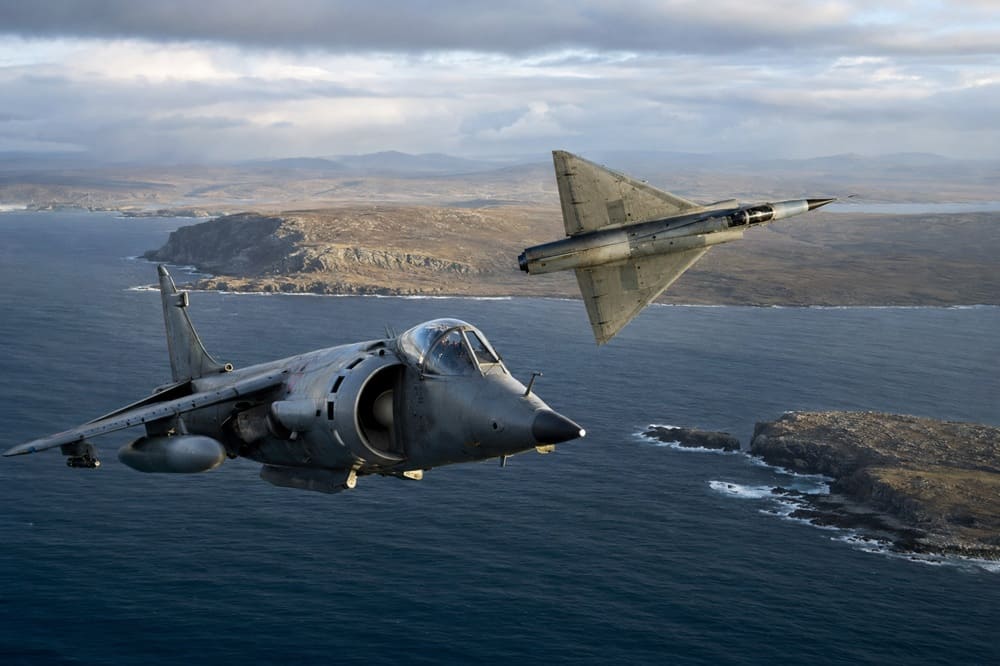
British wartime statements claimed that Sea Harriers had destroyed as many as 28 Argentine aircraft. Later reconciliation reduced the confirmed air-to-air total to 20. No Sea Harrier was destroyed by an Argentine fighter. Two fell to ground fire, and four were lost in accidents, including a probable mid-air collision. The current Royal Navy account confirms the 20-to-zero air-combat record.
However, Britain had no aircraft with early warning radar. The Blue Fox radar also struggled to track targets flying at very low levels. Argentine aircraft used sea clutter, terrain masking and the radar horizon to attack British ships. So the Sea Harriers won the recorded air duels but could not close down the fleet’s airspace. Argentine aircraft damaged or sank several ships, but they lost many of their own.
The Important Lesson
The Falklands showed that vertical thrust was not a trump card against supersonic fighters. Often overhyped in accounts, the real breakthrough is vectoring in forward flight, or VIFFing. The one-stop combat system was the real winner. Controllers positioned Sea Harriers on the ships. It had staying power because it was near a carrier. Training focused on low-level speed to save energy. Finally, the AIM-9L converted fleeting opportunities into kill opportunities.
The declassified records also show how precarious Britain’s position was. Lack of airborne early warning sent the carriers east and cut fighter patrol time. If Argentina had better coordinated its Mirage force, tankers, reconnaissance assets and strike formations, British defenses would have been under far greater pressure. The final lesson is operational, not aerodynamic. Better weapons, information, basing and engagement geometry can win against a theoretically inferior aircraft.
References
- Royal Air Force — Corporate Lessons from Britain’s Falklands Air War
- Argentine Government — History of the Mirage and Dagger
- US Air University — Argentine Airpower in the Falklands War
- US Marine Corps University — The AIM-9 Sidewinder in the Falklands War
About the Author