
PAF 1990s Fighter Search: Sanctions to JF-17
The Pakistan Air Force started looking for fighters in the 1990s. This development occurred after the acquisition plans faced hurdles. Pakistan had asked for F-16A/B Block 15 OCU aircraft as part of Peace Gate III and IV. The United States denied sending them on October 6, 1990, because of the Pressler Amendment. By 1994 the F-16s that Pakistan had already paid for were just sitting in the United States, and the Pakistan Air Force was getting weaker.
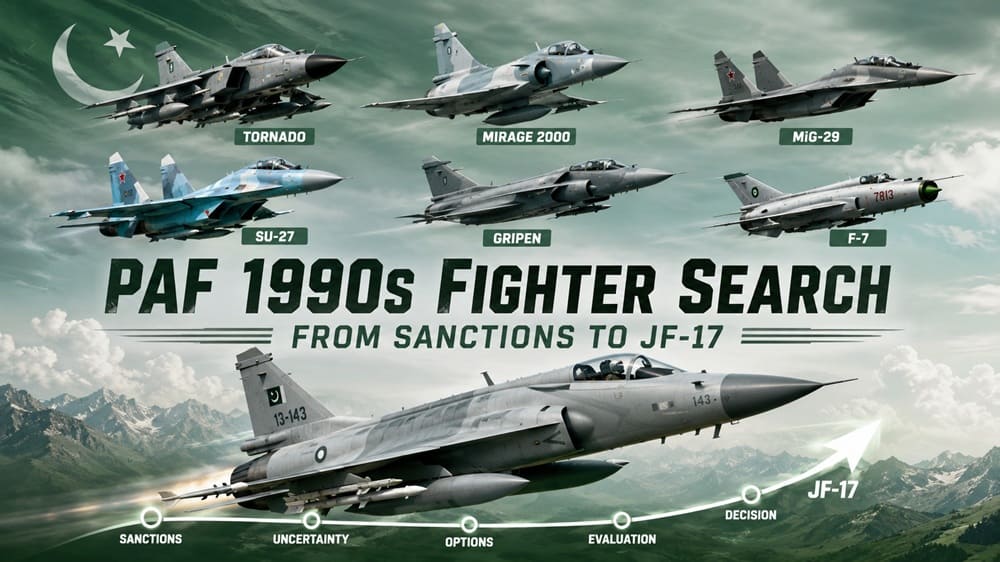
The Pakistan Air Force had to explore options. The Pakistan Air Force needed a fighter that could take the place of the F-16s they were not getting, protect Pakistan’s airspace and be easy to maintain even with sanctions. So the Pakistan Air Force started looking at two things at the time: talking to countries about buying advanced fighters and finding temporary solutions to upgrade the fighters they already had.
Tornado: Poor Fit
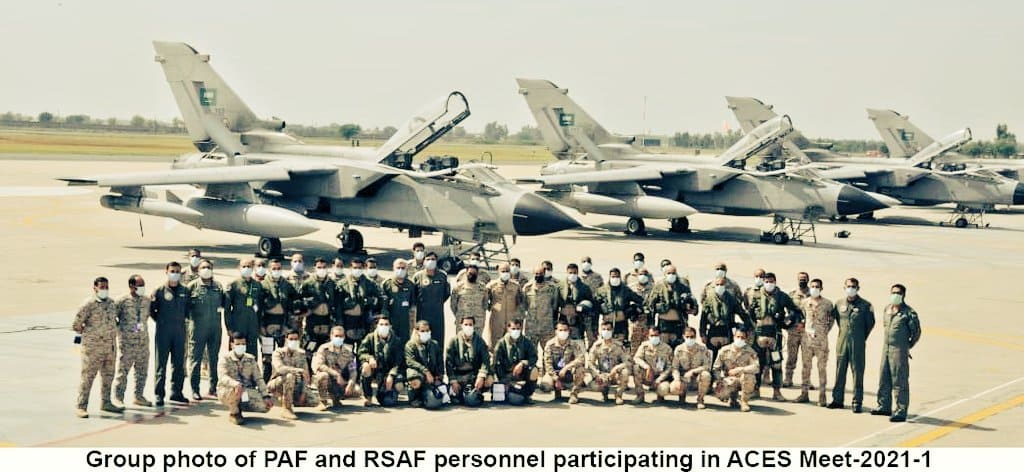
The Panavia Tornado MRCA/IDS was one of the planes that PAF thought about using. The Pakistan Air Force looked at the Panavia Tornado from around 1990 to 1993. The Panavia Tornado could do many things, like fly into enemy territory, follow the land and carry many weapons.
As a matter of fact, the Panavia Tornado was not what Pakistan needed. The Panavia Tornado was costly to use and maintain, and it was better at attacking than defending as an interceptor in an affordable way. So Pakistan said no to the Panavia Tornado. Test pilots revealed that the Tornado lacked manoeuvrability and flew like a brick.
Mirage 2000: French Option
When the Pakistan Air Force started looking for fighters in the 1990s, it considered buying up to 40 Mirage 2000 planes. Then they turned to France. They thought the Mirage 2000E was a good choice because Pakistan already had a lot of Mirage III and Mirage 5 fighters in their inventory. The Mirage 2000E had some features like fly-by-wire controls and impressive agility, and it also had Western avionics. A report from MEED said that France and Pakistan agreed on a deal in January 1992.
Later on, they started negotiating again, and it seemed like they might not buy 40 planes after all because they were having some financial problems. Then the Mirage 2000-5 became an option from France. This plane had an upgraded radar, and it was good as an interceptor. As a multirole fighter, it could also do many jobs. In the end, they did not make a deal for the Mirage 2000-5 because it was too expensive and there were political issues and concerns about the weapons.
MiG-29 and Su-27: Russian Options
Pakistan also thought about buying MiG-29 and Su-27 fighter jets of Russian origin in the 1990s. The MiG-29 was really good for short-range air battles, while the Su-27 had an extended range, could carry many weapons and was great at dominating the skies. Both of these Russian planes came with big problems. Pakistan didn’t have experience with Russian maintenance, spare parts and how to integrate their weapons. Furthermore, buying these planes would have meant changes in how the Pakistan Air Force operated and what it knew about technology. So the PAF decided not to go for it. There was also Indian pressure on the Russian government.
Gripen: Sanctions Blocked Deal
Sweden offered the Saab JAS 39 Gripen to Pakistan in August 1994. The Gripen seemed like a fit for what the Pakistan Air Force wanted. It was a plane, not too big, and did not cost too much. Furthermore, it was designed to work even for dispersed operations.
There was a problem. The Gripen used parts made in the U.S. including its engine. These factors made it difficult to get approval for the sale because Pakistan was under U.S. sanctions at the time. This situation showed that even if a fighter plane is not made in America, U.S. technology rules can still control it.
F-7PG: China’s Practical Answer
The F-7MG became the clearest confirmed 1990s flight evaluation. In July 1997 pilots from the Pakistan Air Force, Kaiser Tufail and Jamshed Khan, went to China to fly the F-7MG. They planned to fly the plane 12 times to see how it worked and what was better about it compared to the F-7P. The F-7MG plane later became part of the Pakistan Air Force and was called the F-7PG. It was not as effective as the F-16 in some ways, such as its radar and payload.
The F-7PG was a reasonable choice for Pakistan because it was reliable and affordable, which was important at that time when things were tough. The radar system on the F-7PG was also acceptable; the radar package also improved the scan sector, electronic counter-countermeasures, look-down/shoot-down capability, and multi-target tracking. This upgrade was better than the old F-7P radar system, and it was important for the F-7MG.
Project ROSE: Stop-Gap Upgrade
Project ROSE was not really about testing fighters, but it is worth talking about. The Pakistan Air Force bought used Mirage planes from countries and put in new avionics and electronics. In 1990 Pakistan bought 43 Mirage IIIO planes and 7 Mirage IIID planes from Australia. Out of 50 planes, 40 were good enough to fly. 28 Of these, some were chosen for Project ROSE, which improved the planes by adding electronics, navigation systems, radar that warns of incoming missiles (Grifo radar), and probes that let the planes refuel in the air and help them last longer.
In 1996 SAGEM signed a contract worth Fr 500 million, or $97 million, to upgrade up to 40 used Mirage III planes. So Project ROSE (Retrofitting of Strike Element) helped Pakistan. It kept the air force strong while they waited for better fighter planes to arrive. Project ROSE gave Pakistan time to obtain the fighters they needed. The Project ROSE upgrade was important for the Mirage 3 and 5 fighter planes.
FC-1: Path to JF-17
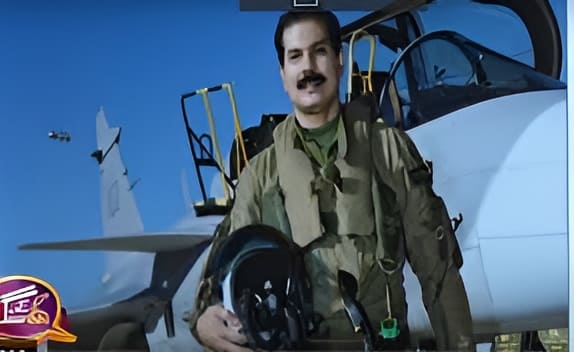
The Super-7/FC-1 was not a fighter that was ready for service in the 1990s. It ended up being a critical result of the Pakistan Air Force search for a new fighter in the 1990s. At that time Pakistan and China decided to work on a fighter that would not be too expensive and simple to maintain. This happened because Western countries would not sell fighters to Pakistan due to sanctions.
The FC-1 programme eventually became the JF-17 Thunder fighter. This initiative entirely changed the way Pakistan inducts fighters. Instead of waiting for other countries to say it was okay, they worked with other countries to develop and assemble fighters in their own country, allowing them to make changes and sell them to other countries as well. The JF-17 Thunder programme vindicated Pakistan and showed that the country could make its own fighters with Chinese assistance.
Defense Assessment
The Pakistan Air Force tested the Tornado MRCA/IDS, Mirage 2000E, Mirage 2000-5, MiG-29, Su-27, Saab Gripen, F-7MG/F-7PG and Super-7/FC-1. The Pakistan Air Force also had Project ROSE which was crucial as a stopgap measure. In the 1990s, the Pakistan Air Force had a tough time finding a new fighter. The Pakistan Air Force could not get a fighter from the West or Russia because of sanctions. The crisis actually helped the Pakistan Air Force because it led to the JF-17 fighter project. The JF-17 project later became part of the Pakistan Air Force’s plan to modernise its fighter aircraft. As a result, the JF-17 significantly improved the capabilities of the Pakistan Air Force.
References
- https://www.f-16.net/f-16_users_article14.html
- https://www.meed.com/pakistan-ties-strengthened-with-france/
- https://www.flightglobal.com/sagem-of-france-sells-40-upgraded-mirages-to-pakistan/3847
- https://defence.pk/threads/mig-21s-f-7s-specifications-capabilities.297826/page-12
About the Author