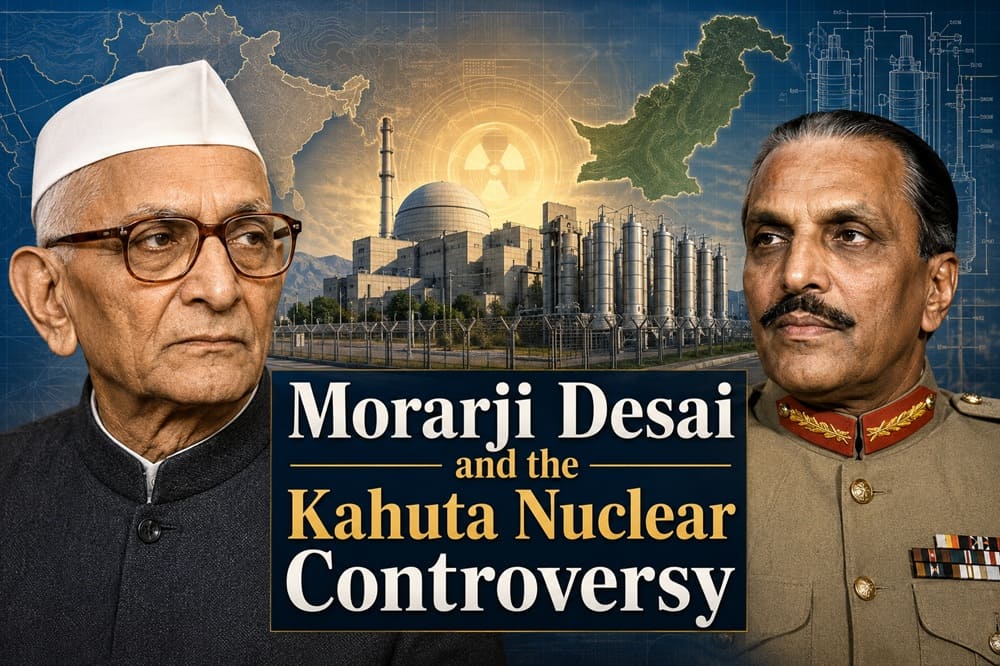
Morarji Desai and the Kahuta Nuclear Controversy
The Morarji Desai Kahuta controversy remains arguably the most debated intelligence story in South Asia. It’s a matter of nuclear secrecy, political self-control, and clandestine operations. The episode often appears to have been a lost strategic opportunity for India. For Pakistan, it was another episode in the broader narrative of the survival of its nuclear programme. Morarji Desai, Prime Minister of India, 1977-79. After the Emergency, he stepped in to lead India’s first non-Congress government.
Meanwhile, his name also got associated with one of the most controversial intelligence claims in the history of Indian security. This episode took place in Kahuta, near Islamabad. With Dr Abdul Qadeer Khan at the helm, Pakistan charged ahead with uranium enrichment and gas centrifuge technology. The political direction of the nuclear programme had already been set by Zulfiqar Ali Bhutto. Later, General Zia ul Haq seized control and imposed military rule.
RAW’s Kahuta Barber Lead
Several intelligence accounts say India’s Research and Analysis Wing, or RAW, began closely monitoring Pakistan’s nuclear progress. The most dramatic incident in the story is about a local barber living near Kahuta. The claim states that engineers linked to Pakistan’s nuclear programme visited a barber shop nearby. RAW is believed to have collected hair samples from the site. Analysts who tested the samples allegedly found traces that are associated with uranium enrichment activity.
This detail has become legendary, as it shows how small clues can expose strategic programmes. However, open-source evidence doesn’t paint the whole picture. Much like the barber episode, it should be considered a reported intelligence account and not a declassified fact. But still, there was some serious logic behind it. If the samples showed signs of enrichment, RAW would have had a rare glimpse of the real purpose of Kahuta. It would also imply that India had found something more than routine scientific work.
RAW’s Rs 50 Lakh Demand
Another reported detail adds to the controversy over Morarji Desai’s Kahuta visit. In popular retellings, RAW believed it could contact Pakistani scientists working at Kahuta. Some reports said an officer asked for Rs 50 lakh for an operation. The reported plan aimed to buy access, extract secrets, or infiltrate the programme from within. Such access would have been priceless for an intelligence service. It could have revealed enrichment rates, progress on centrifuges, security gaps or weaponisation timelines.
But, it is said, Morarji Desai turned down the request. His decision is a product of his worldview. He said that India should not interfere in the internal affairs of its neighbours. He also was distrustful of aggressive covert actions. For RAW, this rejection was more than a budget issue. It allegedly shut a slim intelligence window into Pakistan’s most secretive national project.
The Desai-Zia Conversation
The most controversial part of the story is Desai’s alleged chat with General Zia-ul-Haq. Intelligence sources say accounts of Desai’s conversation with Zia had him telling Zia that India knew about Pakistan’s nuclear work at Kahuta. Simply put, the warning was: ‘Pakistan, India knows what you are doing.’ If true, the revelation would have giant implications. Pakistan would have known that Indian intelligence had found a way to penetrate its nuclear programme.
So Islamabad would increase security, monitor contacts, keep tabs on scientists and plug weak points. There were some commentators who said this episode exposed RAW assets in Pakistan. Others go further and say that authorities arrested, killed or disappeared many agents. On the other hand, public documentation remains scant. Official enquiries have not confirmed the larger figures often repeated online. This kind of evidence is important. The charge may have intelligence value, but sober analysis must distinguish reported assertions from documented records.
Israel’s Kahuta Interest
Israel was also concerned about Pakistan’s nuclear advances. Israeli strategists feared the prospect of Pakistan producing the first nuclear bomb in the Muslim world. The term “Islamic bomb” gained popularity in Western and regional security discussions. Later reports suggest that Israel considered attacking Kahuta. This would have involved Indian co-operation. You would have needed access to an airbase, routing, refuelling or operational support.
A strike on Kahuta could have altered the course of South Asian history. However, it also risked a major war. India had to worry about Pakistani retaliation, diplomatic fallout and the risk of wider escalation. The plan never materialised. Pakistan’s nuclear installations remained safe. These developments led to increasing strategic importance for Kahuta.
Kahuta’s Technical Importance
Kahuta mattered because uranium enrichment can produce the fissile material for nuclear weapons. Centrifuge technology, procurement and industrial-scale enrichment were the focus of Dr A.Q. Khan’s network. Pakistan was already far ahead, as early as the late 1970s. According to Carnegie’s A.Q. Khan chronology, Pakistan first enriched uranium at Khan’s Kahuta facility on 4 April 1978, marking a key milestone in its nuclear programme.
CIA Connection
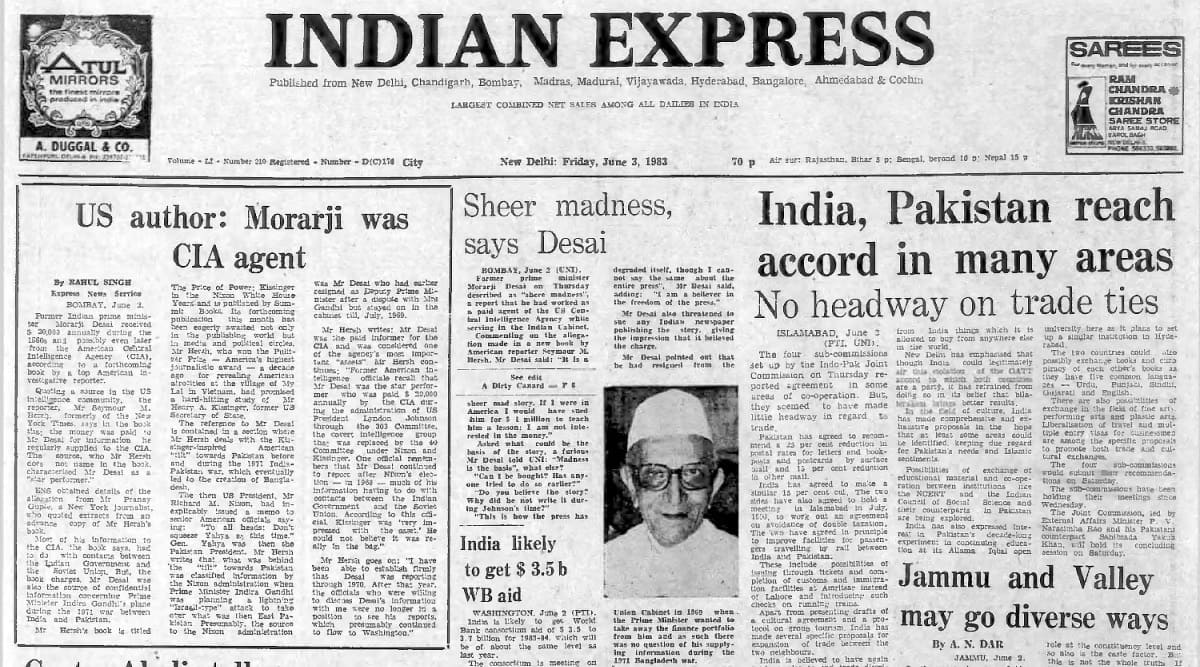
An upcoming book by an American investigative journalist claims the U.S. Central Intelligence Agency (CIA) allegedly paid former Indian Prime Minister Morarji Desai $20,000 a year in the 1960s and possibly later. In the book, former New York Times journalist Seymour M. Hersh, quoting a source in the US intelligence community, says the money was paid to Desai for information he regularly supplied to the CIA. The book does not name the source, who described Desai as a “star performer”. “Sheer madness” was how Morarji Desai dismissed a report that he had worked as a paid agent of the US CIA while in the Indian Cabinet.
Pakistan Goes Nuclear
In May 1998, Pakistan had demonstrated its nuclear capability. India’s own nuclear tests followed its Pokhran-II tests earlier this month. Those tests ended South Asia’s long history of nuclear ambiguity. So the Morarji Desai Kahuta controversy is significant because it precedes that public moment. It is one of the shadow years when intelligence agencies and political leaders alike tried to influence nuclear outcomes without open war.
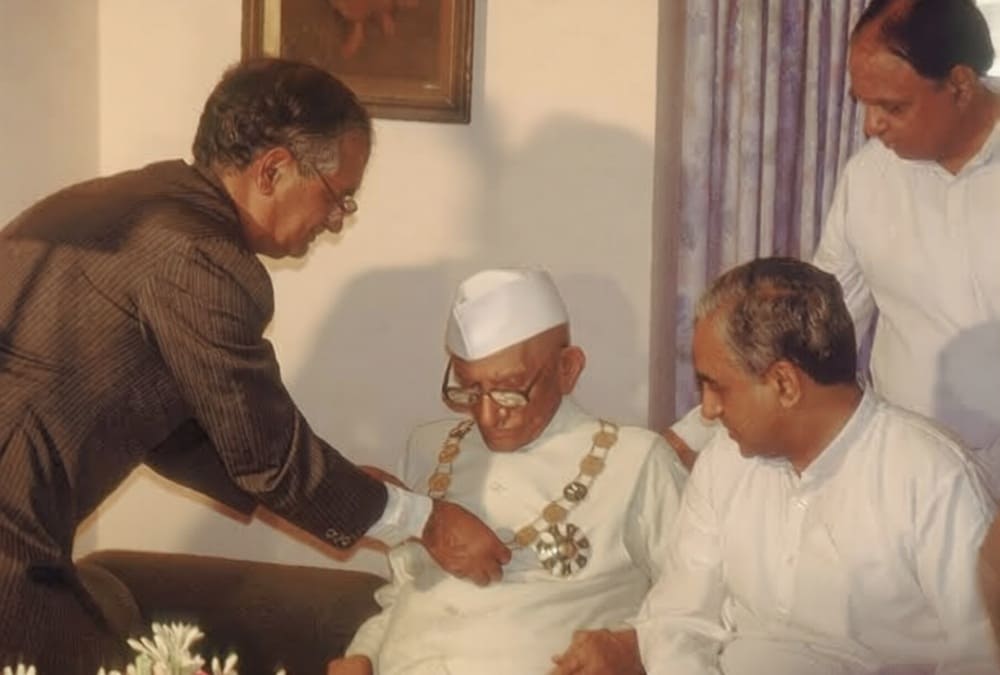
Later, Pakistan awarded Morarji Desai its highest civilian award, the Nishan-e-Pakistan. Pakistan officially linked the award to his peace efforts and his role in improving relations between India and Pakistan. Meanwhile, the award has remained politically sensitive in India because of the Kahuta controversy.
Conclusion
Did Morarji Desai Save Pakistan’s Nuclear Programme? That’s too broad an interpretation. Political will, technical leadership, foreign procurement routes and military protection were the factors that led to Pakistan’s nuclear endeavour. Nor was that the result of any one Indian choice. But the reported incident is still important. Had Desai turned down a feasible RAW operation and then warned Zia, he might have endangered India’s intelligence access at a crucial time.
That would be a serious setback for the intelligence operation. Nuclear programmes do not depend on laboratories. They rely on secrecy, counterintelligence, leadership judgement, and political will. The Morarji Desai Kahuta controversy is significant because it raises a difficult question. Was restraint the reason for avoiding a bigger war, or was it the reason for the growth of Pakistan’s nuclear shield? Slogans are no evidence. We need proof. However, the episode does show how one political conversation can shift the intelligence battlefield.
References
- https://www.pmindia.gov.in/en/former_pm/shri-morarji-desai-2/
- https://carnegieendowment.org/research/2005/09/a-q-khan-nuclear-chronology
- https://theprint.in/politics/story-behind-treason-charge-against-morarji-desai-why-congress-is-reviving-it-to-target-jaishankar/2634867/
- https://www.britannica.com/technology/nuclear-weapon/Pakistan
- https://www.armscontrol.org/act/2008-06/looking-back-1998-indian-and-pakistani-nuclear-tests
- https://www.jstor.org/stable/45064896
About the Author