
World Cup 2026 Counter-Drone Security Explained
World Cup 2026 counter-drone security has become a core part of tournament protection. The event is not only a football spectacle. It is also a complex homeland security operation across the United States, Canada and Mexico. FIFA’s 2026 tournament uses 16 host cities and a much larger 48-team format. Therefore, security planners must protect stadiums, training bases, fan zones, transport corridors and broadcast sites.
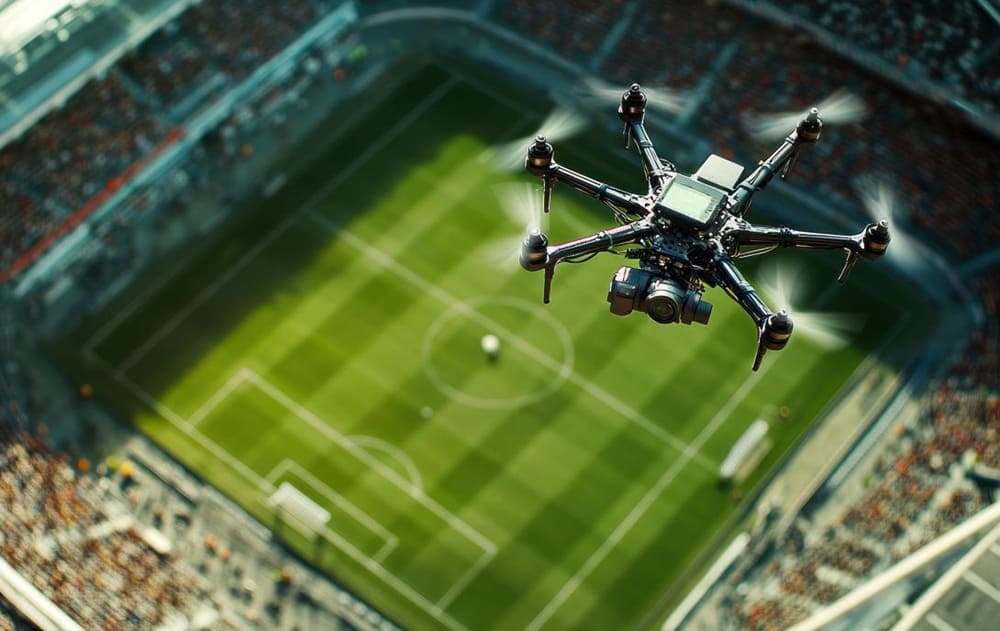
This broad footprint creates a serious low-altitude airspace challenge. Small drones have changed the threat picture. A cheap quadcopter can bypass fences, police barriers and stadium gates within minutes. It may carry a camera, disrupt play, track security routes or cause panic. In a worst-case scenario, a modified drone could carry a hazardous payload.
Drones May threat Stadiums
Why counter-drone security is important for World Cup 2026 Drones strike from another axis Event security controls ground access the traditional way. But there are drones in the airspace above the crowd. Modern stadiums use bollards, magnetometers, CCTV, armed patrols and ticket screening for protection. These steps restrict people, cars and weapons at the ground level. But they do little to stop a drone flying over the perimeter. The threat isn’t always of military grade.
Many incidents can involve careless fans, vloggers or private operators. But an innocent drone can stop a game. It could also interfere with emergency helicopters or crowd control operations. The problem is one that echoes modern battlefield lessons for defense observers. Ukraine, Red Sea and Middle Eastern conflicts have demonstrated how small unmanned systems generate asymmetric pressure. Now, that same logic is being applied to civilian mega-events.
No-Drone Zones
Regulation is the first step in securing the World Cup 2026 against drones The legal basis for enforcement is airspace restrictions. The U.S. Federal Aviation Administration has set up no-drone zones around World Cup venues, fan events and base camps. Restrictions are in place around listed stadiums on match days within 3 nautical miles and up to 3,000 feet above ground level.
This is important, since detection alone does not solve the problem. Authorities need a clear legal demarcation before they seize drones, fine operators or support criminal prosecution. Canada and Mexico will also use aviation regulations, police powers and local security plans. However, each country operates its own legal system. So cross-border coordination will remain crucial to tournament security.
Sensor Fusion
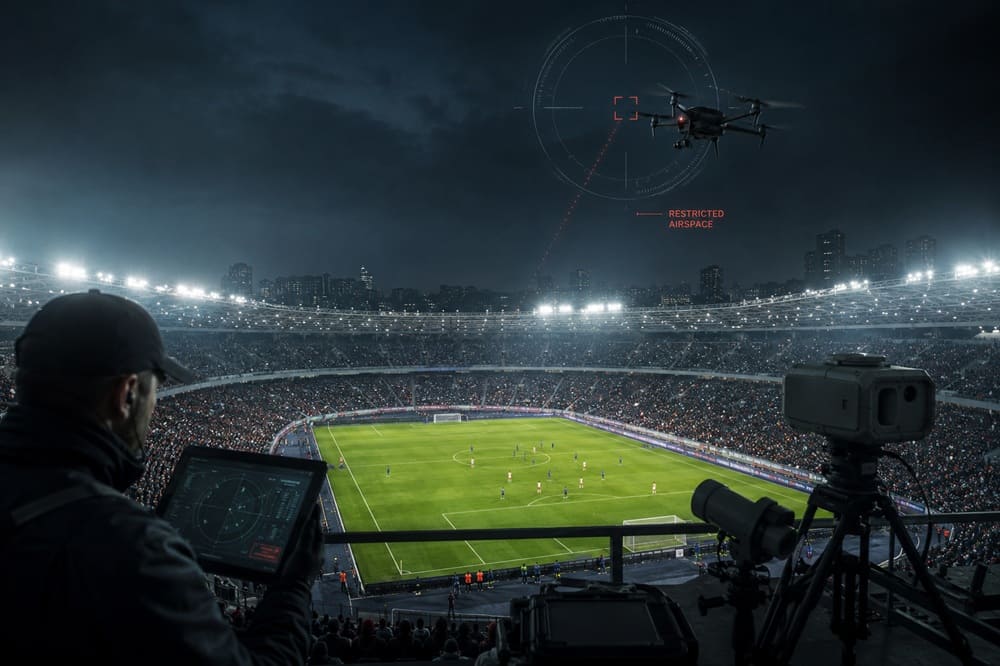
You can’t rely on one type of sensor for World Cup 2026 counter-drone security. Small drones fly low, move slow, and often get lost in urban clutter. That means security teams need layered detection. Radio-frequency sensors can detect control links between a drone and its operator. Radar can detect small moving objects at low elevations. Electro-optical cameras provide visual confirmation of the object. Infrared sensors are effective at night.
Acoustic systems can detect rotor noise, but crowds and traffic degrade their effectiveness. The main technical challenge is sensor fusion. Radar contact alone does not necessarily indicate a drone threat. A radio frequency hit does not have to be an exact position. However, combined data provides operators with a clearer track, classification and response window.
Operator Location Matters
Counter-drone security for World Cup 2026 will likely centre on identifying the operators. Taking down a drone above a packed stadium has its own dangers. The debris could hit spectators, players, roads or nearby buildings. There are also risks in electronic attack. Jamming can interfere with authorised systems, emergency communications or links with nearby aircraft.
Protocol takeover may only work on some drone models. So commanders have to balance speed, legality and safety. Often the best solution is to locate the pilot, stop the flight, and take the equipment. This technique minimises risk and preserves evidence. It also helps with prosecution and deterrence for the public.
Command Centres Must respond Fast
Counter-drone defense relies on command and control. The stadium operations centre could include police, aviation regulators, federal agencies, emergency services, FIFA security teams and private technology providers. Each actor controls a different part of the chain of response. Another team could locate the drone. The operator may be identified.
Mitigation may be approved by a senior authority; therefore, speed depends on practised procedures. That’s why drills are important. U.S. planners are rushing to build networks to detect drones and response plans for host cities, Reuters reported. The U.S. has also invested heavily in counter-drone technology and preparedness with substantial federal funding.
A complex Distributed Tournament
World Cup 2026 counter-drone security has a peculiar geographic problem. A single-city event can be used to build one protective model. This tournament covers three countries, many cities and many time zones. Los Angeles, New York-New Jersey, Dallas, Atlanta, Miami, Toronto, Vancouver, Mexico City, Guadalajara, and Monterrey have differing airspace conditions.
Differences between cities exist in density, distance to airports, weather, buildings and radio-frequency congestion. Planners need C-UAS layouts specific to the site. Deconfliction measures for a stadium near an airport differ from deconfliction measures for a stadium in a lower density zone. Protection is also needed for fan festivals where large crowds gather outside the boundaries of stadiums.
For wider drone warfare context, see Defense News Today’s ‘Drones’ section: https://defensenewstoday.info/drones/
For regional security context, see Defense News Today’s North America section. https://defensenewstoday.info/north-america/
Strategic Assessment
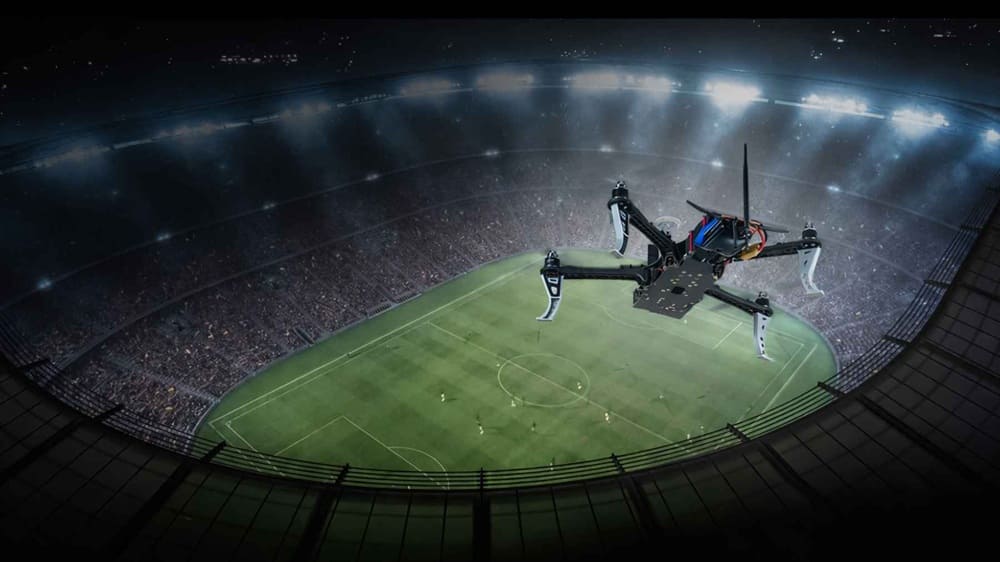
Counter-drone security shows military tech entering civil protection. Drones aren’t niche toys anymore. They now also require governments to protect low-altitude airspace during public events. The aim is not to put an invisibility dome over every venue. That would be impossible. Instead security teams want to detect early and classify quickly and respond proportionally.
This model combines law, sensors, intelligence, police action and technical mitigation. It protects the public as well and doesn’t make stadiums into combat zones. The tournament will affect the planning of future major events such as the 2028 Los Angeles Olympics and G20 summits. If World Cup 2026 does a satisfactory job managing drone risks, it could set a standard for civilian counter-UAS doctrine.
Conclusion
Counter-drone security is now part of the World Cup 2026’s protective architecture. Drones can fly over ground security, disrupt matches and strain emergency services. So host nations need no-drone zones, sensor fusion, rapid command centres, operator tracking and careful mitigation rules. The real challenge is not only to stop drones. The challenge is to halt them without creating any greater danger below.
References
- https://www.fifa.com/en/tournaments/mens/worldcup/canadamexicousa2026/host-cities
- https://www.faa.gov/newsroom/faa-establishes-no-drone-zones-fifa-world-cup-2026-stadiums-fan-events-and-base-camps
- https://www.reuters.com/sports/soccer/world-cup-security-planners-race-counter-drone-risks-2026-06-10/
- https://www.reuters.com/business/aerospace-defense/us-invests-counter-drone-tech-protect-fifa-world-cup-venues-2026-01-12/
About the Author