Wendelstein 7-X 2025 — Germany has “arrived” at fusion power
What matters (and what doesn’t)
A wave of news and posts claims Germany has “arrived” at fusion power because the Wendelstein 7-X (W7-X) ran “for 30 minutes at 100 million °C” and is “about to connect to the grid.” However, the verifiable milestone is different, and it is still a big deal.
On 22 May 2025, the Max Planck Institute for Plasma Physics (IPP) team in Greifswald achieved a world-record triple product for long-duration, high-performance discharges, holding the peak value for 43 seconds. In other words, W7-X pushed performance into power-plant-relevant territory for a meaningful pulse length, and it did so in a stellarator.
What is W7-X?
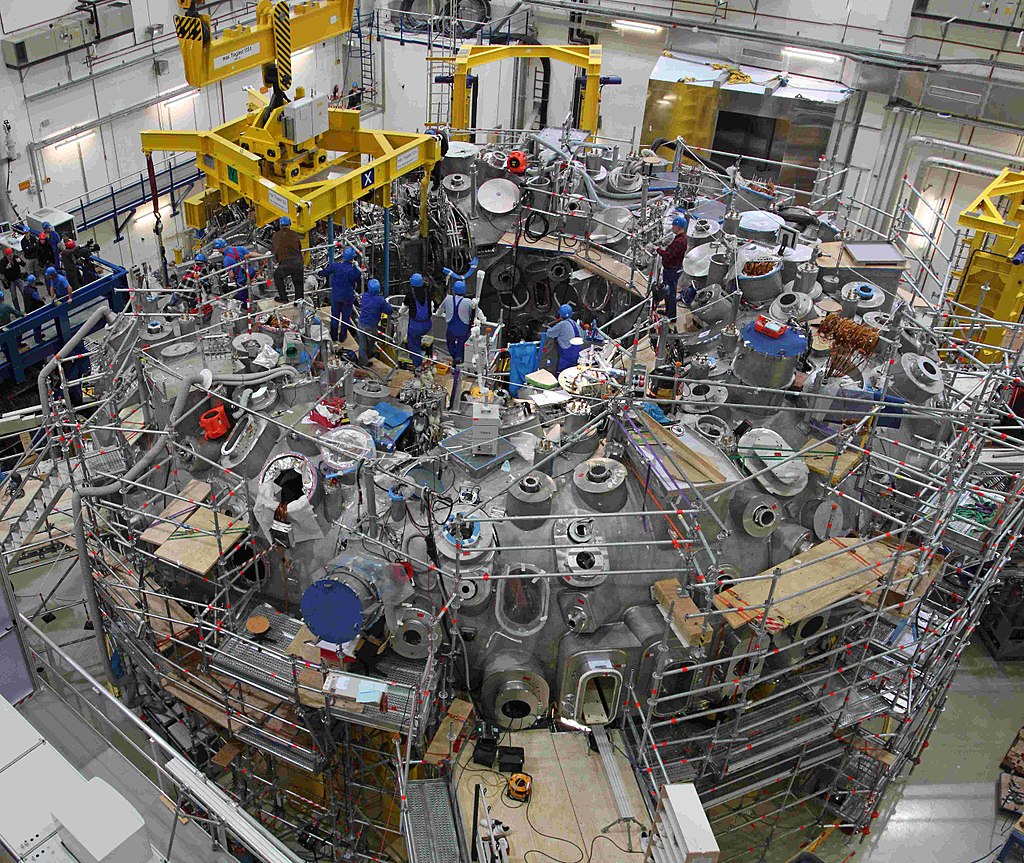
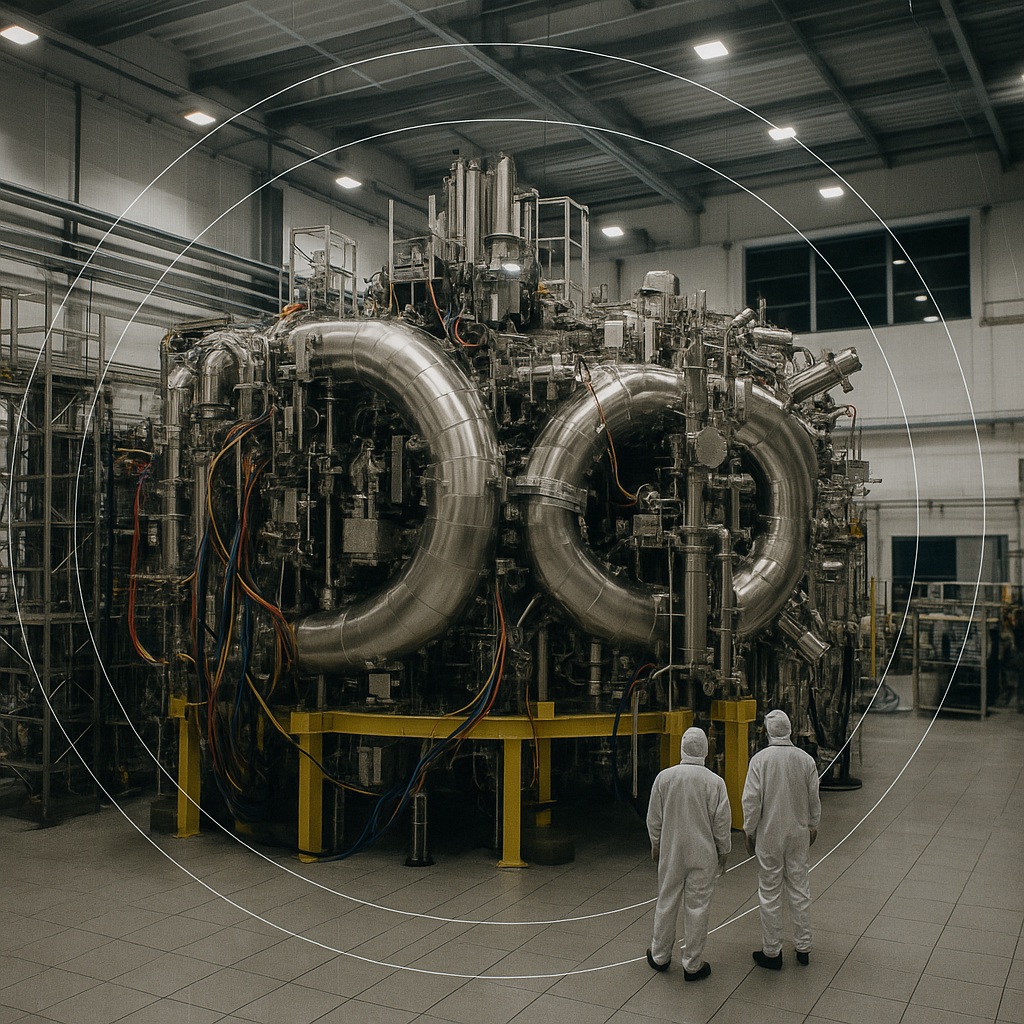
W7-X is the world’s largest stellarator experiment. It exists to test whether an optimized stellarator configuration can sustain high-quality confinement in steady-state conditions. It is not built to produce electricity. That distinction matters, because “grid connection” implies a power plant and a turbine cycle. W7-X is a physics and engineering testbed.
May 2025 record: the numbers
The May 2025 campaign (OP2.3) ended with a result fusion engineers care about: sustained, high-performance operation.
- Record metric: triple product peak, held for 43 seconds
- Why it’s notable: W7-X exceeded prior tokamak performances in the long-duration regime, even though major tokamak records still dominate very short pulses
- How they did it: continuous fuelling via an Oak Ridge National Laboratory pellet injector, firing ~90 frozen hydrogen pellets during the record shot
Therefore, the Wendelstein 7-X fusion milestone is not “fusion power on the grid.” It is a validated step towards steady-state, power-plant-like plasma conditions.
Stellarator vs tokamak: operational logic
Tokamaks create part of the confining magnetic field using a strong current driven through the plasma. That approach is simpler to build and has a broad research base. However, it also invites current-driven instabilities that can end a discharge.
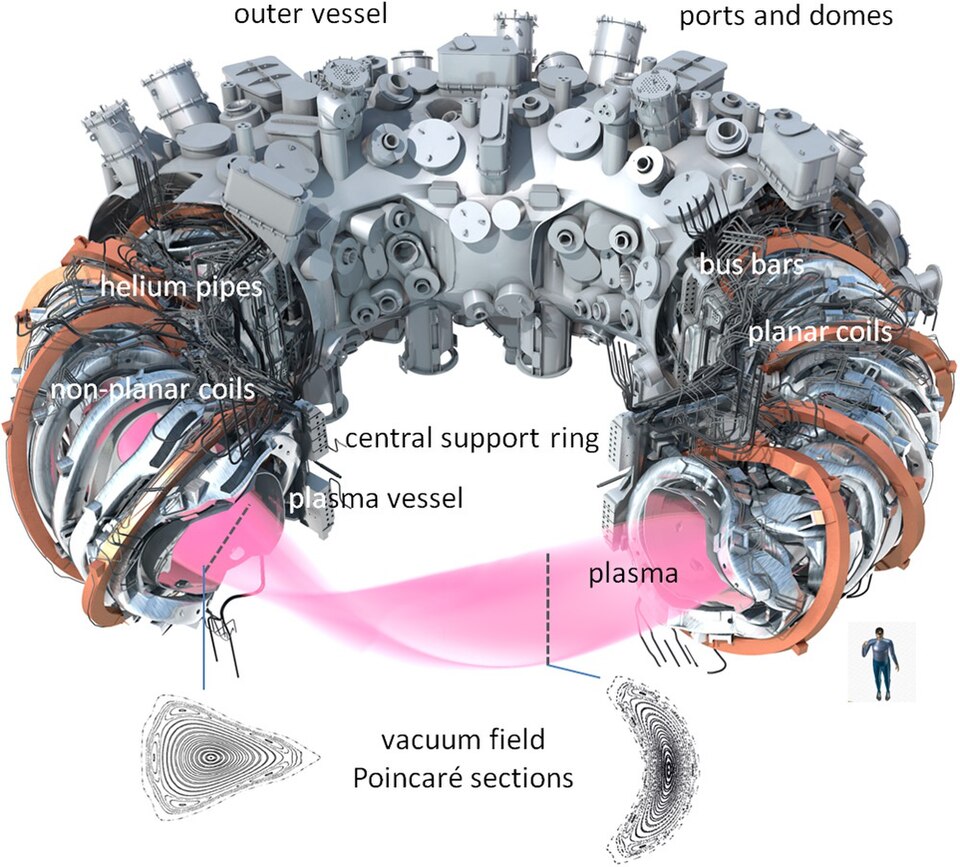
A stellarator, by contrast, relies on complex external coils to generate the full 3D magnetic geometry. In theory, that presents you better stability and a clearer path to continuous operation. However, this approach results in significant engineering complexity. W7-X exists to prove that the complexity pays off.
Tokamak vs Wendelstein 7-X Specs Comparison
| Parameter | Tokamak (ITER reference) | Wendelstein 7-X (Stellarator) |
|---|---|---|
| Confinement concept | Toroidal field coils and plasma current helps create confinement | Fully shaped by external 3D coils (no reliance on large plasma current) |
| Primary aim | Burning-plasma demo and net-gain regime experiments | Prove steady-state stellarator operation and power-plant-relevant confinement |
| Major radius (R) | 6.2 m | 5.5 m |
| Minor radius (a) | ~2.0 m | 0.53 m |
| Plasma volume | ~830 m³ | 30 m³ |
| Magnetic field (headline) | ~5.3 T (confinement field); ~11.8 T (peak at coils) | 3 T |
| Plasma current | 15 MA | Not required for main confinement (no tokamak-style transformer current) |
| Heating power | ~50 MW (design heating input) | 14 MW |
| Pulse length (design/goal) | 400–600 s (design pulse at main point) | Up to 30 minutes (design goal) |
| Magnet system | 18 superconducting toroidal field coils | 50 non-planar + 20 planar superconducting coils |
| Electricity generation | No (experimental device) | No (experimental device) |
Triple product: Lawson logic
The parameters are included, and the triple product is calculated by combining the following:
- Particle density
- Temperature
- Energy confinement time.
It acts as a practical shorthand for whether a device can approach the conditions needed for net energy gain. Moreover, what made W7-X’s 43 seconds important is not the number alone. It is that the shot lasted long enough for the plasma conditions to settle into a quasi-steady state, which is closer to what a real plant must do.
The long-duration story
The 43-second record sits inside a broader trajectory. IPP reports that W7-X:
- Now routinely reaches ion temperatures around 40 million °C
- In 2023, W7-X sustained plasma for over eight minutes, set a stellarator record, and reported an energy conversion figure of 1.3 gigajoules.
Crucially, the team’s stated target is a 30-minute pulse with high energy coupling. So the “30 minutes” claim belongs to the roadmap, not to a confirmed 2025 grid-ready breakthrough.
Why it matters for defense
Fusion research looks civil, but the enabling stack overlaps with strategic defense technology.
- High-field magnets and cryogenics: Superconducting systems and precision power electronics are relevant for many defense-adjacent industries.
- Materials under extreme heat loads: Divertors, wall protection, coatings, and tritium handling shape future industrial supply chains.
- Control, sensing, and resilience: Fusion devices push real-time diagnostics, closed-loop control, and fault tolerance—skills that translate to complex platforms.
Energy security, on the other hand, is strategic. A credible path to abundant, clean baseload power shifts the geopolitics of fuel, shipping, defense, and industrial capacity. It will not happen overnight, but the direction already affects national research priorities.
What to watch next
If you want a grounded checklist, track these signals:
- Repeatability: can W7-X reproduce the high triple product regime routinely, not just once?
- Pulse extension: can the pellet-fueled approach push from tens of seconds to minutes reliably?
- 30-minute campaign execution: IPP has stated the aim; delivery will be the real credibility marker.
- Spin-out realism: IPP notes start-ups orienting around W7-X learnings, but commercial timelines still hinge on engineering maturity.
Bottom Line
Wendelstein 7-X matters because it treats fusion like a reliability problem, not a one-off stunt. Its twisted external magnets hold the plasma steady, so the machine can chase long, repeatable pulses without leaning on a huge plasma current. Therefore, W7-X shines when it runs calmly and consistently, not when a headline goes viral.
Moreover, it forces the hard questions early—how you fuel the plasma, dump heat safely, and keep control systems stable for minutes, then longer. However, the clever coil design, while innovative, also presents significant challenges in terms of construction and maintenance. If W7-X keeps stretching pulse length while preserving strong confinement, it makes the stellarator path look far more realistic for real-world power.
References
- https://www.ipp.mpg.de/5532945/w7x
- https://www.pppl.gov/news/2025/wendelstein-7-x-sets-new-performance-records-fusion-research
- https://www.euro-fusion.org/eurofusion-news/wendelstein-7-x-sets-world-record-for-long-plasma-triple-product/
- https://www.ipp.mpg.de/5585948/10jahre_w7x
- https://www.ipp.mpg.de/w7x
About the Author