US vs Russian Jet Engines: Strengths and Weaknesses
It all depends on what you measure when you try to figure out if Russian or American fighter engines are “better”. Do you look at raw thrust, service life, fuel burn, cost, ease of maintenance, or turnaround time? Both countries have spent decades investing in high-performance propulsion, and their engines show that they have different design priorities and operating realities.
This paper directly compares selected Russian and American fighter engines, focusing on key features like engine type, model name, power, thrust-to-weight ratio (TWR), and how often major repairs are needed. Generally, Russian designs are known for their high power and ease of maintenance, even under challenging conditions. However, they usually have slightly lower TWR numbers and shorter times between overhauls.
American engines, on the other hand, tend to have higher TWRs and stay on wing longer between overhauls. This is because they use advanced materials, have stricter manufacturing tolerances, and make design choices that also work for low-observable airframes. The downside is that these engines usually cost more and need more specialized help to run at their best.
Engines Analysis
This table offers a concise overview of how each engine strikes a balance between power, durability, and maintenance requirements.
| Country | Engine Type | Engine Name | Thrust (Afterburner) | Thrust-to-Weight Ratio (TWR) | Overhaul Interval |
|---|---|---|---|---|---|
| Russia | Turbofan | Saturn AL-31F | 27,557 lbf | ~7.6 | ~500 hours |
| USA | Turbofan | Pratt & Whitney F100 (F-15, F-16) | 29,160 lbf | ~7.8 | 6,000–8,000 hours |
| Russia | Turbofan | Saturn AL-41F | 33,000 lbf | ~10 | ~1,000 hours |
| USA | Turbofan | Pratt & Whitney F119 (F-22 Raptor) | 35,000 lbf | ~9 | 6,000–8,000 hours |
| Russia | Turbofan | Klimov RD-33 | 18,300 lbf | ~7 | 400–500 hours |
| USA | Turbofan | General Electric F404/F414 (F/A-18 Hornet, F-35 variant) | 22,000 lbf | ~9 | 4,000–6,000 hours |
| Russia | Turbofan (3D thrust vectoring) | AL-31FN (J-10A Chinese fighter) | 29,800 lbf | ~7.8 | ~500 hours |
| USA | Turbofan (3D thrust vectoring) | General Electric F135 (F-35 Lightning II) | 43,000 lbf | ~10.5 | 6,000–10,000 hours |
1. Thrust and Power-to-Weight Ratio
- American Engines: The design of U.S. engines, such as the Pratt & Whitney F119 in the F-22 and the F135 in the F-35, aims to achieve high thrust-to-weight ratios. These engines provide exceptional performance, particularly at supersonic speeds and during stealth operations. American engines often achieve excellent acceleration, giving their aircraft advantages in air-to-air combat and quick response scenarios.
- Russian engines, like the Saturn AL-41 (used in the Su-35) and the Saturn AL-31 (used in the Su-27 and Su-30), also produce high thrust but prioritize raw power and afterburner performance. While they generally consume more fuel than their American counterparts, they compensate with greater endurance at higher speeds, which is particularly useful for maneuvering dogs and maintaining power in harsh environments.

2. Durability and Maintenance
- American Engines: U.S. engines are designed to be low-maintenance and have a longer operational lifespan. Advanced materials and precision engineering allow American engines to endure longer cycles between maintenance, reducing downtime and ensuring better performance over time. This feature makes them highly reliable but often more expensive due to the need for sophisticated materials and manufacturing techniques.
- Russian Engines: Russian fighter engines are known for their ruggedness and simplicity, making them easier to repair in the field and more resilient in harsh operating conditions. They may not last as long as American engines but are designed for ease of maintenance and can often tolerate lower-grade fuel. This capability is advantageous for operations in remote or resource-limited areas but may mean a shorter service life.
3. Maneuverability and Supermaneuverability
- American Engines: With innovations like thrust vectoring in the F-22’s F119 engines, American fighters can perform advanced maneuvers that improve agility and control in combat situations. U.S. engines focus on stealth and maneuverability, which enhances survivability in modern combat.
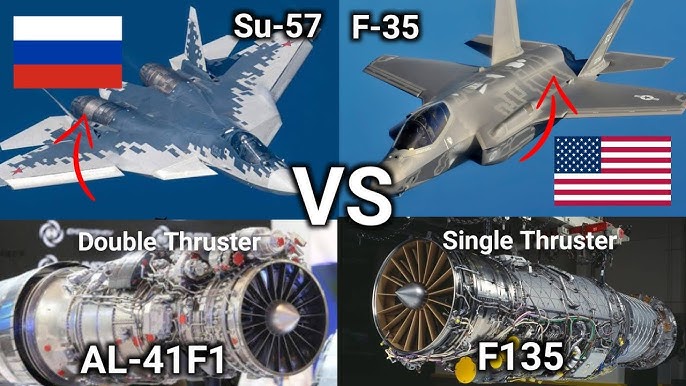
- Russian Engines: Russian fighters excel in supermaneuverability thanks to engines like the AL-41F1 with 3D thrust vectoring. These engines give Russian aircraft the ability to perform unique maneuvers, like Pugachev’s Cobra and Kulbit, which are advantageous in close-range combat. The emphasis on thrust vectoring also allows Russian jets to maintain agility at various speeds, making them formidable in dogfights.
4. Stealth and Signature Management
- American Engines: American engines, especially those used in stealth fighters like the F-22 and F-35, are designed with stealth in mind. Advanced technology minimizes infrared and radar signatures, which is crucial for operations that rely on surprise and evasion.
- Russian Engines: Russia has made strides in reducing radar cross-sections and infrared signatures, but stealth is not as high a priority as in the U.S. This design choice prioritizes speed and power over stealth, allowing for notable advantages in face-to-face encounters rather than stealthy approaches.
5. Fuel Efficiency and Range
- American Engines: U.S. fighter engines tend to be more fuel-efficient, allowing for extended range and endurance. Advanced turbine technology and materials, which function well under sustained high temperatures, achieve this efficiency, providing strategic advantages in long-range missions.
- Russian Engines: Russian engines consume more fuel but perform well even with lower-quality fuel, providing flexibility in diverse combat conditions. While these characteristics can limit range, the focus is on delivering robust power and endurance in shorter, more intense engagements.
6. Cost and Production
- American Engines: The high-performance requirements and advanced technology in American engines make them expensive to develop and produce. This cost factor contributes to the overall expense of American fighter jets, which are often pricier than their Russian counterparts.
- Russian Engines: Russian engines are generally more cost-effective, partly due to simpler manufacturing processes and materials. This cost efficiency makes them attractive in export markets and allows Russia to produce a high volume of engines for various aircraft types.
Materials used in Jet Engines
| Engine area/part | United States (typical materials used) | Russia (typical materials used) |
|---|---|---|
| Fan + low-temp compressor | Titanium alloys for blades/disks; some composite use in select applications | Titanium alloys widely used for blades/disks |
| Mid/high compressor stages | Titanium where temperature allows; nickel alloys as temperatures rise; some steel in specific structures | Similar mix: titanium in cooler zones; nickel alloys in hotter sections |
| Combustor liners/hot sheet parts | Nickel- and cobalt-based alloys with good oxidation and heat resistance | Nickel- and cobalt-based alloy families used for similar heat/oxidation demands |
| High-pressure turbine (HPT) blades | Single-crystal nickel-based superalloys for creep strength at extreme temperatures | Nickel-based superalloys, including directionally solidified and single-crystal classes |
| HPT blade coatings | Thermal barrier coatings (ceramic top coat over metallic bond coat) to protect and raise temperature margin | Protective coatings such as aluminide-type diffusion layers and thermal barrier coatings used on hot parts |
| Turbine disks (rotors) | Polycrystalline nickel-based alloys (often optimized for fatigue and creep) | Nickel-based disk alloy families used for fatigue + high-temperature strength |
| Shafts / high-strength rotating members | High-strength steels and/or nickel alloys depending on heat/load | Similar: high-strength steels and nickel alloys depending on location and duty cycle |
| Nozzles/afterburner hardware | Heat-resistant nickel alloys and stainless steels; coatings to manage oxidation | Heat-resistant nickel alloys and steels; protective coatings for oxidation/heat cycling |
| Bearings/housings | Bearing steels; high-temp alloys for adjacent structures | Bearing steels; high-temp alloys for surrounding structures |
| Emerging hot-section materials | Ceramic matrix composites (CMCs) in some advanced programmes; advanced coatings | Research in advanced superalloys/coatings; limited public detail on frontline CMC use |
Engine Philosophies
This format highlights their strengths and trade-offs, with Russian engines prioritizing power and maneuverability while American engines emphasize efficiency, stealth, and durability.
| Aspect | Russian Engines | American Engines |
|---|---|---|
| Design Philosophy | Simplicity and ruggedness: designed for ease of maintenance in harsh environments | Advanced technology, high reliability, and precision engineering |
| Thrust and Power | High thrust with emphasis on afterburner performance; suited for dogfights | High thrust-to-weight ratio; excellent acceleration for multirole missions |
| Durability | Built for quick maintenance in the field; shorter service lifespan | Long-lasting, low-maintenance engines designed for extended operational cycles |
| Maneuverability | Supermaneuverable with 3D thrust vectoring; enables advanced aerial maneuvers like the Cobra | Strong maneuverability with thrust vectoring in some models; agile but designed to balance stealth features |
| Stealth and Signature | Lower priority on stealth; some radar cross-section reduction but higher infrared signature | High priority on stealth; low radar and infrared signatures for stealth operations |
| Fuel Efficiency | Lower fuel efficiency, designed to use lower-grade fuel; shorter range | Higher fuel efficiency supports longer-range missions |
| Operational Range | Typically shorter due to higher fuel consumption | Extended range due to efficient fuel consumption |
| Maintenance | Easier to repair and maintain in field conditions; designed for simplicity and ruggedness | This system requires advanced facilities and skilled personnel, but it has fewer maintenance intervals because of the use of advanced materials. |
| Cost | The cost is generally lower because it uses simpler manufacturing processes and materials. | The higher cost reflects the use of advanced materials and precision manufacturing techniques. |
| Export Appeal | High appeal for countries needing cost-effective and powerful engines | Appeals to allies seeking advanced technology and high performance |
Real World Example
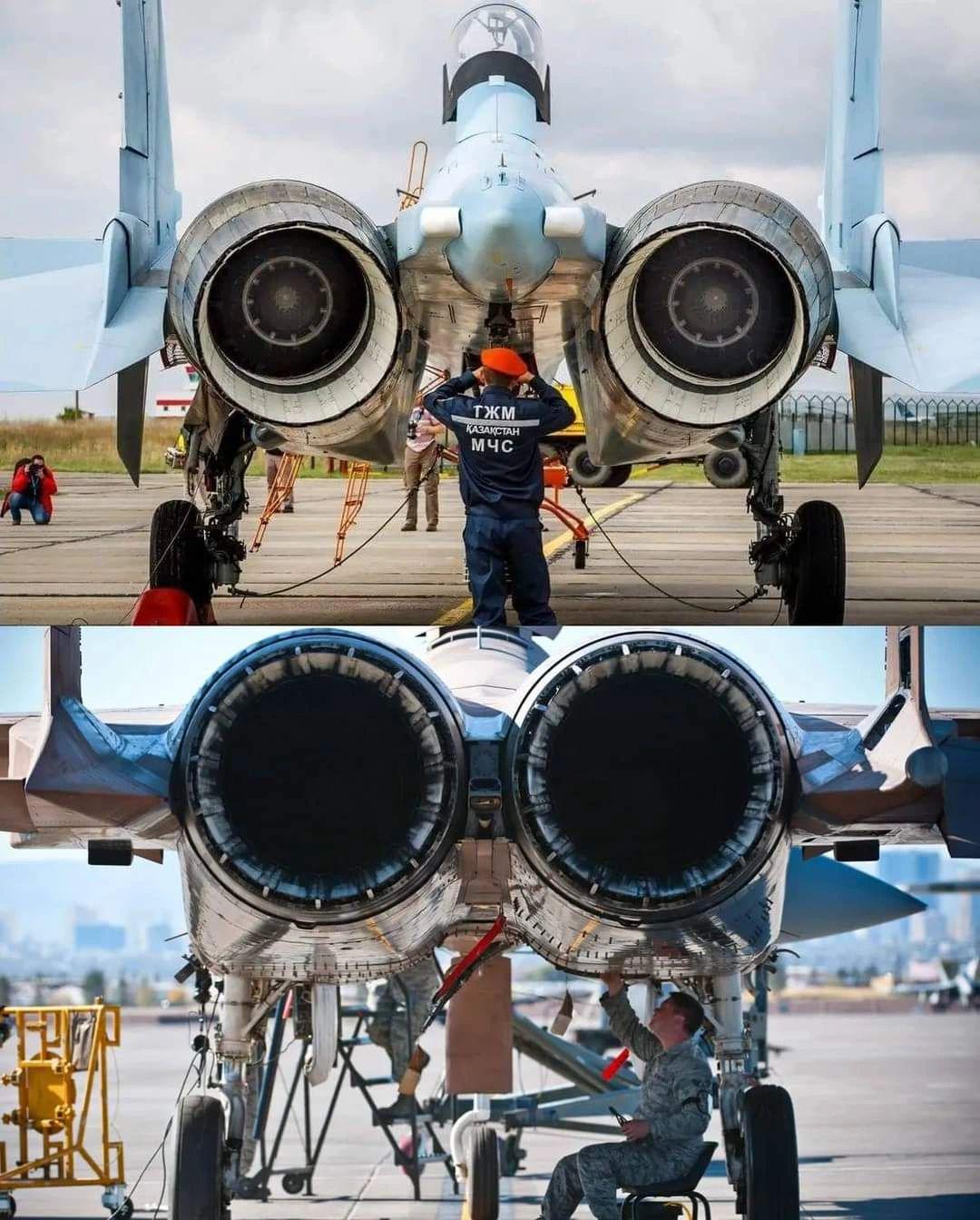
Su-35 (AL-41F1S Engines)
F-15E Strike Eagle (F100-PW-229 Engines)
In the End
Conclusion
When it comes to overall quality and stealth, American engines are typically superior due to their higher fuel efficiency, longer lifespans, and lower radar/infrared signatures, which makes them appropriate for long-range and multirole missions. Nevertheless, Russian engines are superior in terms of thrust, supermaneuverability, and field maintenance ease, which gives them an advantage in tough operating conditions and dogfighting.
Generally speaking, American engines (such as the F119 and F135) are superior in terms of stealth, long range, and dependability. Because of their maneuverability, thrust, and operational flexibility under difficult circumstances, Russian engines—like the AL-41F1—frequently win favor. Since both excel in their positions, the decision will mostly be based on operational philosophy and mission priorities.
References
- https://www.rtx.com/en/prattwhitney/products/military-engines/f119
- https://airspacepower.com/wp-content/uploads/2024/06/F135-Engine-Fast-Facts-compressed_1.pdf
- https://www.geaerospace.com/sites/default/files/2022-01/F414-Datasheet.pdf
- https://en.wikipedia.org/wiki/Saturn_AL-31
About the Author