
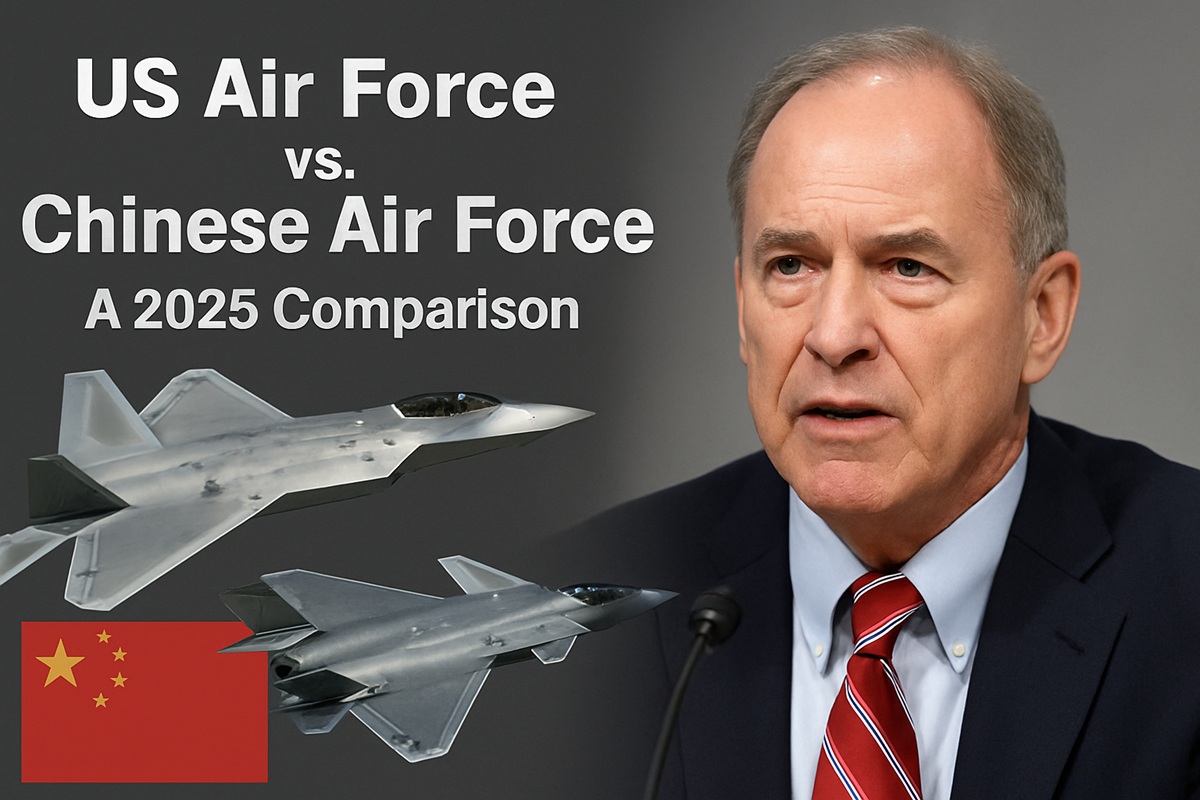
US Air Force vs Chinese Air Force 2025 — Col. John "JV" Venable
2025 Airpower balance really matters
The US Air Force vs. Chinese Air Force 2025 debate is no longer a distant, theoretical war game. It now shapes real planning for a Taiwan crisis, Pacific basing, and alliance reassurance from Japan to Australia. When a former USAF fighter pilot warns that America is falling “woefully short” against a peer adversary, defense professionals should treat it as a data point, not mere rhetoric.
This analysis examines Col. John “JV” Venable’s key assertion: China maintains a competitive advantage in capacity, rivals closely in capability, and could potentially take the lead in operational readiness.
Capacity: Readily available, not just on paper
On paper, the United States Air Force still looks enormous. The total force includes more than 2,000 fighters. However, Col. John “JV” Venable, USAF (Ret.), a retired US Air Force F-16 pilot and former Thunderbirds commander who currently serves as an airpower analyst with the Mitchell Institute, highlights that only a small portion of the fighters are part of squadrons that are ready for combat. Two years ago, he was told that about 750 US fighters met that standard, and he notes the figure has slipped further since.
By contrast, the Chinese People’s Liberation Army Air Force (PLAAF) has refitted its entire frontline fleet with fourth- and fifth-generation aircraft. According to his assessment, China can now generate 1,100 combat-ready fighters able to sortie over Taiwan without refueling. That gives Beijing a huge local numerical advantage in any US Air Force vs Chinese Air Force 2025 scenario centered on the Taiwan Strait.
For US forces, sortie durations would be longer, tanker demand would be higher, and basing would be more vulnerable. In simple terms, capacity now leans toward China.
Capability: stealth fleets and re-equipment
Capability remains more complex. Roughly 24% of the US fighter fleet is stealthy, with F-22s and F-35s forming the high-end core. Yet the United States achieved that ratio not by flooding the ramp with new aircraft, but by retiring older jets. The Air Force still plans to cut around 300 additional fighters, arguing that they are not survivable in a fifth-generation conflict.
Those older jets, however, still have value for secondary theaters, presence missions, and lower-intensity contingencies. When planners frame everything around a single high-end fight with China, they risk leaving gaps elsewhere.

Meanwhile, China keeps building. The PLAAF is reportedly fielding around 120 J-20s a year, alongside another 170 “fourth-plus” generation fighters annually. The US Air Force, by comparison, expects to field fewer than 60 fighters in total this year, including fewer than 30 F-35s. Under the current President’s budget, it will buy zero F-15EXs for this cycle.
Anecdotal reports now suggest that the J-20 performs better than early Western assessments predicted, especially as China iterates sensors, engines, and weapons. The United States likely still holds a qualitative edge overall, particularly in integration and EW. However, in the US Air Force vs Chinese Air Force 2025 balance, that edge is narrowing as China’s production lines keep running hot.
For more profound context on Chinese stealth development, readers can explore Defence News Today’s analysis of China’s J-20 and regional airpower trends.
Readiness: Sorties, flying hours, human factor
Where the warning becomes most stark is readiness. In his first year as an F-16 pilot, the speaker logged 350 flight hours. The average fighter pilot received more than 200 hours a year, and the Air Force considered anyone with fewer than 150 hours non-combat capable.
Today, official minimum thresholds stand at eight sorties per month for an experienced fighter pilot and nine for an inexperienced pilot. The former officer notes that the service has not met those minimums in several years. Current annual hours have dropped to roughly 110 hours per pilot, well below what earlier generations viewed as combat-ready.
Chinese pilots, by contrast, reportedly average around 200 hours per year. If those figures hold, they suggest that the PLAAF now matches or exceeds USAF pilots in raw flying time, at least in frontline units. Readiness, which once served as America’s decisive advantage during the Cold War, no longer looks like a clear win.
For air forces, training is capability. Hours in the cockpit, depth of tactics, and exposure to complex scenarios all decide who actually performs when the first missiles fly.
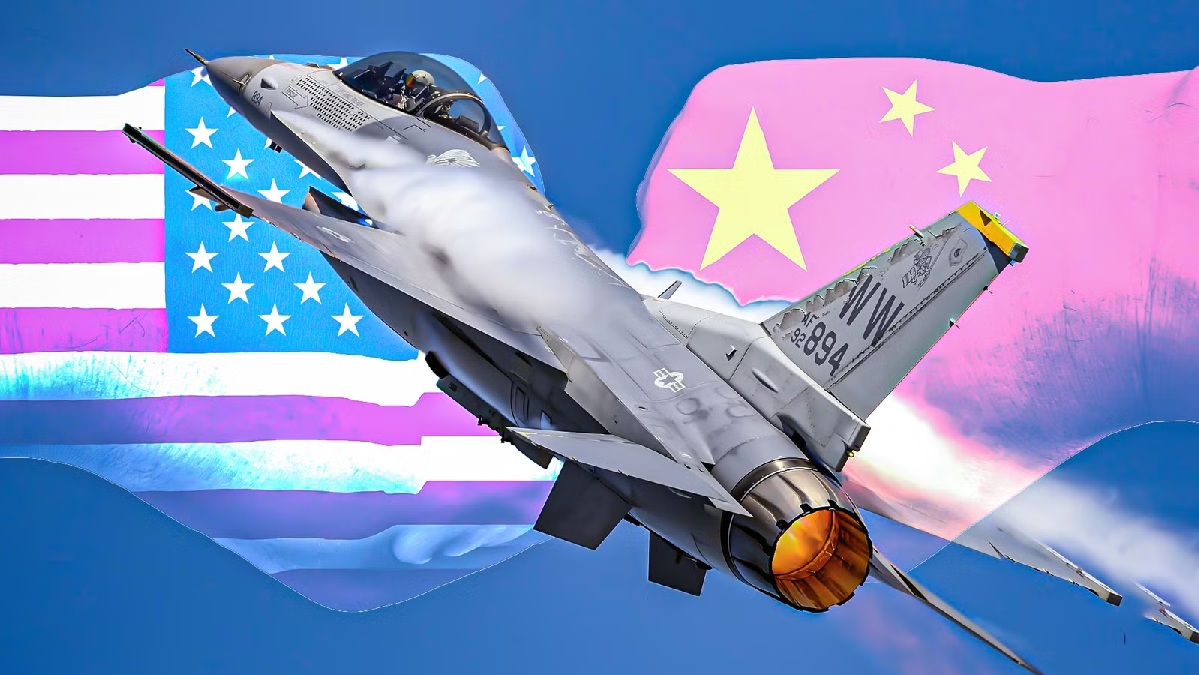
Taiwan or Western Pacific crisis
In a Taiwan contingency, the US Air Force vs. Chinese Air Force 2025 balance would play out across three axes:
- Capacity: China could surge more fighters close to the fight, with shorter transit and turnaround.
- Capability: Both sides would deploy advanced stealth and “4.5-gen” platforms, but China’s production tempo might offset some US qualitative advantages.
- Readiness: Pilot training levels and sortie generation rates could tilt actual combat effectiveness, especially as a campaign drags on.
US forces would still bring powerful assets: global ISR, bombers, stand-off weapons, and allied support from Japan, Australia, and others. However, they would enter the fight without the overwhelming, theater-level dominance that many planners once assumed.
Defense News Today has already explored US and allied airpower options over the Taiwan Strait. Those pieces explain how basing, logistics, and munitions stockpiles shape real combat readiness.
United States must decide now
The speaker closes with a blunt message: “Our ability to fight tonight and the future of our capability begins today. It doesn’t begin in seven years.” His warning underlines several urgent choices:
- Will the United States continue to divest legacy fighters faster than it fields replacements?
- Can the Air Force restore pilot training hours to Cold War standards, or at least halt further decline?
- Will Congress fund the munitions, tankers, and hardened bases needed to support sustained operations in the Western Pacific?
For defense professionals, the US Air Force vs Chinese Air Force 2025 debate should not become a simplistic scoreboard. Instead, it should drive sober assessments of force design, pilot pipelines, industrial capacity, and alliance integration.
If Washington treats these trends as a call to action rather than a doom narrative, it can still correct course. If not, China’s quiet accumulation of capacity, capability, and readiness may become the decisive story of Pacific airpower in the next decade.
References
- https://www.defensenewstoday.info/china-air-force-j20-stealth-analysis
- https://www.defensenewstoday.info/us-china-airpower-taiwan-scenario
- https://www.rand.org/pubs/research_reports/RR3927.html
- https://media.defense.gov/2024/China-Military-Power-Report
About the Author