

MQ-9B HALE
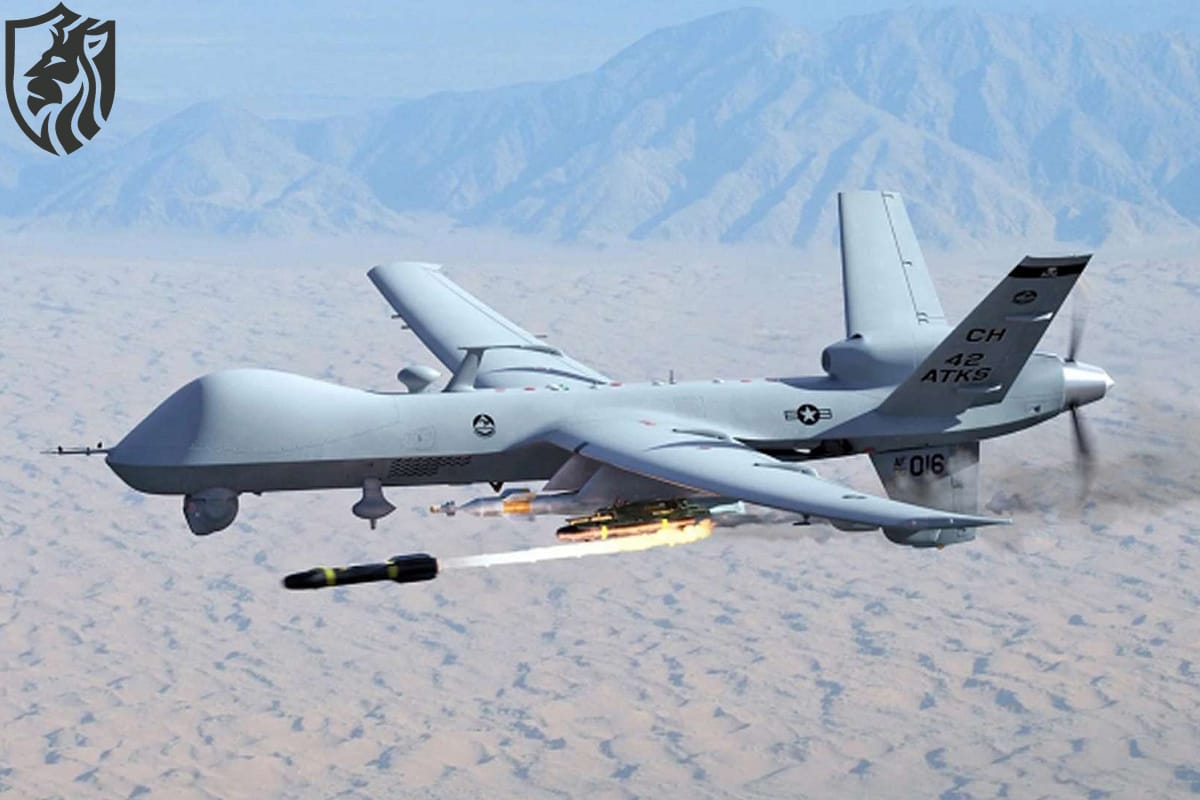
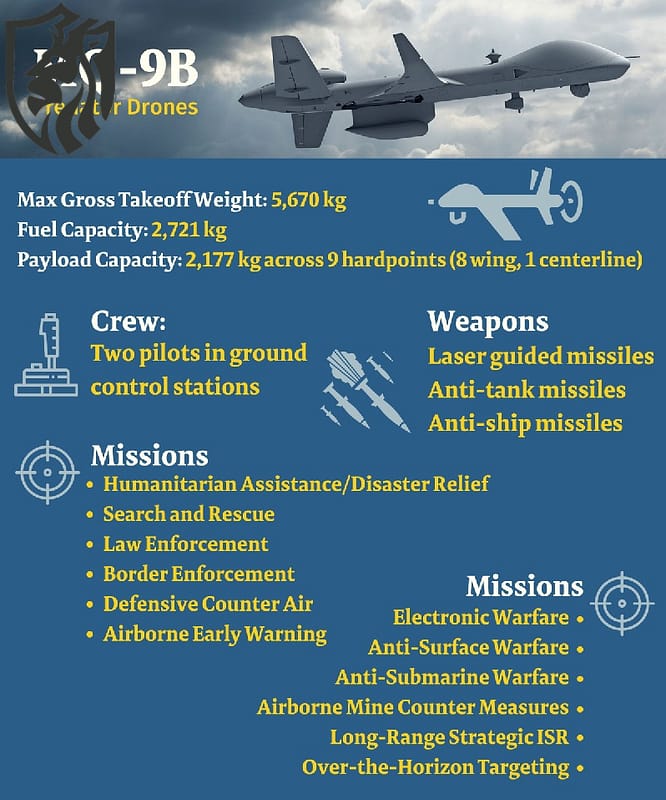
The United States and Qatar have signed a nearly $2 billion deal for eight MQ-9B SkyGuardian drones. This marks the first Middle Eastern purchase of the advanced unmanned aerial vehicle from General Atomics.
The White House announced the agreement on 14 May 2025 after months of negotiation. The deal includes precision-guided ammunition, advanced sensors, and essential support equipment.
It aims to boost Qatar’s military technology and reaffirm its role as a key American ally. The agreement comes amid shifting dynamics in the Persian Gulf region.
Observers question the long-term impact on regional security and balance of power. The $1.96 billion contract will equip Qatar with MQ-9B SkyGuardian unmanned air systems.
These drones provide precision strike, intelligence, surveillance, and reconnaissance capabilities. The package includes 200 KMU-572 guidance kits for Joint Direct Attack Munitions.
It also includes 300 BLU-111 bombs, each weighing 500 pounds. There are 100 MXU-650 air foil groups for GBU-12 Paveway II laser-guided bombs.
The sale also features 110 AGM-114R2 Hellfire II missiles for precision strikes. Additional systems include 10 AN/APY-8 Lynx radars with synthetic aperture technology.
L3Harris Rio Grande
Qatar will also receive L3Harris Rio Grande communications intelligence sensor suites. Large ground support equipment will ensure operational readiness.
General Atomics will serve as the primary contractor for the program. RTX and Lockheed Martin will assist with delivery and integration.
The U.S. State Department says the sale will strengthen Qatar’s ability to counter emerging threats. It will provide timely intelligence and a credible strike capability as a regional deterrent.
Qatar first showed interest in the MQ-9B drones in 2020. The sale was delayed due to U.S. export controls and regional political sensitivities.
The March 2025 State Department endorsement and subsequent signature are a reassertion of a commitment to solidifying relations with Qatar, which is home to the Al Udeid Air Base, a key base for United States military operations in the Middle East.
The White House again stated that the deal speeds up Qatar’s defense spending in the U.S.-Qatar defense partnership, supporting the American industrial base and regional deterrence.
The phrase was repeated in X posts, where users commented on the significance of the deal to the two countries’ strategic interests.
MQ-9B SkyGuardian
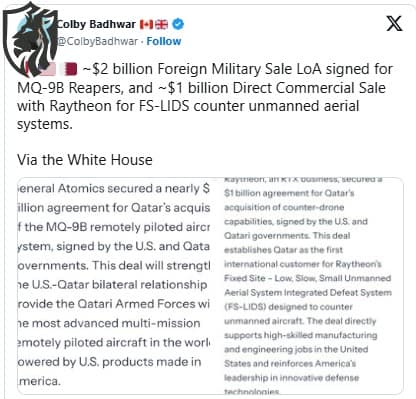
The MQ-9B SkyGuardian, a next-generation evolution of the MQ-9A Reaper, is a leap in unmanned air technology. With a 79-foot wingspan and a 950-shaft-horsepower turboprop, the drone flies for over 30 hours at altitudes above 40,000 feet.
The open architecture of the system is able to support advanced sensor payloads, making the system versatile for kinetic and intelligence-gathering missions.
The Lynx AN/APY-8 radar provides high-resolution imagery, and the L3Harris Rio Grande suite offers communications intelligence collection.
The NATO STANAG 4671 qualification of the platform ensures its use in civilian airspace, differentiating it from its predecessors.
The MQ-9B is also armed with weapons like Hellfire missiles and JDAM-guided bombs, which allow it to attack land as well as sea targets with precision.
The MQ-9B stands out from its regional peers due to its extended endurance and payload. For instance, the United Arab Emirates-operated Wing Loong II from China has similar ISR capability, but it lacks the NATO system compatibility and extended flight time of the MQ-9B.
Turkey’s Bayraktar TB2, which several Gulf nations operate, is less powerful and smaller in dangerous situations. The MQ-9B’s price—approximately $245 million per unit, support and ordnance included—reflects its superior capabilities, although it is significantly more than its competitors.
The expense has raised questions regarding the congruence of Qatar’s investment with the operational requirements, especially in the aftermath of the platform’s susceptibility to contemporary air defense systems.
Wars in Iraq, Afghanistan, and Yemen
US operations have historically extensively used the MQ-9 series. Since its induction in 2007, the MQ-9A Reaper has been continuously utilized in wars in Iraq, Afghanistan, and Yemen, having recorded more than 2.5 million flight hours by 2020.
Counterterrorism operations have relied heavily on the drones, which gather real-time intelligence and execute precise strikes.
Adversity, however, has marred their history. In 2019, an American MQ-9 was downed by Houthi rebels in Yemen with a surface-to-air missile, and the system was found to be vulnerable to advanced air defense systems.
The MQ-9B improves on these problems by adding advanced safety features, like a system that helps it avoid obstacles, but there are still worries about how it will perform in enemy areas.
Qatar’s acquisition of the MQ-9B fits in the complex geopolitical context. The Persian Gulf has been witnessing tensions, mostly sparked by the Persian Gulf states’ competition and Iranian naval presence within the Strait of Hormuz. Qatar navigates a delicate relationship with both Iran and America.
Qatar will significantly enhance its ability to monitor vital maritime routes using drones, which support its liquefied natural gas exports.
The SeaGuardian, a prospective maritime derivative of the MQ-9B, would potentially include features like the Seaspray 7500 radar intended for surface surveillance, thus furthering Qatar’s knowledge of its maritime domain.
These capabilities are essential in an environment where ever-present danger from Iran’s small submarine and fast-attack craft force is present.
Trump Administration
The transaction also serves wider U.S. strategic interests. The Trump administration negotiated the agreement, emphasizing arms sales to Gulf allies as a strategy to counter Iran’s influence.
The White House press release emphasized the transaction’s contribution to the building of regional deterrence, a point also made by General Atomics executives at the IDEX 2025 defense exhibition.
General Atomics Aeronautical Systems President Dave Alexander declared 2025 a critical year for expanding the company’s presence in the Gulf, as it negotiates identical deals with Saudi Arabia and the UAE.
The talks are a measured U.S. move to keep its advantage in the regional arms race, where China and Turkey are gaining ground with lower-priced options.
Qatar’s military modernization program helps place the acquisition in context. The Qatari military has an inventory of advanced aircraft to begin with, such as the Eurofighter Typhoons, Dassault Rafales, and Boeing F-15QAs.
The MQ-9B complements this inventory by providing persistent surveillance and strike capabilities not available on piloted aircraft.
However, integrating drones into Qatar’s operations will mean significant investments in training and infrastructure. The country’s relatively small military, consisting of about 12,000 personnel, may not be able to expand sufficiently to support a sophisticated unmanned system.
United States committed
The United States committed to providing technical support; however, the program’s success will be contingent on Qatar’s ability to create a robust operational structure.
The MQ-9B’s mission in Qatar’s inventory will be ISR missions with secondary uses in counterterrorism and maritime security. The drones might assist coalition operations from Al Udeid, where allied and U.S. forces plan regional operations.
The MQ-9B’s long endurance makes it ideal for reconnaissance in remote areas. Such areas often harbor terrorist groups like Al-Qaeda or ISIS affiliates.
In naval missions, the drones can track smuggling and piracy in the Gulf. They can also help monitor other illegal maritime activities.
The platform’s flexibility allows it to act as a communications relay. This enhances coordination between Qatar’s air, naval, and ground forces.
Globally, the MQ-9B is part of a growing class of medium-altitude, long-endurance drones. India ordered 31 MQ-9Bs in a $3.4 billion deal in October 2024.
The United Kingdom operates the Protector RG Mk1, its own MQ-9B variant. Both nations value the platform for its versatility and reliability.
India’s deal includes a domestic assembly of 21 units to strengthen its defense sector. Qatar could follow a similar path to boost local defense capabilities.
General Atomics’ Sparrowhawk
The MQ-9B can integrate with mini-drones like General Atomics’ Sparrowhawk. This pairing shows its role in advancing network-centric warfare. This feature enables the drone to use mini-drones on risky missions, minimizing exposure to damage.
The fast-paced technology environment challenges the MQ-9B, despite its advantages. Low-cost autonomous swarm drones, which are harder to detect, can supersede the long-term utility of the platform.
China’s advancements in counter-drone technologies, including electronic warfare jamming systems, are another challenge.
In a 2023 encounter, a Chinese ship allegedly jammed the communications of a U.S. drone in the South China Sea, and there is no question that effective countermeasures are needed.
General Atomics has spent money on upgrades such as low-Earth orbit satellite connectivity to make the MQ-9B more survivable, but it adds to its already hefty price tag.
The timing of this transaction is significant. The acquisition by Qatar follows years of delays that angered Qatari officials, as reported by Army Recognition. The conservative arms export policy of the Biden administration, along with concerns about technology transfer, has slowed progress.
The return of the Trump administration in 2025 appeared to have accelerated the process, as well as its entire defense sales agenda. According to Breaking Defense, Trump himself signed the deal to facilitate sales to Gulf allies.
Letter of Offer
In addition, this transfer has also benefitted other regional actors, as the UAE is excited to receive a Letter of Offer and Acceptance for 18 MQ-9Bs by the end of 2025.
For America, the accord solidifies its industrial base and strengthens its position of authority in the Gulf. San Diego-based General Atomics has numerous employees and possesses a supply base that benefits from such agreements.
The deal also accounts for expanding Chinese and Turkish unmanned aerial vehicle activity in the area. For instance, the United Arab Emirates has deployed numerous Wing Loong IIs in hotspots such as Yemen and Libya.
By providing Qatar with MQ-9Bs, the United States ensures interoperability with its military and that of NATO allies, thus ensuring a technological edge. Qatar’s purchase of the MQ-9B SkyGuardian is a major milestone in its defense modernization and its alignment with US strategic interests.
The unmanned aerial vehicles will upgrade Qatar’s capability to defend its borders, patrol strategic sea lines, and contribute to regional stability. But the cost and logistical challenges have questioned the long-term impact of the deal.
Conclusion
With the Gulf States mired in a Byzantine web of alliances and enmities, the MQ-9B’s introduction will test Qatar’s capacity to employ state-of-the-art technology in a risky environment.
Will Doha’s investments bear fruit in the form of a greater regional presence, or will they be largely a symbol of its continually deepening relationship with Washington? The answer to this question could well determine the balance of power in the Persian Gulf for the near future.
References
- Breaking Defense—US Approves $2B Drone Sale to Qatar
https://bit.ly/3KBE1Ag - Army Recognition – MQ-9B SkyGuardian Data Sheet
https://bit.ly/3Qpa0iK - General Atomics – MQ-9B SkyGuardian Overview
https://bit.ly/4cWMFJz - DSCA – State Dept. Approves MQ-9B Sale to Qatar
https://bit.ly/45pRsmO - CSIS – US Arms Sales to the Gulf: Intent and Risks
https://bit.ly/4byP4lv - Naval News—How MQ-9B Enhances Maritime Security
https://bit.ly/3WsFGFS - Defense News Today—India Buys 31 MQ-9B Drones
https://bit.ly/3Qm7nOl - SCMP—China’s Counter-Drone Capabilities Rising
https://bit.ly/4cdljOl - The National Interest—Al Udeid Air Base’s Strategic Importance
https://bit.ly/4cZp4Rz
About the Author