

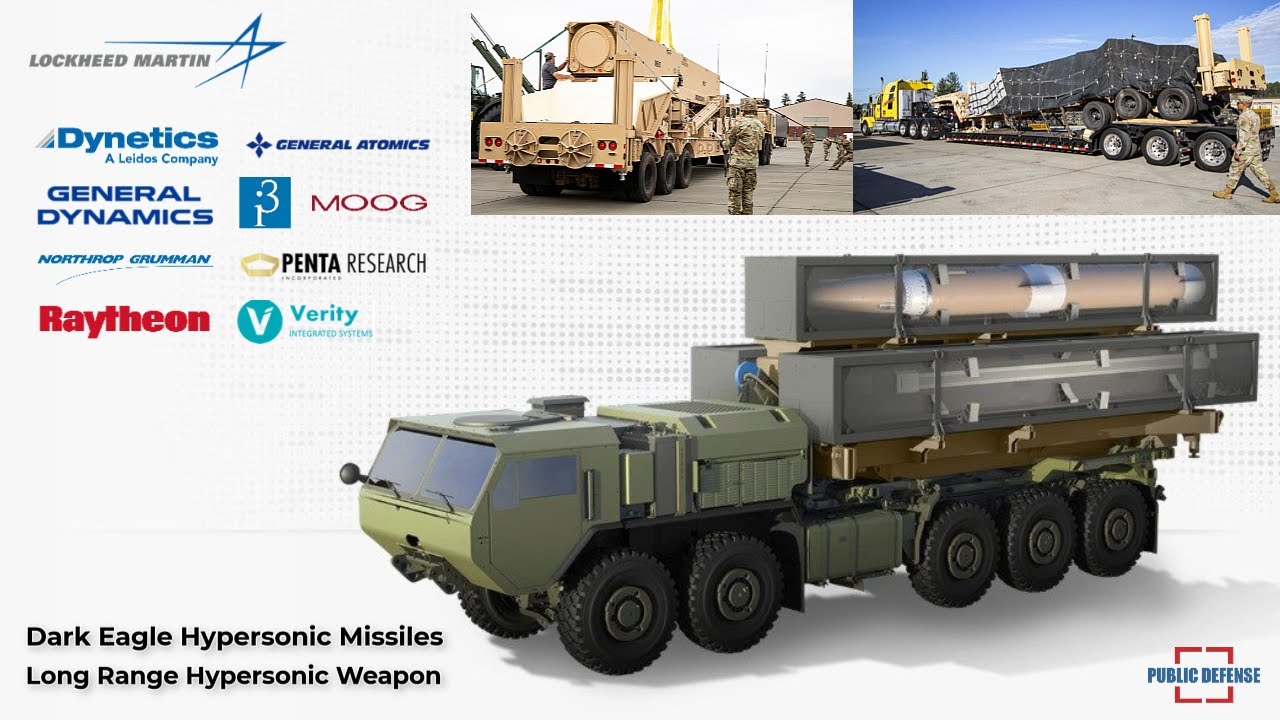
Dark Eagle Launcher
he U.S. Army stands at a strategic turning point with the upcoming deployment of the Long-Range Hypersonic Weapon (LRHW). Also called Dark Eagle, the advanced system is expected to be operational by the end of fiscal year 2025. This weapon represents a major leap forward in military technology and global strike capability.
Although there is excitement, the LRHW has suffered delays due to technical problems during demanding testing phases. With a range of 1,725 miles, Dark Eagle promises unmatched speed, precision, and flexibility for the U.S. military.

Revealing the U.S. Army’s Dark Eagle Hypersonic Missile
At the center of the LRHW is a ground-fired missile with a hypersonic glide body. This sophisticated system, aided by a variety of transport, fire control, and operating equipment, is designed to deliver speeds well in excess of 3,800 miles per hour.
The velocity the system permits the missile is such that it can reach the outer boundaries of the Earth’s atmosphere, making it theoretically unreachable by present-day air and missile defense capabilities. The main task of Dark Eagle is to counteract Anti-Access/Area Denial (A2/AD) tactics, debilitating enemy long-range capabilities and striking high-priority targets with limited warning.
The Collaborative Initiative Behind Dark Eagle
The U.S. Army and Navy spent a lot of time working in collaboration to bring the LRHW into being. One of the standout aspects of this system is the Common Hypersonic Glide Body (C-HGB), which, when combined with a 34.5-inch booster produced by the Navy, creates the Navy-Army All-Up Round plus Canister (AUR+C).
With this setup, deployment from multiple platforms, such as naval surface ships and submarines, becomes possible, boosting their operational capability. Top defense firms Lockheed Martin and Northrop Grumman have been key in designing the missile to meet the changing strategic needs of the U.S. military.
Mach 5 and Beyond: The Dark Eagle Speed Factor
The C-HGB is founded on a different reentry system developed with Sandia National Laboratories. Dynetics, a subsidiary of Leidos, is responsible for developing prototypes for the Army and Navy under a Department of Defense contract.
A booster rocket propels the glide body to hypersonic speeds before releasing it, enabling the missile to fly freely. This cutting-edge design allows Dark Eagle to fly at speeds over Mach 5, making it impossible for enemies to detect or intercept.
The LRHW system is organized into operational batteries, each consisting of four Transporter Erector Launchers (TELs) and two AUR+C missiles per launcher. A Battery Operations Center manages command and control operations, facilitating smooth integration and quick response times. Despite its promising potential, the development of Dark Eagle has encountered several challenges.
Dark Eagle Testing Hurdles and Deployment Delays
The Army initially planned for three flight tests prior to putting the first LRHW battery into service. However, several setbacks have caused delays. A booster flight test failed in October 2021, with a failed full missile test in June 2022. Further delays came in October 2022 when the Department of Defense cancelled a planned test to correct earlier technical concerns. Pre-flight discrepancies led to the cancellation of another attempt in March 2023.
The latest planned test in September 2023 did not occur, and the failure prompted the Army to admit that it would miss its target deployment schedule. In June 2024, the Government Accountability Office issued a report that identified integration issues as a key factor behind the delay in the initial deployment and full operational capability of the system. These technical difficulties have moved the deployment timeline further, reflecting on the intricacies involved in the development of such a sophisticated weapon system.
The Future of Hypersonic Warfare
| Event | Date | Outcome |
|---|---|---|
| Failed Booster Flight | October 2021 | Unsuccessful |
| Full Missile Test | June 2022 | Unsuccessful |
| Postponed Test | October 2022 | Delayed |
| Pre-flight Discrepancies | March 2023 | Scrubbed |
| Missed Deployment Target | September 2023 | Not Achieved |
In spite of the delays, LRHW is a revolutionary step for U.S. military capability. When fully deployed, Dark Eagle promises to considerably improve strategic deterrence and power projection. Its speed, reach, and accuracy have the potential to reshape future warfare by evading conventional missile defense systems and providing overwhelming impacts in hostile theaters.
While the Army labors to overcome engineering challenges and advance this new-gen weapon, however, questions also linger regarding its ultimate deployment: how will its use change global security dynamics? Will enemies create countermoves designed to nullify this powerful system?
How will its introduction play out in exacerbating geopolitical tension and military thought globally? At least one fact is certain, though: Dark Eagle is primed to rewrite the rules on the battlefield and solidify America’s leadership as the world leader in hypersonic weapons technology.
References
- U.S. Army Official Website – www.army.mil
- Lockheed Martin—www.lockheedmartin.com
- Northrop Grumman—www.northropgrumman.com
- Sandia National Laboratories – www.sandia.gov
- Government Accountability Office (GAO) Report – www.gao.gov
- Defense News—www.defensenews.com
- U.S. Department of Defense—www.defense.gov
About the Author