
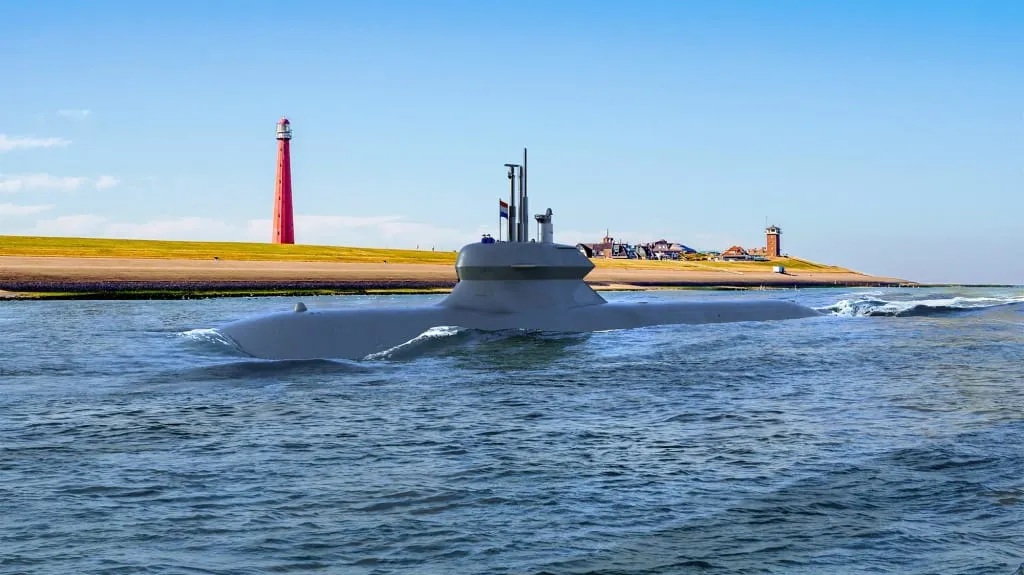
Swedish A26 Blekinge Submarine
Sweden is betting big on the A26 Blekinge-class submarine—a next-generation diesel-electric boat built for the Baltic’s harsh realities. It promises the sort of stealth, endurance, and multi-mission flexibility that NATO planners love, especially now that Sweden sits inside the alliance’s northern defensive arc.
However, one issue keeps dominating every serious discussion about the program: time. In other words, Sweden may field one of the most capable non-nuclear submarines on the market, yet the schedule has stretched so far that the “gap” has become a capability of its own.
Why NATO Wants Sweden’s A26
The Baltic has always punished predictable forces. It is shallow, cluttered, and noisy, which makes it perfect terrain for submarines that can hide, listen, and strike. Therefore, Sweden’s undersea fleet matters far beyond Stockholm’s coastline. Moreover, Sweden’s A19 Gotland-class boats already proved how dangerous a quiet conventional submarine can be.
A Gotland-class submarine famously achieved a strong “kill position” during US Navy exercises in 2005, setting a lasting precedent for anti-submarine warfare training. Sweden intends to run the A26 Blekinge-class submarine alongside three upgraded Gotland-class AIP boats, with common combat systems and sensors across the force. That shared architecture should simplify training and maintenance while improving fleet-wide data fusion.
What Makes A26 a “Fifth-Gen” Submarine
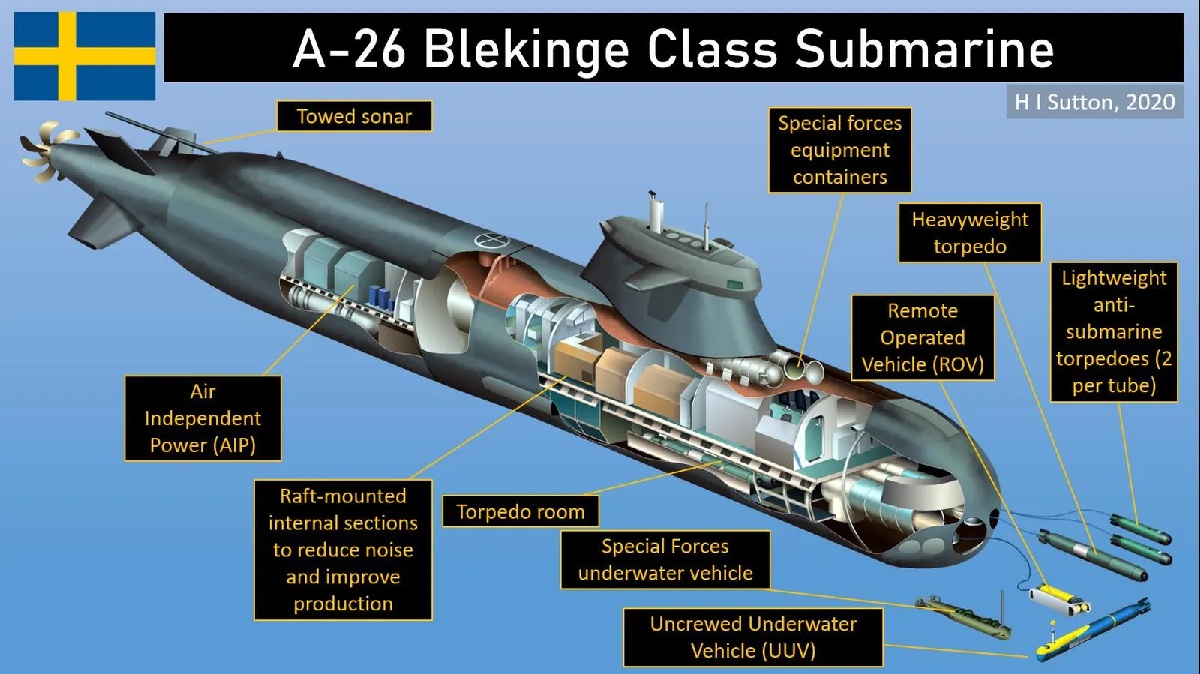
Saab markets the A26 concept as a “system of systems” rather than a single hull. The design integrates special forces, uncrewed systems, and seabed tasks into the mission model, rather than treating them as add-ons.
Baltic Stealth: Ultra-Low Detectability
Stealth continues to be the key to entry. The A26 is designed to be exceptionally difficult to detect, which is the decisive trait in confined waters. Therefore, even modest numbers can create outsized deterrence. At the same time, Sweden wants more endurance than earlier boats, plus better onboard processing for modern intelligence, surveillance, and reconnaissance (ISR). That combination supports NATO-style multi-domain operations, where undersea sensors feed the wider picture quickly.
Multi-Mission Portal: Key Capability
The A26 Blekinge-class submarine also brings a distinctive feature that fits today’s contested operations: a large forward “portal” intended for special forces combat divers and uncrewed underwater vehicles (UUVs). Saab specifically highlights the Multi-Mission Portal as a path to launch and recover divers and compatible underwater vehicles, which broadens the mission set without needing a separate mothership.
Seabed Warfare and Undersea Infrastructure
The Baltic region now treats seabed infrastructure—cables, pipelines, sensors, and unmanned nodes—as operational terrain. Consequently, a boat that can interact with the seabed and deploy UUVs gains a real advantage in shallow-water “seabed warfare” tasks. In practical terms, that means covert ISR, reconnaissance of critical infrastructure routes, and support to special operations in a dense maritime battlespace.
Big Problem: Delays and Cost Growth
Capability is not the dispute. The program’s core issue is that Sweden needs these hulls sooner than the shipyard can deliver them.
Original Plan and Export Assumption
Sweden initially planned (around 2010) to replace two aging Södermanland-class submarines with A26 boats by 2018 and 2019. The formal order for two new submarines followed in 2015. A program cost was cited as 8.4 billion kronor, later described as 11.2 billion kronor inflation-adjusted (about €1 billion), and deliveries were once aimed at 2022–2024. However, the early budget proved too optimistic. It leaned heavily on securing an export customer by June 2019 to share costs. That partner did not materialize, so Sweden carried the full bill.
Keeping the Fleet Ready While Waiting
Because the A26 timeline slipped, Sweden had to manage risk in the existing force. One Södermanland-class boat was mothballed in 2021, while the other entered deep maintenance and upgrades to keep it viable through 2028, which would mark roughly 40 years of service. This sort of life-extension work buys time. Yet it also drains focus and funds, especially when you need industrial momentum for a new class.
Saab–FMV Contract Reset
As costs rose and schedules slipped, Saab and Sweden’s Defence Materiel Administration (FMV) renegotiated. In October 2025, Saab announced an additional order worth about SEK 9.6 billion, with most deliveries in the 2026–2032 period. That same October 2025 update also pushed delivery deeper into the next decade and lifted the total contract value to around SEK 25 billion, according to FMV.
On delivery dates, reporting varies in public sources. The FMV’s published update cites deliveries in 2031 and 2033, while some defense reporting and commentary frames the second hull as slipping as far as 2035. Either way, the operational takeaway is the same: the A26 arrives in the early-to-mid 2030s, not the 2020s.
Karlskrona Yard Reality
Some analysts also point to the challenges of restarting “new class” submarine production after a long gap. The Kockums yard’s last brand-new submarine deliveries were in the mid-1990s with the Gotland class, which makes A26 a demanding industrial reboot. Therefore, even with money in place, output depends on workforce depth, supply chain resilience, and stable program management.
A26 Blekinge vs Gotland Class
| Category | A26 Blekinge-class (Type A26) | Gotland-class (A19) |
|---|---|---|
| Status/timeline | Under construction; latest public schedule points to first delivery 2031 and revised programme cost around SEK 25bn | In service since 1996–present; upgraded/modernised boats active |
| Builder/yard | Saab Kockums, Karlskrona | Kockums (now Saab Kockums) |
| Primary mission fit | Designed for Baltic littoral operations, ISR, seabed tasks, special operations, and UUV support | Baltic-optimised conventional submarine; strong stealth reputation and ASW/ASuW focus |
| Length | 66 m (reported) | 60.4 m (original) / ~62–62.7 m after upgrades (reported) |
| Beam | 6.75 m (reported) | 6.2 m |
| Draught | 6.0 m (reported) | 5.6 m |
| Displacement (surfaced / submerged) | Reported around ~1,925 t surfaced / ~2,100 t submerged (open sources vary) | 1,494 t surfaced / 1,599 t submerged |
| Propulsion/AIP | Diesel-electric with Stirling AIP; reported three Stirling engines enabling weeks submerged | Diesel-electric with Stirling AIP |
| Speed (surfaced / submerged) | Open sources often cite max ~20 kn and ~6 kn on AIP (figures vary) | ~11 kn surfaced / ~20 kn submerged (batteries) / ~5 kn on AIP |
| Endurance | Reported to remain submerged for weeks using AIP (mission/profile dependent) | Often reported more than 14 days submerged without snorkelling (AIP and profile dependent) |
| Crew | 17–26 (reported), with higher max when carrying special forces in some sources | Commonly reported around ~24–32 max depending on fit |
| Armament (typical) | Reported 4×533 mm + 2×400 mm torpedo tubes, plus mines (fit dependent) | 4×533 mm + 2×400 mm torpedo tubes; also externally mounted mines (reported) |
| Special forces & UUV interface | Signature feature: bow Multi-Mission Portal; reported ~1.5 m dive-lock for divers and UUVs | Can support special forces and mission payloads, but without an A26-style portal-centric design |
| Seabed warfare/infrastructure | Strong emphasis on seabed interaction, UUV operations, and undersea infrastructure tasks | Strong littoral operations capability; seabed focus depends more on payloads and mission fit |
| Sensors/combat system | Public detail varies; modern sonar arrays and optronic mast concepts are widely reported | Integrated sonar suite reported; configuration varies by upgrade package |
| Baltic/NATO value | Potential high-end conventional asset—if delivered on revised schedule | Proven, available deterrence and training asset in Baltic operations |
NATO Membership Shifts Sweden’s Naval Mission
Sweden joined NATO on 7 March 2024, ending its long tradition of non-alignment. That political shift also changes how Sweden frames naval power. Instead of focusing only on national coastal defenses, Sweden now helps protect the alliance’s northeastern flank. Consequently, Swedish submarines support deterrence and surveillance across a wider theater, especially as NATO integrates Nordic and Baltic planning more tightly.
Moreover, allied undersea forces already enjoy numerical advantages in the region. The A26 concept fits this posture perfectly—because it adds stealthy ISR, special operations delivery, and seabed interaction that matter in the Baltic’s shallow “littoral” geometry.
Bottom Line: Best-in-Class, Arriving Late
The A26 Blekinge-class submarine fits what NATO wants for the Baltic. It stays quiet, supports many missions, and works well with UUVs and special forces. However, the program faces a clear strategic risk. A true game changer arriving in the 2030s enters a faster, harsher threat environment. Meanwhile, UUV concepts keep evolving at speed. Undersea infrastructure competition also grows more intense each year. Therefore, Sweden’s success depends less on marketing and more on delivery discipline at Karlskrona.
References
- https://www.saab.com/products/5th-generation-submarine
- https://www.saab.com/newsroom/press-releases/2025/saab-receives-additional-order-relating-to-the-swedish-a26-submarines
- https://www.nato.int/en/news-and-events/articles/news/2024/03/07/sweden-officially-joins-nato
- https://www.fmv.se/aktuellt–press/aktuella-handelser/fmv-tecknar-uppdaterat-kontrakt-for-ubat-typ-a26/
- https://defensenewstoday.info/spain-unveils-a-submarine-with-unmatched-underwater-capabilities/
About the Author