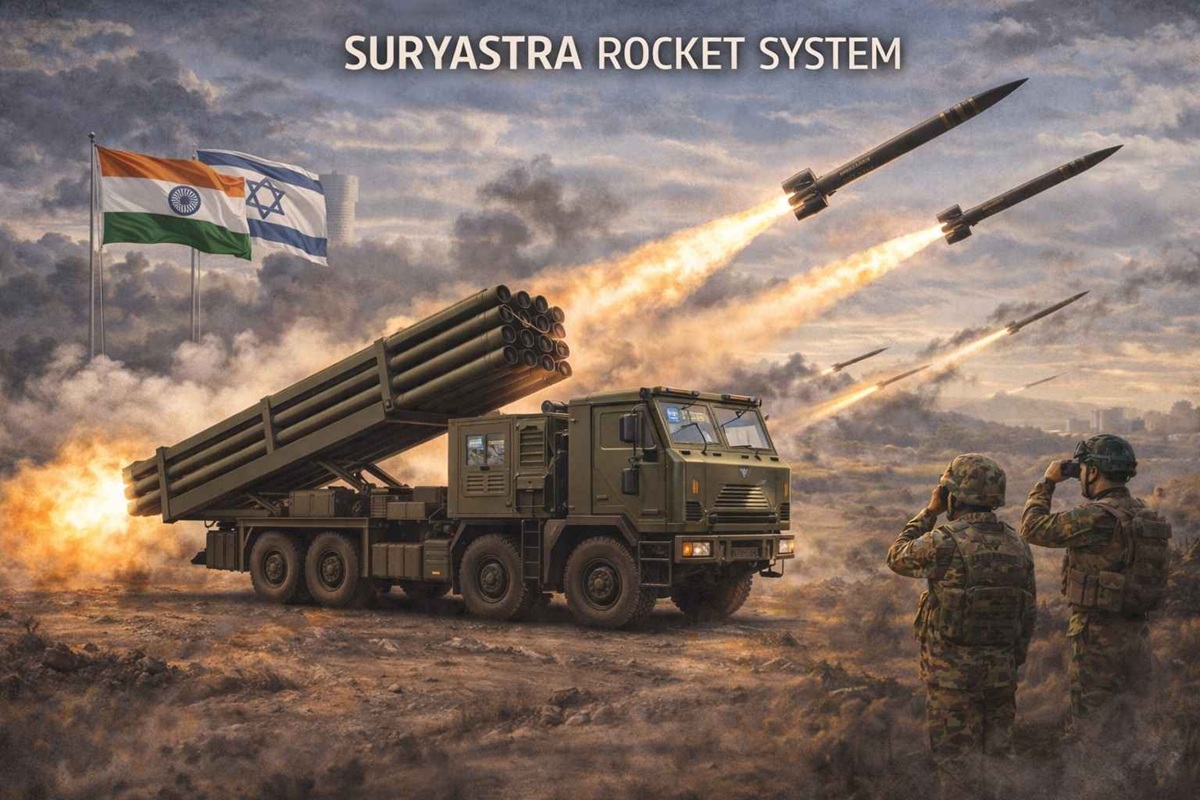
Suryastra Rocket System — India’s Multi-Caliber Fires
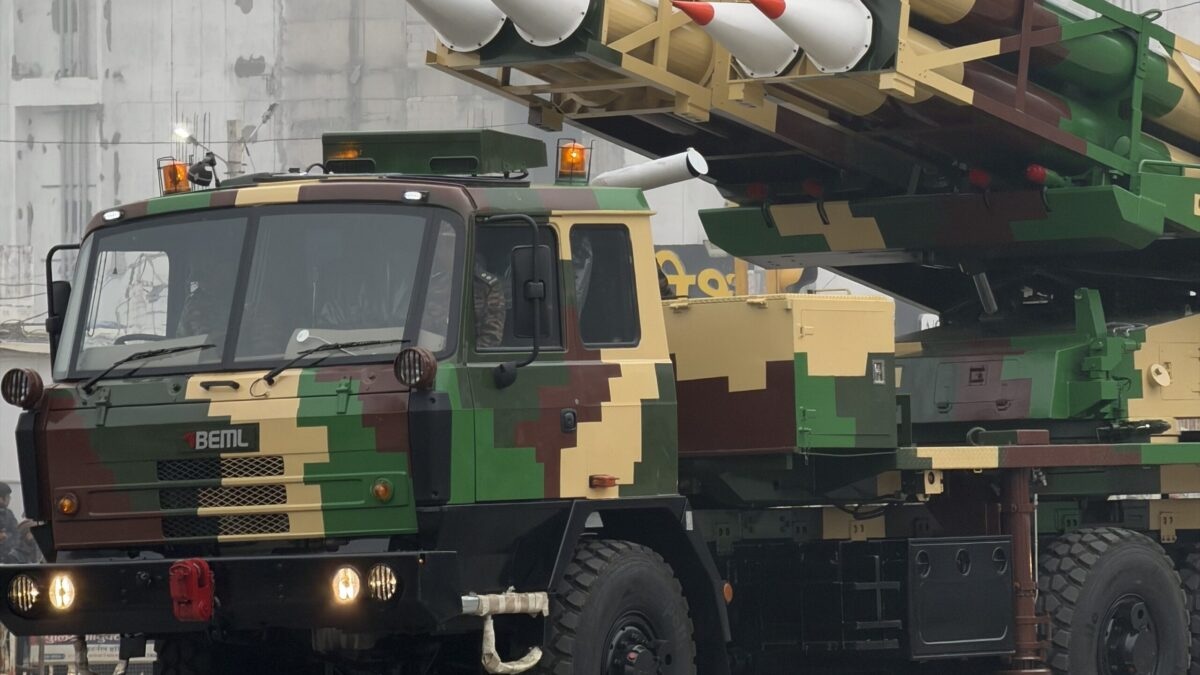
India has unveiled a new long-range rocket artillery capability. During Army Day parade rehearsals in Jaipur, the Army publicly displayed a wheeled launcher carrying mixed-caliber munitions—an uncommon sight in conventional rocket regiments. That first public showing matters because it signals India’s intent to field a more flexible, precision-focused deep-fire toolset.
The Suryastra rocket system appears designed to bridge two needs at once. It offers medium-range precision fires for tactical shaping while also enabling deeper strikes against higher-value targets. Moreover, the launcher’s loadout suggests a “one vehicle, multiple effects” approach that can reduce logistics friction in fast-moving operations.
Jaipur Debut
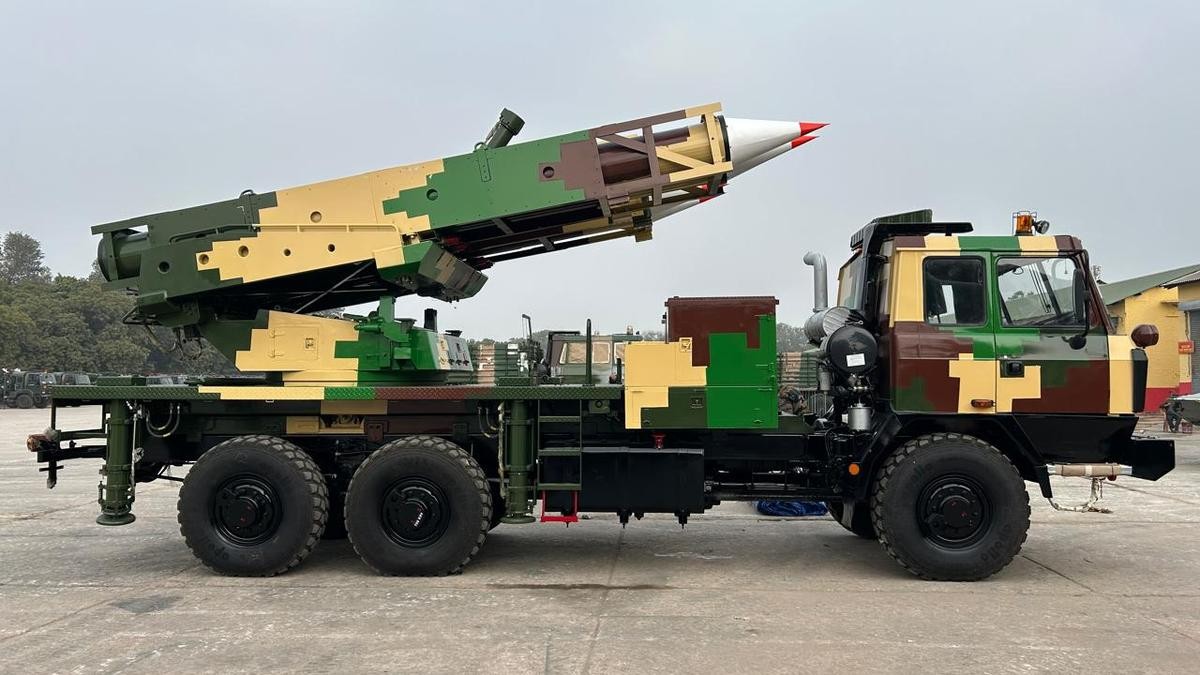
Footage from the rehearsal displayed a launcher configured with two 370 mm Predator Hawk missiles and four 306 mm guided rockets on the same vehicle. In practical terms, that mix indicates a platform built to switch between deep-strike and extended-range precision fire without changing the base launcher.
The demonstrated ranges reinforce that intent. Predator Hawk munitions are typically associated with a range of up to 300 km, while the 306-mm guided rockets are comparable to the EXTRA family, which is commonly listed at a range of up to 150 km. Therefore, the same battery could service targets across a wide depth band with a single launcher type.
Universal Launcher, Not Single-Rocket MLRS
Traditional multiple launch rocket systems often lock units into one rocket class per launcher. In contrast, this system follows the “universal” launcher concept: standardized pods, selectable munitions, and mission-driven loadouts. That approach mirrors the operational logic behind Israel’s PULS design, which supports multiple calibers and pod configurations.
This aspect matters for planners because it changes how rocket artillery gets tasked. Instead of assigning separate launchers for separate ranges, commanders can tailor pods to the mission. Moreover, mixed loads can complicate an adversary’s counter-battery planning, because the same launcher can generate different threat rings over time.
370 mm and 306 mm Munition Options
The 370 mm Predator Hawk is widely described as a precision strike rocket/missile with a 50–300 km stated reach, depending on configuration and mission profile. It is also commonly marketed as effective “regardless of weather conditions,” which supports round-the-clock deep fires when ISR can cue targets.
Meanwhile, the 306 mm EXTRA guided rocket is typically presented as a high-precision rocket with a 30–150 km range. That bracket fits the “extended-range” role: striking logistics nodes, assembly areas, air-defense elements, and fortified positions beyond standard tube artillery reach.
Put simply, the loadout India displayed suggests two deliberate strike bands: 150 km for persistent shaping and 300 km for deeper, higher-value targets. However, the real advantage lies in the ability to reconfigure quickly between those bands.
NIBE–Israel Industrial Partnership
The public reveal followed a signed procurement deal. Reporting indicates the Indian Army and NIBE Limited concluded a ₹293 crore contract for the supply of the system, with collaboration involving Israeli partners linked to the PULS technology base. One report also described that figure as “about $69 million.”
Separately, Indian reporting says NIBE partnered with Elbit Systems under emergency procurement powers for the same ₹293 crore acquisition. It also notes a technology collaboration agreement signed in July 2025 to support domestic production. Therefore, the program sits squarely inside India’s broader push to localize advanced strike capabilities.
Rocket Rivalry Pushed India to Move Faster
Pakistan’s Fatah-1 and Fatah-2 rockets underlined how quickly precision rockets are reshaping South Asian firepower. India did not need to be “impressed” to take note. Instead, the message was straightforward: guided rockets can reach headquarters, supply nodes, and air-defense sites before units can disperse.
As a result, India sharpened its own deep-strike plans to protect deterrence and limit exposure. Upgraded Pinaka variants and newer multi-caliber launcher concepts help widen range choices and improve accuracy. Moreover, local production reduces delays, builds stockpiles, and gives commanders more options during tense border flare-ups.
Pakistan’s Fatah-2 vs Indian Suryastra
| Attribute | Fatah-2 (Pakistan) | Suryastra rocket system (India) |
|---|---|---|
| Category | Guided rocket/surface-to-surface strike system | Universal multi-calibre rocket launcher system |
| Core idea | Longer-range precision fires from a dedicated munition family | One launcher can fire different calibres via modular pods |
| Launcher load (as commonly shown/reported) | Typically a twin-canister launcher (2 rounds ready) | As displayed in Jaipur: 2× 370 mm missiles + 4× 306 mm guided rockets |
| Calibre(s) | Not consistently published in open reporting | Multi-calibre; demonstrated with 370 mm and 306 mm pods |
| Reported max range | Commonly reported around ~290 km; some sources claim up to ~400 km | Up to ~300 km (370 mm class) and up to ~150 km (306 mm class) |
| Guidance (reported/typical) | Often described as INS with satellite-aided guidance | Munition-dependent; guided rockets/missiles for precision strike |
| Primary use-cases | Deep strikes on high-value targets (C2, logistics, infrastructure) | Medium-to-deep precision fires; adaptable loadouts for different missions |
| Industrial base | Pakistani defence industry programme | Indian supply led by NIBE with Israeli partner collaboration/technology lineage |
| Public status | Publicly showcased; reported as entering/being in service pathways | First public appearance during Army Day parade rehearsals; procurement underway |
| Key strength | Potentially longer reach as a single dedicated strike rocket | Flexibility: same launcher covers multiple range bands by swapping pods |
| Main trade-off | Less mix-and-match flexibility if optimised for one munition set | Deep reach depends on stocking 300 km-class munitions |
| What’s unclear publicly | Standard CEP, warhead variants, production volumes | Final Army scale, full pod compatibility list, munition inventory mix |
Likely Army Mission Roles
Indian officials and coverage describe the launcher as a precision surface-to-surface strike system. This description matches how modern rocket artillery is used: quickly locating, targeting, and hitting important targets, as well as carrying out longer-range missions against enemy forces when there is
In practical operational terms, the system supports:
- The system supports deep strikes against logistics hubs and staging areas within 150–300 km bands.
- Precision strikes against fortified positions where massed unguided rockets waste rounds.
- Counterforce options that pressure adversary air defenses, ISR nodes, or command posts.
If the system achieves consistent precision at range, it also strengthens deterrence by raising the cost of concentrating assets near the front. Moreover, mobility on a wheeled chassis improves survivability when counter-battery threats intensify.
Suryastra vs Pinaka: Roles
India already fields the Pinaka family, and the Army continues to modernize rocket artillery for better accuracy and survivability. The new launcher, as shown, would complement that force by pushing reach outward—especially in the 150–300 km bracket demonstrated in Jaipur.
That does not replace Pinaka’s role in all scenarios. Instead, it broadens the Army’s menu of effects: shorter-range saturation and guided fires on one side and longer-range precision strike options on the other. Therefore, the Army can allocate expensive long-range rounds to high-payoff targets while still keeping volume fires available when needed.
What comes next
Fieldable realities such as sustained accuracy, reload speed, pod compatibility, crew workload, and networked targeting integration will determine the success or failure of the Suryastra rocket system. If India can pair those fundamentals with local production scale, the launcher could become a key pillar of the Army’s deep-fires modernization—especially for rapid, precision strike missions across varied ranges.
References
- https://defence-blog.com/india-showcases-new-long-range-rocket-system/
- https://odishatv.in/national/indian-army-signs-rs-293-crore-deal-for-indigenous-long-range-rocket-launcher-suryastra-10970183
- https://www.elbitsystems.com/land/weapons-systems-and-munitions/missiles-rockets/predator-hawk
- https://www.elbitsystems.com/land/weapons-systems-and-munitions/missiles-rockets/extra
About the Author