

Sudan Army chief slams Quad truce proposal — bias row
Sudan Army chief slams Quad truce proposal
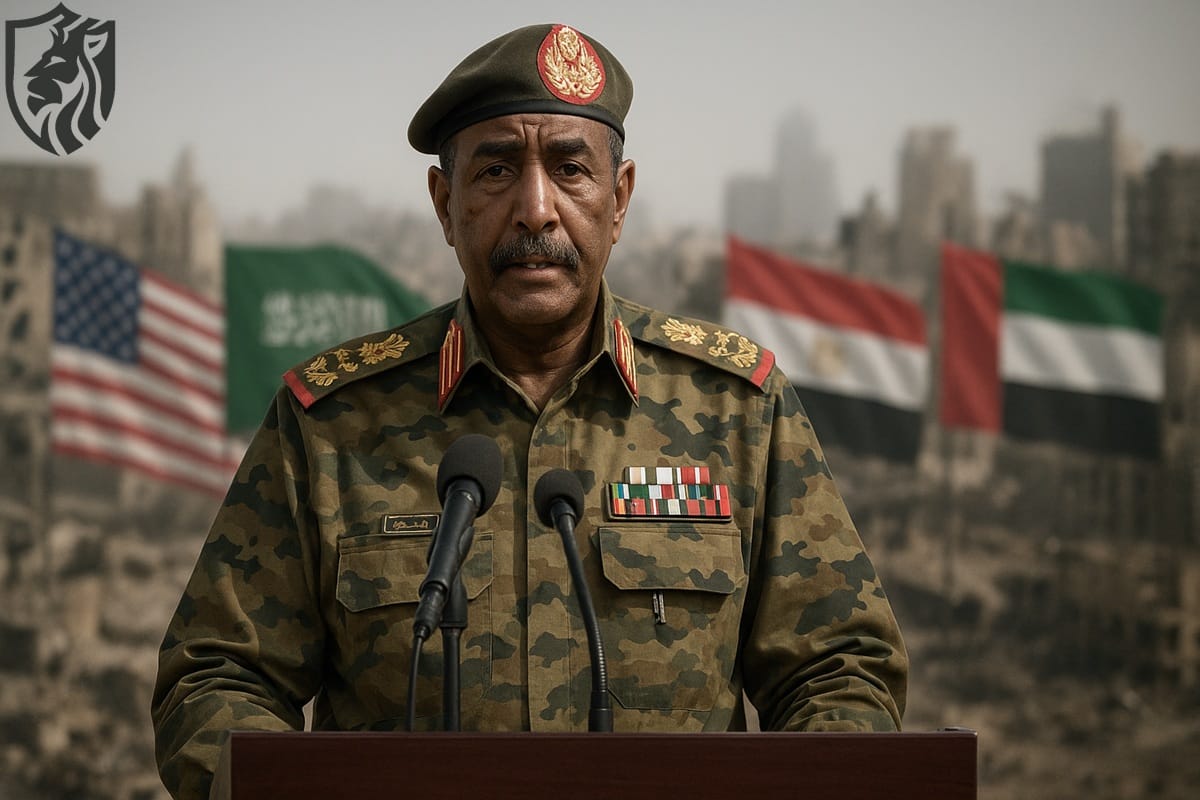
Sudan Army chief Abdel Fattah al-Burhan has rejected the latest ceasefire blueprint in unusually blunt terms. In his words, the Sudan Army chief slams the Quad truce proposal as the “worst yet” and unfit for any serious negotiation. Defence analysts interpret the statement as more than just rhetoric, indicating a strengthening of Khartoum’s stance against external pressure.
The proposal came from U.S. envoy Massad Boulos, representing the so-called Quad mediators. That format brings together the United States, Saudi Arabia, Egypt, and the United Arab Emirates. However, Burhan argues that the platform now suffers from a serious credibility problem.
A mediation format under fire
In his video address, the Sudan Army chief slams the terms of the Quad truce proposal as fundamentally skewed. He claims the text “eliminates the armed forces, dissolves security agencies, and keeps the militia where they are.” This framing presents the plan as a quiet surrender document rather than a balanced ceasefire.
For officers inside any professional military, the implication is clear. A deal that dismantles the state’s security architecture while freezing militia gains is politically suicidal. It is also, from Burhan’s perspective, operationally unacceptable for a force that still holds large parts of Sudan.
The UAE factor and claims of bias
Burhan’s harshest language targets Abu Dhabi’s role in the mediation. Once again, the Sudan Army chief slams Quad truce proposal dynamics by arguing that the process is “biased” as long as the UAE remains inside it. He accuses envoy Massad Boulos of simply echoing Emirati talking points.
Khartoum and multiple external observers have accused the UAE of backing the Rapid Support Forces (RSF) with arms and logistics. Abu Dhabi firmly denies these claims. Nevertheless, Burhan insists that “the entire world has witnessed the UAE’s support for rebels against the Sudanese state.”
From a military-political perspective, Burhan is simultaneously pursuing two objectives. First, he delegitimises the Quad’s neutrality. Second, he portrays the Sudan Armed Forces (SAF) as defending a sovereign state against externally enabled militias. For a wider look at Gulf security activism in Africa, readers can explore Defence News Today’s coverage of Gulf power projection.

Battlefield reality
The war between Burhan’s SAF and Mohamed Hamdan Daglo’s RSF began in April 2023. Since then, repeated mediation efforts have failed to lock in even a durable ceasefire. Both sides still believe they can force a decision on the battlefield, which makes every paper proposal look like a secondary front.
On the ground, the Army remains under pressure. It recently lost its last major stronghold in Darfur to RSF forces and allied militias. Yet it still controls Sudan’s north, east, and centre, including its capital, Khartoum. Meanwhile, the RSF holds much of the west and parts of southern Kordofan.
Against this backdrop, the Sudan Army chief slams the Quad truce proposal as disconnected from these realities. Any legitimate agreement, in his opinion, must call for a complete RSF pullback and confinement to predetermined areas. Anything less would formalise the current gains of the RSF and threaten the state’s exclusive use of force.
What the contested plan reportedly contained
Burhan describes the document as politically explosive. He claims the proposal dismantles the regular armed forces and security agencies while leaving the RSF “where they are.”. If this design is accurate, it would contradict the conventional logic of demobilisation. Normally, peace processes involving militias and regular forces work towards integration, disarmament, and security-sector reform.
The Sudan Army chief criticises the features of the Quad truce proposal as a one-sided approach. The state unbuilds itself; the militia stays intact. That is not a formula many generals accept over coffee in a hotel ballroom. The RSF, by contrast, announced it would accept the truce plan. That public stance lets the group posture as the more flexible actor, even as fighting continues.
Trump, MBS, and a competing political track
Burhan’s criticism of the Quad comes just as another initiative emerges. Recently, U.S. President Donald Trump declared that he would move to end the war, after Saudi Crown Prince Mohammed bin Salman urged him to engage. In response, Burhan thanked both leaders and described their push as an “honest” initiative.
This contrast matters. While the Sudan Army chief slams the details of the Quad truce proposal, he welcomes the Trump–MBS track as more balanced. He signals that he is not rejecting all external involvement, only formats he views as structurally biased.
The proposal serves as a diplomatic warning to mediators. If their proposals appear to have been drafted in Abu Dhabi instead of a neutral setting, Khartoum will withdraw.

Humanitarian catastrophe
Behind the negotiations and speeches sits a vast humanitarian disaster. The war has killed tens of thousands and displaced around 12 million people. Analysts now describe Sudan as facing the world’s largest hunger and displacement crises.
Humanitarian agencies echo that assessment. Updated figures and situation reports appear in UN OCHA’s Sudan crisis updates and UNHCR’s Sudan emergency page. These sources track worsening food insecurity, collapsing health services, and cross-border refugee flows.
Every time the Sudan Army chief slams the terms of the Quad truce proposal, or the RSF issues its statements, millions of civilians wait for practical relief that never quite arrives.
What to watch next
Several questions now matter to military and defence observers:
- Will the Quad revise its blueprint to address Burhan’s core objections?
- Can the Trump–MBS initiative move beyond rhetoric into enforceable guarantees?
- How long can the SAF maintain operations while facing strategic disadvantages in Darfur?
- Will RSF gains harden into de facto partition lines or remain fluid?
For now, Burhan insists that “this is a war for survival” and refuses any plan that does not require a complete RSF retreat. As long as the Sudan Army chief slams the drafts of the Quad truce proposal as biased, Qatar-style shuttle diplomacy will struggle to gain traction. The front line, not the conference room, remains the primary decision space.
References
- https://www.defensenewstoday.info/analysis/sudan-civil-war-tracker
- https://www.defensenewstoday.info/analysis/gulf-security-competition-africa
- https://www.unocha.org/sudan
- https://www.unhcr.org/emergencies/sudan-emergency
About the Author