
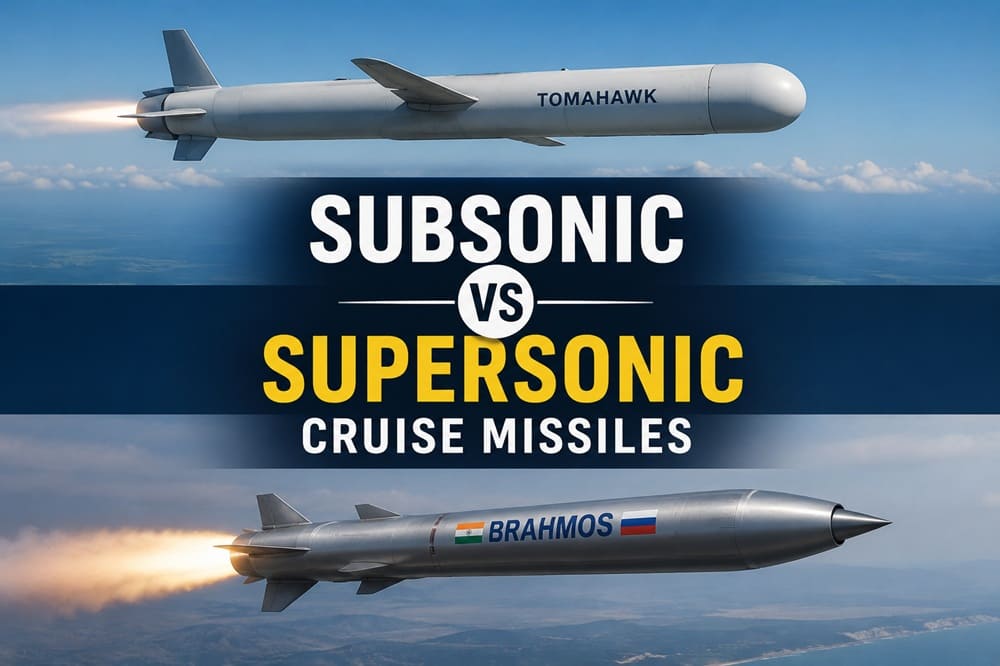
Subsonic vs Supersonic Cruise Missiles
A cruise missile is an unmanned, aerodynamically lifted, powered vehicle that flies a controlled trajectory to its target, distinguishing it from a ballistic missile, which follows a largely unpowered, gravity-driven arc after boost. Within the cruise missile class, three speed regimes dominate the design space: subsonic (roughly Mach 0.7–0.9), supersonic (Mach 1–5), and hypersonic (Mach 5 and above). Each regime forces a different compromise among range, cost, signature, and the time a defender has to react. None dominates on every axis.
Subsonic Missiles: Range at a Cost
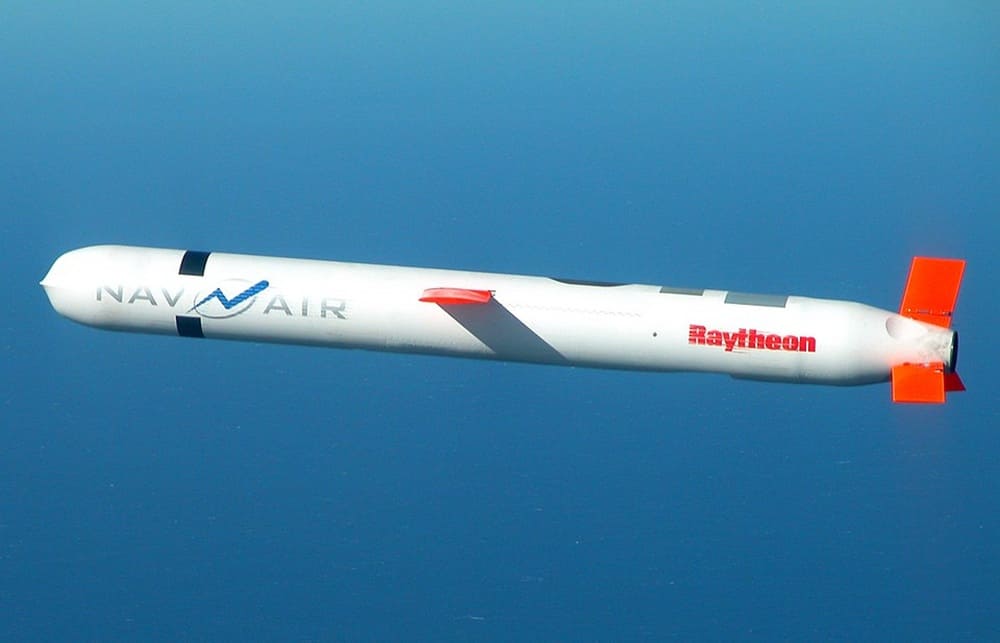
Long-range subsonic cruise missiles are made possible by turbofan engines. The U.S. Navy’s Tomahawk Block V cruises at about Mach 0.74. That is around 890 km/h. It costs about $2 million a round and has a range of more than 1,000 miles. The stealthier AGM-158B JASSM-ER has a low observable airframe. The design is mated to a Williams F107 turbofan. That gives her a range of around 930 km. It flies at around Mach 0.85-0.9 and costs about $1.3 million. High-bypass turbofans are more efficient producers of thrust than are the propulsion systems used at higher Mach numbers. Less drag also equals subsonic flight. This design keeps the fuel-to-airframe mass ratio high. This feature explains its long reach and moderate cost.
The price is exposure time. At roughly 890 km/h, a missile needs about 20 minutes to cross 300 km, during which layered radar, fighters, and surface-to-air batteries each get an engagement opportunity. Russia’s Kh-101 and Kalibr, both around Mach 0.8, illustrate the resulting vulnerability empirically. Ukraine’s Air Force has reported intercepting roughly 88 per cent of Kh-101/Kh-55-family missiles fired since the start of 2026, and 60–80 percent of Kalibr missiles in combined raids — including one mid-March 2026 attack in which all 49 subsonic Kalibr and Kh-101 missiles launched were destroyed.
High-Speed Missiles: Fuel for Time
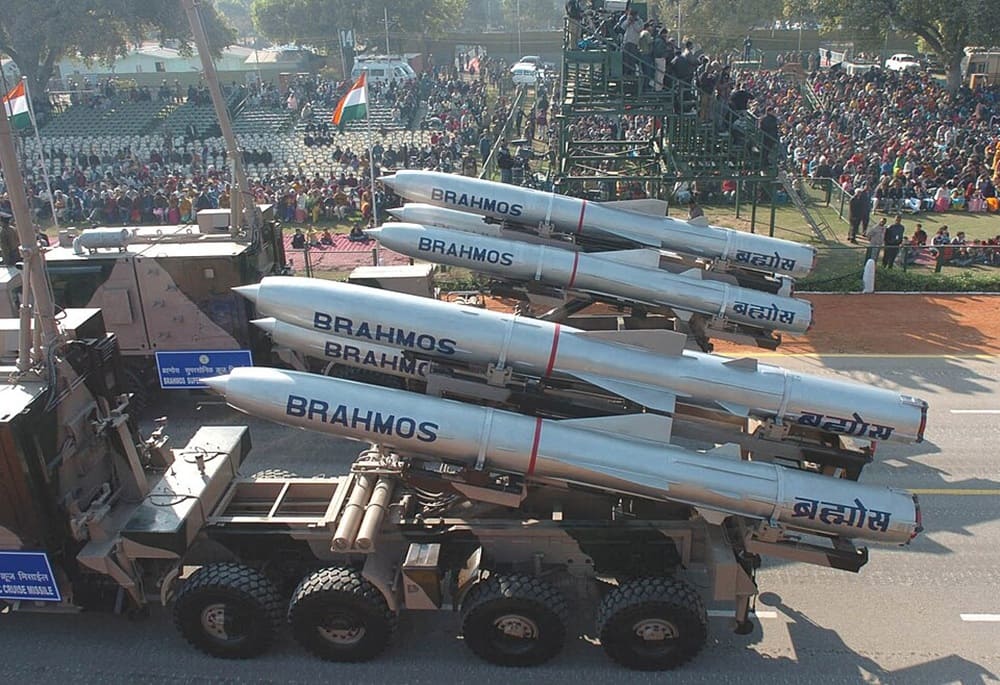
Ramjet- and scramjet-boosted missiles flip that trade on its head. The India-Russia BrahMos still speeds at Mach 2.8-3.0, or around 3,400-3,700 km/h. It uses a solid rocket booster and a liquid propellant ramjet. But its basic range is only 290 km. Longer versions 450-800 km. The units cost between $3 million and $5 million. Russia’s 3M22 Zircon is said to reach Mach 8-9. But Ukrainian combat reports said it was flying closer to Mach 5.5-6. In the terminal phase it accelerates quickly to Mach 7-8. Its effective range at low altitude is 400-450 km. Range can be up to 1000-1500km on a semi-ballistic trajectory.
And the payoff is reaction time. A Tomahawk will travel around 300 km in about 20 minutes. A BrahMos would take maybe five minutes to cover the same distance. Reported combat speeds are two to three minutes for Zircon-class missiles. This capability dramatically reduces the time from detection to intercept. But even the best defenses can run out of interceptors or time to react. They may not get a second chance to be engaged. A Russian mass salvo in June 2026 starkly showed the gap. Ukraine intercepted only 26.8 per cent of the 41 ballistic and hypersonic “high tier” missiles. All eight Zircons in the wave came through clean.
Drag increases with the velocity. The thrust needed to overcome that drag also goes up sharply. This phenomenon is why sustained supersonic and hypersonic flight requires fuel at a much greater rate than subsonic cruise. These missiles are therefore shorter range and larger in payload. This information also explains the much higher development costs. As of mid-2026, the U.S. Air Force’s Hypersonic Attack Cruise Missile had not yet flown. At that point it had won more than $1.4 billion in development contracts. Procurement was expected to add another $3 billion through FY ’31.
Kinetic Strike, Heat Risk
A supersonic cruise missile can still cause serious damage even without a warhead because its mass and extreme speed generate powerful kinetic energy on impact. At high velocity, the missile body itself acts like a penetrating projectile, destroying aircraft, radar sites, ships, shelters, or hardened targets through sheer momentum and structural shock. However, speed creates a major disadvantage: heat signature. Supersonic flight produces intense aerodynamic heating, especially around the nose, engine inlet, and exhaust areas. This makes the missile easier for infrared sensors, satellites, and modern air-defense systems to detect, track, classify, and engage before it reaches its target.
Heat Signature: The Hidden Cost
Comparative discussions of these missile classes fixate on radar cross-section, but aerodynamic heating deserves equal weight. Stagnation temperature scales with the square of the Mach number, following the standard compressible-flow relation T₀ ≈ T(1 + 0.2M²) for air. At Mach 3, resulting skin temperatures exceed 300°C; at Mach 8, theoretical stagnation temperature tops 2,700°C. This generates an infrared signature detectable by infrared search-and-track systems regardless of how well the airframe suppresses radar returns.
Reporting on Zircon indicates that its plasma sheath, while dampening radar reflectivity, runs hot enough that the missile must decelerate to roughly Mach 5–6 in the terminal phase for its seeker to function in the surrounding ionised air. This same constraint explains why sustained hypersonic cruise remains rare even in the most advanced programmes: scramjets operate efficiently only across a narrow corridor, roughly Mach 4 to 8, below which they cannot ignite and above which thermal and structural loads become prohibitive.
Conclusion
Neither regime is strictly superior. Subsonic missiles remain the more economical, longer-ranged, saturation-capable choice; supersonic and hypersonic missiles trade range and unit cost for a compressed engagement window that current air defenses still struggle to close. The experience in Ukraine is clear: attackers are increasingly firing subsonic and high-velocity missiles together. Slower missiles fill the radar picture, while faster threats exploit the gaps and have much lower interception rates.
References
- – Ukrainian Ministry of Defence and Air Force interception reporting, 2026
- – Royal United Services Institute (RUSI), analysis of Zircon capability
- – U.S. Congressional Research Service, *Hypersonic Weapons: Background and Issues for Congress*
- – U.S. Government Accountability Office, HACM program schedule and cost reporting, 2025–2026
- – U.S. Navy (NAVAIR) and RTX/Raytheon Tomahawk program documentation
- – Lockheed Martin and U.S. Air Force JASSM/JASSM-ER program data
- – BrahMos Aerospace official specifications
- – Open-source aggregation via Wikipedia entries for 3M22 Zircon, BrahMos, Tomahawk, Kh-101, and AGM-158 JASSM
About the Author