
Super Sukhoi Upgrade — Fixing Su-30MKI’s FBW
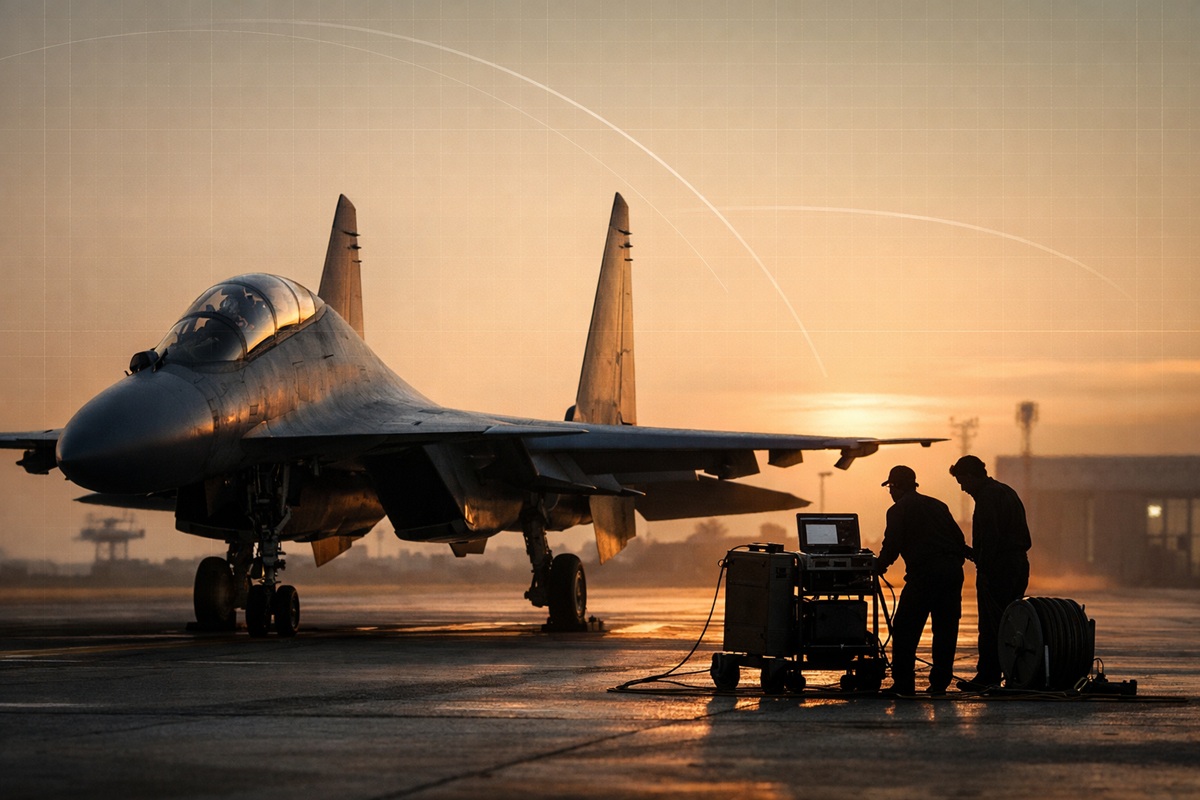
India is moving to extend the combat value of its Su-30MKI fleet through the Super Sukhoi upgrade, a major modernization drive that focuses on avionics, survivability, and weapons growth. Crucially, the upgrade narrative also returns to an older concern: the aircraft’s fly-by-wire (FBW) flight-control behavior and the need to refine control laws for safer, more predictable handling across the envelope. For the Indian Air Force (IAF), the subject matters because the Su-30MKI still carries a large share of day-to-day airpower tasks. Therefore, improving stability, mission systems, and electronic protection in one program offers a direct path to higher readiness and credible deterrence.
Super Sukhoi: Why It Matters
The Su-30MKI has always offered range, payload, and multi-role flexibility. However, modern air combat now punishes aircraft that cannot see first, jam smartly, and shoot at standoff range. The Super Sukhoi upgrade targets exactly those gaps by updating sensors, computing, and defensive systems, while also preparing the platform for newer weapons. Open reporting has linked the program to an MoD-cleared push worth around ₹60,000 crore, led by HAL with DRDO support, and tied to a plan to upgrade 84 aircraft as a core tranche. Just as importantly, this approach fits India’s broader aim to replace older imported subsystems with local equipment wherever possible, because supply resilience now counts as combat power.
FBW Concerns: What’s on Record
The FBW topic emerged from somewhere. In 2012, then IAF chief Air Chief Marshal N.A.K. Browne publicly said the IAF had identified a “fly-by-wire” problem and described it as a design issue taken up with the design agency. Separately, FlightGlobal reported earlier that a Su-30MKI crash investigation pointed to likely fly-by-wire system failure as a cause in a 2009 incident. So, when some commentary describes the aircraft as “unstable,” the defensible takeaway is narrower: the IAF has acknowledged FBW-related concerns before, and modernization plans logically include flight-control refinement as the jet absorbs new sensors and electronic-warfare loads.
IAF Su-30MKI crashes/losses (2013–2025)
According to The Week, Flight Global, NDTV, The Economic Times, and Aviation Week, most of the IAF Su-30MKI crashes were caused by a fly-by-wire (FBW) issue that was identified in 2012 but has not been resolved by HAL; this problem continues to persist. The Super Sukhoi upgrades will not rectify this; below are mentioned confirmed crashes from The Week, Flight Global, NDTV, The Economic Times, and Aviation Week sources, but other hidden issues persist. One can blame bureaucracy or mismanagement; after the identification of the FBW fault back in 2012, the IAF couldn’t rectify it, and lastly, the Su-30MKI crashed no later than 2024 because of a problematic FBW. These incidents resulted in the loss of precious human lives and diminished credibility for the Sukhoi Design Bureau.
| Date | Location | Nature of loss | Crew outcome |
|---|---|---|---|
| 19 Feb 2013 | Pokhran range, Rajasthan | Training crash (night sortie) | Both ejected and survived |
| 14 Oct 2014 | Near Pune, Maharashtra | Training crash | Both ejected and survived |
| 19 May 2015 | Near Tezpur, Assam | Routine sortie crash | Both ejected and survived |
| 15 Mar 2017 | Barmer district, Rajasthan | Routine training crash | Both ejected and survived |
| 23 May 2017 | Near the Tezpur/Arunachal region | Aircraft lost after going missing; later confirmed crash | Two fatalities |
| 27 Jun 2018 | Nashik area, Maharashtra | Test/acceptance-related crash (reported) | Both ejected and survived |
| 8 Aug 2019 | Near Tezpur, Assam | Training crash (fell into/near fields) | Both ejected and survived (injuries reported) |
| 28 Jan 2023 | Near Gwalior region, Madhya Pradesh | Mid-air incident during training (Su-30 + Mirage 2000) | Su-30 crew ejected and survived |
| 4 Jun 2024 | Nashik district, Maharashtra | Crash during flight (technical issue reported) | Both ejected and survived (minor injuries reported) |

FBW on a Heavy Fighter: How It Works
FBW replaces direct mechanical or hydraulic pilot-to-surface control with computers that interpret pilot inputs and aircraft state. Moreover, it continuously adjusts control surfaces to keep the aircraft inside safe limits, even during aggressive maneuvers. On a large, thrust-vector-capable Flanker derivative, the software matters as much as the hardware. Therefore, if control laws feel “twitchy,” laggy, or inconsistent at specific conditions, pilots lose confidence, and the force pays a readiness tax in training burden, maintenance churn, and operational conservatism. That is why the Super Sukhoi upgrade discussion often highlights flight-control work alongside new avionics.
Avionics & EW: The Survivability Core
Beyond the FBW debate, the biggest battlefield payoff typically comes from three areas:
1) Improved Sensors & Data Fusion
Modern radars, IR sensors, and mission computers improve detection, tracking, and target-quality cueing. Consequently, the aircraft can engage earlier and with less exposure. Reporting on the planned package points to new mission systems and sensor upgrades as central elements.
2) Upgraded Electronic Warfare Suite
Electronic warfare (EW) has become the daily layer of survival, not a niche add-on. A refreshed EW suite helps the Su-30MKI detect hostile emitters, choose optimal countermeasures, and reduce missile endgame accuracy. Moreover, it supports safer operations in contested airspace where surface-to-air systems overlap fighter threats.
3) New Weapons & Stand-off Range
A modernized Su-30MKI becomes more dangerous when it can fire longer-range AAMs and deliver precision strikes from outside dense SAM rings. In practice, that means upgrading interfaces, software, and pylons so the aircraft can exploit newer munitions as they enter service.
Roles: HAL, IAF & Russian OEMs.
HAL sits at the center of the execution model because it already builds and sustains the type in India. Meanwhile, DRDO and private firms contribute Indian subsystems, and the IAF drives operational requirements and certification priorities. Russian OEM participation still matters when it comes to legacy components and design authority touchpoints. However, recent coverage stresses that India aims to push indigenous content higher, with HAL as the lead integrator for the overall upgrade architecture. Therefore, the program is less about “handing it back to Russia” and more about modernizing the fleet while reducing long-term dependency.
Su-30MKI vs Super Sukhoi Specifications
| Category | Su-30MKI (current baseline) | Super Sukhoi (upgrade) |
|---|---|---|
| Programme status | In service with IAF | AoN granted for indigenous upgradation via HAL |
| Lead organisations | IAF operator; HAL sustainment/production | HAL as upgrade lead integrator (Indian upgrade route) |
| Fleet/tranche size | IAF operates a large Su-30MKI fleet (often cited ~270+ in open sources) | 84 aircraft frequently cited as initial upgrade tranche |
| Upgrade budget | N/A | Often cited around ₹60,000 crore for the overall modernisation effort |
| Engine | 2× AL-31FP thrust-vectoring engines | No widely reported engine-type change within the Super Sukhoi scope |
| Max speed (baseline) | Commonly cited around Mach 1.9 | Not a primary change driver (upgrade focuses on mission systems) |
| Range (baseline) | Commonly cited ~3,000 km unrefueled (IFR extends mission reach) | Not a primary change driver |
| Flight control computers | Digital flight-control computers are already in service; exact hardware baselines can vary by build/batch, called the DFCC/32-bit. | Upgrade narrative implies refreshed/modernised avionics and control behaviour; DFCC/64-bit is consistently official in open reporting |
| Fly-by-wire system | Digital FBW in place; IAF has previously flagged FBW design/handling concerns | Upgrade narrative includes fixing/modernizing control and avionics behavior (software/harmonization, integration effects) rather than advertising a wholesale new FBW “type.” |
| Electronic warfare | Existing RWR/CM/EW fits vary by batch | ASPJ jammer pods planned (100 sets; delivery target often stated as ~36 months) |
| Electronic countermeasures (ECM/CM) | Defensive aids suite exists (typical components include RWR and countermeasures like chaff/flare; fit can vary by batch) | Emphasis on stronger ECM via jammer pods plus improved survivability integration (how EW/CM cues are fused and presented to the pilot) |
| Radar/sensors | Current fleet uses established radar/sensor baseline (varies by batch) | Discussions about new radar and IRST upgrades occur frequently, but final selections and performance figures are not consistently made official. |
| Armaments (typical) | Mix of Russian/Indian weapons across batches; commonly includes BVR AAMs, short-range AAMs, guided bombs, and stand-off strike weapons. Some aircraft are modified for heavy stand-off weapons (e.g., BrahMos-A) | Planned deeper integration of newer Indian precision weapons and longer-range AAM options; broader stand-off strike and SEAD/DEAD weapon compatibility often cited |
| Upgrade intent | Multirole air dominance and strike | Higher survivability (EW/ECM), better situational awareness (avionics), and improved long-term relevance |
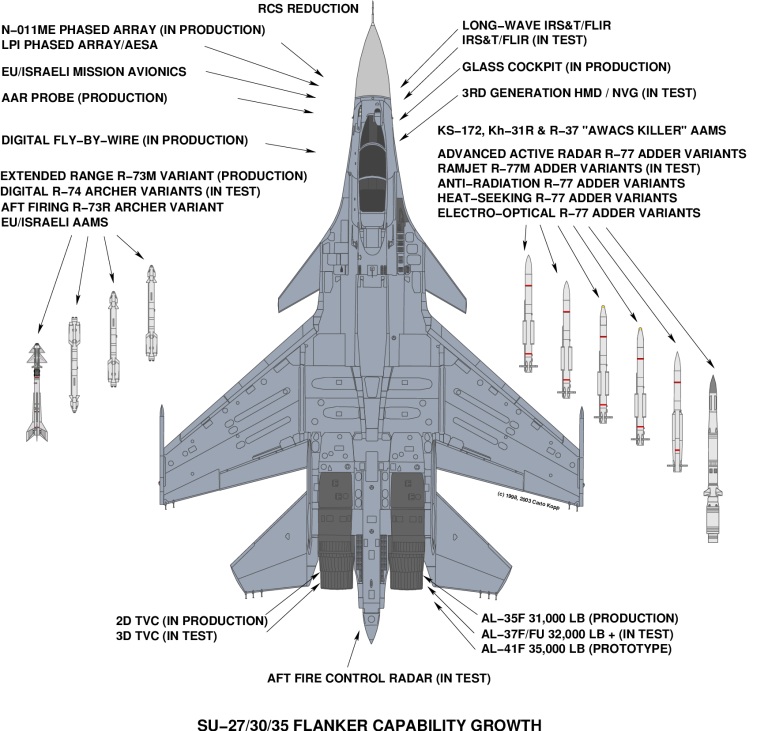
FBW issues in 2025
Some reports from the Economic Times in 2025 suggest that the upgrade might change or enhance the flight control computer (DFCC/64-bit), which could make the aircraft easier to handle and work better with new avionics—but this is mentioned as part of a larger upgrade plan, not as evidence of a persistent FBW problem. The question here is: if the flight control computer is functioning properly, what are the reasons for interfering with its stable operation? It can be upgraded with new components and new supporting software, but changing it altogether is creating anomalies.
Strategic Impact: Keeping Su-30MKI Relevant
India doesn’t need the Su-30MKI to become a stealth fighter to keep it lethal. Instead, the jet needs to:
- Detect threats earlier
- Survive a dense electronic attack
- Fire first at useful ranges
- Maintain predictable handling during high-load maneuvers.
That is precisely why the Super Sukhoi upgrade matters. It turns a proven airframe into a more networked, more survivable, and more weapons-flexible platform—without waiting for next-generation fleets to arrive in large numbers.
References
- https://www.flightglobal.com/fly-by-wire-failure-downed-indian-su-30mki/87984.article
- https://www.financialexpress.com/business/defence-indian-air-force-advances-su-30-mki-upgrade-with-indigenous-technologies-and-strategic-partnerships-3322038/
- https://www.defensenews.com/global/asia-pacific/2024/09/17/india-orders-hundreds-of-new-engines-for-su-30mki-fighters/
- https://www.sps-aviation.com/story/?id=1066
- For more information on the Su-30MKI upgrades and related defense topics, visit Defence News Today and join discussions at the Defense News Today Facebook Group.
About the Author