Russian Zone-Effect Space Weapon — Starlink at Risk
NATO Warns of Orbital Pellet Cloud
Two NATO-nation intelligence services reportedly suspect Russia is developing a new anti-satellite concept aimed at SpaceX’s Starlink constellation. The findings, shared with the Associated Press, describe a “zone-effect” approach: scatter hundreds of thousands of high-density pellets into Starlink’s orbital band, then let physics do the rest. Each pellet would measure only a few millimeters. However, at orbital closing speeds, even millimeter-class impacts can blind sensors, cut wiring, and shred solar arrays. The concept therefore targets availability, not spectacle.
How Pellets Can Cripple Satellites Quietly
A pellet does not need to smash a satellite into fragments to create a kill. Instead, it can puncture radiators and crack power systems. Analysts also point to solar panels as a likely failure point because they present large, fragile surfaces. Moreover, the public record already shows how “small” strikes can still matter. Reporting cited a suspected impact by a tiny debris piece that damaged a Chinese spacecraft intended to return three astronauts to Earth. That example keeps operators cautious about any new source of hard-to-track fragments.
Why Moscow Targets Starlink
Starlink supports Ukraine’s battlefield communications and helps units coordinate fires and targeting when Russia degrades ground networks. NATO-linked reporting even framed the constellation as a “grave threat” to Russian operations. Consequently, Russian officials have repeatedly warned that commercial satellites aiding Ukraine could count as legitimate targets.
Debris Spreads Beyond the Target
The same feature that makes the idea attractive—area effects—also makes it hazardous. You cannot easily “corral” a pellet cloud so it only touches Starlink. Analysts caution that a scattershot release could engulf an orbital regime, affecting everything within its vicinity. Starlink’s typical orbital shell sits around 550 kilometers (340 miles). The Tiangong station and the International Space Station orbit lower, yet analysts still flagged risk as pellets decay and drift down over time. Therefore, a strike meant to deny one service could spill over into wider, long-lasting space disruption. That blowback risk fuels skepticism. Victoria Samson of the Secure World Foundation said she would feel surprised if Russia chose an option that could also cut off its access to space.
Russian “Zone-Effect” vs other countries
| Country | System/example | “Zone-effect” mechanism | Intent (as reported) | Orbit/altitude context | Key takeaway |
|---|---|---|---|---|---|
| Russia (alleged) | “Zone-effect” pellet cloud concept (often discussed in relation to Starlink) | Disperses hundreds of thousands of millimetre-scale dense pellets to cause widespread impact damage | Claimed as deliberate area-effect | Reported focus on LEO constellation shells (often cited around ~550 km) | Hard to attribute, but high risk of collateral damage and self-harm |
| USSR (historic) | Co-orbital ASAT interceptor (Istrebitel Sputnikov lineage) | Co-orbital approach followed by detonation creating a local shrapnel kill zone | Yes (local area effect) | LEO co-orbital engagement | Effective locally, but generates hazardous fragments |
| Russia | Direct-ascent ASAT intercept (example: 2021 event) | Kinetic hit generates a large debris cloud that increases collision risk | Area effect is a consequence | LEO: debris spreads across nearby orbital bands | Creates widespread hazard, but not “quiet” or deniable |
| United States | Direct-ascent ASAT test (example: 1985 event) | Kinetic intercept creates a temporary debris cloud | Area effect is a consequence | LEO is often cited around ~555 km | Debris risk can persist depending on altitude |
| United States | Low-altitude intercept (example: 2008 event) | Kinetic intercept creates shorter-lived debris due to lower altitude | Area effect is a consequence | Low LEO (often cited around ~270 km) | Lower altitude reduces long-term debris persistence |
| China | Direct-ascent ASAT test (example: 2007 event) | Kinetic intercept produces a massive, long-lived debris field | The area effect is a consequence. | Higher Low Earth Orbit (LEO) is often cited at approximately 865 km. | Long persistence makes the “zone” hazardous for years |
| India | Direct-ascent ASAT test (example: 2019 event) | Kinetic intercept creates debris, designed for faster decay via lower-altitude engagement | Area effect is a consequence | Low LEO | Debris decays faster than higher-altitude tests, but still creates risk |
Where It Fits in Russia’s Counterspace Toolkit
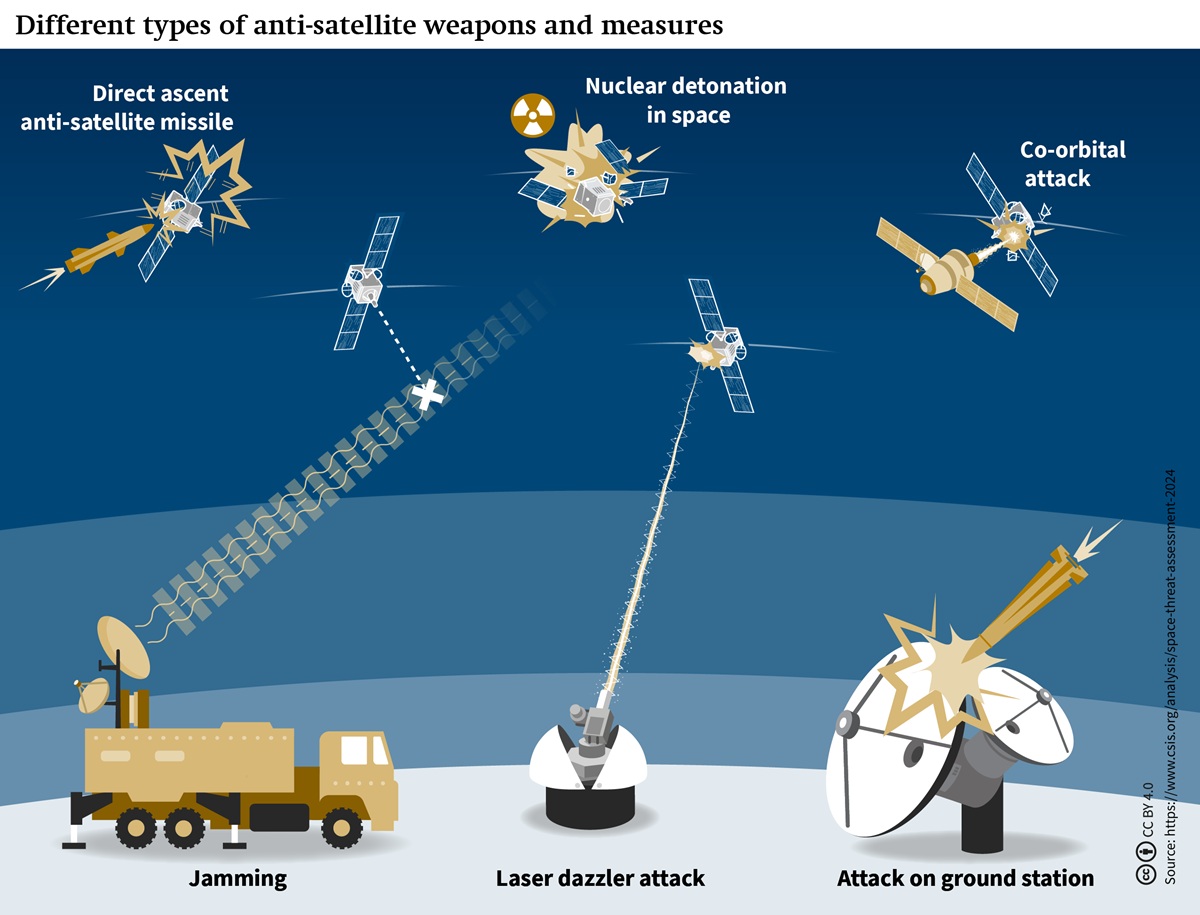
If Russia ever fielded a Russian zone-effect space weapon, it would sit alongside more familiar counterspace tools. Russia has already demonstrated direct-ascent ASAT capability; in 2021 it destroyed a defunct satellite and generated a debris field. This month, Russia also said it has fielded the S-500 and described it as capable against low-orbit targets. However, the “zone-effect” concept aims for ambiguity and deterrence. Clayton Swope described it as a “weapon of fear” that signals willingness to threaten orbital chaos, even if deployment remains uncertain.
Key Signals to Watch Next
Because the reporting says the system remains in development, look for practical indicators rather than rhetoric:
- Unusual launches of small satellites that could dispense pellets.
- Anomaly clusters or damage patterns in specific orbital shells.
- The new policy messaging explicitly targets commercial constellations.
Conclusion
The reported Russian “zone-effect” pellet idea highlights how vulnerable today’s orbital networks are. Although some analysts doubt it will ever be deployed, the concept still signals a shift towards scalable, hard-to-attribute counterspace coercion. As a result, militaries and commercial operators should strengthen constellations, enhance tracking, and build resilient communications plans before a real-world confrontation makes those gaps painfully clear.
References
- https://apnews.com/article/russia-starlink-musk-ukraine-space-china-canada-c69c1fda5ffc93828712ab723e606a2c
- https://www.pbs.org/newshour/world/intelligence-agencies-suspect-russia-is-developing-anti-satellite-weapon-to-target-starlink-service
- https://www.csis.org/analysis/space-threat-assessment-2025
- https://www.swfound.org/publications-and-reports/2025-global-counterspace-capab
About the Author