
Russia Zebra Camouflage vs AI Kamikaze Drones
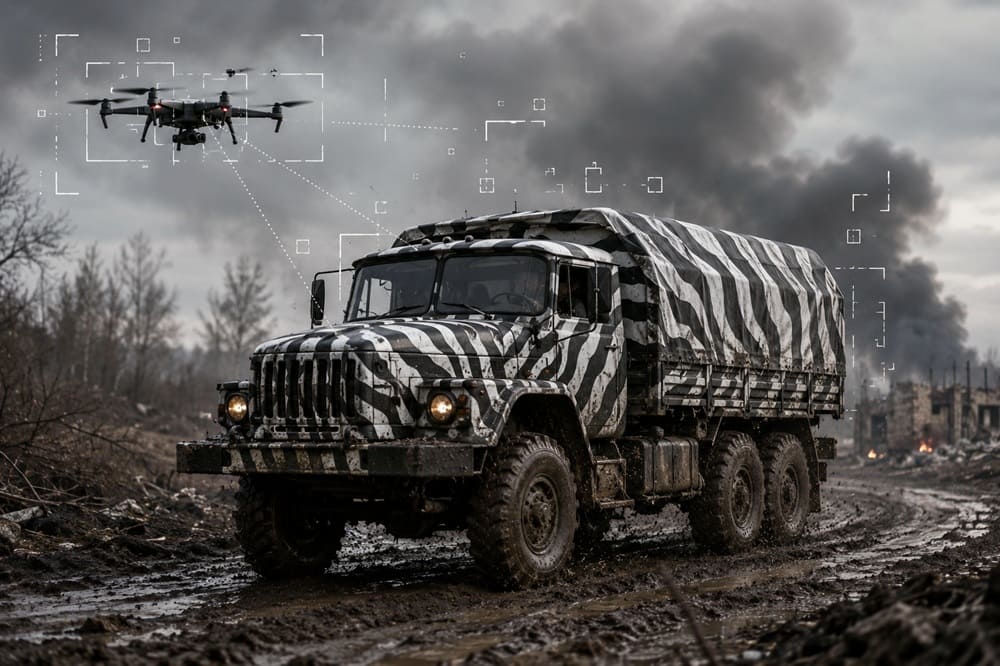
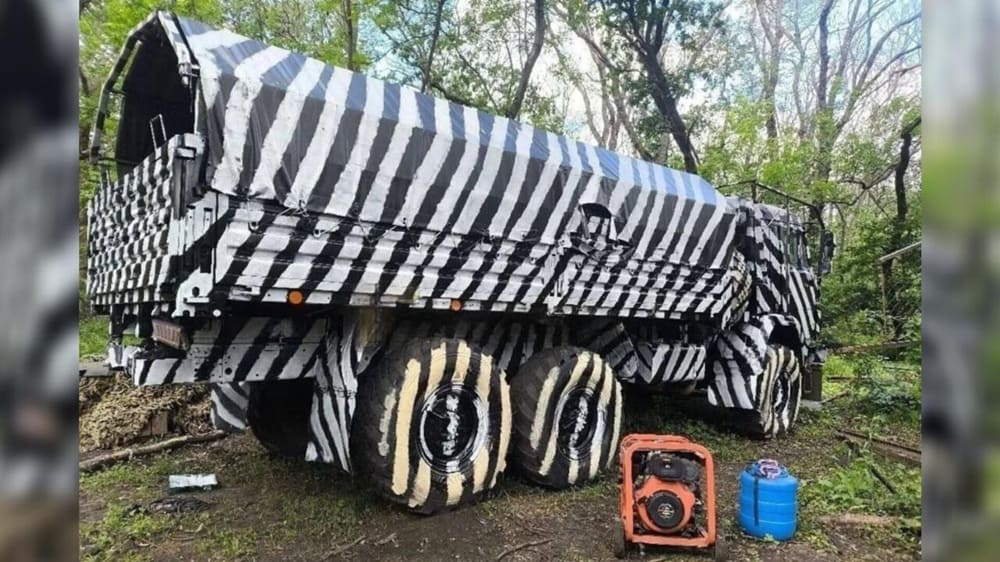
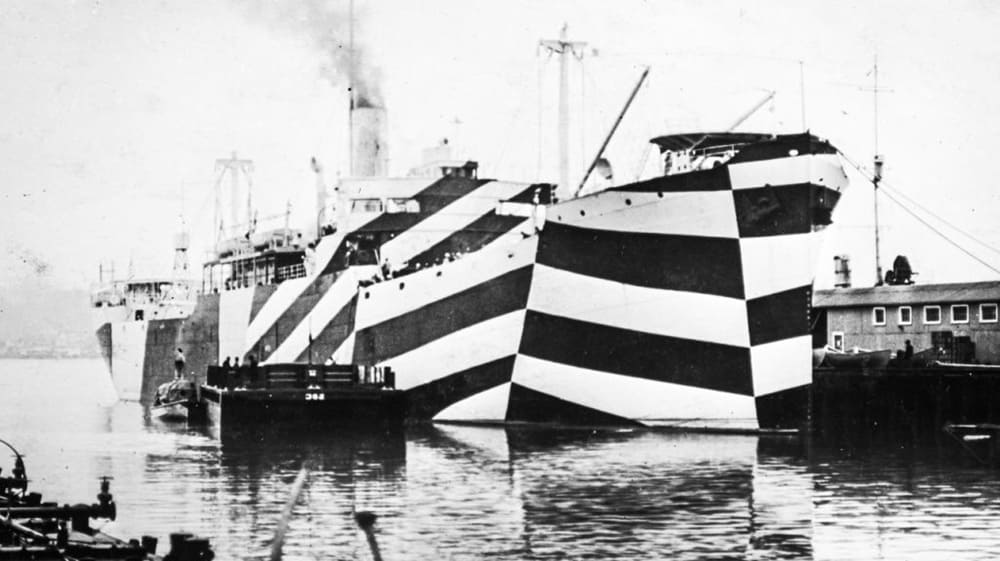
Russian zebra camouflage has pushed an old visual trick into a new machine-vision battlefield. Recent imagery reportedly shows Russian Ural and KAMAZ trucks painted with bold black-and-white stripes. The patterns recall First World War dazzle camouflage, yet the intended target now appears different. Instead of confusing a naval rangefinder, the design may disrupt Ukrainian AI-assisted drones.
The idea looks strange at first. A striped vehicle does not hide well from human observers. However, modern drone warfare does not depend solely on human eyesight. Ukrainian units increasingly use computer vision, assisted tracking, and last-mile navigation under heavy electronic warfare. Therefore, Russia may be trying to deceive the algorithm rather than the pilot.
How AI Drones Detect Vehicles
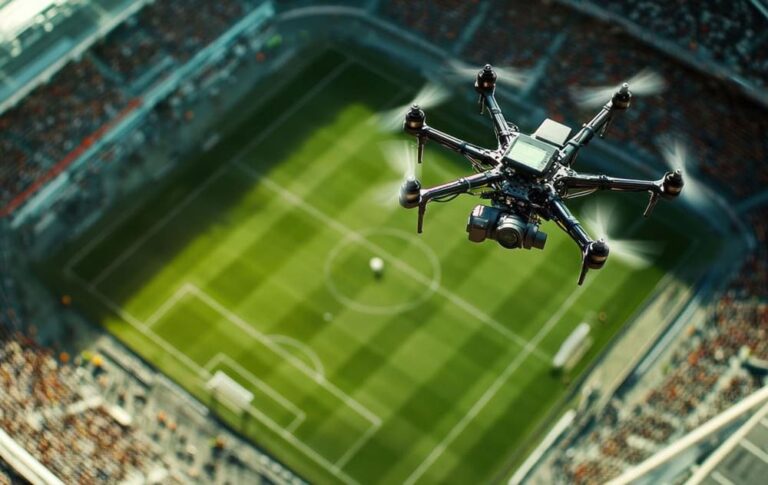
Drones with artificial intelligence use cameras, processors on board and trained detection models to recognise objects on a battlefield. These systems analyse shape, contrast, texture, motion, shadow and vehicle geometry. They might classify a truck, armoured vehicle, artillery system, or troop carrier through probability scores rather than human-style understanding.
That’s an important point. A human sees a truck through experience and context. A neural network sees patterns learned from the data it was trained on. A high-contrast striped truck causes a distribution shift if the majority of the training images contain green or brown cars. Consequently, the model might identify the object with less confidence.
Russia’s zebra camo hits that weakness. The stripes can break the outline between the bonnet, cargo bed, tyres, wheel arches and cab. In addition, the pattern may introduce spurious edges between structural features. The tracking box may wobble during terminal approach, but a drone may still see a vehicle.
Importance of Dazzle Patterns
Dazzle camouflage was not meant to make ships or vehicles invisible. It attempted to distort speed, heading and range estimation. Russia’s new pattern is driven by the same logic. It does not conceal the vehicle; it conceals the interpretation at the sensor-processing level.
This technique is most important in poor visual conditions. Dust, smoke, video compression, oblique angles, low-resolution feeds, and sudden movement all already impair drone accuracy. Zebra stripes can add an additional layer of uncertainty. So the tactic may be most effective as a marginal defense rather than as a complete shield.
It might also be useful for electronic warfare. Jamming disrupts command links, so drones may have to rely more on onboard vision and autonomy. In that phase, even a small loss of target-lock quality can be significant.
Camouflage That Confuses AI
Computer-vision researchers call this problem physical adversarial camouflage. It uses patterns placed on real objects to degrade object detectors. Unlike digital image attacks, physical designs must survive distance, lighting, rain, mud, camera blur, and changing angles.
Russian zebra camouflage appears cruder than laboratory adversarial patterns. Yet field solutions do not need elegance. They need low cost, speed, and scale. Paint can cover many logistics vehicles faster than new electronic countermeasure kits can arrive.
However, this method carries a weakness. If Ukrainian analysts collect enough images of striped Russian vehicles, they can retrain their models. The pattern may then become a signature. In that case, the zebra look could mark a target rather than protect it.
Logistics Value for Russia
Reported use of Russian zebra camouflage probably signals pressure on Russian logistics. Ukraine has attacked fuel trucks, ammunition carriers, engineering assets and supply convoys using drones. These targets may not be heavily armoured but provide support for artillery, infantry and armoured formations.
Russia has already tried cages, nets, armour screens, smoke, decoys and electronic warfare to protect its vehicles. Zebra paint suits this improvised survival culture. it costs little, requires no complex supply chain, and lets local units experiment quickly.
However, they should not overestimate it. The striped truck is still visible to thermal cameras, route surveillance and human drone pilots. Engine heat, exhaust signatures, tyre marks and patterns of movement can still expose it. So, zebra paint is just one layer in a broader counter-drone defense system.
Ukraine Adapts Back
Ukraine can counter the tactic through data collection and model retraining. Operators can feed images of zebra-painted vehicles into detection datasets. Engineers can also train models on varied paint schemes, weather conditions, angles, vehicle states, and partial occlusions.
In addition, Ukrainian units can use multi-sensor confirmation. Thermal imaging, human review, geolocation, route intelligence, and target behaviour can all reduce reliance on colour imagery. If AI supports the pilot rather than replaces judgement, the pattern loses much of its value.
Conclusion
Russia’s zebra camouflage is strange, but it signals a serious transition in the battlefield. Camouflage isn’t hiding things anymore; it’s manipulating data. Drones are flying sensors, strike platforms, and AI data collection nodes now.
This contest will continue to grow. Ukraine is going to update models. Russia will change the patterns. Both sides collect battlefield images and retrain systems. Eventually the front line will be an adversarial dataset: every drone video will train the next algorithm.
The zebra truck alone will not change the war. But it shows the power of cheap visual deception to undermine costly digital targeting. In modern combat, survival begins when a camera decides what to see.
References
- https://www.twz.com/news-features/russian-trucks-get-dazzle-paint-to-throw-off-ai-enabled-drones
- https://www.reuters.com/business/aerospace-defense/ukraines-defence-ai-chief-predicts-new-paradigm-warfare-2026-06-12/
- https://defensenewstoday.info/drones-ai-and-robotics-challenge-top-100-defense-firms/
- https://defensenewstoday.info/cyber-security/
About the Author